Ann and I, like most Americans, love Italian food, especially peasant food, cucina povere, for its simple and honest flavors. Unlike most Americans, however, we would almost never go out to eat at an Italian restaurant. Why pay for food that is so easy to make better at home? Although I don't think we necessarily set out to have an Italian-themed dinner, it turned out so and the saga follows.
 |
What's Better Than Chianti Classico?
A Jeroboam of Chianti Classico Riserva! |
Ann's a full-blooded Italian, no matter how you slice it. She's adopted. Her birth parents are both
napoletani and her adoptive parents are
calabrese and
barese (
pugliese) respectively. So she's spicy and opinionated southern Italian through and through. You would think that the menus that she comes up with would be southern-inflected, but really, she has no problem mixing and matching from the various corners of Italy, something that would be frowned upon in the old country. I don't know that she set out to have an Italian dinner, but that's where we ended up after she asked me to make
braciole.
Such is our menu planning that Ann asks "Will you make this?" and I do. Sometimes I throw in an idea or two or a refinement here and there, but mostly because I can and will cook anything, more often than not, I leave the broad strokes of the menu to Ann. If it pleases her to have a dish, I am pleased to make it for her. I think I may have suggested gnocchi alla romana as a sop for the braciole braising sauce, but I no longer remember. It was a tag-team effort in both menu composition and cooking.
The menu in this cold, pre-Christmas season for our quasi-holiday dinner before our friends all get wrapped up in their own holiday travels and plans is pretty much all down to Ann. We split the cooking. For our antipasto, I whipped up a batch of bagna càuda from Piemonte via Provence in France. For dinner, Ann made a primo of baked polenta, also from the north in Lombardia and neighbors, while I made a secondo of braciole, a dish from Calabria and Sicilia (where the little meat bundles are called involtini). And for the dolce course, Ann made a ricotta cheesecake, cosmopolitan to Italy with Greek origins. So, quite naturally, the wine we selected was from Tuscany, just to further mix up the regions!
Hence the title of this post: a mutt of an Italian meal. And I mean this is the best of ways. Although there can be some pejorative meaning to the word mutt, as dog lovers, Ann and I know that the non-purebred dogs, the rescue mutts from the shelters, are often the best dogs combining the best traits of many breeds. And by extension, we hope our menu combines the best of the many regions of Italy.
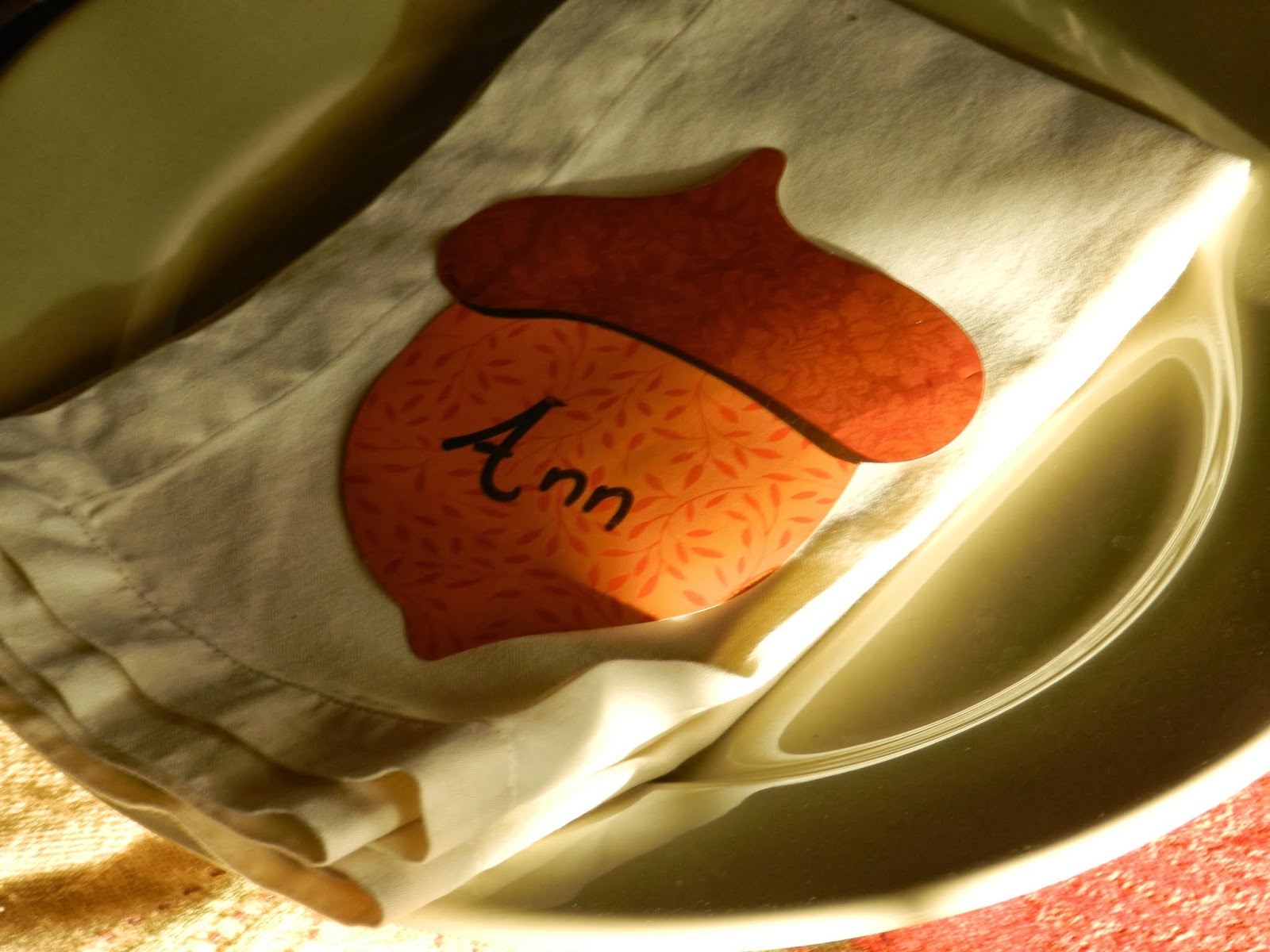
Ann decided for this dinner that we should be a bit more formal than most of our meals that are consumed around the island in the kitchen, so she set a beautiful, simple, and tasteful table in the dining room.
As guests Rob and Dyce and Michelle and Andreas were arriving, I was reheating the pot of bagna càuda on a low flame so that it would be good and hot for our appetizer course. If you speak any Romance language at all, you will recognize the term bagna càuda in the piemontese dialect means "hot bath." And indeed, bagna càuda is a hot bath into which to dip bread and/or crudités, typically bitter vegetables such as chicories (endives) and cardoons. For our little soirée, I used what I had in the refrigerator: sweet peppers, carrots, celery, and cucumbers.
 |
| Unappetizing Looking Bagna Càuda |
Now on to what bagna càuda is for those of you who have not experienced this culinary delight that looks much like oily mud, nearly off-putting in appearance by all accounts. It is a mix of three ingredients: anchovies, garlic, and olive oil. The amalgam of these three ingredients is way more than the sum of the three individual ingredients, but you have to allow yourself to try it without prejudice. Only then can you decide if it is for you.
If you think a salty, funky, umami-laden oily mix of anchovies and garlic is a culinary delight, you are welcome at our table. Otherwise, maybe take a hard pass on dinner at our house where we make food for people who like to eat anything and everything.
My canonical recipe (actually, it is a ratio, not a recipe) for bagna càuda is one head of garlic to 3 tins of anchovies (90-100 grams) to one-half cup (100-125ml) of extra virgin olive oil. Step one is to soften the garlic so that you can make a paste of it. I like to do so by poaching it in milk and after the milk is drained away, I mash the garlic with a wooden spoon. Then I add the anchovies and heat them a bit over low flame to get them falling apart, then add the oil. If you like (as I like), rather than stirring and stirring, use an immersion blender to smooth out the sauce. Serve warm to hot.
 |
| Poaching Garlic in Milk |
 |
| Mashed Garlic Awaiting Anchovies |
While we were in the kitchen dipping our veggies in bagna càuda and washing it down with the double magnum of Chianti, the braciole and the polenta were both in the oven finishing up. At some point in the evening, I pulled them both out of the oven and we grabbed our glasses of wine and headed to the dining room to grab our plates to fill them with dinner.
 |
| Pork Braciole in Marinara, Baked Polenta |
 |
| Pork Braciole in Marinara |
 |
| Baked Polenta |
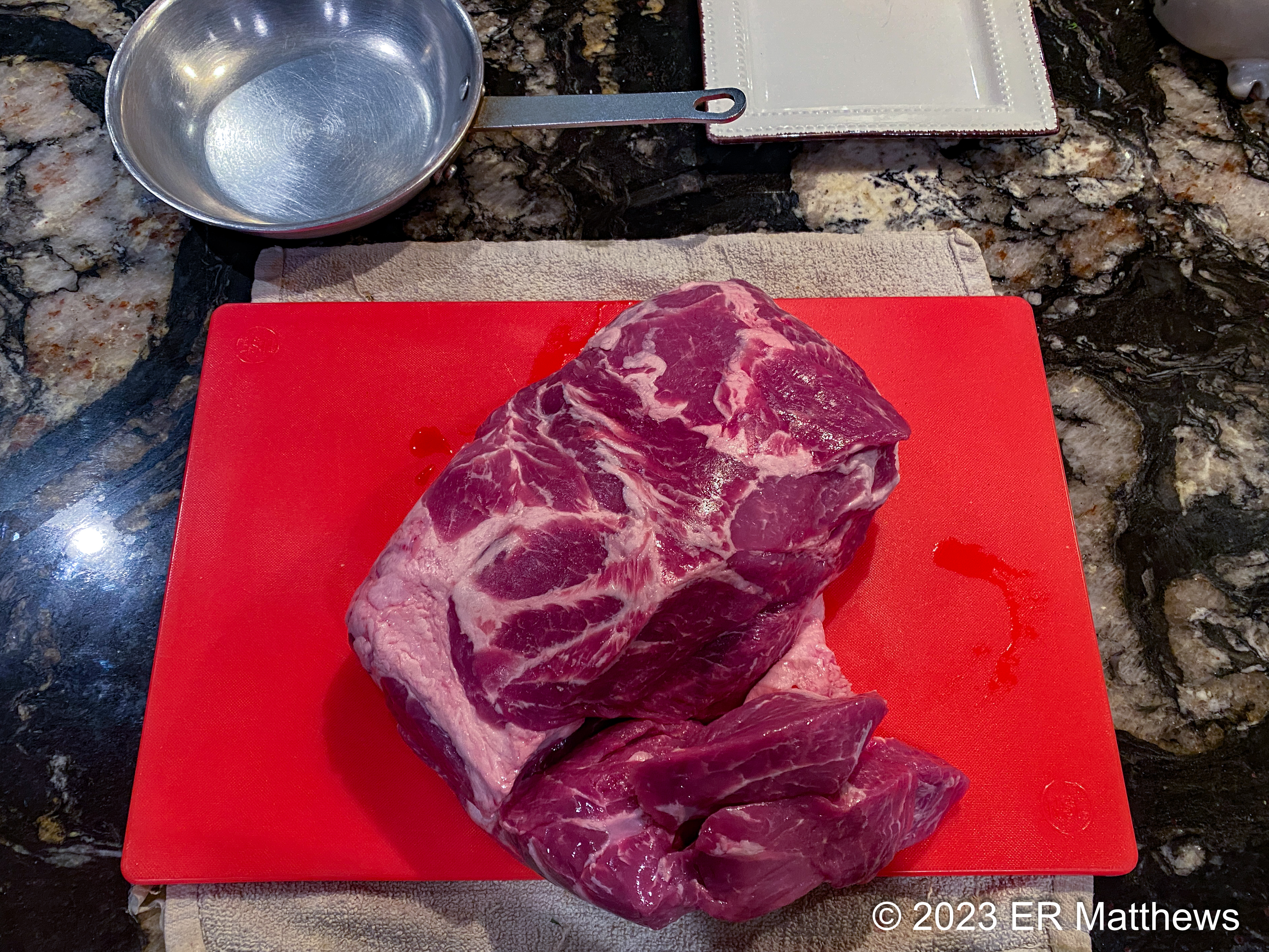
Making braciole is relatively simple, but it does take some effort and patience. While it is more traditionally made from beef, such as flank cut thin, I prefer to make it out of pork shoulder which I find more flavorful and more tender. Although you can buy in some meat markets thin slices for braciole, I prefer to buy a roast and cut and pound my own. Below, you see a deboned pork shoulder on my cutting board along with my industry-standard meat pounder, a small frying pan.
I've been in a bunch of restaurant kitchens, and by and large, every cook I've ever seen pounding out meat used the bottom of a frying pan to do so. Slice your roast into quarter-inch steaks and then flatten them to an eighth of an inch. To pound the meat, place a slice on the cutting board and cover it with a piece of film wrap, then use the flat of the frying pan to gently persuade the meat to flatten out. It doesn't generally take a lot of force.
 |
| Pork Shoulder with Ersatz Meat Pounder |
 |
| Pounded Pieces of Pork Shoulder, Trim Cut for Carnitas or Ragù |
Braciole are quite often stuffed with a bread crumb mixture. For this dinner, we needed to keep the filling gluten-free, so Ann and I kicked about ideas, landing ultimately on white beans which Ann asked if I would flavor with guanciale, cured hog jowl. To start the filling, I smoothed out 3/4 of the beans to a purée in the robot coupe while rendering a really fine dice of guanciale on the stove. After removing the almost browned guanciale from the pan, I cooked a really finely diced onion in the guanciale fat. To the cannellini purée, I added the browned guanciale bits, the onions and their oil, a bunch of pesto, and the remaining quarter of whole beans, for texture. Naturally, I salted to taste.
 |
| Rendering Fine Dice of Guanciale |
 |
Braciola Stuffing: Cannellini Purée, Whole Cannellini, Pesto, Guanciale,
Onions Cooked in Guanciale Fat |
You roll braciole exactly as you would a burrito or an egg roll. Place a small amount of filling toward the top center of the meat and fold the top down and over the filling. Fold the sides in to the center to encase the filling, then roll from the top down to close the packet. Secure with one or more toothpicks. I prefer the longer wooden drink garnish picks; the extra length means that I only need one to secure the packet. Sometimes this takes two toothpicks.
Once the packets are assembled, brown them in a pan on all sides and remove to a braising dish. Meanwhile, make a marinara. My braising pan typically takes a half gallon of sauce to cover the meat that I am braising. Marinara is trivial to make (and we used to make it on the fly at the restaurant whenever a parent would request pasta marinara for a child). For a rough half gallon, put two 28-ounce cans of tomatoes in your blender along with four large cloves worth of minced garlic, a pinch of salt, a tablespoon of dried basil, and a pinch of pepperoncini (crushed red pepper flakes). Blitz it and voilà!
 |
| Starting to Brown Braciole |
 |
| Browned Braciole Ready to be Covered in Marinara |
After covering the browned braciole in marinara, cover the brasier (I use aluminum foil, unnecessary if you are using a dish with a cover) and place it on a sheet tray; braciole love to bubble over and create a mess on the bottom of the oven. Braise in a moderate oven for 2 to 3 hours. You'll know they're done when they are fork tender.
To accompany the braciole, I wanted a starch to act as a sop for all the leftover marinara. In Italy, the sauce would often be ladled over pasta as a first course with the meat served afterwards. Ann and I, we wanted something more elegant for our dinner and I proposed gnocchi alla romana, made by cooking semolina, letting it set up on a sheet tray, cutting out rounds, and baking those rounds nicely arranged in a gratin with a sprinkle of cheese until prettily browned.
How silly of me to propose that, given that we needed to keep the dinner gluten-free and semolina is ground wheat. How fortunate though that Ann mistakenly grabbed the container of polenta (which is ground corn) from the pantry instead of the container of semolina! Not trusting the polenta cooked in milk and augmented with egg yolks and butter to fully set up enough to be cut into rounds, Ann put it directly into a baking dish and we baked the whole thing under a thin crust of pecorino romano.
 |
| Stirring Polenta |
 |
| Polenta Ready for Cheese and the Oven |
Ann's final contribution to our dinner was a ricotta cheesecake, made without a crust to keep it gluten-free. You can make cheesecake with almost any soft unripened small curd cheese: cream cheese, farmer cheese à la the German
quarkkuchen, or ricotta in the Italian style.
Cheesecake is one of the simplest desserts to make and I have made untold hundreds during my career. Here are some tips born of experience.
The basic formula is to figure out how much cheese your springform pan requires and work from there. Naturally, at the restaurant, we were making several cakes at a time; fortunately, the basic ratio scales quite well. At home, our 10" x 2.5" springform mold holds four pounds of cheese without breaking a sweat which works out quite well for ricotta which comes in convenient 2 pound containers. The ratio continues with 2 eggs per pound plus an additional egg for every two pounds, thus 10 eggs for this batch. So, 7-8 eggs for a three-pound brick of cream cheese, if you are going that route.
For each two pounds of cheese, three-quarters of a cup of sugar seems to be about right, though I always add less to start and add flavorings to taste. The amount of sugar can vary based on how sour the cheese is (cream cheese tends to be much more tart than ricotta) as well as the flavorings you are adding. If your flavorings are sweet, you might need less sugar; bitter, such as espresso, you might need more sugar. For additional flavorings, Ann added a good slug of Mexican vanilla and the zest of three lemons.
As an aside, you may not want any sugar at all if you are making a savory cheesecake. We used to make blue cheese cheesecakes with walnut crusts that we would bake in shallow tart pans to pair with certain sweet wines. These cakes required no to minimal sugar. I can remember making black olive and rosemary tarts to accompany wild boar. Your imagination is really the limit with cheesecakes.
Although I always baked my cheesecakes in a slow oven in a water bath (covering the bottom of the pan with aluminum foil to avoid water infiltration), you can certainly bake them in a slow oven without a water bath, which is what Ann did in this case. In any case, 325-350F is about right, though we never had a thermometer on our ovens at the restaurant. You will almost certainly have to tent the top of the cakes with aluminum foil to keep them from burning, simply because the top is going to brown long before the center is set. So, cook your cheesecake uncovered until it is as brown as you would like, then tent it for the duration with aluminum foil.
How long a cheesecake requires in the oven depends on way too many factors to give a hard and fast rule, so do as we did in the restaurant and as Ann did with this one: cook it until it is done. At first, the center of the cake, when you shake it gently, will be liquid and will slosh back and forth. As the cake cooks, it will set from the outer edge and move towards the center. As the cake cooks, the batter will puff up. When it is evenly puffed all the way to the center, you can be pretty certain that it is done. Do not be surprised when the cake settles as it cools.
When cheesecakes come out of the oven, I like to let them cool a few minutes, then run a spatula between the cake and the side walls of the mold. Then I'll crack the mold open, but leave it in place on the cake and let it finish cooling. Separating the mold from the cake in the early cooling stages will help avoid cracks in the cake as it cools. Cheesecakes shrink slightly as they cool and if the edges of the cake adhere to the sides of the pan, the center may shrink away from the edges and tear cracks in your beautiful cake.
 |
| Mad Scientist Flavoring the Batter |
 |
| Done to Perfection |
 |
| Dusted with Espresso Sugar |
 |
| Freaking Delicious Ricotta Cheesecake with Hints of Lemon and Espresso |
We, the six of us, all had a wonderful time and enjoyed our meal thoroughly. After dinner, Andreas, Rob, and I held forth at the dinner table while the other three, the youngsters of the group, disappeared to the family room. Next thing I knew, the family room erupted in 80's and 90's pop and hip-hop and there was a full-fledged dance party going on! Some parting shots below.
 |
| 'Tis the Season! |
 |
| Shout Out to the Chianti Classico Consortium |