Showing posts with label star anise. Show all posts

Friday, January 30, 2015

Hot and Sour Chicken Soup

Hot and Sour Chicken Soup
It was about 25 years ago in San Francisco's Chinatown that I discovered that hot and sour soup could really be a thing of beauty. I was splitting my time between Virginia and a residential hotel in Sunnyvale, down the 101 from San Francisco and I was spending most of my free time between Napa/Sonoma and Chinatown, learning both wine and Chinese food. This was back in the day before most of the good Chinese food had fled the city.

I was already a disciple of Henry Chung, at whose Kearny Street hole in the wall I was a frequent visitor before the scary 1989 Loma Prieta earthquake shuttered it for good. The storefront was tiny: five or six tables and a counter, my haunt, where I could watch the ladies making the dishes. What amazing smoked ham and scallion cakes came out of that kitchen! Thanks to the Chung family's help and that of many other generous souls in Chinatown, I was just learning how amazing real Chinese food could be and I was cooking a lot of it back at home in Virginia, learning the ingredients, the techniques, and the metaphors. And already I knew enough to know that I didn't like hot and sour soup, that insipid gloppy crap that every Americanized Chinese restaurant served.

Once I got invited to a fancy fixed menu dinner at one of the big touristy Chinese restaurants in Chinatown, a place that hole-in-the-wall-spelunker-me would never have entered. One of the early courses in our banquet was a cup of hot and sour soup that blew me away with its rich broth, carefully curated spice, and fresh vegetables. A light went on that evening!

Yesterday was a wan, bleak day. Schools closing right after lunch signaled the coming rain, sleet, and ice and scared off all our lunch and dinner customers, so I decided to take the night off and cook dinner at home. The weather had me thinking soup. I proposed chicken soup to Ann and somehow we arrived at hot and sour chicken soup.

A quick stop at the market yielded some chicken legs, straw mushrooms, pressed tofu, lop cheung, slivered bamboo shoots, and a couple kinds of pickled vegetables. There are two kinds of preserved vegetables at the market of which I am especially fond right now, the one that is mainly stem mustard in chile oil labeled "Tasty Vegetable Good with Meal," and a sweet-and-spicy turnip pickle that is not labeled at all in English.

Ordinarily, I would make a rich pork stock for my soup, but given that this was a spur of the moment dinner, I went with chicken and added sliced pork lop cheung for the pork component. I poached the chicken in water with a splash of soy sauce, ginger, whole garlic, a couple of star anise pods, and a half a cinnamon stick, just enough spice for a background hint and nothing more. Once the chicken was tender, I fished it out and strained the seasonings out of the stock.

Into the stock went dried daylily buds, tree ear and straw mushrooms, tofu, both preserved vegetables, slivered bamboo shoots, and the lop cheung. I'm not a big fan of straw mushrooms, but Annie is and so I added them for her. Next, I picked the chicken and added the meat to the soup and let the whole simmer for about 15 minutes to rehydrate the dried vegetables. At this point, I then started to season, working the balance of sweet (rock sugar), salty (soy sauce), sour (Chinkiang black vinegar), and spicy (ground white pepper).

The very moment I was happy with the seasoning, I swirled in the tiniest amount of cornstarch just to amp the body slightly (something I wouldn't have done with a super-rich pork stock) and served the soup with a scattering of green onions over the top.

This was the soup I was meant to make on this dreary day. Not only was it warm and comforting, but it brought back some great food memories from my days in California, of a time when each new dish was a revelation, a discovery. Those days are mainly long behind me now, but the memories are vibrant still.

Tuesday, August 19, 2014

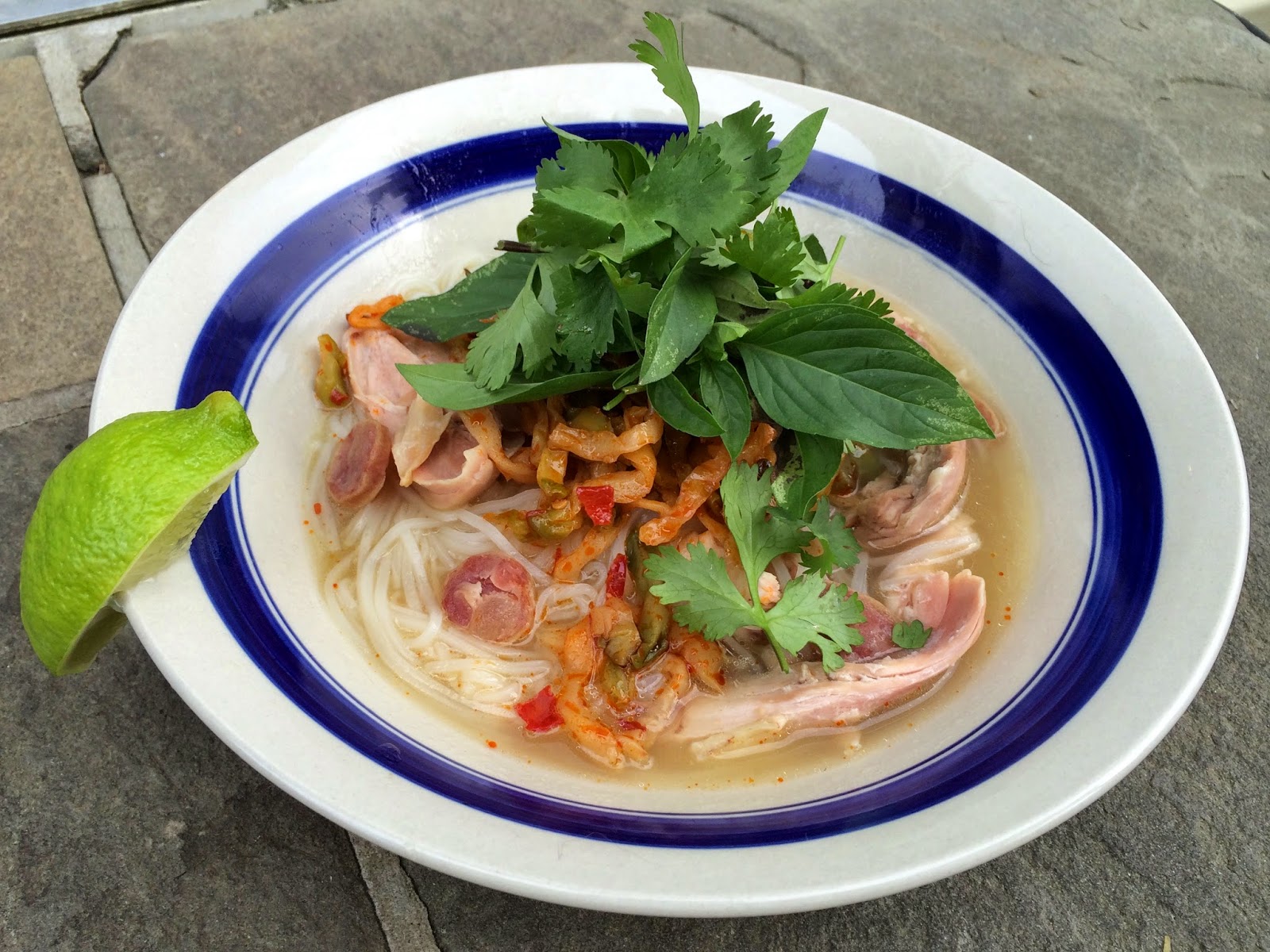
Phở Gà (Vietnamese Chicken Noodle Soup)

Tough weekend. I couldn't eat all day Sunday for a minor medical procedure on Monday and after getting out of that, I needed something really comforting to eat. Enter phở gà.

Phở Gà (Vietnamese Chicken Noodle Soup)
When I make pho, it is typically the more common beef version, but when I am not 100%, chicken suits me (and most of us) better. It was Ann's idea that I make chicken noodle soup: good call!

Here are my tips for making phở gà:

1. Poach the chicken until it is done, remove it from the broth, pick the meat from the bones, and return the bones to the stock to keep enriching it. This way, you achieve both goals: rich broth and tender chicken. Leaving the chicken meat in too long just renders it tough.

2. Char the onion and ginger on the flame for a few minutes before adding to the stock. It adds great depth of flavor.

3. Sweetness is optional. I almost never add sugar to chicken pho. But I often add just a touch of Chinese sausage (lop cheung) to the broth at the last minute. It imparts a certain sweetness. This is certainly non-traditional, but it's my bowl of soup, damn it, and I will cook it the way I want.

4. Have a light hand with the seasonings. To a half gallon of stock, I added four star anise and half a stick of cinnamon for just 20 minutes so that the flavor was there, but really in the background. You want the delicate chicken flavor to come through.

5. Knock yourself out on garnishes. I love pickled mustards stems from China, so I garnish my soup with them, but not with so many that I mask the delicate chicken broth.

6. I don't add either hoisin or sriracha to my bowl with chicken as I would with beef. Again, I want the chicken to be front and center.

Tuesday, February 4, 2014

Red-Cooked Chicken

"Oh my God, I think this is better than your pork belly bánh mì!" exclaimed Ann. This is high praise indeed: my bánh mì, currently on the lunch menu at the restaurant, was tops on her list of all the dishes that I have ever cooked. And for such an unassuming looking dish to assume the mantle of the-best-dish-ever is saying something. Though no stranger to hyperbole when it comes to food, Ann seemed earnest in the extreme. I can understand her excitement: this dish clearly shows why Chinese cuisine is one of the world's great treasures.

Red-Cooked Chicken: Uninspired Plating, Inspired Flavors
Unwittingly, Ann asked me to cook this eastern Chinese classic last week. As she was flipping through some or another food thing, she showed me a plate of red-cooked pork and said she wanted it. The dish wasn't labeled red-cooked but that's what it was. It's been 30 years since I red-cooked anything at home (though it is the basis of many dishes at the restaurant). I decided to lighten up the calories by going with chicken, but chicken legs instead of insipid breasts.

Red Cooking Basics
I've been red cooking dishes so long that I no longer remember the prescribed formulae, if there ever were such things, for this braise. Because of the long cook time, I put together the dish in the slow cooker the night before, so that I could remove it from the refrigerator and start it cooking before I left for work in the morning, to have it waiting when I returned.

Into the slow cooker went the three huge chicken leg quarters, 6-8 star anise pods, half a cinnamon stick, a chunk of rock sugar, a handful of whole garlic cloves, several slabs of ginger, a couple whole green onions, the peel of a tangerine, and the stems from a bunch of cilantro. To this I added about half a cup, maybe three-fourths, of soy sauce, several tablespoons of Chinkiang black vinegar, and water to just reach the top of the chicken.

To finish the dish, I put some rice on to cook, removed the chicken to a plate, and strained and defatted the braising liquid which I then reduced to the point where if I reduced it any further, it would be too salty. At the very end when the sauce and rice were done, I blanched some Chinese broccoli and we sat down to dig in.

This dish clearly belongs in the pantheon of great dishes invented by humankind. It is that good. And that simple: try it yourself. If you've never had it before as Ann had not, it will be a revelation of the best kind.

Friday, December 7, 2012

Red-Cooked Duck

Back in July (the first of July to be exact), Yael and Dan had us over to their farm for a splendid dinner feast and we have been trying to return the favor forever. Such is the nature of the restaurant life and the resulting 2-3 days off per month that it was the first of December before we could actually all get together for dinner at our house.

I have had duck on the brain for a month, red-cooked duck specifically, so I built a (non-traditional) Chinese menu around that.

Turkey and Black Truffle Rillettes
We had an extra jar of truffled turkey rillettes in the refrigerator from Thanksgiving that we started with. The flavor is now better than ever and it would probably get even better still except that now all three jars are gone, gone, gone.

Jook, Fully Garnished


Jook Garnishes: Cilantro, Spicy Cowpeas, Green Onions, Mustard Stems
Now that the weather is cold, my brain is about all things braised/slow-cooked and I have been on a jook tear recently. Jook, also known as congee, is quintessential Chinese comfort food: rice cooked in broth until it disintegrates and becomes a thick porridge.

For mine, I cooked down several chicken hind quarters and a bunch of chicken feet with about a pound of fresh ginger and a bunch of cilantro stems to make the stock. I picked the chicken meat and reserved it. Into the stock went some Carolina Gold heirloom rice and after simmering for about four hours, it had turned to a silky soup. Just before serving, I mixed the chicken back in and prepped a plate of garnishes: cilantro, spicy salted cowpeas, green onions, and preserved mustard stems (zha cai).

I know that jook is traditionally breakfast food, invalid food, and/or a meal by itself, but I like it as an appetizer in a western format meal.


Mise en Place for Pan-Fried Noodles
Because we had rice as a first course, I didn't want to serve it again with the main meal, so I decided to go with pan-fried noodles topped with a variety of vegetables and fungi: shiitakes, tree ear mushrooms, dried daylily blossoms, spiced and pressed tofu, snow peas, garlic chives, green onions, shallot rings, ginger and garlic. I finished the vegetables with a splash of soy sauce and sugar.

Red-Cooked Duck and Bok Choy with Pan-Fried Noodles in Background
Red-cooking is one of my all time favorite braising methods. I cut the duck into serving pieces and browned them. Then cut up the carcass and browned it very deeply in the oven. From this I made a rich duck stock. The duck slowly braised in the duck stock, soy sauce, brown sugar, and a really nutty Sherry with lots of green onions, a dried clementine peel, crushed garlic, and loads of sliced ginger. For spices, I added a sachet containing a few star anise pods, a cinnamon stick, and a handful of Sichuan peppercorns. The duck braised on Saturday for about three hours after which I removed the duck, defatted the stock, and reduced it to the point where I was happy with the flavor. Highly reduced soy-based liquids can get way too salty in a hurry.

Sunday, I put the stock back with the duck in a very slow oven and let it rewarm gently. Then at service, I pulled the duck and lightly thickened the sauce by adding a touch of hoisin sauce. I plattered the duck with some bok choy and poured the sauce over. Really, really good.

Binyamina's Farmer Series, Cab-Shiraz 2009
And speaking of really good, Dan and Yael brought this Cabernet Sauvignon-Syrah blend from Binyamina Winery, one of the largest wineries in Israel. The soft fruit went beautifully with the duck!

Monday, September 3, 2012

Ribs for Labor Day

For our ribs for Labor Day, I decided to do something totally off the wall and do my own version of an Asian barbeque. I don't have a lot of experience with ribs. Ribs and fine dining are not exactly synonymous, are they? And I don't have any equipment either. But then I can MacGyver a smoker out of just about anything and who said they had to be smoked anyway?

I started with six St. Louis racks of commodity pork. Time got away from me and I forgot to order Berkshire racks from my supplier. I prefer the St. Louis racks (squared off spareribs) to the back ribs (the so-called baby backs) because the spareribs are larger and meatier. Spareribs are the lower half of the rib cage that wraps around and protects the chest cavity. The back ribs are the upper half that attach to the spine. Anatomy lesson over.

Peeling the Silverskin

On Wednesday afternoon, I started prepping the ribs and getting them in a marinade. First thing, I pulled the silverskin off the back side of the ribs. While not necessary, it is what the pros do and as a professional chef, I aim to be professional about my food. Then I trimmed any excess fat and silverskin from the front of the racks.

Herbs: Anise Hyssop, Cilantro, Lemongrass, Kaffir Lime, Thai Basil

From there it was into the marinade which I assembled from a bunch of stuff from the walk-in, mostly from herbs that were on their way out. There's no point in throwing out herbs just because they are unsightly, especially when they still taste good. I made a half gallon of slurry from Thai basil, cilantro stems, lemongrass, some really beat kaffir lime leaves, a huge bunch of blooming anise hyssop, garlic, ginger, star anise, black pepper, cinnamon, fish sauce, brown sugar, oil, and water. The slurry was primarily oil-based on the theory that oil extracts more flavoring compounds from the seasonings than does water. I kept the salt and sugar to a minimum because I wanted the ribs to take on flavor over several days without becoming jerky-like.

Straining the Marinade over the Racks

Saturday morning dawny hot, sticky, and rainy. Not a good day to contemplate firing up the smoker outside. Good thing. I don't have a smoker outside. Right off, I headed into the kitchen to concoct my dry rub, a rub that I have been thinking about on and off for a couple of days. I mixed up the rub that I had been working out in my mind, tasted it, and then tweaked the salt. I'm pretty happy with it and I think I have the long, mild white pepper burn just right.

The formula that I arrived at is:

   4 parts five-spice mix
   4 parts white sugar
   2 parts kosher salt
   1 part onion powder
   1 part garlic powder
   1 part ground white pepper

My five-spice mix is a bunch of things and certainly more than five spices, but as its creator, I am allowed, no? The mix is heavy on ground ginger, allspice, and star anise. It contains lesser amounts of cloves, cinnamon, anise seeds, Sichuan peppercorns, and white pepper.

Initial Dry Rub on top of Marinade

After taking the ribs out of the marinade, I rubbed them to get a nice even coat of the marinade and then dusted them with dry rub on both sides. They then went on sheet trays in a very slow oven for about 3-1/2 hours. Once out of the oven and while still hot, both sides of the racks got a coat of a wet rub of hoisin sauce, sesame oil, rice vinegar, fish sauce, and cayenne pepper. I then covered them in foil to let them cool slowly in the wet rub.

Wet Rub on Warm Racks
After a night in the walk-in in the wet rub, I put a final dry rub on the racks. In retrospect, it was too much. One dry rub application was plenty. Then it was on to the "smoker."

Racks Just out of "Smoker"
After trying several approaches that were just not going to work, I finally partially disassembled our gas grill and sat a foil packet of soaked applewood chips on the rightmost burner. Fortunately, our grill is big enough to hold three racks off to the left of the one lighted burner, plus another rack up on the warming shelf. After about 10 minutes of the burner on low, there was no smoke and the temperature in the grill was just about 100 degrees—too low. So I cranked the righthand burner and the temp went to about 215 after 10 minutes, with a modest amount of smoke. I smoked the ribs for 45 minutes and they turned out as you see above.

Hot off the Grill! My Biggest Fan!

The ribs were pretty good overall. The texture was spot on: not falling off the bone, but tender to the tooth. The amount of smoke was just right. But the final dry rub was too much. Next time I finish with the wet rub and let it caramelize without the final dry rub. Live and learn.

Sandy Hook, Oregon

Over the past few years, I have found I process trauma by hiking and by writing. On Thursday October 15, my town, Bend, Oregon joined the in...