Showing posts with label pork. Show all posts

Wednesday, July 16, 2025

Dimitri Comes to Bend

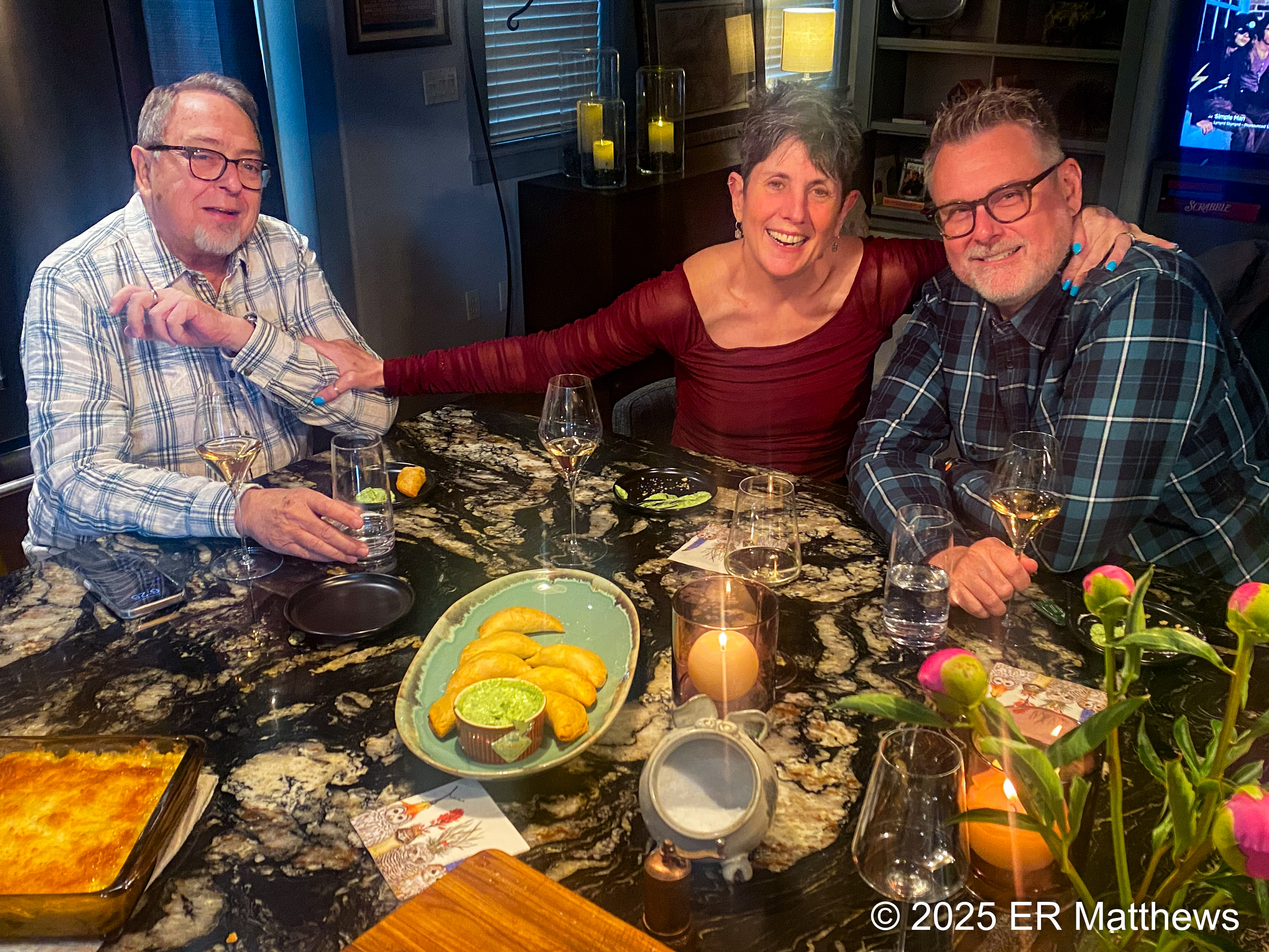
Surprise! Our friend Dimitri texted out of the blue on Monday that he and his friend Joe would be in Bend for the weekend. Dimitri still lives in Northern Virginia just outside of DC, so he was not on our bingo card for weekend visitors. He and Joe, a friend currently from Virginia but from Portland in the past, were flying into PDX. After visiting Oregon wine country and exploring Portland, they would be driving to Bend for a long weekend.

Mediterranean Crew: Greek, Italian, Italian
Dimitri and Joe had plans to dine out on Saturday at the same time we were at the Trevor Noah show at the amphitheater, so we set a get-together for Sunday starting with pre-game at Viaggio Wine Bar. We met them there after they returned from a day trip to Crater Lake, which if you have never seen before like Dimitri, I guess you have to see. But honestly, battling buses of tourists is not my thing and I would have preferred to visit Paulina Lake instead.

Dimitri and Joe are fellow winos, so we thought that a visit to Viaggio would be welcome. There, they could drool over the curated selection of bottles on the shelves and Coravin selections on the glass list. Where else can you find shelves full of Wachau and Kamptal Riesling, Piemonte wines of all sorts, or Rhônes for days? Maybe in large cities, but in the small city of Bend three hours in any direction from civilization, the selection at Viaggio is miraculous.

After a bottle of Pibarnon Bandol rosé, we drove to the house where all I had to do was assemble dinner. In planning dinner, I wanted something that I could put on the table with little to no effort. Gone are the days of à la minute cooking where cooking is the focus rather than our guests. Hence our menu of chips and salsa verde, enchiladas de carne adovada, and posole amarillo with bacon, corn, and green chiles. Ann made another summer berry and brioche pudding and I had plenty of lemon-thyme sorbet base in the fridge ready to go into the freezer.

How I arrived at this menu is anyone's guess. I was definitely looking for a slow-cooker meal that would not involve a lot of active cooking on my part. Probably in the back of my mind was the kilo of Chimayo chile that I scored in New Mexico in December. And then, I found some really good looking pork shoulder at the store. Also, who does not like enchiladas? Chips and salsa as well as posole are natural companions to carne adovada, so that part of the menu should not be a surprise.

Before we get into dinner however, Dimitri came bearing a gift, a 2014 Glen Manor Petit Verdot. I texted Jeff, "A friend showed up with a bottle of this," to which he replied, "Keep that friend!" I remember this wine. I believe I did a pairing for it for a barrel tasting. I could be wrong; 2015 was a hot minute ago.

Dimitri Brought Us a Gift
Chips and Charred Jalapeño Salsa Verde
My usual salsa verde is tomatillos (large can, drained), cilantro (one bunch), garlic (4 cloves), and a serrano chile. When I am lazy, I used canned tomatillos rather than roasting fresh ones. I am often lazy these days. I wanted to change it up a bit with some smokiness, so I charred two jalapeños and used them instead of the serrano. I also threw in an avocado and a pinch of smoked paprika for added smoke.

It was good, but next time, I want it smokier. Maybe I try using a charred poblano. Definitely will char fresh tomatillos on the next iteration. It will be a fun experiment. A batch of salsa verde or chimichurri is usually in our refrigerator: we eat a lot of vegetarian and fish tacos that benefit from salsa.

Saturday, I made a batch of slow cooker carne adovada. Like most dishes, I used no recipe for this super simple stew. I started by cutting the pork shoulder into large cubes, then browning one side of the cubes, followed by transferring them to the slow cooker as each batch browned. I want the flavor that browning creates, but I find that browning all sides of the meat tends to contribute to dryness. Browning one large side of the pork chunks suffices to yield both flavor and succulence.

After the meat was all browned, I added a diced onion to the pork pan along with call it a dozen minced cloves of garlic. Once the onions cooked, I added a a bit of Mexican oregano, rubbed between my palms into a powder, a lot of spicy ground Chimayo chile, and a lesser amount of ancho powder to add some balance to the Chimayo chile. The chile was probably a cup in total, 3/4 Chimayo and 1/4 ancho. After stirring this into the onions well, I added perhaps a couple cups of water, a splash of Sherry vinegar, and a small amount, perhaps a tablespoon, of agave nectar. Once this sauce came together, I poured it over the pork, stirred well, and put the slow cooker on.

I believe that adovada must have acidity; your grandmother may disagree as is her right. Not a lot of acidity, but some. So I always put a bit of vinegar in mine (as I do my Mexican-style chorizo). I also think that spicy Chimayo chile needs just a hint (below the taste threshold) of sweet to help mellow it, hence the agave.

When the pork was cooked, some six or seven hours later, I separated the liquid from the pork. I separated the meat and the cooking liquid for several reasons. With the liquid chilled, I could peel off the layer of pork fat that I did not want in my sauce (and use it to cook anything else; who does not love chile-flavored lard?). Because I was making enchiladas, I wanted a more solid filling that would not bleed through the tortillas. And, I wanted a thicker, more intense sauce to fold into the filling and to cover the tops of the enchiladas.

After defatting the cooking liquid, I reduced it as far as I could without it becoming too salty. I salted the pork cubes during browning. But it was a really mellow thin sauce after hours of braising and I wanted a thicker, more in-your-face chile sauce for the enchiladas. I made a quick paste of a tablespoon of flour (for thickening), half a cup of Chimayo chile, and a little of the reduced braising liquid. After stirring really well to remove all lumps, I stirred this slurry into the sauce and cooked it gently to thicken.

Enchilada Sauce, Thickened with Flour and Chimayo Chile
Once we got back to the house, assembly of the enchiladas was trivial. I mixed some of the carne adovada with some of the sauce and the meat shredded as I stirred it. After seasoning it to taste, I rolled the tortillas around this filling, placing them in an oiled half hotel pan, seam side down.

I digress, but this is my blog, so I will digress if I want to. When I retired from the restaurant, I kept one of the half hotel pans for my home kitchen. If you have worked in food service and are of a certain age, you will remember that hotel pans used to be thick and heavy, not thin and flimsy as they are today. I kept one of the old school thick pans for home use and I use it often. I had some really awesome hotel pans too, but they are far too large for home cooking.

I spooned more sauce over the top of the rolled tortillas to make them into true enchiladas ("sauced with chiles") and then scattered over just a bit of melting cheese. I used mozz, but any melting cheese such as queso chihuahua, queso quesadilla, queso oaxaca, queso asadero, or Monterey Jack would be perfect.

Posole Amarillo with Bacon, Green Chile, and Fresh Corn
I am a huge fan of hominy. I grew up on it, always fried in bacon grease as it is traditionally served in the South. It was good. When I was in grad school in Texas, I learned that the rest of the world does not see the dish the same as I grew up with. Posole is always always a stew with pork, red chile, and white hominy. It was good: I loved this stew at first bite. Then I went to New Mexico and found that they often serve a drier posole as a side dish, more akin to my southern hominy, but with local chiles. It was good. Then I started making casseroles of hominy bound with cream sauce. It too was good. What I figured out is that posole dishes are as numerous and varied as the people that make them. I feel free to riff on this ingredient in any way that seems appropriate to me.

Over the years, I learned that hominy is not always white. It is the color of the corn from which it is made and as we all know, corn comes in many shades: white, yellow, red, and purple. I have used the different colors for effect over the years. I used a lot of maíz morado, purple hominy, at the restaurant. This time, I felt like using yellow hominy.

This time, I fried up some bacon most of the way done, then added diced red onion and garlic and let that cook. Then I added the hominy and diced mild green chile (Anaheims that I torched on my patio). It too was good. I made it Sunday morning and refrigerated it. While the enchiladas were in the oven, I reheated the posole and sliced the kernels off two ears of corn. They went into the dish as a sweet counterpoint to the smoky green chile vibe going on. It was even better.

Enchiladas de Carne Adovada and Posole Amarillo
After dinner, it had cooled off enough to go outside so Ann put the tunes on out on the patio and we all took our dessert, summer berry pudding and lemon-thyme sorbet, outside. I opened a bottle of 1977 Warre's Port, because I save those kinds of wines for fellow winos like Dimitri and Joe. It was a great night!

Dessert on the Patio
Ann's Berry and Brioche Pudding
Lemon-Thyme Sorbet with Summer Berry Pudding

Wednesday, May 21, 2025

A Southwest Dinner

We're getting close to the summer travel season when we are going to be on the road somewhat often. Before we leave for Virginia for my daughter Ellie's wedding, we wanted to have Rob and Dyce over for a casual dinner.

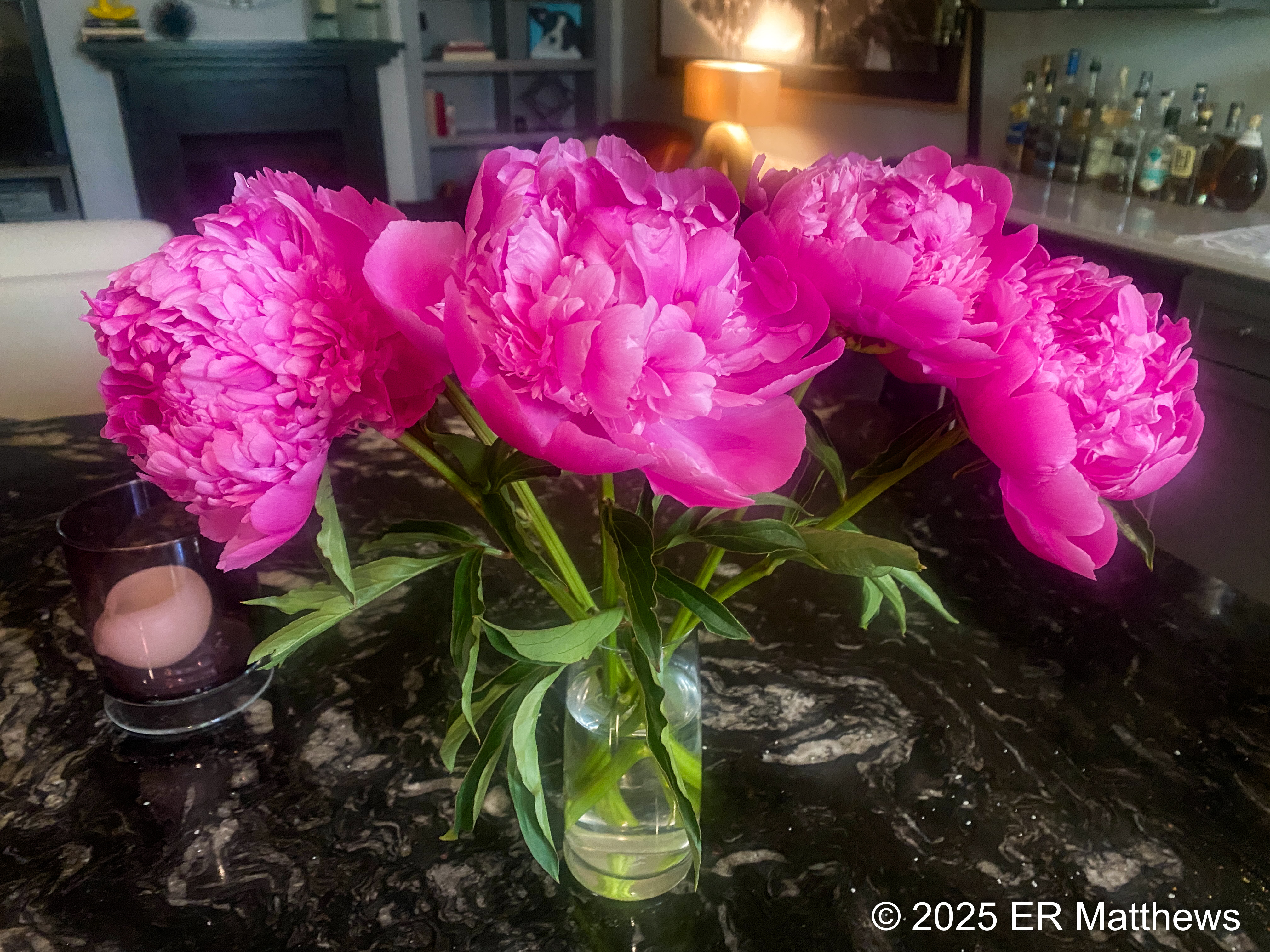
Rob and Dyce Brought the Most Gorgeous Peonies
I really am trying to avoid dinners with lots of last minute cooking so that I can relax and focus on guests. That shifts meals towards braises and dishes without touchy timing. Ann had kindly suggested all manner of dishes, but nothing grabbed me.

Unclear on what to make and rooting through the freezer, I found a bag of cleaned and cubed pork shoulder from a foray to Costco. Their shoulders come in two packs and that's a ton of meat. I typically break down both shoulders into cubes for braises like carnitas and freeze what I don't need right away.

Knowing that Rob and Dyce are fond of New Mexican food had me thinking along those lines and so I decided to make chile verde. After pondering for a few days, I decided to make a posole casserole to accompany the pork, and to offer empanadas for an appetizer. After a week of beautiful weather, it cooled off again and the choice of heartier food seemed lucky and apropos.

Then I remembered the heirloom masa harina that Ann gave me for my birthday and I decided to make tortillas to accompany the meal. And so the menu was set with the only last minute task to cook the tortillas. Somehow in the course of moving, my tortilla press did not make it to this house and so I improvised using a cast iron pan and a cut open Ziploc bag.

Empanadas de Picadillo Dulce, Cilantro Aïoli
Empanadas I make with an egg-enriched pie crust that never fails to bake up flaky and golden brown especially when brushed with an egg wash. Habitually, I fill empanadas most often with picadillo dulce, a sweet and sour pork that I first learned about by reading old Spanish-language recipes in the Biblioteca Nacional de México.

The filling is clearly of Moorish origin, containing almonds, olives, and sometimes raisins, though I have made it my own through the years. This version was ground pork shoulder, almonds, olives, onion, poblano chile, garlic, Mexican oregano, and three types of dried red chile (the majority ancho). I made it sweet and sour with brown sugar and Sherry vinegar. I have outlined the process in a previous post.

Masa Balls for Tortillas
Ghetto Tortilla Press: My 1930's Griswold Skillet
Tortillas on the Table
Chile Verde, Posole-Chipotle Casserole, Tortillas
Chile verde is not a recipe but an idea. At essence, it is cubes of pork braised in a salsa verde. There are as many ways to make it as there are cooks and they are all wonderful. I am certain that I make it differently each time and this time, I used the slow cooker to free our single oven to use in baking the posole.

For chile verde, there are two essential steps. First, make a salsa verde and second, brown the meat and braise it in the salsa.

For salsa verde, I roasted at high temperature (say 400F) a sheet tray of poblano peppers, Anaheim peppers, onions, garlic, and tomatillos. I rotated the chiles as each side became blistered. Once done, I pulled the tray out and covered it in film so that the veg could steam until cool and loosen the pepper skins.

Next up, I skinned and cleaned the peppers, dicing and reserving three or four Anaheims for the posole casserole. The peppers, garlic, tomatillos, onion, and a bunch of fresh cilantro went into the food processor. I blended it until roughly smooth and put it in the slow cooker.

For the pork, in recent years, I have adopted a process by which I only brown one surface of the cubes. This provides great flavor while not drying out the pork. After browning all the pork and putting it in the food processor, I deglazed the pan with a splash of water and poured all the porky goodness into the slow cooker with the pork and salsa. Eight hours later, the pork was tender and the sauce reduced to just the right thickness.

The posole casserole, something I started making in my 20s as a broke graduate student, I assembled in the afternoon and put into at 350F oven about 90 minutes before we were ready to eat. Timing is not critical, a delightfully brown crust is.

I admit that I did not make my own posole, though I could. I bought two 28-ounce cans of commercial hominy, the same Teasdale brand that I used in the restaurant. One can each of yellow and white hominy went into a mixing bowl with the reserved chopped green chiles, half a bunch of sliced green onions, and the kernels of one ear of fresh sweet corn for contrast and variation on the corn theme. Purple hominy (maíz morado) would have been cool, but my store had none.

I bound the casserole with a chipotle béchamel: olive oil and a spoon of flour cooked for a minute, then a pinch of salt and one finely chopped chipotle in adobo. After mixing the hominy and sauce, I adjusted the salt and put it into an oiled baking dish and topped it with a little grated white cheese. The result is as delicious as it is simple.

Making tortillas with modern masa harina is a trivial process of mixing the corn flour with enough water to make a workable dough. Then you roll it into balls and smash the balls between sheets of plastic (or a cut open Ziploc freezer bag in my case) in a tortilla press (or beneath a cast iron skillet in my case). We restaurant chefs are used to adapting and overcoming: no tortilla press, no problem. I can even patty them by hand, old school.

After peeling the masa circle off the plastic, it goes into a hot, dry frying pan on low to medium heat. Cooking both sides takes less than a minute and if I had a flat-top, I could have cooked them all at once rather than one at a time. Naturally, I could have fired four pans on the stove and cooked four at a time, but no matter. We were all busy yakking while I was pressing and cooking tortillas.

It should be axiomatic that a tortilla is only as good as the masa from which it is made. And if you use shitty Maseca or Masa Brosa, you are going to get a shitty tortilla. My masa is from Masienda and is processed from heirloom corn varieties grown on small farms in Mexico. It is expensive relative to the big brands (but even so, tortillas cost cents), but it helps sustain small farmers and preserve heirloom corn varieties.

Saturday, February 1, 2025

Slow Cooker Bolognese

I love traditional ragù bolognese. In my culinary lexicon, that means a shredded meat sauce made from cubes of meat, stock, a little soffritto, a splash of wine, and a bit of cream or milk. In my world, this sauce is not made from ground meat, but certainly plenty of bolognese would argue about that. It is cooked long enough until the meat is sufficiently tender to shred when stirred with a spoon; there is no such thing as a quick ragù bolognese. Many traditional versions use pancetta and beef. I use only pork shoulder, primarily because I like pork better than beef.

I've made it in the oven, on the stove top, and in the slow cooker, especially when I want to leave it unattended while I am away from the house. The batch illustrated below, I threw in the slow cooker for about 9 hours. It is two-day process. The first day, I make the stock and then on the second day, I make the meat sauce using that stock.

The sauce is only as good as the stock you make it with, so if you want great sauce, you must first make great stock. I first roast stock bones, pork neck bones in this case, with chunks of onions, carrots, and celery. Once that comes out of the oven, I remove all the solids to the stock pot and put the roasting pan over a moderate flame.

To the pan, I add a large spoonful of the best tomato paste in the world, estratto di pomodoro, which has a deep, rich, umami flavor. Stirring constantly so that the paste will not burn, I further caramelize it for another minute or two. Then I stop the caramelization and potential burning by adding a glass of water. Once the water goes in, I scrape all the browned bits off the bottom of the pan.

After all the bits are off the roasting pan and into the liquid, I turn off the heat and pour the liquid into the stock pot. Into the stock pot go all my vegetable trimmings (leek leaves, celery leaves and ends, carrot tops, onion peels, parsley stems, etc.). Onion peels may surprise you, but they have been used forever as a yellow or brown dye and that color will serve your stock well.

Next, I add a couple of pig's feet (trotters) to the stock pot. Some people add a packet of gelatin to the stock pot to give the resulting stock a satiny mouthfeel, but I prefer to do it the old fashioned way using pig's feet. After filling the stock pot with water, it will simmer for several hours. I strain, cool, and refrigerate the stock overnight to solidify any fat on top which I remove the following day.

I pick the meat off the neck bones and use it for something (tacos!). In this case, since I am making meat sauce, I add it to the sauce.

Vegetables and Pork Necks Ready to Roast
Roasted Vegetables and Pork Necks, Ready to Deglaze
Vegetables and Scraps for the Stock
Stock Just Starting to Cook
Strained Stock
On the second day, I start the bolognese by browning my pork shoulder cubes. I brown them only on one side. While browning them develops flavor, browning also dries the meat out. As a compromise between flavor and succulence, I brown just one side.

Browning Pork Shoulder Cubes in Batches
After Browning the Meat, the Goodness Called the Fond Remains
Once the meat has been browned, caramelized meat juices called the fond in classic French cuisine remain on the bottom of the pan. Just like I did for the stock, I want all this tasty flavor in my meat sauce. As you can see, I am adding layer upon layer of flavor to the finished product.

To start removing the bits from the pan, I leave it on the flame and add my soffritto (mirepoix in French), a small dice of carrots, celery, and onions. The water in the vegetables will help loosen the fond from the pan as I stir. Once the vegetables have started to cook (the onions have gone translucent), I ensure that the remaining bits come off the bottom of the pan by adding a glass of white wine. I only ever use white wine for my ragù. 

Soffritto for Ragù
Now it's time to put the meat sauce on to cook. I put the browned neck cubes, the picked neck meat, the soffrito, the defatted stock, and a cup of heavy cream to the slow cooker. I put it on high and let it cook until it reaches the consistency of the sauce in the final picture, skimming the surface fat every now and again. I season the sauce with salt at the end. It's never good practice to salt a sauce that is going to be highly reduced (thus concentrating the salt) before the end.

The process will take several hours at a minimum and more if you are using a slow cooker. This batch took about nine hours in the slow cooker. It would have taken far less on the stovetop, but I had things to do away from home that did not leave me time to keep a mindful eye on the sauce on the stove, stirring it every now and again to keep the bottom from scorching. As a home cook, cooking should fit your life style; your life style should not be cooking. That's the province of a restaurant.

Sauce Before Cooking
Finished Ragù Bolognese
There's nothing hard about this sauce. It merely takes a lot of time (the vast majority of which is unattended), but that time is necessary to achieve the caramelized and umami-rich flavor that you expect from a quality meat sauce.

Finally, I note that there are no seasonings other than salt. The bolognese do not add herbs to their sauce in general, nor do they add garlic. Some do add a touch of nutmeg (noce moscata), but that remnant of highly spiced medieval cooking has never been my jam. You do you.

Friday, October 11, 2024

Italy Day 18, Firenze: Arrivederci Mosquitoes, Buongiorno Americans

Friday, October 11

Firenze, Firenze, Toscana

Highlight: Fantastic afternoon and dinner out
Lowlight: So many f*cking Americans

I awoke in Ferrara having once again got very little sleep. Besides the torment of the mosquitos in our apartment, I was probably agonizing about turning in the rental car. Today would be the day that we would drive from Ferrara to our final vacation stop in Firenze. We'd drive the A13 to Bologna and then take the now familiar A1 autostrada from Bologna through the mountains to just northwest of Firenze. We'd then drop the rental car back where we got it at the airport, take a shuttle bus from the rental car center to the terminal, and then take the tram into downtown Firenze and find our apartment.

Firenze: Cattedrale della Santa Maria del Fiore
Our trip is coming to an end, and quickly. We talked about it last night. This vacation has been a few flashes of brilliance coupled with a lot of torment and boredom, not at all what I expected from my first trip to Italy. Lots of it has been trying. And we have survived it. Survived it as a couple, I mean. This kind of vacation will rip your relationship apart if it is not solid. By this yardstick, ours is undeniably solid. And we are ready for home. Three weeks is a long trip. 

We wanted to leave Ferrara as late as possible in the hopes that we could get into our apartment in Firenze immediately so that we did not have to worry about luggage as we navigated the streets of the capital of Toscana. So, we stuck it out in Ferrara until 11, the deadline for checking out. When we tried to leave, we could not get enough signal to get a GPS route on our phones. So, I started walking downtown to get the free WiFi to plot a route. Ann texted me once I was almost there that she managed to get a route so I walked the 10 minutes back to the apartment and we got underway. This Internet problem is a pain in the butt.

At one point in leaving Ferrara, the GPS wanted us to turn right but which of the three possibilities we should take was unclear. I assumed that following the bulk of the traffic was likely correct. But while stopped at a red light, I realized we were going wrong. I could get on the correct course if I moved right a lane and took a quick, sharp right. And as I was so doing, I saw two carabinieri standing there, one of whom gave me the WTF are you doing sign. In my best Italian driver style, I shrugged him off and kept accelerating through the gear box.

The trip to Bologna and then through the mountains was routine. At some point, we stopped at an AutoGrill alongside the autostrada to use the facilities. I have to say that the AutoGrills are pretty amazing. You can get fast food, coffee, gelato, a sit down meal, tourist schlock, groceries, and all manner of other things there and people swear by the quality of the food. This mirrors my experience in France that the truckstops have really decent food. Among the food stuffs for sale at this particular AutoGrill were whole salame, fresh pasta, and boxed pasta. I saw a bunch of boxes of oversized bucatini in long blue DeCecco boxes; the pasta must have run 50cm long, a full half a meter! 

I was wondering where in the vicinity of the airport to get diesel to refill the car before we turned it back in. It turned out to be a non-issue: there’s a service area just before the airport and the friendly attendant told me to pump first and pay inside. Easy peasy. I had already been to the rental car center to get the car, so navigating to it was easy. But finding an attendant was not, at least not in the location where Neal told me to drop the car. An attendant from another agency directed us to the correct location. Still, it took a few minutes to find an attendant. It's not like at American airports where you drop the car in a return lane, leave the keys inside, and walk away.

After that, we waited for the shuttle to the airport for just a few minutes. Once we got on the shuttle bus, we realized it was wall-to-wall with American college kids, a sign of things to come. The shuttle took a very convoluted 8-9 minutes to drop us 400 meters away at the terminal, located across the autostrada from the rental car center.

Catching the tram for the 20-minute ride into Firenze was simple enough; I had already noted the location of the airport tram stop just to the right of the terminal building when we arrived three weeks ago. The ticket machine was simple after dealing with those from TrenItalia. You merely buy a ticket for €1,70 which is good for 90 minutes after validating it on the tram and it is good for any destination and also I believe for transfers to buses.

Ann was a little concerned about our stop which our host had said was the main train station named Santa Maria Novella. However, Santa Maria Novella was not one of the names of the stops that our tram was making. We wanted the Alamanni stop; looking at the route map for the tram made it look like Alamanni was correct and we were able to verify that with another passenger. Likewise, the name of the airport stop on the way back was not Amerigo Vespucci but Peretola Aeroporto.

Our apartment was not supposed to be ready until 16:00, but it was ready when we arrived at 14:15 after dragging our luggage the two or so blocks from the station on rough cobblestones. We were highly fortunate to get inside just before a brief rain shower hit. It passed quickly but it was enough that we would have been soaked.

Our room was a great apartment on the third floor of a building downtown above a little trattoria. The steps were steep, ancient, and off kilter which made schlepping the suitcases up to our room a bit of a challenge, but the apartment was beautiful. Our host really thought of everything and was fantastic in texting us directions, advice, places to eat, and so forth. There was even a map of Florence on the wall in our room with his favorite walks marked, each with a theme, and cool places to visit highlighted. He even left exquisite pastries in our room; I would eat them for breakfast before heading back to the airport.

Our Host Left Pastries for Us; They Were Killer
After the rain shower, the sun came out and shone brightly, encouraging us to take a walk about town. Firenze was one of the highlights of Ann's 1996 trip to Italy and she has been hyping it for months; I was naturally eager to see what she found so attractive about this medium-sized walkable city. I was looking forward to it being one of the highlights of our trip, our last hurrah before getting back on a plane for the seemingly interminable trip across the ocean.

From our apartment near the main Santa Maria Novella train station, we wandered in the direction of the Piazza del Duomo lured on by the stunning warm brown terracotta tiles of the duomo designed by Filippo Brunelleschi, the massive dome that we could glimpse here and there between and above buildings. We had not progressed more than a block or so in the direction of the duomo, when we encountered hordes of tourists, tourists so thick that we had at times to shoulder our way through.

My first impression was that I hate this town full of filthy rich Asians dripping in designer outfits and even more American kids with SoCal accents. I came to Italy to get away from America for a while, to get some perspective on my own country through the lens of another country, and yet, here we were surrounded by Americans. We heard almost exclusively English on the streets and almost no Italian at all. I felt that we were in some medieval-themed Disneyland full of Instagram wannabe-influencers with their noses firmly planted in their phones, not watching where they were going or even taking in the gorgeous architecture around them, when they were not busy filming themselves.

Carousel at the Piazza della Repubblica
As we made our way toward what is known nearly universally as The Duomo, the full church, the Cattedrale della Santa Maria del Fiore, with its glorious campanile came into view. I've seen St. Patrick's in NYC, St. Paul's in London, Nôtre-Dame in Paris, and many other grand cathedrals, but none of this prepared me for the simplicity and the splendor of this cathedral in Florence. It is one of the most amazing buildings I have ever seen. The stonework in all colors of marble is unfathomable in this day and age.

Il Campanile di Giotto

As I mentioned earlier, Ann came to Firenze in 1996 and took a bunch of photos including many of the Duomo. Below is a shot that I took on this trip; Ann took a similar one on her phone. After we returned to Oregon and she was going through her camera roll, she realized that she had taken an almost identical photo from nearly the exact same spot in 1996. I find that to be an amazing coincidence.

My 2024 Photo
Side by Side of Ann's 1996 and 2024 Photos
After enduring the obnoxious crowds of Americans at the Piazza del Duomo, we tried to escape by heading away from the cathedral. We were not really successful as we walked by one high-end designer boutique after another. Clearly, people come to Firenze to spend obscene amounts of money on extravagant habillage and jewelery. Our escape path led us by the Bargello and on towards the Arno River, where we found scads and scads of, you guessed it, more Americans.

Museo Nazionale del Bargello
Pediment on the Palazzo di Giustizia
Skyline of the Palazzo di Giustizia
Badia Fiorentina - Monastero
Interplay of Light and Shutters
Torre Arnolfo at the Palazzo Vecchio
Right at the river, we walked by the entrance to the Museo Galileo and its sundial, a wonderful public art installation. From here, we walked into the middle of the Uffizi Gallery, or rather, I elbowed my way into a sea of people. It was so crowded and the sun angle was so wrong, that I didn't even stop to take a photo. As much as I might like to have seen some of the collection at this museum, I would never put up with this kind of crowd to do so. We kept moving downstream along the Arno with the famed Ponte Vecchio in clear sight.

Annie Camps Out on Scorpio at the Galileo Sundial
Upstream Side of the Ponte Vecchio
Downstream Side of the Ponte Vecchio
Across the Arno: Campanile at the Basilica di Santo Spirito
We did not go out on the Ponte Vecchio; it was wall-to-wall people. I am satisfied with having seen it at a distance, this, the only bridge across the Arno in Firenze not destroyed in the Second World War. Please do not hate me when I say that I did not find this famous bridge at all pleasing to my eye. I dare say I might even call it an eye sore, unlike the graceful Ponte alla Carraia just downriver.

During our walk, finding ourselves exasperated with the unruly crowds, we decided to seek out the wine bar that our host had recommended to us as being excellent and hidden away from tourists. Firenze provides some minimal free WiFi, so I was able to plug the wine bar location into my phone and navigate there. Our track would have us continue along the north side of the river beyond the Uffizi, past the Ponte alla Carraia, and to the Piazza Ognisanti and Chiesa di San Salvatore.

Ann in Front of the Ponte alla Carraia
The Light Does Not Get Better Than This
Chiesa di San Frediano
Chiesa di San Salvatore
Detail Above Door to San Salvatore
Horse Drawn Carriage Near the Palazzo Lenzi
Interesting Shop Selling Paintings
The enoteca we were aiming for, Nuova Vigna, is tucked away just at the foot of the Ponte alla Carraia such that it took us a moment of poking about to find it even when we were within 25 meters of the door. A young guy welcomed us into the store which looked confusingly like a cross between a wine shop, restaurant, and pasticceria. The spaces serves as a pasticceria in the day, a wine bar from the afternoon on, and a restaurant at night. We spent a wonderful couple of hours with the two guys there, one of whom is a sommelier. As we walked in and were considering the wine list, the younger guy asked, "Why not a glass of Prosecco?" Naturally, why not?

Hide and Seek: Where is the Hidden Enoteca?
Left Fork, Left Corner, Behind the Optician
Enoteca Vigna Nuova/Pasticceria Batoni
Soon enough, two glasses of Prosecco appeared on the table and I took a quick sip of the €7 glass. You really cannot expect much from a glass pour of inexpensive Prosecco, can you? I was totally unprepared to have the best Prosecco of my life. I looked at Ann; she looked at me with that "Am I really tasting what I'm tasting?" look. Suddenly, tucked away in a little off-the-beaten-path enoteca with a glass of phenomenal wine in my hand, I was feeling much better disposed to the city of Firenze.

Suddenly, We Love Firenze!
This is Excellent Prosecco
Nebbiolo Anyone?
We spent a fair amount of time chatting with the two guys and naturally we got to talking wine with the one who is a sommelier. We decided after the Prosecco that we wanted a red, preferably a Nebbiolo and he led us directly to this bottle of Langhe from Barale Fratelli in Barolo. It was a damn fine bottle of wine and went really well with the savory pastries that they brought us gratis. It was a shame to see, at the end of the day, that what leftover pastries the staff did not want had to go in the trash.

While at the enoteca, we started thinking about dinner and made a reservation at another host-recommended restaurant just down the street from our apartment, Il Bacaro Fiorentino. After resting at the apartment for a while, we made the 200-meter walk to Il Bacaro and were seated outside on the sidewalk just as the sun was setting. During the course of our 3-4 hour meal, it seemed to us that this is more of a locals restaurant than a tourist place. Also, it is clear that they take their food and wine seriously.

Frontman Endrit Devolli Behind his Cicchetti Counter
Enjoying a Beautiful, Tourist-Free, Dinner
Before it got busy, we chatted with frontman Endrit Devolli about all things restaurant as we sipped on an excellent bottle of Pira Barolo Serralunga d'Alba. Of all the comune to produce Barolo, Serralunga is my favorite for power, structure (tannins and acidity), cherry fruit, and herbaceousness. Back to the restaurant, it seems to meld the concept of Venetian bacaro (a tapas-style bar where the small dishes are called cicchetti) with Florentine osteria. The dishes coming out of the kitchen, manned by veteran Venetian chef Luca Marin, were refined and probably the best meal we had in Italy.

Dynamite Pira Barolo Serralunga d'Alba
Once the wine was on the table and we had had a chance to go through the menu, though we wanted everything on the menu, we ordered two antipasti, a terrine and some burrata. The terrine of chicken livers was the single best thing I had in Italy, perfectly cooked and delightful. When we finished these two dishes, we asked our server to bring us a third antipasto, one that we really wanted to try, baccalà. Twenty or so minutes later, out from the kitchen came a delightfully presented tower of whipped salt cod with sticks of fried polenta. This exquisite dish was a close runner up to the terrine for best dish during our vacation, running neck and neck with the anchovy toast at Ponte Pietra in Verona.

"La Terrina dello Chef" con Fegatini di Pollo e Ristretto di Vin Santo
Best Dish of our Trip: Brilliantly Cooked, More Pudding than Terrine
Burrata Fritta Ripiena di Pesto, Melanzana Affumicata, e Pomodorini
Baccalà Mantecato all'Olio d'Oliva con Polenta Fritta
Awesome Flavor, Great Presentation
When we tasted how amazing the baccalà was, I asked Ann, because she was on the restaurant side of the table while I was on the street side, if she would go in and ask Endrit to order the rest of our meal for us. He did and the rest of the meal was a surprise. The primi, ravioli and gnocchi, were both works of art. The sfoglia for the ravioli was outstanding and the gnocchi were the lightest and most ethereal that I have ever had, sauced with a tomato and scampi (langostino) sauce reminiscent of my shrimp étouffée sauce.

Gnocchi di Patate alla Busara di Scampi
Best Gnocchi I've Ever Eaten: Ethereal, a Work of Art
Busara is a Venetian Scampi and Tomato Sauce; Think 
Étouffée Sauce
Ravioli di Ricotta e Olive Taggiasche al Ragù di Coniglio Arrosto
The Star of This Dish was the Beautifully Thin Sfoglia
By the time the secondi, pork and duck, hit the table we really didn't need any more food, but we ate it anyway! The duck with cherries was well-cooked but my least favorite effort of the evening. I'm not a big fan of secondi in the first place because I always find the smaller plates more interesting. I cannot fault the cooking here, but this duck was not the Moulard that I love. Once you've had the best duck there is, all other duck pales in comparison.

As for the huge pork chop, I do not know what the spices were that it was marinated in, but I do know that it was delicious and that the sprig of nepitella added to the pan lent a great flavor. If you recall from the Verona posts, nepitella is a mint that grows wild all over Italy. The crust was great on this chop, but the highlight was the really tasty fat. This chop came from a high-quality hog. I would have preferred the meat to be a little less well done, but that's a hard thing to do when trying to get a hard sear on a chop.

Petto d'Anatra alle Ciliegie
Braciola di Maiale Marinata alle Spezie con Nepitella
After being hugely stuffed at Il Bacaro, we rolled the 200 meters down the sidewalk back to our apartment, noticing that Firenze seems to be a different town after dark, somehow less touristy and more romantic. Our wonderful enoteca and ristorante experiences capped a day that all in all was largely drama-free and enjoyable, save for the early GPS route issue and the swarms of tourists. We went to bed quickly, aiming to get up and get moving early in the morning to avoid as many tourists as possible.

Fourth of July 2026

And so, here we are, at the 250th anniversary of the signing of the Declaration of Independence. When I was a teenager, I found the 200th to...