Showing posts with label cumin. Show all posts

Tuesday, May 26, 2026

Memorial Day 2026

Looking through previous posts of our Memorial Day celebrations, they have been much bigger productions. In the past, we would invite a crowd for holidays and I would really cook up a storm. More and more in recent years, we prefer smaller and quieter, quality over quantity.

Grilled Chicken with Chimichurri and Baked Cream Corn
with Bacon and Green Chiles
This year, we decided to celebrate quietly, just the two of us, by cooking something a bit out of the usual and sharing a bottle of wine.

Usual these days means that if it takes more than fifteen minutes to prep, it probably is not going on the menu—I only spend hours in the kitchen a very few times each year. I suppose this is all a direct backlash to the restaurant days when I would spend countless hours cooking, at least 40 of my 80- to 90-hour week. And without doubt, this is a reflection that my priorities have changed: being in the kitchen is still rewarding, but spending time with people, especially Ann, is even more important.

In the days leading up to Memorial Day, Ann had grilled chicken on her mind. When I went to the store to get a package of chicken thighs, I also happened across the first fresh corn of the year and so a menu came together quickly, while standing in the produce section.

I have always relied on raw ingredients to help me prepare my menus. In the restaurant days, when I would find myself with little inspiration, going to the farmers market and putting hands on ingredients would usually do the trick. Or, on non-market days, walking into the restaurant pantry and looking through the hundreds of ingredients—15 types of rice alone—would spur my creative juices.

Grilled Chicken Thighs
Sunday, I skinned and boned out the chicken thighs, saving the bones and trim in the freezer to add to my next pot of stock. Then I made a quick marinade of ground cumin, salt, pepper, a touch of Chimayo chile, minced garlic, and minced cilantro stems with just enough oil to make it into a paste. The chicken marinated overnight in the refrigerator for grilling on Monday.

Baked Creamed Corn
The creamed corn was my idea and response to seasonal vegetables. Ann wanted something quasi-decadent with the chicken: she had been angling all week for risotto or Israeli couscous. I just was not in a rice or pasta mood, especially in light of fresh corn.

I tried to keep the corn as light as possible, yet still have it feel decadent. To that end, I fried a bit of smoked pork shoulder to render a touch of grease; it is much less fatty than bacon. To this, I added the kernels from four ears of corn and two Anaheim chiles, roasted, peeled, and seeded. I use a propane torch to roast chiles; my technique is posted here.

Two tablespoons of flour went in next and cooked for a minute or two to cook off the floury taste. Then I added a bit of chicken stock, call it a half a cup, to create a fake cream base (traditionally, I would have omitted the flour and cooked down heavy cream until thick) and then thickened it a touch more with grated Cotija cheese, a big handful.

Between the pork shoulder and the Cotija, the corn needed no additional salt. To finish the dish, I scattered a bare handful of grated jack cheese on top and put the pan in a hot oven until it browned. That's my quick take on a lighter creamed corn.

While the corn was browning, I made a batch of chimichurri, because, grilled meat deserves chimichurri. Chimi is so easy to make that I do not use a recipe. I posted a step-by-step here if you need photos and a recipe. The basic premise is to add a bunch each of destemmed cilantro and Italian parsley to the food processor along with a chopped shallot and a couple cloves of minced garlic, a teaspon of Greek oregano, a half a teaspoon of crushed red pepper flakes, and let it rip. When well blended, add a good slug of red wine vinegar and twice that much extra virgin olive oil. After it comes together, season to taste. After a couple of batches, you will find what you like: thinner, thicker, more acidic, milder, etc.

Friday, August 25, 2023

Morocco via Marseilles

It's not a big secret that I love the food of North Africa; at the restaurant, my tasting menus often included dishes from or in homage to Tunisia, Algeria, and Morocco. I find the use of spices fascinating and second only in the world to Indian cooking, another love of mine. North African cuisine also relies heavily on my favorite style of cooking, the braise, in the form of its ubiquitous tagines. Tagines are stews, essentially, cooked in the flat earthenware dish with the conical lid which gave its name to the dish.

Ann and Michelle
And I am a big student and lover of French provincial cooking, the more rustic dishes of the countryside versus the haute cuisine of Paris and the Michelin-starred restaurants. Provence, as a region, really excites my palate with its broadly Mediterranean cuisine, a far cry from the more pan-European cuisine of Paris and the north. I have fond memories of eating exciting and for me at the time, novel, dishes in Aix, Nice, Cassis, and Marseille.

What do these two regions on opposite sides of the bright sunny blue Mediterranean have to do with each other? A lot, as it turns out. People and their food have been coming and going across the water from continent to continent for millennia. And as people and cultures have mixed, each side of the sea has influenced the other in innumerable ways. The second language of the North African nations is French and the second cuisine of the south of France is North African, interpreted through the French lens. Highly spiced tajines, for example, are widespread along the Mediterranean coast of France.

I am always truly fascinated how distinct cuisines meet across political boundaries to inform each other. Think of Tex-Mex or the Polish influence in Pittsburgh and the Rust Belt. The mixing of African and French cooking to form une cuisine afro-française delights me.

We had new friends Andreas and Michelle over for dinner last evening and in the process of brainstorming the menu, Ann was pushing in the Moroccan direction. This naturally had me thinking of a tajine. And then I remembered a subtly spiced chicken tajine that I had once in Provence spiced merely with cumin, garlic, and olives. I would make a version of this tajine but naturally, I would make it my own, adding both saffron and preserved lemons to the dish in my food memory for a subtle, yet complex dish.

What to serve with a tajine? Well, naturally, one would make a very plain couscous to soak up all the delicious braising juices. But a dietary restriction precluded any gluten in the dinner. Ann suggested (she's very good at helping me to focus in my menu-making) panisse, the delightful chickpea French fry replacements from Marseille, the major French port on the Med. Why not panisse? It and other chickpea flour dishes (such as socca from Nice) are so common to Provence though they are likely to originate from another close neighbor, Italy.

That left one more dish for the menu, a side salad. Chopped tomato salads are common across the entire Mediterranean from North Africa to the Levant and back through Turkey, Greece, Croatia, Slovenia, Italy, and France. Everyone has a simple salad of chopped tomatoes simply dressed. I thought to make a Moroccan version spiced with cumin until a sachet of fennel pollen arrived in the mail the afternoon of our dinner. Fennel pollen would make a tremendous substitute for cumin. And with that, the menu was largely set: panisses, tomato salad, and chicken and olive tajine.

Any time we have people over for dinner for the first time, I like to set a menu of dishes that I can execute in advance so that I can spend my time socializing rather than cooking. We save guest participation dinners for those who like to cook for future gatherings. However, Ann conveyed to me that Andreas was really into cooking or at least seeing some cooking, to pick the mind of a chef, and so Ann and I did minimal prep beforehand and left much of the actual cooking for after Andreas and Michelle arrived.

Cooking Chickpea Flour for Panisses
Bartender Annie Pre-Mixing a Batch of  Cocktails
About a week before the dinner, I started the process of preserving a lemon, cutting it into lengthwise quarters, coating it in salt mixed with a touch of cinnamon and thyme, and covering the whole with some kalamata olive brine (rather than lemon juice). I used to keep big batches of preserved lemons in the refrigerator, but they take up too much space, so now I just make them to order. They will cure fairly well in a week on the counter, but two weeks is better.

As an aside, we used to make preserved lemons (and dozens of other pickles) in huge containers at the restaurant and pray that the health inspector would not come in during the two-week period that we left them on the counter before refrigerating them. Health inspectors are notoriously bad at overlooking food items that are traditionally not refrigerated: butter, eggs, cured hams, cheeses, and all manner of pickles including sauerkraut and preserved lemons.

Also, I made a batch of harissa, the super spicy chile and spice paste that is ever so common in North Africa, especially Tunisia. I did not know when I made the batch what I would use it for other than as a condiment to accompany the tajine. I have made my own harissa for so long now that I can barely remember the process of reading through recipes for it and trying a bunch of commercial versions to come up with my own version.

One thing I don't like in a lot of commercial versions is a dependence on tomatoes or tomato paste in the sauce. If it's supposed to be a chile sauce, why use tomato as a filler? And so my version came over time to be a mixture of crushed red ripe jalapeños (easily available in the US), smoked paprika, spicy Hungarian paprika, garlic, lemon juice, olive oil, a pinch of cinnamon, and spices. For my spices, I add texture to the sauce by leaving half of the spices whole. My spices include roughly equal parts of fennel, caraway, and cumin. The whole spices soften after about a week while all the flavors marry in the refrigerator. In my not so humble opinion, my harissa beats any that I have ever tasted.

Later in the week when talking with Ann about the menu, she clarified for me that her idea was to serve the panisse as a first course rather than as a couscous replacement with the main course. I loved that and immediately thought that we needed a dipping sauce for the crunchy sticks of cooked chickpea flour. Out of seemingly nowhere, the idea of harissa aïoli jumped into my mind and so the sauce issue and how I would use the harissa were settled.

Early yesterday morning, I ground a bunch of cumin and chopped a lot of garlic which I mixed with olive oil to make a paste. I then rubbed this paste into a batch of chicken thighs and put them in the refrigerator to marinate all day until needed at dinner time. Next, I pounded out a couple of cloves of garlic into a paste in my big green granite mortar and made a batch of plain aïoli that I flavored with a bunch of harissa to give a spicy sauce the color of Russian dressing.

After that, I made a batch of batter for the panisses by whisking water, salt, and olive oil into chickpea flour, bringing it a boil while stirring, then cooking over low heat while stirring constantly for ten minutes. Finally, I would spread the super thick batter into a greased dish to cool to room temperature on the counter. My basic recipe is roughly 250g of chickpea flour to a liter of water with a teaspoon of Kosher salt and a drizzle of olive oil. This is the perfect amount to put into a 9"x9" brownie pan.

In the afternoon, Ann mixed up a bunch of her Oaxacan Old Fashioneds (reposado tequila, mezcal, bitters, and agave nectar). She also rimmed four coupes with smoked salt, meaning that all she had to do when Andreas and Michelle arrived was to chill the drinks and strain into the cups. 

Panisse with Harissa Aïoli
When our guests arrived, I fired two frying pans on the cooktop, one for browning the chicken and one for frying the panisse. While the first batch of chicken was browning, I flipped the panisse cake onto my cutting board and cut it into fingers which Andreas and I fried in olive oil to crispy goodness.

While everyone was enjoying dipping these crunchy fingers into the spicy aïoli, I drained the excess oil from the chicken pan and added diced onion, preserved lemon, and saffron. The onions cooked until translucent at which point I added both green and black olives, both pitted, and moistened the mixture with a bit of chicken stock. Once the sauce was boiling rapidly, I poured it over the chicken which went into a 400F oven, covered, until the chicken was tender, about an hour.

Star of the Show: Tomato Salad
Between sips of wine and while the chicken was cooking, I made a quick tomato salad. It is so hard to get decent tomatoes in this part of Oregon, so I rely on grape tomatoes year round. They aren't awesome, but they aren't bad either. After splitting the tomatoes in half, I minced a quarter of a red onion and a big handful of Italian parsley from the farmers market. These I mixed into the salad with the juice of a lemon, some olive oil, salt, black pepper, and a big sprinkle of fennel pollen.

Fennel pollen is something that I used to use frequently at the restaurant, mainly by sprinkling it over a finished dish. There is something special about a big piece of roasted Striped Bass garnished with a slug of great olive oil, a grating of lemon zest, a sprinkle of coarse salt, and a sprinkle of fennel pollen.

Fennel pollen is exactly what it sounds, the dried pollen from fennel plants created by harvesting fennel blooms, letting them dry, and then shaking them to release the pollen. Fennel pollen is wickedly expensive but its unique and inimitable flavor makes it so worth the price. And a very little goes a long way as it is extremely flavorful. At first taste, the flavor is clearly of fennel, like fennel seed. But unlike fennel seed, the flavor is stronger, deeper, richer and finishes with a delightful fruitiness. Get you some today and play with it. You are guaranteed to fall in love with it as much as Ann and I have.

I had not set out to create a salad that would upstage every other thing that we ate or drank, but that was the happy result of substituting fennel pollen for cumin. Everyone was blown away by this simple salad. I will never forget it. The combination of fennel pollen and tomatoes yields a result that is far, far greater than the sum of the two parts. Happy, happy belly!

Chicken and Olive Tagine
Once the chicken was tender, I pulled it out of the oven and placed it on the stovetop where I boiled it rapidly to evaporate and concentrate the braising liquid. The result as you see in the photo above was as delicious as it was simple. To recap, the chicken was marinated in cumin and garlic, browned, and mixed with onions cooked in olive oil with saffron and preserved lemon to which I added green and black olives and chicken stock.

Ann, Andreas, Michelle

Saturday, May 6, 2023

Xi'an Cumin Lamb with Scissor-Cut Noodles

Now that my foot is almost better and I am in a walking boot, I can at long last get back in the kitchen and start cooking again. Ann showed me a photo a few times recently of a dish that is something of a current-day internet phenomenon, cumin lamb noodles modelled after the New York restaurant chain Xi'an Fine Foods.

Xi'an Cumin Lamb with Scissor-Cut Noodles
And so on our last foray to the grocery store, my first since early February (you don't know what a blessing it is to be able to do your own shopping until you cannot), we got some lamb to make the dish. We would have liked to have got some shoulder or loin, but that's really only available at the as-yet-unopened-for-the-season farmers market, so we settled for ground lamb.

Our original thought was to make some of our typical pasta dough (egg pasta of about half all-purpose flour and half semolina) hand-cut into wide flat noodles, but that egg pasta did not sit well with me because it is atypical in China. Meanwhile, I had been reading about various styles of Chinese noodles and decided to make some wonderful looking scissor-cut noodles.

Noodle Dough Resting
The noodle dough is merely a couple cups of all-purpose flour, some Kosher salt, and enough water to bring it together into a shaggy dough. I kneaded the dough just enough to bring it into a ball and let it rest on the counter under film for a couple of hours to hydrate. Then later in the afternoon, I kneaded the dough into a smooth paste to develop the gluten. I let it rest for another hour or so before we started on dinner.

Right after making the dough, I toasted the spices, one part Sichuan peppercorns and three parts cumin. At the same time, I heated a quarter cup of oil with a tablespoon of chile flakes to make some chile oil (which is much better made to order than in bulk because it goes rancid fairly quickly).

Toasting Sichuan Peppercorns and Cumin
Oil and Chile Flakes Becoming Chile Oil
When we were ready to eat dinner, Ann and I attacked it together. She started the lamb while I cut pieces of dough into a pan of boiling water. The lamb is a quick sauté of onions, spicy green chiles, and ground lamb seasoned with the ground spices that I toasted earlier. To finish the sauce, she added some soy sauce, chile oil, sesame oil, black vinegar, and a bit of sugar.

Ann Making the Lamb Sauce
Cooking the Noodles
In cooking the noodles, I treated them just like gnocchi or spätzle, removing them from the pan once they floated. It could not have been simpler. The final dish we garnished with (much) more chile oil, sesame seeds, and cilantro.

Delicious Xi'an Cumin Lamb with Scissor-Cut Noodles
We're definitely making these noodles again, one, because they are so easy to make, and two, because they satisfy our desire for pasta with body (you might guess by that, that we are no fans of capellini). The sauce needs work. We hewed closely to a recipe from the web, but now we feel free to make it our own.

Our next version needs to be spicier and funkier, plus I feel like I want a higher ratio of Sichuan peppercorns in the spice mix. I'm thinking of starting with fermented soy paste and creating a dish more akin to zha jiang mian. Good thing the farmers market opens in a week or so, giving us access to locally raised lamb shoulder.

Wednesday, December 16, 2020

Shakshuka

It's cold, gray, and dreary here in Oregon during the shortest days of the year and only about 2 and a half months into our 8-month rainy season, there's no relief in sight. This drab weather has put me in the mood for warm, comforting, bright, and sunny food so I have planned to make shakshuka for dinner.

Shakshuka, a dish of eggs poached or baked directly in a tomato-based sauce, is common to North Africa and the Mediterranean. It's probably most commonly known as an Israeli breakfast dish, but the dish feels African to me, and I believe that it came to Israel when Jews from North Africa emigrated to Israel.

But who really knows. It is quite likely that eggs baked in tomatoes developed simultaneously in a lot of places, eggs and tomatoes both being inexpensive and common foods. Certainly the dish is also common on the northern side of the Med (think uova in purgatorio from Italy and oeufs à la provençale in France) and who among us in America has not feasted on huevos rancheros at our local Mexican restaurant?

No matter the dish's provenance, it is what I wanted to chase the dreary skies away and bring me back to summer for a few minutes.

Shakshuka: Baked Eggs
With shakshuka in mind, last week at the grocery store, I bought bright and cheerful yellow, orange, and red peppers, the best reminders of summer that I could find.

Garlic, Onions, Poblanos, and Colored Bell Peppers
Although the vegetables for shakshuka are traditionally chopped, I prefer to slice mine to give the resulting dish more texture.

Peppers and Onions Starting to Cook
In a deep sautoir, I heated enough olive oil to cover the bottom of the pan and then added all the sliced onions and peppers. Stirring frequently, I cooked the vegetables until they started to go limp. At this point, I added minced garlic, a little bit of cumin (not more than a teaspoon and a half for this large pan), and my secret spice, the barest hint of cinnamon. A touch of crushed red pepper flakes complete my spicing.

In a departure from many versions of shakshuka, mine is not a spicy dish in either of the senses: neither piquant from pepper nor containing a lot of spices. I've not found cinnamon to be a typical spice in other people's shakshuka, but for me, the barest pinch of ground cinnamon adds that mysterious hint of je ne sais quoi. It is at once subtly exotic, but wholly unrecognizable as cinnamon.

After Adding Tomatoes and Juice
To this large pan, after the vegetables became limp, I added a couple of large (28-ounce) cans of diced tomatoes in juice and I let it cook down for a good 45 minutes, wanting all the flavors to meld into a deliciously chunky sauce.

Eggs Ready to Cook
Once the sauce is thick and ready to eat, I season it and moderate the flame so that it just simmers. I make small wells in the sauce with a spoon and crack an egg into each hole. At this point, I will either place the pan into a moderate oven and bake uncovered or I will leave the pan on the stove top and cover it with a sheet tray. In both cases, I will serve the eggs with a copious amount of sauce once the egg whites have set.

Thursday, November 12, 2020

Roasted Chickpea and Broccoli Salad with Yogurt Dressing

We're starting to eat more and more vegetarian meals and I got to thinking about a salad of roasted chickpeas and broccoli with some sort of yogurt dressing. 

Roasted Chickpea and Broccoli Salad with Yogurt Dressing
The salad turned out pretty well, but without a good bit of dressing, I found the roasted chickpeas a bit dry. If I had dried them and coated them in olive oil, they would have crisped a lot sooner, but we are watching the fat intake as we near 30 pounds of collective weight loss.

Drained Chickpeas Tossed with Salt and Pimentón
I drained the chickpeas and used the remaining moisture to help the salt and pimentón adhere. If you're not watching the calories, pat the chickpeas dry and toss them in olive oil before adding the seasonings: the quality is definitely better.

Roasted Chickpeas
Broccoli on a Sheet Tray Coated with Pan Spray
Broccoli Roasted for 20 Minutes in a 425F Oven
Finishing the Broccoli by Steaming
Once the chickpeas and broccoli are roasted, toss them with as much or as little of the yogurt dressing as you would like. Season to taste. If the broccoli is nicely brown but still a bit crunchy for my liking, I like to put it in a bowl covered in film so that it can steam just a bit more and even out the cooking. File that away under school-of-hard-knocks lessons that they don't teach in culinary school.

Cumin-Chipotle Yogurt Dressing

This is a really easy, very low-fat dressing that is super tasty and versatile. I don't ordinarily like low-fat yogurt: it tastes and feels funny and fake to me. But as the base for a flavorful lower-calorie dressing, it works fine.

1 cup plain low-fat Greek yogurt
1/2 cup water
1 teaspoon freshly ground cumin
1 tablespoon chipotle adobo
1/2 teaspoon Kosher salt
1 pinch dehydrated garlic

Mix everything well. If you need to, thin with additional water and adjust seasonings to your preference. The cumin flavor will expand as the dressing sits in the refrigerator, so go just a little lighter than you think you want, if you are not going to use the dressing immediately.

Friday, April 8, 2016

Seven-Layer Dip Bowl

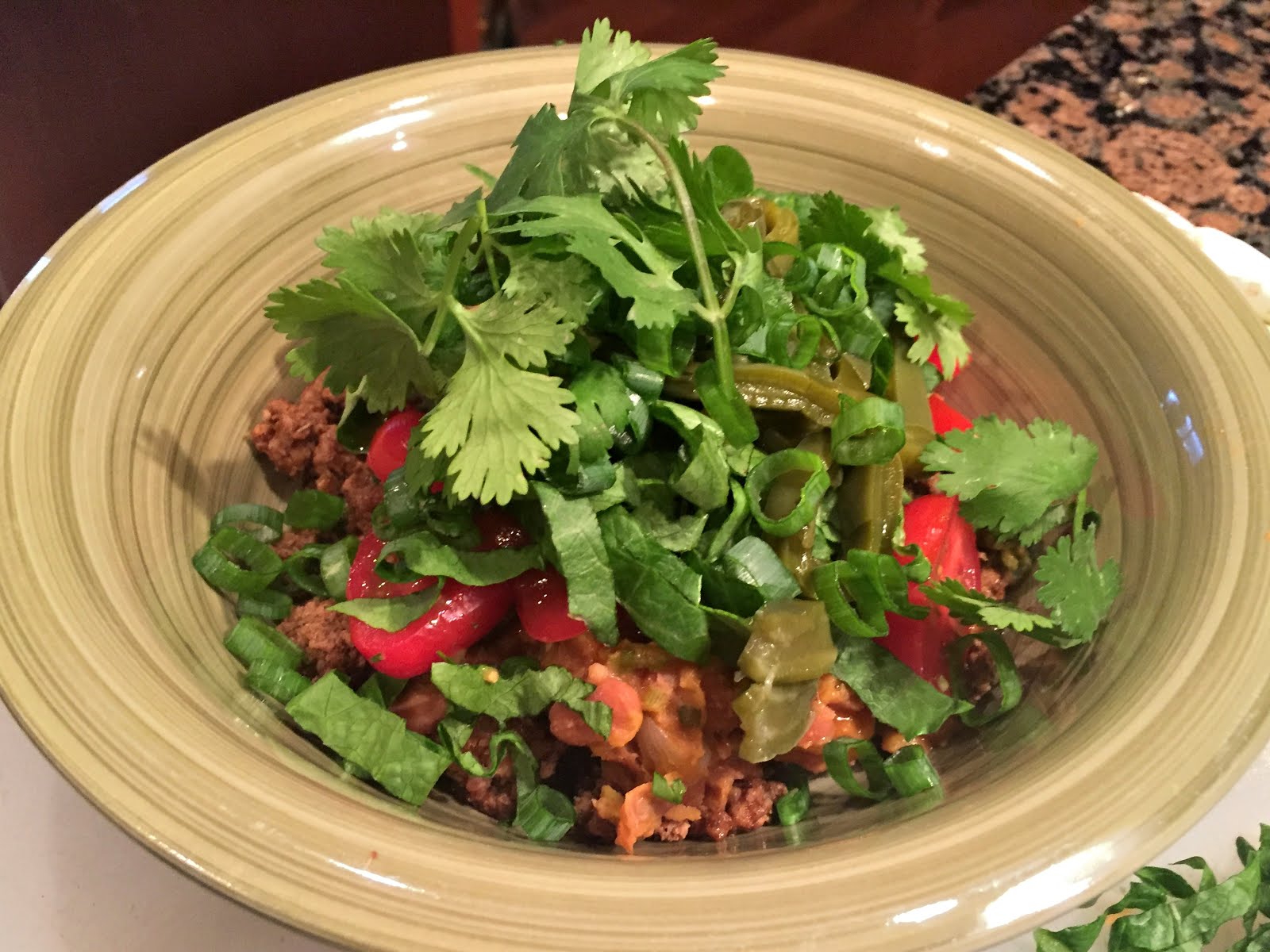
Delicious and Healthy, Too!
This cold wet weather is not helping the restaurant business one bit, but it is giving me more time at home with Ann, so that's something of a win, no? Last night was another in a long series of slow week nights and so I decided to go home and make dinner for us. It's no secret that Ann and I are slowly trying to work off all that winter weight we put on and so we are being a bit more selective in what we eat.

We haggled a bit on the phone over dinner, throwing out one idea after another. It all kept coming back to the thawed ground turkey in the fridge. It finally dawned on me that we could do a really healthy version of the horribly unhealthy seven-layer dip, yet put it in a bowl so that we could eat it without the usual tortilla chips.

The layers are up to you, but I avoided the cheese and sour cream in my bowl because of my lactose intolerance. Ann went for both from her stash in the fridge. This is not a quick or haphazard meal. Between vegetable prep and milling spices and adding cook time for the beans and the turkey, this was a solid 30 minutes of work, even for a very quick professional chef.

The bottom layer for both of us was ground turkey which I added to a sauté of onions, poblanos, and garlic and cooked until just done through. Then I seasoned with salt, cumin, ancho powder, oregano, and the barest hint of cinnamon. A spice mill really helps. Get one. Keep your spices and chile peppers fresh and rotated and mill them to order. It does make a difference.

For the beans, the second layer, I opted for something texturally between soup beans (frijoles de la olla) and refried beans (frijoles refritos). I started by draining a large can of cooked pintos: I love to rehydrate dry beans overnight, but that's not a possibility much of the time, especially on a day when I didn't anticipate being home for dinner. Canned beans aren't as economical or even as tasty as dried beans, but they sure are one of life's great convenience foods and there's no shame at all in using them.

In the bean pot, I started  a sauté of diced onion, diced poblano, minced garlic, and minced cilantro stems. Once this cooked down for a bit, in went the beans, about two ounces of the adobo off a can of chipotles, salt, and water to cover. I cooked the beans in parallel with the turkey. Once the turkey was done, I moved the beans to the high burner and brought them down rapidly. Towards the end, I smashed some beans against the side of the pot with my spoon and this thickened the sauce quite quickly. I finished them like refried beans, cooking them while stirring often, until the beans started to pull away from the side of the pot.

On top of the turkey and beans, I layered chipotle salsa, halved grape tomatoes, nopalitos, green onions, and topped the whole thing with cilantro. Cubes of avocado and fresh, raw sweet corn would be great in this, in season.

This dish has it all: extremely tasty, high protein, low fat, high fiber, and has only complex carbs in the beans. It's a winner even if you doctor it with a bit of cheese, sour cream, or both.


Monday, May 7, 2012

Seís de Mayo

This is the first posting of four on our recent party on Seís de Mayo.

I'm not one to celebrate made-up holidays like Cinco de Mayo, that mostly American creation fueled largely by the beer companies, but I don't need an excuse to have a party! Ann decided a few weeks back to have a small party on the 6th of May so she could show off her delicious quinoa salad and try out new recipes for tequila sangria and margarita cupcakes.

Pre-Game Huevos con Chorizo
After a week off from work, I hadn't really cooked anything in days, so I was ready to do a little work. I hit the kitchen at 8am and worked steadily until shower time at 2. Ann joined me around 10 and we prepped and talked and pre-gamed it a little bit. I just love it when the two of us are messing around in the kitchen! Define "messing around" however you see fit. ;) Many people would be daunted by this much work in the kitchen, but I love it and don't get to do enough of it at work.

With all the chorizo, peppers, and onions laying around, who can blame us for having a big plate of huevos con chorizo at noon with some beer chasers?

Pre-Game Beers
Here's the menu:

   Fried Asparagus with Cilantro-Pimentón Aïoli
   Oven-Baked Tortilla Chips
   Mango-Tomatillo Salsa
   Guacamole
   Quinoa Salad with Black Beans, Avocado, and Lime-Cumin Dressing
   Quesadillas with Chorizo, Bison Skirt Steak, Poblanos, and Onions
   Margarita Cupcakes
   Tequila Sangria
   Beer

Joining us for the festivities were Kelly and Marco Due plus Neil and Patty. Neil is home on a break from his tour in Iraq and I haven't seen him since he deployed last fall.


Kelly and Marco Due being entertained by....
The One and Only Ann!
It's Good to be Stateside, Beer in Hand!
Patty always tries to hide from the camera
Grayce trying to prove she is a lap dog
This post is huge, so I have broken it down into several smaller pieces. Three more to come.

Seís de Mayo: Quesadillas Etc.

This is the third post of four on our Seís de Mayo party.


Sangria

To warm everyone up when they arrived, I made two big pitchers of so-called sangria from Pinotage (a South African grape that is the scion of two French grapes, Pinot Noir and Cinsault). This is not really sangria so much as it is a berry wine punch, but I was under orders. ;) I mixed the wine with tequila and St. Germain and then added mixed berries, fresh pineapple, lemon slices, lime slices, and agave nectar.

Pinotage: Fruity and Inexpensive, Just Right for Sangria

Quinoa Salad with Black Beans, Avocados, and Lime-Cumin Vinaigrette

Ann makes a delicious salad of quinoa, black beans, red onions, avocados, tomatoes, garlic, cilantro and whatever else she feels like putting in it, all dressed with a simple vinaigrette flavored with lime juice and cumin. It's just a wonderful side dish (or even a great vegetarian summer main dish).

Quinoa Salad
Quesadillas with Chorizo, Bison Skirt Steak, Poblanos and Onions

Quesadillas are fun to make for a crowd, either on a grill or as I did it, in a pan on the stove. You can put just about anything you want in them, but I was in the mood for chorizo. The cheese we used was some generic pre-shredded white cheese from the grocery labeled "Queso para Pupusas," cheese for pupusas, that amazing Salvadoran stuffed tortilla. Any melting cheese will do.

And what better to go with sausage than peppers and onions? The five pounds of onions and peppers that I started with cooked down by at least half. I was planning for leftovers anyway, because how useful is it to have onions and peppers in the fridge?

We also had a tiny bit of bison skirt steak leftover, so I cooked that too.

Bison Skirt Steak, Nice and Rare
And I leave you with two parting shots.

I can feel your jealousy from here, dear reader.
Stay tuned for the final episode in which dessert gets made!

Ode to the Tortilla

I love tortillas. It wasn't always that way. I am a child of the early 1960s. Then, on the East Coast, our food was influenced by two th...