Showing posts with label Pacific cod. Show all posts

Saturday, December 5, 2020

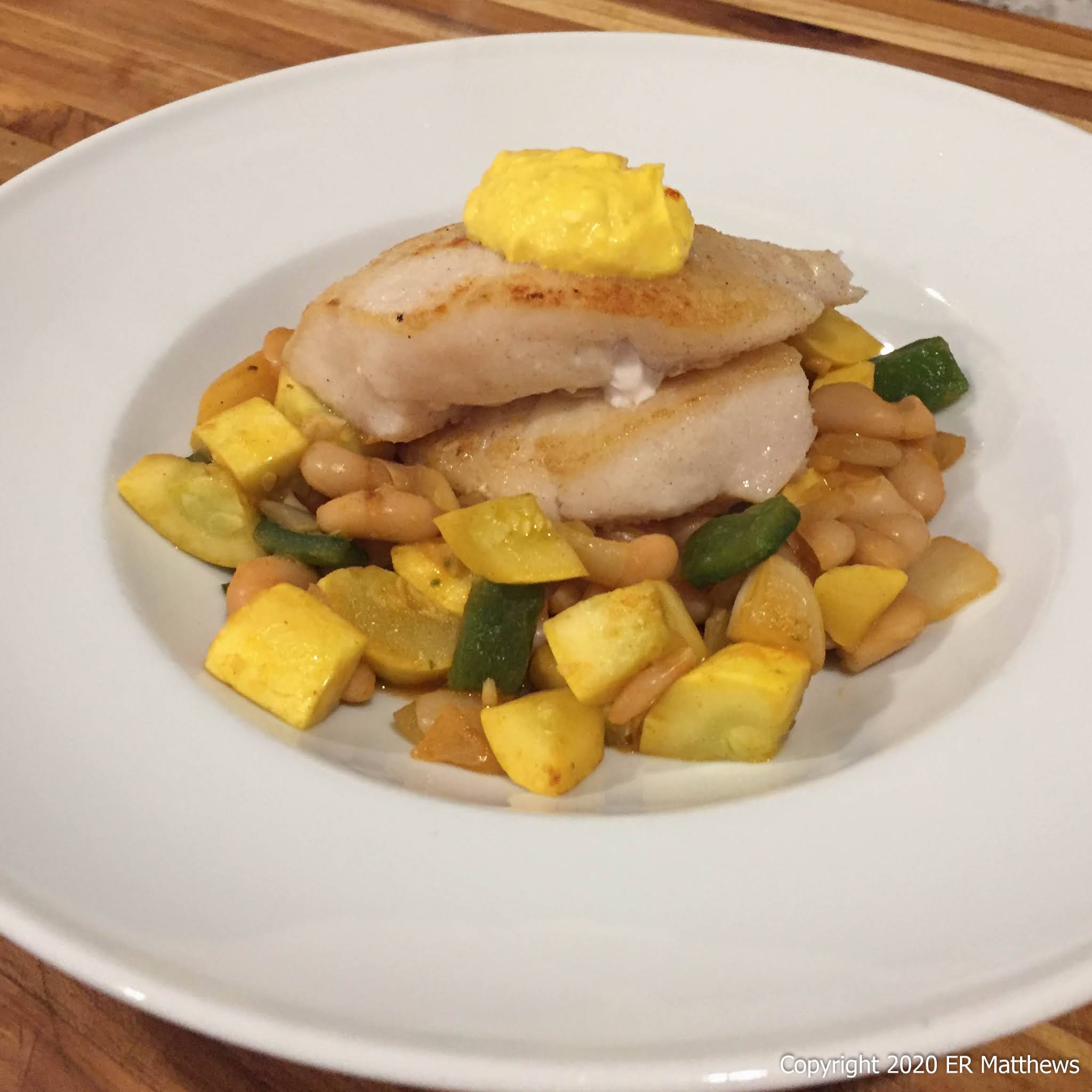
Pacific Cod with White Bean Sauté and Saffron Aioli

Every now and again, we need to have something just a touch bad in our diet and saffron aïoli fills that bill well. It's something that we used to serve with fish often at the restaurant, especially the baccalà cakes that we would make from cod that we salted ourselves. If you've ever seen the crap that passes for commercial baccalà in the US, you'd make your own too.

Pacific Cod with White Bean Sauté and Saffron Aïoli
We had bought a really nice looking piece of Pacific cod at the store and were looking for a quick dinner. I rummaged the refrigerator and found a poblano pepper and yellow summer squash, so I chopped those with an onion and some garlic and made a quick white bean sauté as base for the fish. The saffron aïoli is a garnish that blends well with both the fish and the white beans.

Garlic, Saffron, and Salt
When making aïoli, I always insist on using the mortar and pestle to achieve a very fine paste. It is impossible to use any other method to get the garlic so finely pounded, especially when making a tiny quantity of aïoli. In this case, I pounded half a clove of minced garlic, a few saffron threads, and a pinch of salt. The sharp edges of the salt crystals act as grist to help grind the garlic and saffron to a paste.

Be aware that garlic becomes extremely pungent when pounded to a paste. In other words, a little goes a long, long way. Take this friendly word of advice from a garlic fiend.

I have had this green granite mortar and pestle a very long time, since the early 1990s, before kids. I recall it being about $45 back then, imported directly from Thailand. A similar mortar will set you back about $90-100 now, but will last forever. Mine saw daily use in the restaurant for 15 years and except for one little flake off the edge, is as good as new. 

Granite is beastly heavy, but that is what you want in a mortar. You want it to sit still on the counter, not move around, and transmit the full force of the pestle strikes into the food being pounded. Notice that I sit mine on top of a towel to keep it stationary on the counters. In the restaurant, we would put it on a cutting board directly over one of the legs of a table or, more likely, sandwich unit so that the mortar would be well supported. If all the energy is going into a flexing table top, the mortar is going to be of little use.

Garlic-Saffron Paste
While traditional aïoli is made from egg yolks and olive oil, I long ago switched to using mayonnaise, for liability reasons. I did not want to make and serve a product based on raw eggs that was not going to be consumed immediately.

I added a tablespoon of mayo directly to the mortar, mixed everything well, and let the aïoli stand for an hour before serving. Saffron, in particular, takes time to color the mayonnaise. The saffron aïoli will look quite blond when you first make it, but will go the screaming brilliant saffron yellow that you see in the top photo given time.

I only made a tablespoon of aïoli because Ann and I are both fiends for it. We could eat it with a spoon! To avoid all temptation, I made just barely enough for dinner.

Wednesday, November 18, 2020

Soupe de Poisson

Soupe de poisson, bouillabaise, and cioppino are names for a class of tomato-based fish soups. In English, I call them generically fish stew, though they are clear broth-based soups rather than thicker stews. I love these soups, in part because I have great memories of eating them on the Mediterranean coast in the south of France. In fact, I love them so much that I put this dish on my opening night menu at my restaurant.

In recent months, I have turned Ann on to this soup and she is so taken with it that she has requested it once a week. That's a little too frequent for me, but soupe de poisson has been a regular staple at our dinner table since the weather turned cold.

This is not a soup for fine fish; this soup is a means to use the lesser types of fish and shellfish. Locally, we get rockfish or Pacific cod. For shellfish, this soup works well with either shrimp or mussels.

Soupe de Poisson with Pacific Cod: Fish Stew
I don't have a fixed recipe in that each batch varies with what I have on hand, as it does in houses all over the Western world. What you need are aromatics (leek, onion, garlic, celery, green pepper, red pepper, fennel), tomatoes, some good stock (fish or chicken), saffron, some herbs (basil, parsley), and a bit of spice (red pepper flakes).

Another Version with Shrimp

Soupe de Poisson


The following recipe is more idea than recipe in that each time I make this delicious fish stew, it differs. I have given quantities below which at our house feed the two of us quite well with a bit leftover for the next day. Though the recipe is highly flexible, I would say that its charm derives from saffron and if you don't have saffron, you don't have this soup.

I have bastardized this soup: in France, you typically will not find peppers in your fish soup. I love them and this is my soup, so in they go. Your clue that the soup in France might contain peppers is that it will be named after another place: à la brésilienne or à l'espagnole, for example.

1 yellow onion, diced
1 leek, diced
4-6 cloves garlic, minced
1 poblano pepper, diced
1 red frying pepper, diced
2 stalks of celery, diced
1 sprig of lovage
1 large pinch saffron
1 restrained pinch of red pepper flakes
1 to 2 teaspoons of dried basil
1 28-ounce can of diced tomatoes in juice
1-1/2 quarts/liters of fish (or chicken) stock
1 pound inexpensive white fish, cut in bite-sized pieces 

The basic approach is to prep all the vegetables and cut the fish into bite-sized pieces. Then cook the mirepoix in olive oil along with a heavy pinch of saffron, a slight pinch of red pepper flakes, and a teaspoon or more of dried basil. When the onions and/or leeks are translucent, add the tomatoes and stock and cook for 20 minutes or so to give the flavors time to come together.

When you're ready to serve, season the broth and bring to a boil. Add the fish and turn off the heat. Serve as soon as the fish is cooked through.

This is the recipe that I would make assuming that I had all ingredients on hand. I often do not have red frying peppers on hand, except in August and September. I would never make this soup with green bell peppers: I do not like their flavor the first time or the second time. I always have poblanos in my refrigerator. Leeks I love in this soup, but they are scarce during the summer months.

While celery is a must, I don't expect you to make this dish using lovage, but I am addicted to its haunting celery-esque flavor. Lovage (livèche for mes amis français) is uncommon everywhere and alas, I will have no more until spring.

More common in the south of France is some form of licorice flavor. If I had a fennel bulb, I would add it. If I had some pastis on my bar, I would add a shot to the soup. Alas, we ran out of pastis in making fabulous cocktails called Le Rendezvous from barman extraordinaire Alain in Grand Case, St. Martin.

I prefer dried basil in this soup to fresh, though in the summer, I will toss a sprig or two of fresh basil in with the lovage in addition to the dried basil. Sometimes, I add a bit of fresh Italian parsley to the soup at the end when I add the fish.

The stock is critical. The collagen in the stock from the bones you used in making it give it a great mouthfeel and body that will make your soup stand out. I have recently had a lot of freshly made chicken stock on hand and I have used that with great result. As our diet transitions away from meat and more towards seafood, I will end up buying some fish bones at the market with which to make my stock.

As for fish, the best soups have a mixture of so-called trash fish which is all well and good when you are at a restaurant with access to a lot of fish and are feeding a lot of people. At home, however, one species of fish will suffice.
Friday, June 26, 2020

Salsa Verde

Fair warning: although this post is ostensibly about salsa verde, it's really about putting a delicious and healthy dinner on the table quickly, with a minimum of effort.

Salsa Verde

Tomatillos are dirt cheap at the market right now, something like 88 cents a pound, so it's definitely time to take advantage of that. It pains me something awful to see people shelling out good money for bottled salsa verde when it is so easy to make something that it so much better in quality for very little effort.

Salsa verde is nothing more than tomatillos (generally called tomates in Spanish, with jitomates reserved for red actual tomatoes), serrano chiles, garlic, and onion, all roasted. After roasting, the vegetables are blended with fresh cilantro and lime juice to taste. 

Tomatillos, Serranos, Garlic, and Onion Ready to Roast

You'll notice in the photo above that I have not peeled the garlic, just sliced it in half. After it roasts, I just squeeze the roasted garlic out of the husks and pitch the husks. Much easier than peeling garlic before cooking.

I used a kilo (2 pounds) of tomatillos, six serranos, a head of garlic, and an onion. Then I finished it in the food processor with the leaves from a bunch of cilantro, the juice of a lime, and salt. Because I wanted this batch of salsa very thick, my yield was about a pint, two cups. I could have thinned it with water.

If the salsa is to be served and eaten right away, it can be served just like this. If you want to keep the salsa in the refrigerator, it is best to cook it in a frying pan for a few minutes with water as necessary to thin as you see fit. You can see that my salsa is vibrant green and thick: I made it to be eaten right away. The raw cilantro in it will rot if you try to store it for any length of time without cooking it.

I make and keep several salsas in the refrigerator to make it dead simple to have tacos for dinner with no fuss. I freaking love tacos. So that everyone can assemble custom tacos, I put all the toppings together and let them roll their own.

Taco Toppings: Tomatoes, Cilantro, Cotija, Nopalitos, Romaine, Salsa Verde

For our tacos the other evening, I seared a piece of Pacific Cod rubbed in cumin, garlic, and Mexican oregano (very different than Greek oregano). 

Pacific Cod Tacos de Pescado


Ode to the Tortilla

I love tortillas. It wasn't always that way. I am a child of the early 1960s. Then, on the East Coast, our food was influenced by two th...