Showing posts with label arugula. Show all posts

Sunday, November 17, 2024

Loubia with Lamb Kefta

Andreas and Michelle went to Iceland just before we went to Italy so we haven't seen them in a hot minute. Our schedules finally allowed us to get together to see their absolutely stunning pictures. Iceland is very near the top of our list of places to visit in the next couple of years. I can hardly wait.

Loubia with Lamb Kefta
Andreas likes to cook and likes to pick my brain to learn new things. This time, he wanted to learn about spicing and I believe he mentioned Moroccan food specifically. At the same time, Ann seemed fixated on lamb and white beans, so I decided to do a bean stew common to the Maghreb, a dish called various things in various locales.

Loubia is a stew of white beans that I have encountered often. I know it in French as tagine d'haricots blancs or cassoulet algérienne. I also know that Andreas loves my cassoulet. And I also know that because it requires hours in the oven, it is not a dish that I can show him how to make right before dinner.

So what to do?

I decided keep on with the slow-cooked beans, but show him how to make two condiments for the beans, a red sauce and a green sauce. The red sauce was my version of harissa (red chiles, cumin, coriander, fennel, caraway, cinnamon, salt, garlic, lemon juice, and olive oil). The green sauce was my version of chermoula, an analog of chimichurri (parsley, cilantro, lemon zest, coriander, fennel, salt, garlic, lemon juice, olive oil). Chermoula is a typical condiment for fish, but I love it with meat in the same way that I love gremolata, salsa verde, or chimichurri with meat.

Long-cooked and mild dishes such as this loubia can often benefit from a zesty, acidic sauce to help wake up the taste buds. Also helpful is a bright green salad with an acidic dressing, such as the one I made from arugula, julienne of apple and fennel, and a tangy vinaigrette made with Sherry vinegar.

Lamb Kefta in the Classic Shape

First thing in the morning, I put my beans that had soaked overnight in lightly salted water on to par-cook for 90 minutes. I used my old stand-by beans, Steuben Yellow Eye beans from Rancho Gordo. Into the pot, I tossed a large sprig each of rosemary, sage, and thyme which would subtly flavor the beans.

Meanwhile, I got busy making the kefta (kofta, kafta, kufta: your choice). Because I was going to serve the beans and kefta with two assertive sauces, I did not highly season the lamb as I often do. The seasonings are a lot of garlic, a decent bit of a mild paprika, some salt, and a bit of coriander, cumin, and dried chile flakes. All the seasonings I mixed into a slurry with a couple of eggs and some white wine (definitely a no-no in the Arab world; substitute any stock or cream). Then I added a couple pounds of ground lamb and a half a cup of rolled oats.

I typically do add some type of starch to my meatballs and meatloaf to loosen the texture of the cooked product so that it is not super dense. I have used panko, panade (bread soaked in cream), cooked rice, and raw rolled oats all to success. Because I always have them on hand, I use rolled oats most frequently, a bonus if you have guests who are gluten-free.

After mixing the forcemeat (with the best tool of all, my hands), I put it in the refrigerator to settle and so that the oats could start to absorb the liquid and bind the mixture. When the beans were just about at the end of their 90-minute par-cook, I shaped the kefta, diced a leek and a large carrot, and minced half a bulb of garlic.

Then it was standard cassoulet procedure from there: brown the meat (the kefta), cook the aromatic vegetables in the same pan scraping up all the brown bits (the fond) from the bottom of the pan, drain the beans and save the cooking liquid for soup, mix the vegetables with the drained beans and season, put a layer of beans in the cocotte, add the meats, top with the remaining beans, fill with a deeply-flavored meat stock to just cover the beans, and finally bake in a slow oven, replenishing the stock as necessary and punching down the crust every hour or so.

While I Cooked, Ann Set the Table and Chose Utensils and Plates
I wanted to have something to snack on while the girls chatted and Andreas and I made the harissa and chermoula. I decided on a baked feta to take advantage of the oven since it would be going anyway in finishing the loubia. This couldn't be easier to make by whipping up a roasted red pepper sauce in the blender and layering it under and over slices of feta.

The roasted red pepper sauce is a pint jar of roasted red peppers, a couple tablespoons of my homemade harissa, a couple tablespoons of the intense umami-bomb estratto di pomodoro (Sicilian tomato paste), a couple cloves of garlic (minced), and a touch of salt. Ten seconds of whirring in the blender and it's done.

I also cut up some olives (Castelvetrano) and toasted some pine nuts for garnish. I stole a bit of parsley from the bunch that I picked for chermoula as an additional garnish.

Baked Feta in Roasted Red Pepper Sauce
Olives, Pine Nuts, and Parsley for Garnish
A Couple of Italian Girls

Loubia with Lamb Kefta
Loubia is Generally Saucier; I Made This Just Like Cassoulet
Arugula Salad with Apples, Fennel, and Sherry Vinaigrette
Loubia with Harissa and Chermoula

Sunday, October 27, 2024

Goodbye Rob and Dyce

While we were in Italy for three weeks, Rob and Dyce decided, quite suddenly as it appeared to Ann and me from the outside, to pack up their belongings and move to Boulder. They told us about a week after we returned from Italy that they would be gone within days, by the end of October. Talk about dropping a bomb!

A Farewell Cassoulet
As sad as I feel about their leaving, I'm a big believer that everyone has to find happiness where happiness can be found. And so, if Bend is not the right place for Rob and Dyce, they should go and find the right place. We wish them all the best in Boulder; it is a great town. When I was a young man, I spent a fair amount of time camped out at the Hotel Boulderado while calling on customers at the IBM locations in and near Boulder and at HP just up I-25 in Fort Collins.

After they shell-shocked us over dinner at their house, a house that was in the process of being dismantled, we all wanted to get together one final time to celebrate. Rather than celebrate at a restaurant, Ann and I preferred to have them to dinner at our house, where we could be assured of a great meal, restaurant quality in Bend being somewhat suspect. We set a date for the final Saturday night that they would be in Bend.

Later on at home, I asked Ann to ask Dyce what they would really like for dinner. Almost immediately came a response that I would have never expected: cassoulet. Of all the dishes in the world, it was going to be cassoulet. Dyce asked if it would be possible. With only three days left before our planned dinner, the answer was yes, but just barely. I did have a pound of really great beans on hand (Steuben Yellow Eye beans rather than Tarbais, different but equally good) and I could just get the cassoulet made in 72 hours. Cassoulet is only as good as the stock you cook it in and great stock takes a long time to make. For me, it's a three-day process and if I started right away, I had three days to make it.

Having done all the shopping and prep on Thursday and Friday, on Saturday morning, I started the cassoulet cooking. By the time they had arrived at 6:30, I had punched the crust down 9 times. Each time you punch the crust into the broth, it enriches and thickens the broth. Traditional lore in France says you must punch the crust into the broth a minimum of 7 times.

What to drink with dinner? Naturally, we are all huge white Burgundy fans and so I met the guys at the front door with a glass of Bouchard Beaune du Château. While it is all well and good to start with a white, a long-cooked cassoulet demands red. But which?

White Burgundy to Start
Those who drink wine at our house know that we have one wine cooler that we designate the do-not-touch cooler. This is the cooler in which we have all our great wines as well as some that will be great after laying down for a long time. If there were ever an occasion to scrounge in this cooler for a wine for dinner, this would be the time. And so, I pulled out a bottle of 1995 Côte-Rôtie the day before and let it stand upright overnight to settle out any solids. Then I gently decanted it about an hour before they arrived.

Gangloff Côte-Rôtie 1995: Brilliant
It is always a crapshoot when opening an older bottle of wine, but it helps to have held the wine in your cooler since it was released as I have this wine. The fill level was great and the cork could have been new, not 30 years old. Thankfully, there was no whiff of cork taint at all. I cannot count the number of times I have opened old bottles just to have to pour them out. This wine was beautiful, with great color, bright acidity, gentle tannins, and aromas and flavors of leather, smoke, and dark fruit. This bottle was brilliant and everything you want a great wine to be. We sipped it with reverence.

I was so off my game that I forgot to take any people pictures and I just barely snapped any at all.


With a heavy meal like cassoulet, I decided not to do any appetizers. None of the four of us is a huge eater. I made a simple salad of arugula and julienned fennel and apples that I dressed with a vinaigrette made with an acidic sherry vinegar. With a heavy dish like cassoulet, you want some bright acidity to counterbalance the long-cooked beans and high fat meats.

Arugula, Fennel, Apple, Sherry Vinaigrette
Cassoulet and Salad
This post is about saying goodbye to friends; there are plenty of others that address how to make a cassoulet. Here's one that discusses a similar cassoulet.

And so here's to Rob and Dyce! It's been great having you as neighbors here in Bend and we wish you all the best on your new adventure in Boulder. We'll see you this summer!

Monday, July 29, 2024

José Restaurant, Dallas

We considered several options to get to San Angelo TX to visit with Carter for his 25th birthday. The most efficient proved to be to fly to Dallas, rent a car, and drive the four hours to San Angelo. With a return flight to Oregon at 10am on Monday morning, we decided that we would return to Dallas on Sunday evening and camp out at a hotel near the airport, especially given the inefficiency of the rental car system at DFW.

This schedule left us with the opportunity to have a nice dinner in Dallas on Sunday night, a night when many restaurants are not open. Of all the places we could have gone, we chose José near Love Field in north Dallas, an easy drive from our hotel near DFW. José is known for its elevated Guadalajaran-inflected food and drink, a celebrated female chef in AQ Pittman, its use of house-made masa from corn brought in from Mexico, and a segment on "Taco Chronicles," the Netflix show that you do not dare watch if you are remotely hungry or trying to lose weight.

The Very Handsome Floor-to-Ceiling Back Bar at José
As a chef, when I go to a restaurant, I just want the kitchen team at that restaurant to show me what they do well. The restaurant knows far better than I do what they do well. So, why should I order off the menu if I have the option to let my hosts decide? It's a rare restaurant that will roll with a request to just order for Ann and me (there are some technical POS issues, but that's more a cop out than anything), so when I e-mailed asking if they would just order for us, I was pleasantly surprised to get an affirmative response from GM Victor Rojas within a short while.

Just as we were seated, a runner dropped off a basket of totopos and a couple of salsas, one red and one green. The green salsa was one of the standouts of the night. It was almost identical to the usual salsa verde I make at home, except that it was smoother and less rustic. I really enjoyed it. It's the small things for me that make an experience.

Within a couple of minutes of our being seated, Victor appeared at our table bearing amuses and introduced himself. He would take great care of us personally for most of the evening and we greatly enjoyed chatting with him.

Blue Corn Sopecito with Blue Crab Salad
While we were munching on the tiny sopes and contemplating the cocktail menu, I had a chance to look around the spacious dining room of the building that was once a dry cleaner. The industrial steel clear span framing gives a large open interior and high ceilings that leave room for an immense custom floor-to-ceiling back bar that is the focal point of the room.

Back to the table, the star of the sopecitos was not the crab, but the blue corn masa from which they were made. One of the primary reasons we selected this restaurant is because they nixtamalize their own corn and grind their own masa. Nixtamalization is the process of soaking dried corn kernels in a basic solution that dissolves the hard outer shell, the pericarp, of the kernel.

It is a process that my great grandmothers would have used to make the hominy (posole) so prevalent to the Scots-Irish Appalachians. When I was a boy, I would often see ash hoppers at country auctions. People would fill these hoppers with ashes from the fireplace and the rainwater would filter through the hopper and drain into a bucket below. The solution in the bucket would be lye, potassium hydroxide. Today, rather than using lye, we use refined hydrated lime (calcium hydroxide) called cal to nixtamalize corn.

Victor helped us choose cocktails. I had a riff on a Manhattan called the The José Way Manhattan, a dark complex mixture of mezcal, amaro, Banane du Brésil, vanilla, and Angostura bitters. Ann had a smoked tequila Old Fashioned of reposado, agave, and a couple of bitters. We really enjoyed our cocktails; they are similar to what we are making currently at our home bar where Ann's Oaxacan Old Fashioned will hang with anybody's.

Ann and Her Smoked Tequila Old Fashioned
The José Way Manhattan
Victor also brought us small glasses of the house mezcal and said that he had gone to Mexico to help make it. After smelling its unusual fruity nose similar to an eau de vie or schnapps, I asked how it was made. It is a pechuga of 100% espadín piñas. The pechuga used in the redistillation came from things that he sourced at the market: apples, guavas, and chile chilhaucle. I have had pechugas flavored with all sorts of things, but this was the most unique mezcal that I have ever tasted, a smooth and highly refined spirit that I enjoyed.

Arugula with Peaches, Fresnos, Grilled Okra, and Goat Cheese
Next up was an arugula salad course, the standout of the meal for me. The salad was plated on a spread of goat cheese from fairly local (Waco) Pachi Pachi Farms. The best parts were the fresh salad ingredients: sliced peaches, sliced mildly spicy Fresnos, and the revelatory ingredient, sliced grilled okra. I also loved the crunch of the toasted quinoa sprinkled on the salad.

As a southerner, I have grown, harvested, and cooked okra all my life. Even though I have cooked it myriad ways, I never thought to grill it gently. The smokiness from the grill enhances the small tender okra without activating any of its slime. In the highest form of chef flattery, I may rip this off, if I can ever find some tender baby okra out here in Oregon where it is essentially non-existent. 

Champagne Telmont
Our cocktails were done after the salad, so wanting a wine that would be able to stand up to anything that might come next, we went the sparkling route, ordering a bottle of Champagne Telmont. A label that we have not had before, it was a fine all-purpose wine with lots of red fruit dominating the nose, the palate balanced by a healthy addition of Chardonnay.

Dobladas de Pollo Enmoladas
Our first course with the Champagne was a plate of dobladas covered in mole. I detected chicken thigh meat, poblanos, and a white melting cheese inside the fresh tortillas and the top had a good sprinkle of queso fresco. To be honest, I wasn't expecting mole in a self-styled Jaliscan/Guadalajaran restaurant, but I have never met a mole I did not like.

Victor referred to the mole as "aged mole," meaning that each new batch contains some of the previous batch, old school, the way it has always been and should be done. He regaled us with the story of the line cook who thought to put the final batch of mole before COVID into the freezer to be used as a starter on the far side of the pandemic. Good looking out!

The mole on these dobladas was a fairly dark, fruity, complex sauce that in my world I would call a mole poblano. As much as I loved this mole, I cannot help but wonder how this combination of chicken, poblanos, and cheese would respond to a mole verde or pipián.

The star of this dish was neither the mole nor the filling. To quote Ann, “that tortilla though!” She would have been content with a stack of those tortillas and a ramekin of that excellent salsa verde. As would I.

Carne Asada, "Patatas Bravas," Salsa Roja
The Carne was an Excuse to Snack Fresh Tortillas!
We would get more awesome tortillas with our next dish, a cast iron dish of carne asada, onions, and peppers, served with whole roasted potatoes tossed in spice ("patatas bravas"), and a beautiful salsa roja. The eye opener from this dish was the salsa roja, an intense concentrated tomato sauce. The sauce was enhanced with smoky chile morita. The texture of the sauce and the smokiness reminded me in the best way of a beautiful roasted eggplant sauce.

Again, while the meat was awesome (sous vide tenderloin, I think), the tortillas and the salsa roja stole the thunder. Ann and I asked for more tortillas with which we polished off all that delicious sauce.

Coconut Flan with Candied Amaranth and Pepita Topping
Neither Ann nor I are dessert eaters because sweet flavors are not really our thing. Flan is so often cloying and pedestrian, but not so in this case. The pastry chef had a deft hand with the sugar and the addition of coconut milk made this flan much more interesting than usual. 

After dinner, Victor brought us little glasses of dark, barely sweet Fernet-Vallet as a digestif, a nice parting gesture. We thanked him profusely for his hospitality, the willingness to order for us, the excellent staff training, and of course, a delicious meal for which I would like to thank all the BoH team, especially the prep cooks and dishwashers who never get any credit, but without whom, nothing would happen.

The stand-out components of our meal were none of the star players. The glory goes to the supporting actors: the masa, the grilled okra, the salsa verde, and the salsa roja.

I compliment Victor, a consummate hospitality professional, and the service team on their attentiveness. I always love going to a restaurant where the entire service team takes responsibility for all guests, not the usual "not my table, not my problem" attitude. The FoH staff at José are well trained. Not a lot of guests would notice this, but then, I'm not an average guest, having owned, cooked at, and run a fine dining restaurant for a very long time.

Friday, July 5, 2024

Fourth of July 2024

Our annual Fourth of July to-do was really just an excuse this year to fire up the pizza oven and continue to perfect my recipe and techniques. I think we're getting close. Ann had invited Rob and Dyce to come over for pizza and as luck would have it, Dyce's parents are back stateside from their home in Tuscany. We are going to visit with them in September and haven't seen them since they came to a Christmas dinner at our house couple years back, a dinner of gnocchi and pork ragù.

Pesto Pizza Topped with Arugula and Mortadella
Despite the high temperature for the day in the low 90s, it was pleasant enough for us to sit out in the courtyard of our house, situated on the cooler east side. I didn't think it was going to happen, but we were cool enough until I fired up the pizza oven, that fire-breathing dragon pointed right in my direction.

Rob, Dyce, and Queen Ann
Neil and Lynne
The Queen and Her Rosé
Patty Green Helen Duschee Tempranillo Rosé
Our Go-To Patio Wine for 2024
To go with our rosé, red wine never being a thought this time of year, I put together a small antipasto board of tomatoes, pesto-marinated bocconcini, giardiniera, olives, Calabrese salame, finocchiona, rosemary crackers, and two spectacular washed rind cheeses, one from Vermont, the other from Switzerland. From Jasper Hill Farm in Vermont, we got a whole Willoughby, a small washed rind cow's milk cheese that has a soft buttery paste. From Switzerland, we got a piece of Aarewasser (literally Aare water) raw milk washed rind cheese that was phenomenal.

Antipasto Board
For pizzas, I set up to do a couple of different base pies and then provided extra toppings for people to add to their slices after the pies came out of the oven. For the pie bases, I had some fresh mozzarella, 'nduja, olive oil, pesto, and a can of San Marzano tomatoes. For additional toppings, we had arugula which Ann and I dearly love on pizza, fresh basil, extra pepperoncini, a block of pecorino romano, several slices of really fine mortadella, and a batch of honey with crushed Calabrian chili for those of us who like a bit of spice with our pizza.

My favorite pie was probably 'nduja and mozzarella topped with arugula and drizzled with Calabrian chili-honey.

Toppings: Arugula, Basil, Pepperoncini, Pecorino,
Mortadella, and Calabrian Chili Honey
First Pie: Margherita, the Classic
Hand-Crushed San Marzanos and Fresh Mozz
Torn Basil and a Drizzle of Olive Oil After Cooking
Pesto with Black Olives and Pepperoncini
After pizzas, we finished with an espresso sorbet that I made from espresso, sugar, salt, and a touch of vodka to help minimize crystallization. It was far too dark when I served it to take photos.

As I mentioned earlier, I think we are narrowing in on the ideal pizza recipe. This batch of dough, I made with King Arthur all-purpose flour, the retail equivalent of the Sir Gallahad flour we used to use at the restaurant, instead of Caputo 00. I like the flavor of this dough better than the more traditional Neapolitan dough made with the stronger Caputo 00. King Arthur AP has 11.7% protein versus 13.5% in Caputo's 00. Given that at retail here in the middle of nowhere Oregon I can only find King Arthur, I'm going to stick with it.

This batch was 65% hydration, 3% salt, and 2% yeast. Pizza recipes, like many doughs, are expressed as baker's formulas. So when I say 65% hydration, the water would weigh 65% of the amount that the flour weighs. So if I were starting with 1000 grams of flour, I would add 650 grams of water (and 30 grams of salt and 20 grams of yeast).

Given that I wanted to make a batch of eight 250-gram dough balls (a total of two  kilograms), using my baker's formula, simple algebra told me how much flour, water, salt, and yeast would yield two kilos of dough. And by the way, bakers and pastry chefs use metric amounts almost exclusively and they weigh everything. The math is way simpler when compared to using arbitrary English amounts and there is no mixing of volumetric amounts such as cups of flour and weights such as a half an ounce of salt.

Over the last series of experiments, we determined that we like 65% hydration versus the easier-to-handle 60%. 65% water to 100% flour is about as wet a dough as I feel comfortable handling right now, but I also think that the results are fantastic, so I am not sure that I will try to push the hydration further.

Another factor is the length of proofing, that is, the time that the yeast takes to cause the dough to rise. To a point, the longer the yeast works, the more flavor it gives the dough. We know empirically from previous tests that we like a dough that has taken 24-48 hours to sit and come together. I started this dough at 3pm on July 3, let it have its first rise on the counter over about three hours, and then balled it and refrigerated it overnight. I removed it from the refrigerator at 3pm the next day, and let it rise unrefrigerated until I fired the first pie at about 7:30pm.

Also critical is managing the heat of the pizza oven. Heretofore, I had cooked pies on max blast and at 7/8 max blast. Neither was really optimal, cooking the top way faster than the bottom and leaving the interior of the crust just slightly undercooked. I'm picking nits here, trying to make professional quality pizzas, not merely good enough pizzas.

This time, I tried a different technique. While I heated the stone in the oven on max blast, when I went to fire a pie, I turned the flame all the way down. This increased the cook time by at least half, from 60 seconds to about 90 seconds. This yielded a much more cooked bottom crust and a fully cooked interior.

I thought the next to last pie had too cooked a bottom (I was the only one who thought this) so the final pie, I turned the flame back to a quarter rather than all the way down. Consensus was that this pie was undercooked. So all the way down in the future it is.

Monday, June 24, 2024

Roasted Beet and Turnip Salad

It's now getting on to good weather and I'm out walking and hiking as much as I can these days. That's not leaving me a lot of energy for cooking, creating new dishes, or even time to write about them. Here's a departure from all my recent wildflower posts.

After a visit to an early farmers market and coming away with early season ingredients including arugula, beets, and pretty little white Hakurei turnips, I decided to make a salad. 

Roasted Beet and Turnip Salad
with Arugula, Goat Cheese, Croutons, and Spiced Hazelnuts
The very best way I know to treat beets for salads (if you're going to cook them at all) is to roast them. I wrap them in a single layer in an aluminum foil packet and place them in a moderate oven until I can pierce them easily. For these smallish beets at 350F, that was about 45 minutes in the oven. The smaller turnips I treated the same way, but only roasted them for about 20 minutes. I just wanted to soften them and not cook them quite all the way through.

For the salad, I peeled and chopped the beets, quartered the tiny turnips, made some croutons quickly in a skillet on the range, and then toasted whole hazelnuts in olive oil in that same pan before tossing them with a little of my pork spice rub. Everything went into a salad bowl with a bunch of arugula and some crumbled goat cheese. After drizzling the salad with a little extra virgin olive oil, a bit of really good balsamic vinegar, and a sprinkle of salt, I tossed the whole thing and Ann and I set about feasting.

I was really pleased with the addition of the beets to this salad. Their pepperiness complemented the arugula and contrasted pleasantly with the beets.

Friday, March 1, 2024

February Celebration: The Luckiest Beans on Earth

Let's Celebrate!

Mid-February has become a time to celebrate at our house. Valentine's Day, my birthday, and our anniversary of having moved to Bend, this year our second so-called Bendiversary, all fall within a week of each other. Accordingly, we aim to have a small party each February to mark these events. What better to do in this bitter cold season than have a party?

Another February Cassoulet in the Books
For this year's celebration, Ann asked me to make a cassoulet. If you have never had cassoulet, it is a bean and meat stew with four components: beans, meat, stock, and a mixture of diced aromatic vegetables called mirepoix. If you look back to all my cassoulet posts, I tend to make them in February at the worst of the cold season for good reason. Cassoulet is arguably the greatest cold weather comfort food in the world. Thank you France for this wonderful celebratory concoction!

Prepping for Cassoulet

For the cassoulet that I would serve on Saturday night, I started the prep work early Friday morning, right after shoveling the overnight accumulation of snow, a pretty typical chore on a February morning. The day-before prep for cassoulet is pretty limited: soaking the beans overnight and making some delicious pork stock in which to cook the beans.

The first step in making stock is to roast your bones. For pork stock, I use pork neck bones that are both inexpensive and contain delicious meat. I am guessing that if they are readily available here in Central Oregon, you can find them just about anywhere. The trick with roasting bones is time. Put them on a lightly oiled sheet tray in the oven and roast them until they are golden brown on all sides, turning them as necessary. It's not a process that you can or should rush. Cassoulet is only as good as the stock that you cook the beans in.

Having turned the roasting pork neck bones on the sheet tray and put them back in the oven to continue browning and getting sexier and sexier, I was standing at my cutting board, my nose reveling in the porky goodness of the aroma emanating from the direction of the oven. I remarked to Ann, ensconced on the sofa by the fire and nose down in her phone, "How do think these beans are going to feel, being slowly cooked in all that porky goodness?" And she replied, "They're going to be the luckiest beans on earth!"

While the bones were roasting, I did some pre-prep on the vegetables for the mirepoix: onions, carrots, leeks, and celery. While I would dice the mirepoix vegetables on Saturday morning, I wanted the vegetable scraps today for flavoring the stock. To that end, I peeled the onion, trimmed the ends of the carrots, peeled off the tough outer leek leaves, and trimmed the leafy ends of the celery. Be sure to wash the leek leaves well; they can accumulate a lot of dirt, or worse, sand.

After the pork neck bones browned, I put them in a stock pot with all the peels, ends, and scraps of the mirepoix vegetables. Filled with water, the stock pot simmered gently for several hours before I separated the solids from the stock. The stock went into the refrigerator to congeal so that I could remove the fat from the top. After the solids cooled, I picked all the neck meat from the bones to put into the cassoulet on Saturday.

Last thing before going to bed Friday night, I put two pounds of beans in a bowl and covered them with a lot of salted water to soak overnight. I had been wrestling with the choice of beans for a few weeks. Two weeks prior, I put an order in to Rancho Gordo for a big box of beans including my two potential candidates for the cassoulet: Tarbais and Steuben Yellow Eye beans.

I have made many cassoulets in my life, about half with the traditional bean from from the Tarbes area in the far southwest of France up against the Pyrenees, the Tarbais bean; and about half with a traditional American bean called the Steuben Yellow Eye, purported to be the original bean in Boston baked beans. Heretofore, I have always slightly preferred the yellow-eyed beans.

Both beans are loved because while holding their shape, they become ultra creamy inside, exactly what you want for cassoulet, which is nothing if not a super peasant dish of pork and beans. After waffling for days on the choice, I decided to go with the original beans, the Tarbais. I was not disappointed; the resulting cassoulet could not have been better. And I still have Steubens to craft into some other delicacy!

Cassoulet Assembly


Would Anyone Manage to Get Here for Dinner?
Overnight Friday into Saturday morning saw a considerable amount of additional new snow and the forecast had it snowing all day. Both of the couples we invited live up big hills that the snow could make impassable, so during the day on Saturday we weren't sure if our party would come off or if we would be eating cassoulet by ourselves. Regardless of the weather, cassoulet is pretty much of an all-day affair and I needed to get started on it. After shoveling snow again, naturally.

The first item of business was to get the beans par-cooking. I drained them and placed them in a stock pot with fresh water and a bouquet garni of fresh rosemary, fresh thyme, and fresh sage. These herbs would impart a slight flavor to the beans while making the kitchen smell amazing for the 90 minutes in which the beans par-cooked.

In my past restaurant days, we had all kinds of meat garnishes for the cassoulet, especially after we butchered one of the hogs that we had a local farmer raise for us. In addition to pig's feet for the stock, we had a lot of trimmings from which I would make traditional garlic sausages. And we would cure, roast, and confit the hog bellies which aged under their bath of congealed duck fat in the walk-in next to vast containers of confited Moulard duck legs. In short, our walk-in contained every kind of meat garnish a cassoulet cook could want.

But now post-restaurant at home in a fairly small city a half a day's drive from anywhere, meats are limited to what I can get at the grocery store, especially because the farmers markets are inoperative at the height of winter; you know, snow and all. Having little alternative, I just decided to go with what I could scrounge at the store. I ended up buying a large tray of chicken thighs and a small tray of breakfast sausage links to use along with all the neck meat that I picked from the stock bones.

While the beans were par-cooking, I browned the chicken and sausages in fat I had saved in the refrigerator from my last couple of batches of chicken confit. And while the meats were browning, I diced all the vegetables I pre-prepped yesterday into mirepoix. This finely diced mix of carrots, onions, leeks, and celery, I cooked in the same pan in which I browned the meats, scraping hard to get all the brown meat bits into the vegetables.

While the mirepoix was cooking, I minced and added an entire head of garlic to give a nice garlicky background note to the cassoulet. The reason for so much garlic is because I would typically have made the dish with a garlic sausage instead of the mild breakfast sausage that I used for this cassoulet.

Once the beans were par-cooked, tender but still a bit crunchy, I drained and mixed them with the mirepoix and then seasoned them to taste with salt. No longer working in the restaurant, I do not have a pan big enough to accommodate this amount of beans and meat, so I decided to use two pans. I put a quarter of the beans in each of the two pans and topped them with 4-5 bay leaves each. Then I split the pork neck meat, chicken thighs, and sausages between the two pans and covered them with the remaining beans.

At this point, I should mention the one cheffy thing about this cassoulet. From time to time, I make chicken confit, that is, chicken cured overnight in a salt and herb mix, then rinsed and slowly poached while submerged under olive oil. Then this chicken gets refrigerated submerged under the fat, which congeals and protects it from spoilage.

After the chicken is all consumed, I melt the remaining fat and pour it into a container to keep in the refrigerator where the fat congeals on top of any juices from the chicken. I reuse the fat for the next batch of confit, but the intensely flavored juices go into a soup or stew. For this cassoulet, I browned the meats and cooked the mirepoix in some of this confit fat and I added the congealed juices (a half cup) to the cassoulet along with the pork neck stock.

After removing the layer of fat from the stock that I made on Friday, I warmed it briefly to liquefy it. Into each casserole, I poured enough stock to cover the beans by a good centimeter and put them in a slow (300F) oven to start the process of becoming insanely good. I checked the beans periodically to make sure they had enough liquid. Each time a crust would form on top of the beans, I would mash it back down into the stock, topping off the stock if necessary.

This process of crusting and breaking the crust and re-crusting over hours is essential to cassoulet. I want to say that the beans cooked slowly for about seven hours and I probably broke the crust four to five times during my forays from the fireside into the kitchen.

While this is a good description of the process of making a cassoulet, a more exact recipe follows just below.

Cassoulet in the Oven
Essential to Let it Crust and Re-crust over Several Hours
Cassoulet Cooling after Seven Hours in Oven

February Cassoulet Recipe


This is a cassoulet, beans aside, that you can make from stock items at the grocery store. In fact, despite the lack of duck confit and other great ingredients, the is the single best cassoulet I have ever made. In other words, don't let lack of ingredients deter you from making a cassoulet. As for the beans, great beans are easily available via mail-order from Rancho Gordo (note that they call them Cassoulet Beans, rather than the Tarbais beans that they are).

This recipe is based on two pounds or a kilo of beans, enough to feed 8-10 hungry people. You'll want to attack a cassoulet over two days, the first given to making the stock and soaking the beans, and the second to cooking the cassoulet itself.

Pork Stock


This stock is made from inexpensive pork neck bones plus the trimmings from all the vegetables that you will use in the cassoulet. If you have a choice, try to select the meatier bones; the meat will go into the cassoulet. This recipe makes a good gallon/4 quarts/4 liters of stock, enough for two pounds or a kilogram of beans.

oil to coat a sheet tray
5 pounds pork neck bones
5 quarts/liters water
tough outer leaves from one large leek, washed well
ends and trimmings from 3 medium carrots
peel of one medium onion
hearts and leafy ends of one bunch celery

Coat a sheet tray with oil and spread the bones out in a single layer on the tray, then place in a moderate to hot oven. Roast until the upper surface is golden brown then rotate the bones to brown another surface. Continue in this fashion until the bones are brown on all sides.

Remove the bones from the sheet tray to a stock pot. Pour enough water onto the hot sheet tray to cover it. With a scraper or spatula, deglaze all the brown bits from the bottom of the sheet tray and pour into the stock pot. Repeat as necessary to get all the brown bits into the stock pot.

Add the remaining water and vegetables to the stock pot and bring to a simmer for a minimum of two hours. I cooked mine for four hours. At the restaurant, we kept stock pots going all the time.

Strain the solids from the stock. When the stock cools, refrigerate it overnight so that any fat in the stock congeals and can be removed easily from the top of the stock. When the solids cool, pick all the meat from the bones and save for the cassoulet.

Cassoulet


This makes a large quantity of beans, enough to feed 8-10 people. Make sure that you have a deep pan or casserole large enough to hold the beans and all the meats. Or use two, as I did. No longer do I work in a restaurant where we had a braiser (called by its French name rondeau) large enough to hold 5kg of beans! When browning the meats, take your time and do it correctly. This is a key step in building flavor.

2 pounds/1 kilogram of Tarbais or other white beans, soaked overnight in salted water
bouquet garni of 1 large sprig each of fresh sage, fresh thyme, and fresh rosemary
1/2 cup oil/lard/duck fat for browning meats
10 chicken thighs, bone-in and skin-on, 5-6 pounds
1 12-ounce tray breakfast sausages
reserved pork neck meat from stock recipe above
1 large leek, in small dice
3 medium carrots, in small dice
2 large stalks celery, in small dice
1 medium yellow onion, in small dice
1 head of garlic, minced
10 bay leaves
salt to taste
1 gallon/4 liters pork stock from recipe above

Drain the beans and cook them in fresh water with the bouquet garni (the fresh herbs, tied together with a string) until tender, but not cooked all the way through. This will take about 90 minutes give or take.

While the beans are cooking, brown the chicken and the sausage thoroughly on all sides. Remove the meats to a platter while you cook the vegetables.

When the meats are browned, in the same pan, add the vegetables and garlic and cook gently until the vegetables are soft and the onions are translucent. Scrape the bottom well to incorporate all the brown bits from the meats into the vegetables.

When the beans are cooked, drain them and mix them with the cooked mirepoix. Season to taste with salt.

Place half the beans in the bottom of your casserole (or a quarter of the beans, if you are using two pans like me).

Give the beans a sprinkle of salt (there's no salt in the chicken, pork neck meat, or stock) and spread the bay leaves on top of the beans.

Next spread the meats over the beans and then top everything with the remaining beans and a final sprinkle of salt.

Pour the defatted, melted stock over the beans to cover by a centimeter or so.

Place the cassoulet uncovered in a slow oven (say 300F) and let it cook slowly. Mine was in the oven for seven hours, so you should get it cooking in the morning to eat at dinner time.

Keep an eye on the cassoulet from time to time. Cassoulet needs to crust, have the crust mixed back into the broth, and re-crust several times. Keep an eye on the stock level and add more as needed. I believe that I broke my crust four times during seven hours and added a bit more stock twice.

The Rest of Our Celebratory Dinner


Cassoulet in the oven, my thoughts turned to an appetizer, something easy and delicious for a cold winter day. We just recently got an order of pantry items in from Amazon (here in Central Oregon, access to less common grocery items is extremely limited), including a tin of fennel pollen, a couple liters of Sherry vinegar, and a couple jars of Calabrian chile paste. Yes, Virginia, these are stock items in a retired chef's pantry and spice drawer.

With these items in mind, I started building the menu. For the Calabrian chiles, Ann had been talking about spicy honey for days and I spent some time musing on what would taste really good with that sweet and spicy sauce. In fairly short order, I came up with using the sauce on some fennel-spiced meatballs that our guests could graze on before dinner. Who doesn't like a good meatball?

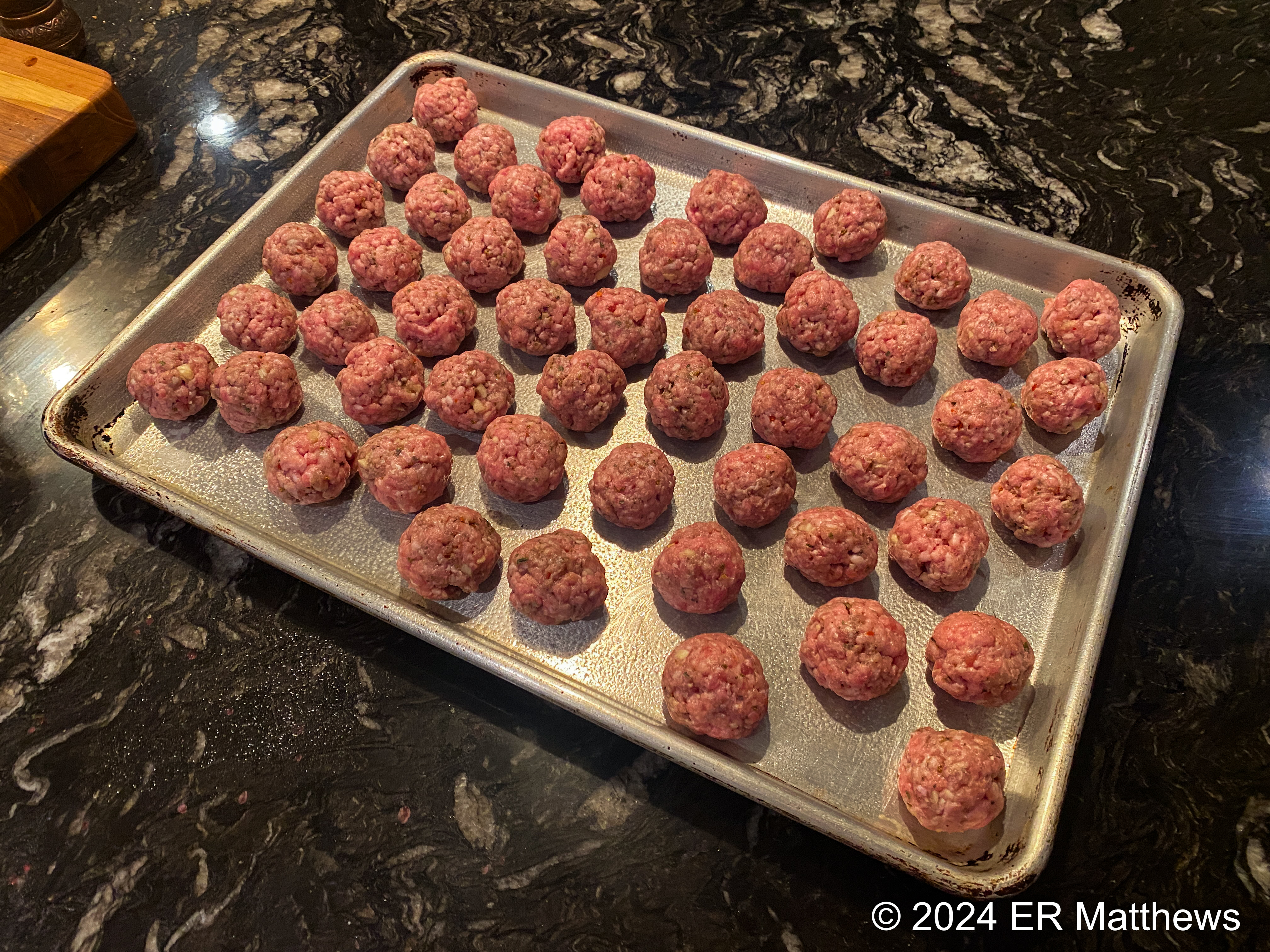
I wanted to keep the meatballs fairly plain to let the Calabrian chile honey be the star of the show, but I did want to incorporate the fennel pollen that had just arrived at the house. The seasoning of the meatballs, made from ground pork, is simple: salt, dried basil, fennel pollen, garlic, and red wine. I mixed this all up in the afternoon and fried a quick test piece to check the seasoning. After adjusting the seasoning to our liking, into the refrigerator went the meatball mix to sit and infuse the seasoning throughout the meat.

After washing up from the meatballs, I made a quick salad dressing for the pound of baby arugula that I had brought home for the store, which is where the Sherry vinegar comes in. I started with one part of sherry vinegar and two parts oil (a splash of French hazelnut oil and the rest extra virgin olive oil) and tweaked it to taste with salt and agave nectar. When I was happy with the taste and acid balance of the dressing, I added a finely minced shallot to the dressing and left it on the counter to be mixed with arugula and thin slivers of pecorino at dinner time.

About a half an hour before our guests were to arrive (still no weather cancellations at this point!), Ann and I rolled the 2-1/2 pounds of meatball mix into small 1" (2.5cm) balls. For ease of cooking, I decided to bake them rather than fry or braise them. The meatballs went in the bottom of the oven under the still cooking cassoulet, which I topped with a bit more stock.

Fennel Pollen Meatballs Ready to Bake
When the meatballs came out of the oven 20 minutes later, I sprinkled them with flaky salt and more fennel pollen, then transferred them to a bowl for serving while Ann made final tweaks to the table, glassware, and so forth. I decided to serve the Calabrian chile honey on the side in case one or more of our guests was not a fan.

Fennel Pollen Meatballs, Calabrian Chile Honey
Just about the time appointed time for our guests to arrive (and knowing full well that the trip to our house would be slow on account of the still pouring snow), Ann cracked a bottle of wine for us to start pre-gaming it . While she was doing this, I went outside to remove the 2.5 inches of snow that had fallen in the the last hour from the sidewalk and to try to clear some space at the curb so that car doors could open without getting stuck in snow mounds.

Cassoulet Wine Pairings 


You've heard the saying, "What grows together, goes together"? It's a philosophy that I have always ascribed to in wine pairings. In other words, a good rule of thumb in wine pairing would be to go with the wine from the area from which the dish originates (when possible).

Living in Oregon, our wine coolers are stuffed with our local wine (Pinot Noir) and are sadly bereft of wines from Southwestern France where cassoulet originates. Unfortunately, these relatively obscure French wines are hard enough to source in major metropolitan areas and pretty much impossible to find out here in the boonies. But still, while Ann was out at her exercise class in the morning, I asked her if she would go by the store near her studio and pick up some French wine for dinner.

Cassoulet is a hearty dish that can pair with a wide variety of reds, anywhere from a light Gamay to a heavy Cabernet. My preference is to match the weight of the dish and the wine, opting for heavier rather than lighter wines. For heavier wines, I really like Cahors (Malbec) or Madiran (Tannat), both sturdy reds, with cassoulet.

Knowing the likelihood of finding such a wine was about nil, plan B was to have Ann grab some southern Rhônes, which are what we call GSMs, being made from any combination of the grapes Grenache, Syrah, and Mourvèdre. She came home with three wines, a Châteauneuf du Pape, a Lirac, and a Gigondas. All were delicious. Alternatively, we could have opened some of our GSMs from Walla Walla and the Rocks District from just north of us along the Columbia River.

Three Southern Rhône Reds for Dinner

Celebrating February


I am afraid that I was so intent on our guests that I forgot to take pictures. Rob and Dyce, sorry! What few I did manage are below.

Pre-Gaming it in Front of the Fire
Ann's Simple Tablescape
with Valentine's Gift Boxes for Guests
Andreas and Michelle
Cassoulet and Arugula Salad
Another cassoulet, my best ever, is in the books. I'm so thankful to have great friends with whom to share it.

Monday, November 14, 2022

A Fish out of Water

We're all creatures of habit for the most part, aren't we?

I know I am. When I get in the kitchen, I expect things to be in a certain location and when they are not, it throws my game off.

Off my game is how I felt the first time trying to cook in our new kitchen, a fish out of water.

A simple case in point: in our last two kitchens, the knives lived in a knife block on the counter next to the cutting board, easily within reach when needed. Trying to declutter our new island, I purchased an in-drawer knife block that lives in the righthand island drawer. After years of reaching for knives on top of the counter, now they're hidden away in a drawer, neither good nor bad, just different, a confounding of muscle memory.

And so it went while cooking in the new kitchen for the first time last week. Things were not where my body thought they ought to be based on muscle memory, despite when designing the kitchen, my visualizing the new location of the items that we most often use. Visualization is part and parcel of my being: every night at the restaurant, when I was actively cooking as opposed to expediting, I would cook (my part of) each dish in my head while standing at my station, ensuring that each tool and ingredient was exactly where I expected it. Efficiency is, after all, born of familiarity and organization.

Despite all the time that I spent visualizing where things would go in the new kitchen, that did not mean that I had considered everything, or that everything would fit where I thought it should go, or even that my body would automatically reach for something where it was hiding. Cooking the first meal in this kitchen reminded me of cooking as a guest chef in somebody else's restaurant. I would always feel a bit helpless in not knowing where anything was. I'm sure if you've ever cooked at somebody else's house, you can relate.

Though it was awkward reaching for the salt, a tasting spoon, or a towel and not finding it right away, it was still a blast to finally cook a meal after a month and a half with no kitchen, even if I had no clue how to work the stove controls. It won't take long to build new habits and muscle memory in our new kitchen and I am looking forward to no longer feeling like a fish on dry land.

Arugula, Tomatoes, Goat Cheese, and Marcona Almonds
with Tomato-Hazelnut Vinaigrette
Pasta with Chicken Confit and Sugar Snaps in Garlic-Thyme Cream;
Crispy Chicken Skin
Brebirousse d'Argental Cheese with Persimmons,
Chipotle-Tangerine Marmalade, and Rosemary Caramel

Ode to the Tortilla

I love tortillas. It wasn't always that way. I am a child of the early 1960s. Then, on the East Coast, our food was influenced by two th...