Showing posts with label oregano. Show all posts

Saturday, January 9, 2021

"Warm" Greek Salad: White Beans with Horiatiki

I'm a big fan of mixing textures of foods in the same dish, witness my vegetable tacos in which I mix cooked vegetables with raw ones to achieve the final product. In the same vein and in response to wanting something warm for dinner in this cold season, but also wanting something fresh, bright, and cheerful, I started thinking about combining two dishes: a humble pan of white beans and horiatiki, the classic chopped Greek salad.

"Warm" Greek Salad: White Beans with Horiatiki
White Beans with Red Onion, Spinach, and Garlic
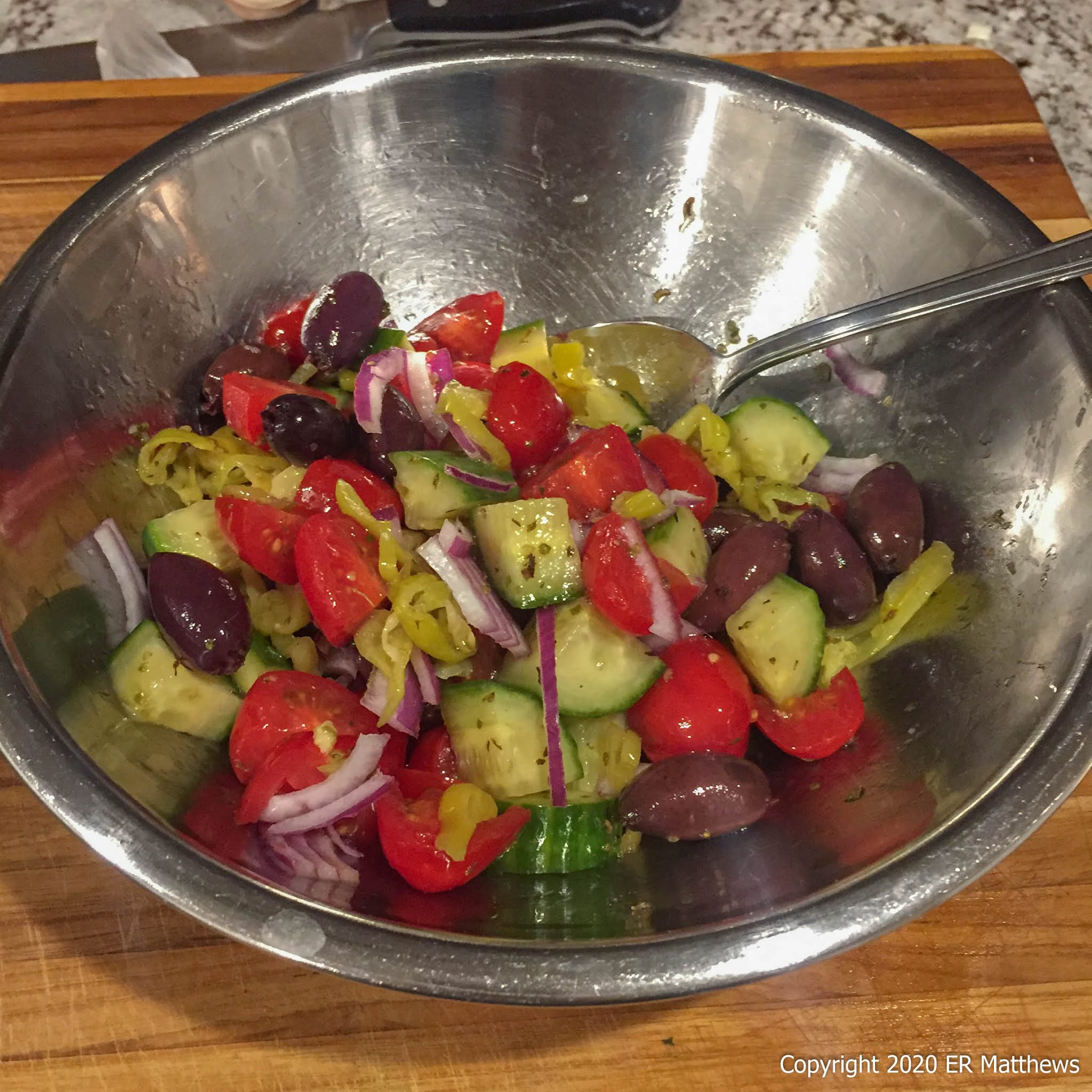
Horiatiki Without Feta
It's quite simple really: cook some onion and garlic in olive oil, add spinach and white beans to warm through and wilt the spinach. Assemble a chopped salad of tomatoes, cucumbers, olives, red onions, and peppers and dress them with olive oil, lemon juice, oregano, and salt. Lay the beans in a bowl and top with the horiatiki.

Feta would be great in this salad or crumbled into the beans or over the top of the plate but we are watching our fat intake and my gut has issues processing a lot of cheese. It's a shame because a great sheep's milk feta is one of the world's great cheeses.

Ann asked me to make this dish again. It really is tasty and it's a great vegetarian dish that can be on the table in under ten minutes start to finish.

Friday, January 8, 2021

Squid, White Beans, and Arugula

There must be foods in everyone's lives, if they ever take the time to reflect on it, that are somehow meaningful in ways that have nothing to do with alleviating hunger, foods that conjure memories. Perhaps it is a dish that grandma used to make, a dessert eaten on a first date, or a secret midnight snack to satisfy a particular craving. In my life, many such dishes make me feel things. Topping the list, perhaps, is white beans with squid and arugula, a dish that I made once again just recently.

Squid, White Beans and Arugula
On the face of it, it is a trivially constructed dish consisting of cannellini beans, baby arugula, raw red onions, and lightly cooked squid dressed with lemon juice, olive oil, salt, and oregano. It is so simple that to taste it is to know how to make it. But it is one of those amazing dishes whose flavors and textures are transcendent, that are more than the sum of the parts. One of my former sous chefs calls it "a perfect dish," high praise indeed.

I cannot in any way take credit for this dish. My history with this dish started in Richmond, VA in the 1980s. Once upon a time, I used to spend pretty much every weekend in Richmond, commuting from my apartment in the DMV in suburban Maryland.

On Richmond's Oregon Hill across from the Virginia War Memorial on the north bank of the James River in a building that looks boarded up sits a restaurant called Mamma 'Zu, a self-styled Italian restaurant that really puts the D in dive. It has no décor to speak of, no fancy furnishings, a surly host, a no-nonsense menu written on a chalkboard, and a wine rack in the back. If you want a bottle of wine, you go to the back and grab a bottle and bring it to your table, or that was the drill 35 years ago.

It is a polarizing restaurant: people love it or they hate it. The restaurant has a well-deserved reputation for taking shit from nobody. They don't accept credit cards, they don't modify their dishes, and you follow their rules or you hit the road. It is a place where the host is intimidating and if you act intimidated, you could be in for a long night. It is also a place where the vibe is chaotically electric and the cooks are jammed into a tiny hell hole of an inferno.

But they turn out some exquisite food. They don't list their excellent pizza anywhere, but if you go there enough, you'll see pizzas coming out along with mounds of pasta. But what I went there for was impeccable seafood. The menu would mainly list the name of the fish and a price, such as "Sardines 24" and "Rockfish 30" and you just ordered them. Woe be unto the newbie who enquired about a preparation or worse, asked for a change in a dish. Me, I never cared. My trust in the kitchen was implicit.

My favorite was an appetizer called Squid, White Beans, and Arugula, the very same dish that you see above, a dish which my then-wife would not touch. I loved it so much that it had to be on the table every time we ate there, which was regularly. Sometimes we would venture to their second location near VCU in The Fan District, a restaurant called Edo's Squid which also had this same dish on the menu. I never liked the swankier location as much, but the food was just as good.

We continued to visit Mamma 'Zu with nearly every trip to Richmond for many years. Fast forward fifteen years or so to a point at which I had opened my own restaurant. One day, into the restaurant walks a young cook looking for employment at a point when I had just lost my sous chef. On the strength of his resume which included stints at both Mamma 'Zu and Edo's Squid, I hired him (and he has gone on to helm many of his own kitchens). In the bustle of getting a new restaurant off the ground, I had put squid and white beans to the back of my mind. He inspired me to put the squid dish on our menu occasionally.

My restaurant was located in Winchester, VA at the very northern point of the state, far, far closer to Pennsylvania than Richmond. The primary industry in Winchester is the hospital which is a large regional trauma center serving a vast geographic area. Many of the employees of the hospital and associated doctor's practices trained at MCV in Richmond and were familiar with the dish from Mamma 'Zu and/or Edo's Squid, which is located just a few blocks west of the hospital.

Many was the transplanted Richmonder who would call me and ask me to make the dish for them on their visit to my restaurant. Such is the nature of the dish that it inspires great loyalty. I have great memories of all the friends and customers who loved this dish as much as I do.

To keep in touch with this dish, I make it from time to time at home. Ann and I both love it. For me, it brings back memories of when I was young, a favorite restaurant, a young sous chef who has gone forth to do great things, of my restaurant and special customers, and of a meal that really resonates with Ann and me. She doesn't have the connection to the dish that I do, but she is the reason that I continue to make it.

Tuesday, September 29, 2020

Roasted Rockfish with Herbes de Provence on Ratatouille

"You've never made me ratatouille."

A statement, not a question, from my wife, a request really, disguised.

Ann hinted that I should make ratatouille, a dish that I have never made throughout a lifetime in the kitchen. "I don't really like it," I responded. Like is the wrong verb, because I do not dislike it. I just would never care to make it for myself. Ever.

There's a bit of backstory here. We grew up without a lot of money, one small income, three ravenous kids. We were not poor, but going out to eat was never an option. Our cars seemed to be third-hand. Luxury foods were not in the cards and during the summer, we ate largely off our garden, my dad being an inveterate gardener.

Those of you who garden, you're probably already beyond the punch line. You know.

Our garden was a good quarter of an acre if not a half, at least three times the size of our current lot here in Oregon. And my dad was an exuberant planter. If three squash plants would feed our family, why not plant a 100-foot row? Ditto for tomatoes. Why not have 50 plants? Peppers. How about four dozen plants of seven or eight varieties?

We kids were free labor to work this massive garden and I foremost, being the oldest and strongest. Our Saturdays were given over to picking vegetables in the morning and prepping and preserving them in the afternoon.

We ate well because of this all year. One wall of our farmhouse basement was reserved for shelves of jars from canning: tomatoes, tomato juice, ketchup, relishes of all sorts, all manner of pickles, peaches, green beans, yellow wax beans, beets, and so forth. Bins of potatoes, sweet potatoes, onions, and apples lined another wall. Our freezer was jam packed with gallon bags of corn, peas, lima beans, and black-eyed peas, the vegetables that did not can well. I learned to put up from day one.

But back to late summer. Those of you who garden know well late July and August when after a trickle of vegetables during the early summer, the garden gods kick things into hyperdrive and bestow an unceasing bounty of tomatoes, peppers, squash, and eggplants. Ready or not, here they come!

My mother's answer, clearly in self-defense from this onslaught, was ratatouille. Ratatouille three to four nights a week. The first couple of times were OK, but by night three, I was ready to vomit at the mere smell of the stuff. Ratatouille for weeks was what we ate with little variety.

Ann, now you know why I have never ever made ratatouille since.

Roasted Rockfish with Herbes de Provence on Ratatouille
I relented of course. How can I not make something for my wife when she asks? How could I disappoint her? One of the things I always disliked about my mother's version of ratatouille is that it would be stewed nearly to death. I wanted to freshen it up a bit and serve a simple piece of roasted fish with it.

Herbes de Provence
It's hard to make a typical Provençale dish without their classic herbs, the soi-disant "herbes de Provence." Everybody's mix is varied. Mine is what I gathered from the garden: rosemary, thyme, oregano, lavender, and basil. These I destemmed and chopped fine.

I do have a quasi-love affair with these herbs and fond memories as well. I remember in great detail driving with Aimé Guibert, the owner of the famed Mas de Daumas Gassac in Aniane, from his home at the winery to dinner in nearby Montpellier. Excitedly and quickly once we climbed to a ridgeline just after dark, he pulled the vehicle to the side of the road and urged a swift exit. "Sentez!" he urged with typical Gallic passion, eager to show off the bounty of his native land. Smell, he insisted.

The warm breezes wafted up the hillside bringing along the fabulous aromas of the garrigue, the scrubland that is common to the Mediterranean coast, be it in Greece, Italy, Provence, or in the Hérault as we were. I could smell the wild rosemary and lavender, but above all the low-growing wild thyme. I could not resist rubbing my fingers through that thyme and then inhaling the amazing aromas.

I have been hooked ever since and thyme is undoubtedly my favorite essential woody herb.

Roasting Roll-Cut Zucchini, Squash, and Eggplant
To create a fresh and lively version of ratatouille, I wanted a base of roasted vegetables. This intentional caramelization and concentration of the vegetables was no doubt a reaction to the overly stewed quality of my mother's version with its mushy, disintegrated vegetables.

Although ratatouille is a peasant dish at heart, many chefs prefer that each of the vegetables be cooked separately and then mixed. This cuisine soignée approach flies in the face of the cuisine pauvre origin of the dish in which all the vegetables would be stewed together. But I like it.

I took a modern approach by roasting the zucchini, squash, and eggplant together after tossing them in the herbs and salt. I roll-cut these long vegetables in the Chinese style so that they would all be in similar-sized pieces and roast at the same time. Once the vegetables were roasted, I sautéed a chopped onion with a bunch of garlic, then added the roasted vegetables, roasted and sliced piquillo peppers, and halved grape tomatoes.

My Ratatouille
I warmed the vegetables through after mixing them, but only just. I did not want the tomatoes to break down at all. I wanted them to retain their freshness and sweet acidity to brighten the dish.

While I was finishing up the vegetables, the herb-covered rockfish, a local species of white fish, was in the oven roasting. Just as it set in the center, I pulled it out and plated it over the ratatouille.

I quite enjoyed it, my first ever foray into making ratatouille. It only took a half a century to get over my instinctual dislike of the dish.

Tuesday, July 14, 2020

Souvlaki

I really miss the Greek Festival every August back in Winchester. The really crummy and cheap Greek wine under the big tents out front of the church, the kids running around like crazy, the smells of roasting lamb and grilling souvlakia, all accompanied by the strains of the emphatic bouzouki band. It was so miserably hot and humid every year, but a heck of a lot of fun! Thinking about it got me to wanting to make some souvlaki ("little skewers") from a pork tenderloin that I had in the refrigerator.

Souvlaki, Spinach, Rice, Tzatziki
The marinade for souvlaki starts with lots of garlic and oregano. Good thing our oregano is going nuts in the back yard right now.

Oregano and Garlic, Sine Qua Non of Souvlaki
I put the finely minced oregano and garlic in a gallon bag along with the zest and juice of a lemon, and a few glugs of extra virgin olive oil.

Ready for the Refrigerator
I cut a large pork tenderloin into roughly one-inch dice, yielding enough cubes for four nice skewers of souvlaki. Into the bag to marinate, the pork went in the refrigerator for two hours before firing the grill.

Skewers of Pork Ready for the Grill
I like to grill my souvlaki hot and quick, so I fired all three burners of the grill for 20 minutes before putting the pork on. The skewers were done at about two to two and a half minutes per side: that's a hot grill.

Souvlaki on the Grill

I wish you could have smelled the fragrant smoke coming off the grill as some of the olive oil in the marinade dripped onto the flame baffles. That's about as good a smell as there is! I know the neighborhood had to be jealous!

I'd normally want to shove these small pork kebabs in a pita with a bit of sliced cucumber and a slathering of tzatziki. I did want to do that this time as well, but we're watching the amount of bread that we shove in our faces.

At least for a few minutes, we were transported back to the Greek Festival in Virginia. Too bad the closest festival is in downtown Portland, an hour and a parking nightmare away. Opa!

Wednesday, January 14, 2015

Yiouvetsi

Yiouvetsi
It was getting late in the morning on Monday when I called Ann to ask about dinner. She generally has some ideas about what kind of food she'd like and those ideas always help focus my mind. I can cook anything I want to (if the ingredients are on hand) and my mind sometimes gets lost in the possibilities. It always helps to have Ann point in a particular direction.

And Monday morning she said, "Let's have pasta. What do you have?"

I started calling off shapes to her while browsing the pantry shelves: pappardelle, gemelli, lumaconi, casarecce, rigatoni, orzo.

"Orzo! Can you make yiouvetsi?"

Can I make yiouvetsi? Of course I can, if I have some lamb. And I just happened to be heading to Costco where they generally have legs of lamb.

Yiouvetsi Basics: Lamb, Onions, Garlic, Cinnamon, Tomatoes
A yiouvetsi is a baking dish, a Greek clay casserole, that has lent its name to a family of baked meat and pasta dishes. When Ann says "make me yiouvetsi," she means arni yiouvetsi, lamb and orzo. At the restaurant, we make vegetarian versions and seafood versions. Octopus yiouvetsi is a staff favorite.

The ingredients are simple and the procedure is simple as you will see in the recipe below. It all comes down to the quality of the ingredients, like most simple dishes. The bowl of yiouvetsi that you see below is incredible, the best that I have ever eaten or made, so good, in fact, that Ann went back for thirds.

Bowl of Heaven
Arni Yiouvetsi

This simple and classic dish of comfort food will require a large ceramic or other baking dish. As you can see above, I used my large oval cast iron cocotte. I use my cocotte so that I can start the dish on the stove and then go to the oven: one pan, not much to clean up. If you use ceramic, you will need a sauté pan in which to brown the meat and cook the onions and garlic. With full prep, cooking, and resting time considered, allow 2 and a half hours to make this dish. Active cooking and prepping is about an hour.

1/2 cup or more extra virgin olive oil
1 small leg of lamb, cubed, about 3 pounds
2 medium onions, diced
12 cloves garlic, minced
1 cinnamon stick
1-2 tablespoons dried oregano
1 quart tomatoes, diced in juice
1 lemon, juiced
salt to taste
1-2 quarts of water
1 pound of orzo
4 ounces kefalotyri or feta cheese

Preheat the oven to moderate, 350F. Heat a pan in which to brown the meat over high flame and then add the olive oil. You did not misread the quantity. The key quality that separates a yiouvetsi from other baked pastas is the oily, lemony slickness of the pasta. You want that much oil or possibly more.

Season and brown the lamb in batches and remove. Add the onions, garlic, cinnamon, and oregano to the pan. The reason I fudge the quantity of oregano is that my experience is that each type and batch of oregano is more or less potent. If you don't know your oregano, add some now and then taste and adjust later in the cooking process.

Once the onions are translucent, start deglazing your pan by adding some of the tomato juice and scraping all the bits off the bottom of the pan. If you are baking in this pan, go ahead and add all the tomatoes and lemon juice at this point. If not, transfer the onions to the baking dish and add the tomatoes and lemon juice. Add the lamb and cover with water.

If you are using a flame safe pan, bring the mixture to a slow boil before transferring to the oven for one hour. If you are using a ceramic dish, go ahead and put it in the oven at this point but cook it for 90 minutes instead of an hour.

Check the lamb for tenderness; check the liquid for seasoning; and fish out the cinnamon stick. If you are happy with the doneness of the lamb, add the orzo and stir. Return to the oven for 20 minutes.

Although feta is less commonly used than kefalotyri, I prefer feta. In either case, I like to cover the top of the casserole with the cheese and turn on the broiler to brown the cheese just slightly as you can see in the top photo above.

Let the yiouvetsi rest for 20 minutes or so before serving. Sprinkle or grate additional cheese over each portion as desired.

Ode to the Tortilla

I love tortillas. It wasn't always that way. I am a child of the early 1960s. Then, on the East Coast, our food was influenced by two th...