Showing posts with label tzatziki. Show all posts

Monday, July 14, 2025

July 4 Celebration

Each year, we celebrate the Fourth of July and the country where we live. I am not a political person, but this year, I am decidedly not feeling at all patriotic, nor am proud of certain things that are happening in our country. Still, we persevered with our celebration in the hopes that this country will right itself. Right is a poor choice of verbs in this instance. Perhaps I should have chosen the verb center.

We invited Rob, Dyce, Dyce's parents who are in town from Italy, and new friend Brad to throw down with us.

Lyn, Brad, Neal, Dyce, Ann, and Rob
The menu ended up as a pseudo-Greek affair. I like burgers for the 4th, but had a hankering for my lamb burgers which blow beef burgers out of the water. From there, it was not a stretch to want to pair the burgers with tzatziki and horiatiki. But then, Ann wanted orzo too, so I combined the orzo and horiatiki to create a cold pasta salad. Then I wanted an appetizer I could make in advance, so after a bit of head scratching, decided on tiropitakia, cheese-filled phyllo pastries. Ann volunteered to make her delicious berry and brioche summer pudding and asked me to make a sorbet. We settled on lemon-thyme and the menu was complete. The recipe for the sorbet is in a separate post.

Some wine was drunk; some food was eaten; some fun was had!

Lamb Burger with Feta and Pine Nuts
I love my lamb burgers and this year, for a change, I recorded a rough recipe because I have had requests for it in the past.

Lamb Burger Recipe


This recipe scales well so I have expressed it in terms of seasonings for a single pound of lamb. In reality, I made a 4-pound batch and I eyeballed everything. It is always a good idea when mixing a batch of forcemeat like this, to cook a tiny bit and adjust the seasonings to your liking. Also, this mix gains flavor in the refrigerator so plan on mixing everything a day or even two in advance. I scaled out six-ounce burgers, my preferred size.

Per pound of ground lamb:

1/4 c dry white wine (substitute red wine or water or stock)
2 tablespoons olive oil
1 teaspoon dried Greek oregano
1 pinch crushed red pepper flakes
1/4 teaspoon Pimentón de la Vera agridulce (smoked paprika)
1/2 teaspoon kosher salt
1/4 teaspoon coarsely ground pepper
3 cloves garlic, minced (I used way more than this!)
small handful of toasted pine nuts
2 ounces sheep’s milk feta, crumbled
optional, if you have spice grinder:
pinch dried rosemary, finely ground
pinch dried thyme, finely ground 

Procedure:

Mix liquids and solids well to distribute salt and spices.
Add lamb and gently mix. Using hands is best.
Refrigerate overnight or two nights.
Patty into burgers or shape into kefta (oval meatballs)
Cook to desired temperature. I like medium rare.


Tiropitakia and Tzatziki
Tiropitakia Ready for Oven
Our appetizer was the tiropitakia (little cheese pies) that you see in photos above. I just went with my gut which said to mix chopped kalamata olives, chopped marinated sun-dried tomatoes, oregano, lemon zest, and grated pecorino cheese with a tub of ricotta cheese. For savory pastries like this, I brush the phyllo layers with olive oil (and for sweet pastries, I use butter). I brushed the tops of the little triangles with olive oil and sprinkled them with oregano and coarse salt before baking until browned in a moderate oven. A recipe for tzatiki is in this post.

Orzo Salad
The pasta salad was simple. I mixed a bunch of olive oil, lemon juice, kalamata brine, and oregano (my usual horiatiki dressing) in a large bowl. Then I cut the horiatiki vegetables and cheese smaller than usual, because otherwise, they would dwarf the small orzo pasta. The usual suspects are: tomatoes, cucumbers, olives, and feta. I omitted peppers because I didn't feel like I wanted them. So there.

I put all the salad ingredients into the dressing for about an hour to marinate. The red onions, I sliced very thin and soaked in several changes of cold water to mellow them out. In the morning, I par-cooked the orzo a couple minutes shy of being done, knowing that it would finish softening in the refrigerator. This is a useful technique for all pasta salads. After cooling the pasta under running water, it went into the vegetables and I tasted for salt. Salt this salad carefully because the kalamata brine, olives, and feta are already salty.

Into the fridge to mellow for a few hours the salad went. Just before serving the appetizers, I put the salad in a serving bowl and garnished with the onions. Just before serving dinner, I mixed everything well to distribute the onions and redistribute the dressing.

Ann's Beautiful Summer Berry and Brioche Pudding
Lemon-Thyme Sorbet with Summer Berry Pudding

Tuesday, April 23, 2024

Lamb Chops and Gigantes Plaki

Spring is starting to arrive in fits and starts here in Bend although one day will be warm and sunny and the next brisk and cool. There's likely to be more snow to come but the grass is starting to green. And this is more than enough to get my grilling juices going after a winter of seeing the grill out by the patio under a mantle of snow.

Ann invited Michelle and Andreas over for dinner this past weekend, and Michelle's mom Jean was in town, so of course she was welcome too. I no longer remember the thought process behind the menu for the night, but I am pretty sure it was built around a bag of huge Royal Corona beans from Rancho Gordo.

Grilled Lamb Chops, Spinach with Onions and Dill on Gigantes
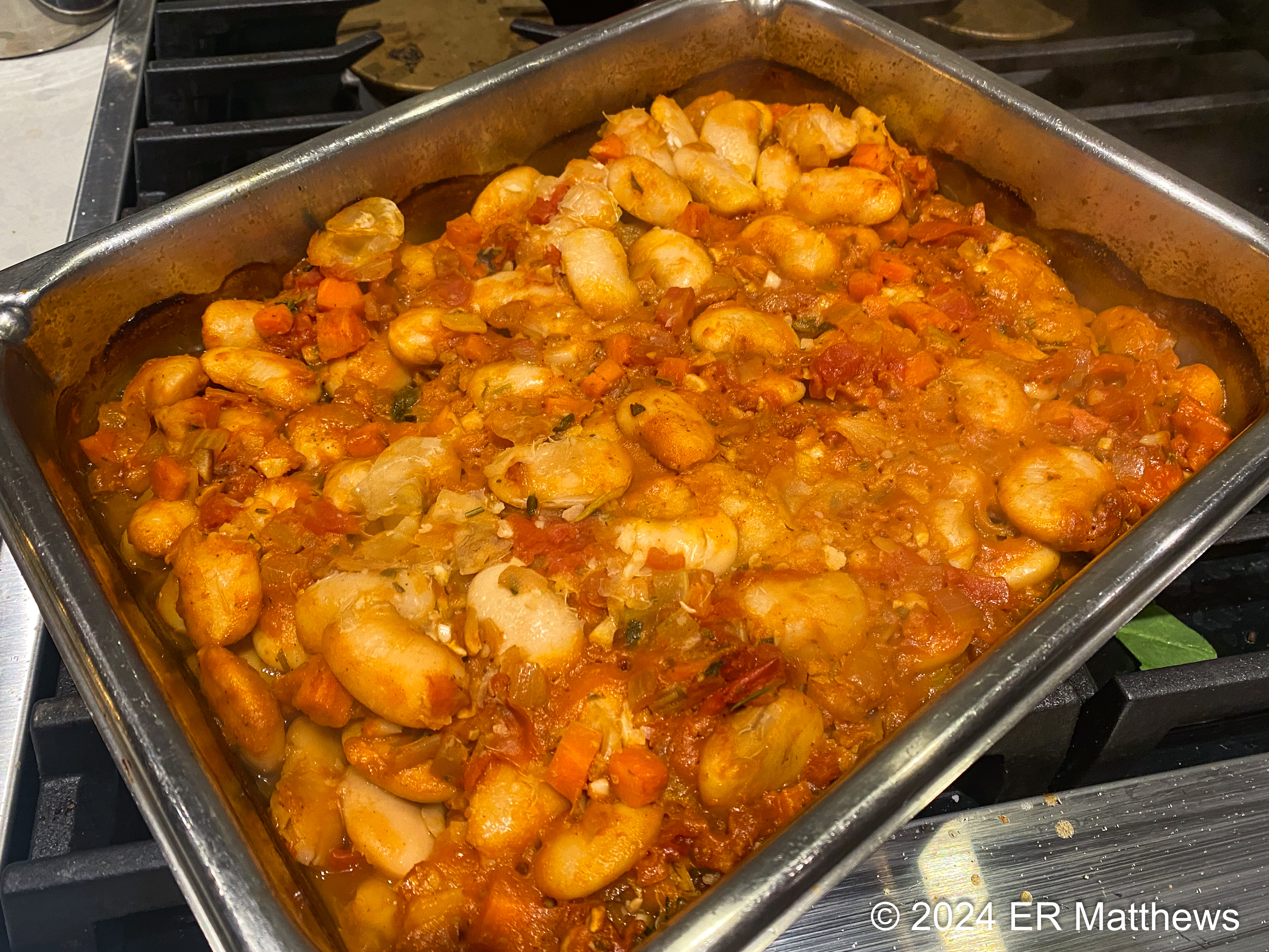
I decided to make these huge beans into the classic Greek gigantes plaki, baked beans in tomato sauce. I'm pretty sure that grilled lamb chops followed from this thought. After a sunny day that was great for cleaning up the grill after a winter of disuse, the sky turned partly cloudy and spit a little rain just before our guests were ready to arrive. Nonetheless, we turned on the fire pit and sat outside anyway.

Royal Corona Beans Soaking Overnight
Uncooked Huge Beans
After soaking the Corona beans overnight, I par-cooked them with a couple bay leaves, a few dried rosemary needles, and four smashed cloves of garlic. I started the beans at 2pm, knowing our guests would arrive at 6 and figuring it would probably be 7:30 before we sat down to dinner. At 5:45, I was a bit concerned about the beans. Although they had been softening constantly through the afternoon, three hours on the stovetop was insufficient to render them creamy. After another 90 minutes in the oven though, they were just fine. Whew!

Tomato Sauce for Beans
I made a simple tomato sauce for the beans by sautéing an onion, a large carrot, and two stalks of celery in olive oil with garlic, crushed red pepper flakes, a bit of fresh thyme, and a fair amount of dried oregano. I also added ground cinnamon, just what would fit on the tip of a knife blade. To me, this dish doesn't taste right without it.

Ann, however, has a different opinion. She has a pretty firm rule that anything sweet or any spice that we Americans consider a pie spice does not belong in a savory dish. So, the sauce wasn't her favorite.

Once the vegetables had started softening, I stirred in a tablespoon of really amazingly concentrated Sicilian tomato paste called estratto. Then, I deglazed the pan with the juice of a lemon and added a can of crushed tomatoes and let the sauce bubble away for 20 minutes or so, just to bring the flavors together.

At 5:45, I scooped the still-cooking beans into the sauce and mixed them well. After transferring them to an oiled half hotel pan, I drizzled a little of the bean cooking liquid over the beans and covered the pan. They baked covered at 350F until dinner time, about 90 additional minutes.

Gigantes Plaki
Our guests arrived shortly after I put the beans in the oven and Ann had poured me a glass of wine, a Semillon-Sauvignon Blanc blend from Walla Walla. We headed outside on the patio by the fire pit with a plate of risotto cakes to have for an appetizer. I like finger food for an appetizer and because Michelle is gluten intolerant, bread such as crostini is out. So, I tend to make rice cakes when she comes over.

Plain Risotto Base: Arborio, Onion, White Wine, Chicken Stock
Lemon, Dill, Feta, and Pine Nut Risotto Cakes; Tzatziki
I made a plain risotto with chicken stock, though I often use water. When the rice had cooled, I added a lot of lemon zest and fresh dill, a good sprinkle of crumbled Greek sheep's milk feta, a handful of toasted pine nuts, and two raw eggs. After mixing the rice well, I shaped it into cakes and seared the cakes.

First thing in the morning, I made tzatziki to accompany the cakes. Each time I make tzatziki, I make it slightly differently depending on what I have on hand and how I'm feeling, but I did publish a basic recipe here.

A Touch Chilly Outside Around the Fire
First thing in the morning, I put a bunch of lamb chops in the fridge to marinade. The marinade was quite simple: olive oil, a splash or two of red wine, a lot of chopped garlic, dried rosemary, and dried oregano. I turned the chops in the marinade every couple of hours.

Lamb Chops Ready to Grill
Lamb Chops, Ready to Plate
After I grilled the lamb chops, we headed inside where I cooked a couple pounds of small spinach. I chopped an onion and cooked it to tender in olive oil, then tossed in the spinach which wilted in short order. I added a big handful of fresh dill and seasoned with salt.

I decided to plate at the stove rather than serve everything family style. I put a bed of gigantes on each plate and then scattered some feta, fresh oregano, and salt over the top. After garnishing the gigantes with a healthy drizzle of olive oil, I put some spinach on top and then added the lamb chops.

All in all, it was a very simple meal and scratched my grilling itch. I'm so glad that we were able to share it with Michelle, Andreas, and Jean.

Saturday, October 21, 2023

Last Hurrah of Summer

In late October, the weather here in lovely Bend OR can be a real crapshoot. We could as easily have mild temperatures as snow. This year, we had some terrific Indian summer weather, perfect for gathering around the fire pit long after dusk. Just back from our trip to Truckee to see Mark and Kelley, we invited Rob and Dyce over Saturday night, the plan to enjoy this last hurrah of pretty weather before winter sets in for good. (As I type, my fingers cold in my chilly office, it is 18F outside, brrrr!)

To go with the awesome weather, Ann wanted me to make a summery dish for dinner, squash cakes, a  staple at the restaurant in season. So popular were they that I had customers begging for them in February when in our climate there in Virginia, we couldn't even set the baby squash plants out until May 15 or so, let alone have ripe fruit. I really couldn't take them off the menu from July to October when squash were in season without risking severe backlash from customers.

The squash cakes were born of a need to use massive amounts of zucchini. If you've ever grown squash, you know that when they start producing, they really come on gangbusters to the point where you may find yourself swimming in squash. It is a real trick in the restaurant business to get people to not only order something mundane that they don't really want to spend money on such as summer squash, but to get them to crave that dish to the point where you cannot take it off the menu. This is such a dish, a real coup in the kitchen, but it requires a lot of labor and time to pull off.

Before our dinner of squash cakes, we sat around the fire pit outside enjoying the last hurrah of summer. To go with our wine (Bordeaux blanc-style Semillon-Sauvignon blanc), I wanted finger food, but I had a salad (horiatiki) on the brain. So I put together these little skewers of cucumber, tomato, pickled peppers, feta, and olives. When I make horiatiki, I dress it traditionally in olive oil and lemon juice with oregano, but that dressing would be too loose and messy for finger food, so I whipped up a quick batch of tzatziki that we could daub on our skewers without too much risk of a mess.

Horiatiki Skewers with Tzatziki
After our appetizers when it was good and dark outside, we moved into the kitchen and I fried up the batch of squash cakes that I had made earlier in the day. The process is time consuming, but I find the results worth the effort.

I'm Using Grey Zucchini Here, Two Per Person
You Can Use Any Summer Squash
Grated on a Box Grater
I Wouldn't Dirty the Food Processor for Only 8 Squash
In Batches, Wring the Water Out in a Clean Towel
We Made a Light Cucumber-Tasting Sorbet from the Drained Liquid
Cook the Dry Squash in Cream
Cook All the Liquid Out
Season and Bind with Grated Pecorino and Panko
Refrigerate to Set, Then Patty out Squash Cakes
Lightly Flour or Bread the Squash Cakes, Then Fry
To go with the squash cakes, I always serve tzatziki; they are a natural combo. This time, I was feeling a light pasta salad as a side dish, so I cooked a batch of orzo and tossed it with lemon juice, olive oil, and oregano. Then I stirred in feta, wilted spinach, and just a few bits of tomato for color.

Orzo with Spinach, Feta, and Tomatoes
These squash cakes are pretty delicious but they take a long time to prepare. They're also a bit tricky to cook, too, because they want to get really creamy in the center. You have to form a good crust on them in the pan; it's the crust that holds the very soft cakes together. It's also that crust that makes a delicious crunchy contrast to the creamy center that makes this dish so delightful.

Tuesday, July 14, 2020

Souvlaki

I really miss the Greek Festival every August back in Winchester. The really crummy and cheap Greek wine under the big tents out front of the church, the kids running around like crazy, the smells of roasting lamb and grilling souvlakia, all accompanied by the strains of the emphatic bouzouki band. It was so miserably hot and humid every year, but a heck of a lot of fun! Thinking about it got me to wanting to make some souvlaki ("little skewers") from a pork tenderloin that I had in the refrigerator.

Souvlaki, Spinach, Rice, Tzatziki
The marinade for souvlaki starts with lots of garlic and oregano. Good thing our oregano is going nuts in the back yard right now.

Oregano and Garlic, Sine Qua Non of Souvlaki
I put the finely minced oregano and garlic in a gallon bag along with the zest and juice of a lemon, and a few glugs of extra virgin olive oil.

Ready for the Refrigerator
I cut a large pork tenderloin into roughly one-inch dice, yielding enough cubes for four nice skewers of souvlaki. Into the bag to marinate, the pork went in the refrigerator for two hours before firing the grill.

Skewers of Pork Ready for the Grill
I like to grill my souvlaki hot and quick, so I fired all three burners of the grill for 20 minutes before putting the pork on. The skewers were done at about two to two and a half minutes per side: that's a hot grill.

Souvlaki on the Grill

I wish you could have smelled the fragrant smoke coming off the grill as some of the olive oil in the marinade dripped onto the flame baffles. That's about as good a smell as there is! I know the neighborhood had to be jealous!

I'd normally want to shove these small pork kebabs in a pita with a bit of sliced cucumber and a slathering of tzatziki. I did want to do that this time as well, but we're watching the amount of bread that we shove in our faces.

At least for a few minutes, we were transported back to the Greek Festival in Virginia. Too bad the closest festival is in downtown Portland, an hour and a parking nightmare away. Opa!

Monday, June 8, 2020

A Hankering for Lamb


Lamb Burger, Tzatziki, Harissa, Horiatiki Salata

Although I am not a big carnivore, I really do love lamb and would eat it in preference to beef just about any time. Lamb shanks are one of my all time favorites, but I would never turn up my nose at leg of lamb, marinated in rosemary, garlic, and red wine, grilled to medium rare. And in the burger department, I do believe I prefer lamb to most beef.

Out here in northwestern Oregon, lamb seems hard to come by and what I do find is exorbitantly priced. Maybe I just need more time to find the right suppliers. Or maybe it is the region. The Willamette Valley seems to be given over more to crops and nursery plants, where the Shenandoah Valley in Virginia hosted a lot more livestock.

I was spoiled in my restaurant days always having a ready supply of lamb. We would take delivery of a whole lamb each week. We went through about five suppliers in the tenure of the restaurant, so it must be hard to make a living raising sheep. Still, we had a constant stream of farmers coming to the restaurant to solicit our business and no shortage of lamb.

I would use the carcasses to teach my cooks (after they graduated from rabbits and fowl) how to break down and use every part of a larger animal, a skill that every chef should have, but so few possess. If we are going to kill an animal to eat it, we are obliged to let none of that animal go to waste. And we did not at the restaurant, a point of particular pride for me.

I would sometimes let a cook break down a lamb, but truth be told, I enjoyed doing it myself. I find something very zen about quickly and efficiently processing a carcass for maximum use. It also allowed me time away from the business aspects of running a restaurant to ponder how to use each cut of the animal.

Even though it was a lot of work each week with each new lamb, I enjoyed the mental gymnastics of figuring out how to put a lamb on the menu. Aside from the offal, which scared a lot of diners and mainly ended up as chef snacks and family meals, every bit had a use on the menu. When diners are looking for rack of lamb or a high-value cut that they recognize, it takes a lot of creativity to put the so-called lesser cuts (necks, breasts, and briskets) on the menu in a way that entices customers to order them.

The hind legs would inevitably end up on the grill in some form or another. The small top loins and tiny tenderloins would end up in a mixed grill, or sometimes on the nightly tasting menu where we would do something special with them. The shoulders and sirloins might get cubed and braised for a tagine or stew or they might also end up on the grill. 

The ribs might go on the appetizer menu, first slow-roasted to tenderness, then grilled at service. The bits and pieces would head for the grinder where they might end up in a terrine, in a meat pie, or on the lunch menu as lamb sliders.

The bones, neck, and so forth would end up getting braised, the picked meat going into some dish (lamb tamales or pot stickers, for example) and the stock being brought down to a demiglace for garnishing the grilling cuts.

The shanks would often go into the freezer for weeks until we could collect enough to put them on the menu. The much sought after racks, we would typically break down into one- or two-bone chops and put them on the tasting menu.

Customers would often ask, "Why don't you put rack of lamb on the menu?" I would always answer with a question of my own, "With two racks per animal and one animal per week, how many weeks would it take to have enough racks to get through a single night at the restaurant?"

With the 24x7 availability of cuts at the supermarket, I believe that many people are so disconnected from the process of butchery that they have forgotten the limited supply of choice cuts on a single animal, if they even considered it. Which brings me back to lamb burger: the lesser cuts often end up in the grinder for burger.

This reflection was brought about by the lamb burgers we had the other night, pan-seared and served with tzatziki, harissa, and a faux horiatiki salata.

Tzatziki


Tzatziki, by any one of its names, is ubiquitous in the Mediterranean and it varies depending on the cook and the region. Each batch that I make is different, depending on what I have on hand and what my mood is. I like my tzatziki really thick, so I make it that way. I prefer red wine vinegar to lemon juice, so I make it that way. I prefer oregano to dill, so I make it that way. I don't peel my cucumbers, because I like it that way. I hope you get the point: use this "recipe" as your jumping off point and make it your way.

1 quart Greek yogurt
1/4 cup extra virgin oil
2-3 tablespoons of red wine vinegar (or lemon juice) to taste
1 5-inch section of cucumber, rind on, finely diced
4 cloves garlic, minced
1 teaspoon dried oregano (or a big bunch of fresh oregano, minced)
salt to taste

Mix everything and adjust the seasoning to your liking. It's better after it stands overnight in the refrigerator.

Thursday, July 4, 2019

A Vegetarian Fourth

Almost two years post restaurant, I rarely get the urge to cook full meals any longer. But on July 4th, I felt like I wanted to cook a really simple meal that we could enjoy on the front porch with our vegetarian neighbors, taking full advantage of Oregon's delightful summer weather.

I always associate the Fourth with watermelon and Ann had been asking me to make lentil burgers for a week or two, so I decided to build a meal around that: lentil burgers, pita, hummus, arugula, tzatziki, and a watermelon salad. I started around 7:30 in the morning with some really easy tasks, mixing up some pita dough, making tzatziki, and knocking out a quick watermelon salad.

About 30 minutes before neighbors Pat and Mary Jo came over, I baked the pita, keeping them warm under a towel, while simultaneously frying the lentil burgers which then went into the oven after I turned it off, to keep warm for dinner.

Pat and Mary Jo
"What can we bring?"
We started the evening with a stack of warm pita, a bowl of hummus, and cocktails of pomegranate liqueur and Prosecco. I think that if that was all we had to eat, we would have been happy chatting away on the front porch, hearing all the neighbors doing the same on their nearby porches.

Starters: Pita, Hummus, Pomegranate and Prosecco
I love hummus. Just ask anyone who ever worked for me at the restaurant. I probably ate it every day for lunch. I eat it less frequently now, cooking less, but I still love it. Although you can't see it, this hummus has a lot of green olives ground up with the chickpeas. I also use a drizzle of sesame oil rather than tahini. Same flavor, but easier.

For this batch destined for company, I went to the trouble of peeling all the chickpeas, six pounds of them. For regular batches, I don't peel them. The texture is really much better if you peel them, but I'm not working that hard on a daily basis. I am no longer a restaurant chef judged by the slightest nuances in food. I'm now a guy who values time with people more than time in the kitchen.

Hummus with Olives and a Drizzle of Olive Oil
Lentil burgers, black bean burgers, squash cakes: I have a love affair with fried vegetable patties of all sorts. For these, I cooked the lentils with garlic and herbs, drained them, added eggs, sautéed mirepoix of carrot, celery, and shiitake mushrooms, fresh herbs (rosemary, sage, thyme), and panko. I pattied them out and put them in the fridge to firm up before frying.

Lentil Burgers; Local Sauvignon Blanc
Who doesn't love arugula tossed with some lemon juice, olive oil, and salt? It's one of the greatest and simplest salads.

I couldn't celebrate the Fourth without watermelon, so I made a really quick watermelon salad with feta cheese, red onions, mint from the back yard, olives, olive oil, and red wine vinegar. Thank goodness for the smart plant breeders who came up with the infertile (seedless) triploid hybrid watermelons that are so delicious and easy to work with!

Call it tzatziki, cacik, or tarator, it's pretty much the same yogurt and cucumber condiment all over the Mediterranean. I've made a few thousand pounds of it in my life, always preferring the flavor of red wine vinegar in mine, rather than lemon juice. Herbs vary with my mood, but almost always include oregano, this fresh from my back yard.

Arugula, Watermelon Salad, Tzatziki
Behind the Scenes: Frying Lentil Burgers
Not sure why people think pita is hard to make. It's among the easiest flatbreads. I don't have a recipe per se, keying off the amount of water to give me final yield. One cup of water will incorporate enough flour to make 8 pita. Salt, yeast, and olive oil round out the dough, which I let rise twice before shaping into balls. After the balls rested for 20 minutes, I patted and rolled them out and into the very hot oven onto a hot sheet tray they went, three at a time, about two minutes on one side and another minute on the other.

These pita are very similar to the flatbreads and naan that I used to make at the restaurant, but I would typically put some yogurt in the dough for those. I did not for these pita, but it wouldn't have hurt.

Pita, Still Puffed from the Oven
When all was said and done, I was really tired. I no longer stand in the kitchen and cook all day and it shows. But I really am OK with that. I like the word retired in front of the word chef. It suits.

Monday, June 30, 2014

A Beautiful Mediterranean Sunday

Sunday was a fantastic day to be outside and Ann and I headed out around 11:30 to wait for Karen to arrive, talking, sipping Pinot Gris, and sitting on the patio in the shade of the pergola. Karen arrived a little while later and we spent a most enjoyable afternoon on the patio catching up, until after we ate lunch late afternoon and headed in to cool off in the air conditioning.

My Two Lovely....

....Dining Companions

Thank You Karen!
Karen brought a couple bottles of Willamette Pinot of which this Boedecker was the superior. She knows exactly what I love to drink.

Mezes: Olives, Hummus, Grape Leaves, Red Pepper Salad
Earlier in the day, I put together this platter of dolma/dolmades, red pepper salad, olives, and hummus. I make the hummus fairly loose with lots of lemon juice, olive oil, and for a special flavor, sesame oil rather than tahini. Try it some time. I took my meal cues from the beautiful breezy warm Mediterranean weather and created a meal that would be recognizable almost anywhere in the Eastern Med.

Turkish Chopped Salad
Early in the day, I chopped red peppers, cucumbers, red onions, and tomatoes. Just before dinner I dressed the salad with lots of chopped parsley, lemon juice, olive oil, and salt and pepper.

Pork Kofta with Feta, Dill, and Mint
I had a hankering for kofta on the grill, but I didn't have any lamb I felt like grinding so I used pork (frown if you must) and seasoned it the same way with feta, dill, mint, garlic, oregano, and various spices (such as allspice, coriander, etc.).

Dinner is Served: Kofta, Salad, and Tzatziki/Cacık
And here you see our dinner, ready to eat, with the kofta, the salad, and a bowl of thick tzatziki that I made the day before. Turkish cacık is rather thinner than this in my experience: I like it thicker.

Friday, April 5, 2013

Easter 2013

In between snowstorms and rain falling from sullen grey skies, the sky became clear enough on Wednesday evening for me to see the full moon, meaning that Easter was just around the corner. I had thought about it a little bit about a month ago when Ann first brought up doing lamb again for Easter. I thought about it for about five minutes, long enough to scratch out a menu on my clipboard—yes, in this digital world, this particular dinosaur's personal assistant is a clipboard—and then promptly forgot about it until I saw the full moon.

I don't know why, but it somehow seemed fitting to do a little Greek food for Easter this year. I just had a hankering for some honest, home-cooked Greek food with no shortcuts. So I set about this menu on Good Friday by getting my pita dough started and then prepped most of the dinner on Saturday during the day, and what little was left over à la minute on Sunday.

Tom and Ann Matthes joined us for dinner. We had expected Ann's parents but her dad, Bob, was not feeling well. We missed them.

Mezés
Olives
Pita
Taramosalata
Marinated Cucumbers
Dolmades

Dinner
Arni Lemonato (Slow-Roasted Lamb)
Roasted Potatoes
Horta: Spinach Braised with Onions and Dill

Dessert
Orange Salad with Pistachios, Candied Pine Nuts, Feta, Mint, and Olive Oil
Cheeses

Dolmades and Marinated Cucumbers
Top to Bottom: Tzatziki, Olives, Taramosalata
I made tzatziki from really awesome goat milk yogurt and traditional taramosalata from bread, tarama, olive oil, grated onion, and lemon juice. I wish that my tarama (mullet roe, bottarga) had a more pronounced fishy flavor, but it was still good.

Ed-Made Pita
As I mentioned earlier, I started pita dough on Friday to let it ferment through several rises to develop flavor. Then I baked several sheet trays of it on Saturday and rewarmed it in the oven on Sunday. I make pita from the exact same dough that I make focaccia and pizza dough. And I make naan from the same dough, substituting yogurt for the olive oil.

Arni Lemonato me Patates, Horta
For the lamb this year, I decided to go with shanks because they are my favorite cut, but I decided to do something different: slow roast them. For whatever reason, I have always braised them in the past. I cut 5-6 slits in each shank and inserted a sliver of garlic, rubbed them with olive oil, and gave them a generous sprinkle of salt and pepper, then roasted them in a very hot oven for about 20 minutes, turning once, until they were browned all the way around. I squeezed a couple lemons over the shanks and sprinkled them with oregano, then added about four ounces of water to the bottom of the roasting pan and double-wrapped it in foil. The shanks cooked in a slow oven for an additional two and a half hours.

I scored some pretty Kennebec potatoes at the farmers market and they got roasted in a very hot convection oven until crispy done. The star of the plate was the horta, the greens, which I only wilted instead of braising. I only used spinach this time because Ann is a bit iffy on other greens and I wanted her to enjoy them. I sweated a finely diced onion in olive oil with several slivered cloves of garlic, then added the spinach and just wilted it. Into the pan next went a little feta cheese, fresh dill, and the first tiny mint leaves of the year from the garden. A quick season with salt and pepper and we had a fabulous side dish.

Tom's Cheeses: Gouda, Detroit Street Brick, Gorgonzola, Cabot Cheddar
Tom and Ann brought cheese for dessert. The orange gouda and the goat brick, I've already discussed in a prior post. The cheese in the front right is Cabot's (yes, the same people who make so-so block grocery store cheese) Clothbound Cheddar, that has been aged by affineurs in Vermont for a minimum of 13 months. Really, really delicious Cheddar that even the Brits would be forced, albeit most grudgingly, to admit is worthy. The hit of the day for me though was the Gorgonzola Naturale, just above the Cheddar in the photo. The texture is just so damned creamy and perfect on this particular wheel of cheese. Splendid!

Blood Orange Salad
No doubt we all know by now that I just don't care for sweets for dessert, though I do have a fondness for fruit. So I made a salad of sliced blood oranges and then tossed chunks of blood oranges with olives and feta and put that over the sliced oranges. I drizzled this with honey and extra virgin olive oil then sprinkled it with salt, pistachios, candied pine nuts, and the cutest, tiniest baby mint leaves from the garden.

Ode to the Tortilla

I love tortillas. It wasn't always that way. I am a child of the early 1960s. Then, on the East Coast, our food was influenced by two th...