Showing posts with label seafood. Show all posts

Wednesday, March 6, 2024

Crunchy Fish Tacos

I've recently revived an old technique for fish tacos and Annie loves the results. Here's how I turned a couple of Pacific Cod fillets into fish tacos.

Pacific Cod Fish Tacos
In recent years, I have been coating fish fillets for tacos with a spice rub and roasting them in the oven. This is certainly a healthy way to eat fish, but many people will miss the crunchy crust of fried fish in their tacos. That got me asking myself how I can get a crispy crust on fish for tacos using a minimum of oil.

Thinking back many decades to when I was just learning how to cook Chinese food (as if there is but a single Chinese cuisine, ha!), I remember using cornstarch not only to thicken sauces and soups, but as a way to coat meat for wok frying. And so I decided to use a bit of cornstarch on fish fillets and to fry them in as little oil as possible.

I cut the cod fillets into pieces that will fit into my pan and then sprinkle both sides with seasonings (sometimes my fish rub, link above). For this particular batch of fish, rather than use a rub, I merely sprinkled both sides with salt, ground New Mexican chile, and a touch of granulated garlic. Then I put a thin coat of cornstarch on both sides.

Pan-Searing Pacific Cod Using Almost No Oil
We eat a lot of tacos at our house because they are quick, tasty, and who doesn't love finger food? One way that I make them quick to prepare is by keeping a lot of garnishes on hand in the refrigerator on a regular basis. These include pickled jalapeños, salsa verde, romaine bottoms, and a squeeze bottle of thinned chipotle sour cream. By planning ahead, tacos take less than ten minutes to bring to the table, just what I want on a busy day or on a day when I don't have the energy or desire to cook an involved meal.

Fish Taco Toppings: (L-R) Pickled Jalapenos, Tomatoes,
Salsa Verde, Cilantro, Chipotle Sour Cream, and Romaine
I've published the recipe for salsa verde before, but it's just a bunch of cilantro, a large can of drained tomatillos, a serrano chile, two cloves of garlic, and a pinch of salt, all blended. We use romaine lettuce on our lunch sandwiches and I always keep the bottoms of the bunches in a bag in the fridge. When it's time for tacos, I slice the bottoms thinly for a crunchy garnish. Chipotle sour cream is merely sour cream, water, salt, and chipotle adobo.

Wednesday, January 17, 2024

Storm Day

We've been staring down the barrel of a winter storm warning for a few days, a warning on the books ever since the prior storm dumped on us on earlier in the week. This weekend was predicted to be extremely cold with a lot of snow. And oddly enough, the forecasters got it largely correct. Saturday the 13th, the snow really started ripping just before dawn and continued for the next 24 hours, a big, big powder day with plenty of wind and arctic temperatures.

Storm Progression, Saturday 10:30
Storm Progression, Saturday 16:00
Storm Progression, Sunday 07:45
All in all, it was just a day to hole up inside and let the storm rage while we sat under blankets by the fire, made some great food, and watched a little playoff football. My short perusal of social media led me to believe that pretty much the entire town was holed up at home as well. I don't believe that even the Mt. Bachelor ski resort was open in the face of this storm. I saw some pretty gnarly footage of the chairlifts iced up and swinging wildly in the wind.

As nice as sitting bundled up by the fire sounds, the day was punctuated by my shoveling the walk and the driveway three times, dawn, noon, and dusk, and really getting cold. Worse, all this shoveling really exacerbated my hurt back to the point where I can barely walk now, days later as I type this. I'm now in about day 10 of a big flare-up. No fun this feeling of being sliced unanesthetized with a flaming knife.

The temperatures Saturday ranged from a high of 1F at dawn to a low of -7F just after sunset and I could only be outside for a few minutes before the pads of my fingers went from stinging cold to numb and insensate, despite my gloves.

I was wearing my US Army combat gloves, the heaviest ones I own that still allow my fingers some mobility and still, ten minutes of shoveling was all I could take before coming in to warm up. For weather like this, I really needed my thin merino base-layer gloves with some big overmitts, but how to shovel with this set-up?

After the first shoveling expedition of the morning and a couple cups of delightful coffee, the first inside order of business was to get something delicious cooking for dinner. Fortunately, I had the foresight the night before to put a couple of pounds of Great Northern beans on to soak. In the winter, I always try to keep the pantry stocked with dried beans, just for times like this storm day.

White Chicken Chili About to Start in the Slow Cooker
Ann had mentioned wanting white chicken chili the day before (hence my soaking the beans) and I happened to have a big tray of chicken thighs that I was going to roast. I repurposed four of those chicken thighs for the chili, leaving the other six for roasting later in the week.

My idea of white chicken chili is white beans, onions, green chiles, cilantro, and garlic, all put in the slow cooker early in the morning and ready to eat by dinner when the chicken falls off the bone into the creamy beans.

In this case, instead of the yellow onions that I normally use, I had a large leek and half a bunch of green onions that had no other purpose, so into the pot they went. And I remembered that Dyce had given us a pint of New Mexico green chile, so that went in as well, with only half as many poblanos as I would normally use. Those New Mexican chiles had a bit of a sting to them!

A few hours later after smelling the beans and chicken starting to cook, Ann and I got pretty darned hungry, so around noon, it was Mission: Lunch. For New Year's Eve, we had planned a really impressive latke board to take to Dyce and Rob's to celebrate the New Year. I had prepped almost everything necessary for the board before the night got called off on account of illness, so we had lots of components already made in the refrigerator heading into this storm weekend.

These items really needed to be consumed before they went bad, so we set about eating them (but still holding onto the caviar in hopes that we can still share it with the guys in the next week.) Ann proposed for brunch that I do something using the smoked salmon that I had brought in from Scotland for New Years and using the loaf of bread that we had slated for another dinner that got axed for illness.

Smoked Salmon Smørrebrød  
Given that I had already prepared two great schmears for our latke board, a smoked salmon mousse and an egg mousse, I set out to make smoked salmon smørrebrød. Smørrebrød are wonderful and beautiful Danish open-faced sandwiches that started as butter on bread, but have evolved into a thing, now fully part and parcel of Danish culture.


The smørrebrød that I made for our lunch consist of smoked salmon mousse, smoked salmon, egg mousse, cornichons, and dill. The smoked salmon mousse is cream cheese, dill, minced capers, and locally hot-smoked salmon. The egg mousse is soft-cooked egg yolks, mayonnaise, dill, minced cornichons, minced capers, salt, and a touch of pimentón for a smoky je ne sais quoi.

Chardonnay by the Fire
While I was busy assembling the smørrebrød, Ann opened a bottle of wine, a Walter Scott Chardonnay. I wasn't really paying attention or even thinking too much (the pain from my back taking center stage) or I might have warned her off Chard to go with our smørrebrød. Even though Willamette Valley Chardonnay is relatively lightly oaked, oak still clashes mightily with fishy fish and smoked salmon is fishy fish. Oak makes the fish even fishier to the point where it's not fun.

While Ann offered to open something different (a sparkling wine would have been excellent), the solution was simple. Eat first, drink after.

At dusk after shoveling the walk and driveway (this really was snowblower snow) while watching the snowmobiles zip up and down the street, I came in to find that Ann had made us a cocktail to sip while we watched the AFC playoff game. Using the new high-end cocktail set that I gave her for Christmas, Ann mixed cocktails of mezcal, tequila, Ancho Reyes, agave, and lime and served them in a coupe rimmed with smoked salt. This was her best effort yet in that the acid balance was perfect.

Ann's Mezcal Cocktail
We don't watch a lot of football because we cut the cord a long time ago and are not willing to pay for the right to watch games. Also, we can take football or leave it. This is the first time that I can remember that a game has been live-streamed on an outlet that we get. From the get-go, the Chiefs crushed the Dolphins to move on to the divisional round of eight.

Watching Football on a Nasty Day
The announcers, in the pre-game yammering, were making a big deal about the weather in Kansas City delivering one of the coldest game time temperatures in NFL history at -4F. For giggles, I checked our temperature here in Bend (on a day when our high was 1F): seven below. I know what the players were feeling; I had been shoveling in that weather all day.

Cold, Cold Evening
As the game was nearing half-time, I served up white chicken chili from the slow cooker. It's hard to imagine a better dish than this on a very cold night. In fact, it was so cold that we opted to stay downstairs and watch the game by the fire, rather than go upstairs and watch it on the big TV. We keep it intentionally warmer downstairs where we spend the day and cooler upstairs where we sleep.

White Chicken Chili
When we went to bed after the game and after some more TV, it was still snowing, but it was definitely not dumping as hard as it had earlier in the day. Overnight, we added another 4-5 inches to our total accumulation, necessitating another early morning shoveling in the frigid air. Fortunately, 24 hours after the storm hit, it was no longer snowing, a flurry or two here and there excepted.

After coming in and warming my stiff fingers by the the fire, Ann and I enjoyed coffee by the fire and stayed near that fire all morning. If my back were not currently ripped to shreds, we would have been out snowshoeing through all the gorgeous new powder. It sucks to be sofa-bound after a big storm has just dumped oodles of fresh powder!

Late morning, Ann asked me to make some eggs with the smoked salmon leftover from yesterday's smørrebrød. As I headed in to the kitchen to get started, I saw the partial loaf of bread also leftover and quickly a plan came to mind. I still had lots of both chives and dill leftover from our aborted attempt to make a latke board for New Years and I decided that the chives should go in the eggs and the dill into a savory French toast.

Eggs with Chives, Smoked Salmon, Savory Dill French Toast
French Toast Almost Done
Dill French Toast Topped with Smoked Salmon and Chive Scrambled Eggs
After all the powder had blown off the tree limbs, we had a freezing fog event that deposited stunning ice crystals on all the plants. Our front yard was a veritable winter wonderland and I leave you with these parting shots.

Now that we have all this spectacular snowshoeing-depth snow, if I could just get my back straightened out to the point where I could walk....

Sunday, September 3, 2023

Shrimp Creole

When I was a really young man, starting in my early twenties in the early 1980s, I spent a decade choosing one cuisine to learn in depth for a year. One of the first cuisines that I selected was what I will call Louisiana cooking, which encompasses both Cajun and Creole cuisines.

Shrimp Creole with Oregon Pink Shrimp
I chose to learn Louisiana cooking early on for many reasons:
  • One of my mother's dishes that I loved was a mean gumbo, either filé or okra from the garden depending on the season (it was the dish she made me the first time I visited her in something like 30 years);
  • Chef Paul Prudhomme was getting a lot of traction in the media at the time, though I am no fan of the blackening technique that made him famous;
  • I lived within striking distance of south Louisiana in both Alabama and east Texas and visited frequently;
  • As a French student in college, I was fascinated with the archaic-sounding français de la Louisiane of the bayous to the point where I would hang out in bars and restaurants in such towns as Thibodaux, Arnaudville, and Breaux Bridge just listening to the largely unintelligible patois;
  • I was inspired by loquacious tales of Cajun food and culture from one of my then-young profs from Thibodaux who spoke French with a decided Southern drawl ("Parlez-vous français, y'all?");
  • And finally because I found the flavor combinations so attractive to my palate, meaning I loved the food so damned much. Seriously, how much do you love Cajun andouille?!?

I haven't made shrimp creole in probably 30 years and I've really no idea what inspired me to take a pint of leftover pink shrimp (my seafood crush of the summer) and turn it into creole. I suspect that Ann and I have had a conversation of late in which I professed surprise that she had never had gumbo, étouffée, or shrimp creole. But as a New Yorker of Italian heritage, why would she?

There is much debate about whether shrimp creole contains roux, flour browned in fat, or not. I learned both ways, the more country style with roux, and the more city style without. Chefs that I respect are divided on the issue which I suspect has to do more with how you were taught (i.e., what your family made) than with any other reason. I like to use roux because I think that it gives a more complex (that is, less tomatoey) flavor. If you want to see the roux process, you might want to have a look at my post from 2008 (damn, I've been at this for a long while!).

Shrimp creole is an easy dish to make. First you make a fine dice of that Louisiana staple, trinity: onions, celery, and green peppers in roughly equal parts. For my pint of shrimp, I used a small yellow onion, half a bunch of green onions, two stalks of celery, and a single poblano pepper. Green Bell peppers have no place in my kitchen: I just don't like their flavor. While you're prepping, you'll want a big handful of minced garlic; let's call it 6-8 cloves.

The other things you'll need are a half a cup of flour and a half a cup of fat; a few tablespoons, to taste, of your favorite Cajun spice mix (I make my own and I call it Magic Dust); a pint of stock; a 28-ounce can of great quality tomatoes, blended to a purée; and a pound of great shrimp, preferably raw.

The process is simple: make a light brown roux from the fat and flour; add the diced trinity to stop it cooking; add your spice mix and a bay leaf and stir them in, followed by the stock and tomatoes. Let the mixture simmer for 20-30 minutes, stirring enough to keep the bottom from scorching and adding stock as necessary until the vegetables are done but still retain some crunch. Taste and adjust the seasoning. When you're ready to serve your creole and after your rice is cooked, drop the shrimp into the simmering sauce and cook only until the shrimp are just cooked through. Serve immediately over rice. Et voilà!

This creole I made was fine, but far from the best that I have ever made. My go-to fat for making roux is duck fat, but I only have olive oil on hand in my retirement, not like when I was rendering ducks every single day of my restaurant life. Duck fat or lard makes a way tastier roux.

And then, there are the shrimp. While these were fresh and local, they were of necessity precooked and peeled. Shrimp dishes (be they gumbo, étouffée, or creole) depend on great shrimp stock which can only be made from awesomely fresh head-on shrimp. You need the fat and flavor from the shrimp heads and the shrimp shells to make a fine stock. Sadly, I had to use chicken stock. It wasn't bad, but it was far from my times in Virginia using fresh head-on shrimp from North Carolina's Albemarle sound, trucked overnight from the docks to the restaurant.

Friday, September 1, 2023

Seafood Supper

Without a doubt, seafood is one of our favorite food groups and last night I made a couple of seafood dishes that I'd like to remember, hence this post. Sadly, I have cooked so many dishes in my life and professional career that I have forgotten more than I remember. Seafood features much less frequently in our diet than we would like, because despite being only 3-1/2 hours from the coast, good seafood is really hard to come by out here in the high desert. Believe it or not, our best source of seafood is often Costco. That's kind of hard to admit for a chef who used to buy directly from the boats, but it's true if a little sad.

John and Heidi came over for dinner last night and we all gathered around the kitchen island to eat. We had really hoped to at least have appetizers if not dinner out in the courtyard around the firepit. But wouldn't you know that it rained, albeit lightly, for the first time since spring? And after some really warm and smoky summer days of late, there was a marked chill in the air and way more humidity than we are accustomed to. Is fall here already on the last day of August? For goodness sake, it just finished snowing on the 19th of June!

Goat Cheese Crostini with Pink Shrimp and Fennel Pollen
Summer here in Oregon is pink shrimp season. Though these tiny shrimp are harvested in the ocean close to shore, they are often called Bay Shrimp. They are netted, then cooked and peeled and are available pretty reliably through the summer. I have been trying to find ways to work with them, an opportunity that I have not had before this summer. Last time, I made them into delicious shrimp cakes. This time, I made them into a quick salad to sit atop crostini.

The crostini are topped with a schmear of softened goat cheese and pink shrimp seasoned with a really great olive oil, lemon zest, salt, and fennel pollen. After I put these delicious appetizers together, I drizzled them with more olive oil, salt, and fennel pollen, then topped each with a fennel frond.

Roasted Steelhead Trout on Fines Herbes Israeli Couscous
I really love the marriage of fish with fines herbes, so I put the two of them together in this dish. Fines herbes is an herb mix used in classic French cooking with seafood, poultry, and other very light proteins. The canonical mix is parsley, chives, tarragon, and chervil, but I use whatever I happen to have on hand. This time the herbs would be Italian parsley, tarragon, and dill. Why is chervil so hard to find? I used it quite a bit at the restaurant, but I had to grow my own.

I boiled the couscous to almost done, then drained and mixed it with a steelhead cream sauce to finish cooking. Just as the pasta was finishing, I added sugar snaps (mange-touts) cut into one centimeter lengths, a big mound of finely chopped herbs, and a quick grating of pecorino romano. The steelhead cream sauce I made by cooking two minced shallots in butter, then adding a quarter cup of brined capers and roughly a quarter pound of diced steelhead trim leftover from portioning the fish. After the fish cooked a bit, I added a pint of cream and let it reduce by half. I made the sauce ahead and rewarmed it before adding to the couscous.

After roasting the fish, each portion went onto a bed of the couscous (which intentionally mimics the look and feel of risotto) and I topped each with a dollop of saffron aïoli and a dill sprig.

Wednesday, July 12, 2023

Kitchen Basics: Poaching Shrimp

It's summer now, even in Bend, Oregon where it last snowed on June 19th of this year, and our palates are turning towards cooler dishes and to raw ingredients. Last night, after waiting nearly a week for our avocados to ripen, I made a quick salad of fresh tomatoes, raw corn, diced avocados, and poached shrimp. I imagine this salad has been made millions of times; there's nothing special about it save for perhaps how I poach my shrimp.

Tomato, Corn, and Avocado Salad with Poached Shrimp
This is a perfect dish to illustrate poaching seafood using a court bouillon, a classic flavored and acidulated poaching liquid, one of the foundations of French seafood cookery.

Although I have specified a recipe below, at the end of the day, we're talking about a salad and salads are nothing if not fungible. That is, you should feel free to adjust this any way that you want. Want a higher proportion of tomatoes? Add them. Don't like cilantro? Maybe use Italian parsley. Don't have a red onion in the pantry? Use green ones instead. Want to add toasted macadamia nuts? Do it. Hopefully, you get the idea.

Tomato, Corn, and Avocado Salad with Poached Shrimp


1 dry pint of small salad tomatoes, halved or quartered depending on size
3 ears of sweet corn, kernels shaved off
4 medium or 2 large avocadoes, diced
1/4 of a medium red onion diced, about a 1/2 a cup
1/2 cup of cilantro leaves
1 pound of poached and cooled medium peeled shrimp
juice of one large lime
2 tablespoons salad oil (I used extra virgin)
salt to taste

Mix all ingredients. Taste and adjust seasoning. Serve immediately so that avocados do not brown. Serves two amply as a main course or four to six people for an appetizer. This would also make a great filling for lettuce wraps.

Poaching Shrimp in Court Bouillon


I call for a sachet for the spices in the court bouillon so that you don't have to pick the spices out of the shrimp before you use them in your salad. You are, of course, welcome to pick them out but don't blame me if you get grumpy about it.

2 quarts of water
1/4 cup of rice vinegar
2 tablespoons Kosher salt
1/2 teaspoon black pepper
1 cheesecloth sachet containing:
1 clove garlic, sliced
1 teaspoon coriander seeds
1 teaspoon allspice berries
1/2 teaspoon brown or yellow mustard seeds
pinch crushed red pepper flakes

Bring all the ingredients to a slight boil and let them cook for 5-10 minutes to really flavor the court bouillon. Raise the heat to a rolling boil and add the shrimp. When the court bouillon comes back to the boil, turn off the heat and walk away. After 15 minutes or so, the shrimp will be cooked and more importantly, will have picked up a bit of the flavorings.

You can use the shrimp warm, allow them to cool in the broth to room temperature, or drain them and refrigerate for later use cold. Me, I like to cool them to room temperature in the court bouillon and add to the other room temperature ingredients in my salad.

Sunday, July 2, 2023

Shrimp Pasta Jambalaya

So I made something at home for the first time (made it plenty of times at the restaurant) that Ann asked me to make again: a pasta jambalaya, a riff on a traditional dish from South Louisiana.

Jambalaya, a rice dish with similarities to jollof rice from Africa and paella from Spain, is near and dear to my heart. I've made countless jambalayas of many stripes over the past five decades and am so comfortable making it that I have felt free for many, many years to adopt the idea and the technique as I have seen fit. In particular, in the past 20 years or so, I have adapted the technique used traditionally for rice to a newer version using Israeli couscous, a dish I call pasta jambalaya.

Shrimp Pasta Jambalaya with Israeli Couscous
Traditional jambalaya has evolved into two different but equal schools as have many Louisiana dishes: Creole and Cajun. The Creole version, essentially city cooking for the relatively richer people living in and around New Orleans, is tomato-based. The Cajun version, country cooking for the relatively poorer people from the bayous, tends to be roux-based. One is red, the other brown.

My heart lies in the simpler country cooking of the bayous and so my jambalaya almost never contains tomatoes, though in my early days learning the idioms of the Louisiana canon, I certainly made my share of all the classic Creole dishes. In extending my Cajun jambalaya to pasta, I make it with and without roux. Roux is essentially a thickener which is not necessary when cooking pasta in this fashion. The pasta will thicken the jambalaya without any assistance. Where roux makes a difference, however, is that inimitable flavor of flour highly browned in duck fat or lard. I did not use roux for this particular jambalaya because I was in a hurry and roux cannot be hurried.

The following photos illustrate the technique for making pasta jambalaya. It is not by accident that this is identical to making risotto. I make the two dishes in the same manner on the stovetop, just like paella. If I were making it in the traditional manner with rice, once I put the rice in the liquid, I would put the whole thing in the oven to finish à la arroz con pollo.

In the pan below, I have my trinity (onions, peppers, and celery) along with a little ham and garlic. My trinity is yellow onion, celery, poblano pepper, and in this case because I had a bunch of bottoms of green onions in the refrigerator needing to be eaten, sliced green onions. I use poblano peppers exclusively rather than Bell peppers that are used traditionally, merely because I don't really care for the flavor of Bell peppers. I contend that if the early Louisiana settlers had poblanos as an option, the cuisine would be based on them rather than Bell peppers.

I used a little cured ham in this, your basic supermarket ham steak. I would have preferred either tasso (spiced and smoked pork shoulder) or andouille (spiced pork shoulder cubes in a casing, smoked), easily available to the restaurant trade, but hard to find outside Louisiana in small quantities for home use. The smoked paprika in my house-made spice mix aka Magic Dust helps add some of the missing smoke flavor.

Trinity, Garlic, and Ham
Cook Until Onions are Translucent
A key part of any Cajun dish is the spice mix. Although pre-prepared spice mixes are now ubiquitous thanks to Chef Paul Prudhomme, I don't use any commercial mix, preferring the base recipe that I developed over many years at the restaurant. In addition to a lot of spice mix in the pan below, I also added a good sprinkle of filé powder (ground sassafras leaves). Although filé in jambalaya is probably heretical, I like the flavor.

Add Spice Mix and Cook for Another Minute
Add the Israeli Couscous (or Rice) and Stir Well
You can use whatever liquid you like in making this dish. If I had some shrimp stock, I would have used that. Chicken or vegetable stock would work great as well. I had neither, so I used water.

Add Liquid to Cover, Reduce Flame, Stir to Keep from Sticking
Add Liquid by Dribbles Until the Dish is Thick and Cooked
Once the pasta was nearly cooked and the liquid nearly evaporated (about three minutes before I thought the dish was done), I added a pound of medium peeled and deveined shrimp and stirred them until they just turned pink. As you can see in the very first photo, I think a sprinkle of grated pecorino works well on this dish, the old saw about "no cheese with seafood" be damned.

Thursday, June 1, 2023

Halibut Cheeks with Spring Vegetables

While we love living in the exquisite beauty of Bend, Oregon, it is not without its issues. Among the biggest issues for foodies like Ann and me is the lack of foodstuffs: we're not near the ocean and we live in a very arid area that is not conducive to a lot of agriculture.

Halibut Cheeks with Spring Vegetables

Last week, we returned to McMinnville over in the Willamette Valley, a lush agricultural region close to the ocean, and where we lived before moving to Bend to be closer to the mountains and areas to hike. We took advantage of our trip to visit the McMinnville Farmers Market, a wholesale produce outlet, and our favorite fish market. We also stocked up on Willamette Valley wines while we were there.

One happy result of the trip is that we returned to Bend with halibut cheeks, asparagus, and sugar snaps. I resolved to cook all three items and finish them in a white wine, caper, and butter sauce.

Wondra-Coated Halibut Cheeks Cooking
Vegetables Cooked Separately from Fish
Before starting to cook the fish, I bought a pot of water to a boil in which to briefly cook both the asparagus and sugar snaps to doneness. Cooking each vegetable separately is a bit of labor, but it ensures that each one is done correctly because each vegetable has a different optimal cooking time. Another reason for cooking them separately is that if I cooked them in the same pan with the fish at the same time that I made the pan sauce using white wine, the acid in the wine would turn the brilliant green vegetables a boring and drab olive color.

Once I started cooking the fish, I started poaching the vegetables, sugar snaps first, asparagus next. When the asparagus was done, the fish and sauce was done and I mixed the lot in bowl before serving.

The halibut cheeks got a thin coat of Wondra flour seasoned with salt before going into a skillet. I turned them when they were half done, about three minutes, and after just a minute on the second side, I added a half a cup of dry white wine and a big spoonful of capers in brine to the pan. While the fish finished up, the wine reduced and also thickened just a bit as a result of the flour on the fish.

Finally, I removed the fish from the pan and reduced the liquid over high flame for just a few more seconds. After turning off the flame, I stirred in about three tablespoons of cold butter in small cubes and gently whisked them into the sauce, making effectively a beurre blanc.

The result was a dish as good and as simple as you can find in any bistro anywhere.

Friday, July 22, 2022

Summer Eats: Sesame Sōmen with Shrimp and Edamame

When the temperatures soar, who feels like eating large, hot meals? We certainly don't. High summer is the perfect time for a cold pasta salad such as the one I made the other night with sōmen, thin wheat noodles from Japan, poached shrimp, shelled edamame, and a soy-sesame dressing augmented with a healthy dose of crushed red pepper flakes.

Summer Salad: Sesame Sōmen with Shrimp and Edamame
The really great thing about this salad is that you can make it in the morning in just a few minutes, put it in the refrigerator, and it will be ready for you when you get home from doing whatever it is that you do on a wonderful summer day.

Although at the restaurant, I developed a standard recipe for the soy-sesame dressing, at home, I don't bother with a recipe, preferring to eyeball it instead. I use roughly equal parts of soy sauce (or tamari), unseasoned rice vinegar, and toasted sesame oil, which I whisk together roughly with a fork just before dumping in the warm wheat noodles.

I pour a bunch of frozen shelled edamame onto the warm noodles; they will defrost quickly in the salad.

For salads, I use small shrimp which I dump into boiling salted water which I turn off. I let the shrimp stand in the hot water until they are just cooked through, a minute to three depending on size. They go into the bowl of warm noodles along with sliced green onions and a healthy pinch of crushed red pepper flakes.

Toss the salad well and let it cool a few minutes before putting it in the refrigerator. Don't worry about seasoning the salad until you are ready to eat. It will take a few minutes for the noodles to absorb the dressing, which can change the seasoning balance. The flavors are better if you let the salad warm up a few minutes on the counter before serving. Just before serving, taste and season as necessary.

Summer Sipper: Txakoli
What to drink with this salad? The obvious choice for a lot of somms is Riesling. Others might go with a Chenin Blanc or even a fragrant Sake. For my part, living in one of the great Riesling producing parts of the world, I drink a gracious plenty of Riesling in the summer. While I am not over-sated on Riesling by any stretch, I do like to taste wines from elsewhere on occasion. Moreover, I like serving obscurer wines that others might not have tasted. Summer screams to me of Vinho Verde from Portugal, but these days, it is ubiquitous. So for me in my quest for obscurer wines, branching out to its Spanish cousin from Basque country makes a lot of sense.

Txakoli (or Txakolina as the bottle in the photo above is called) is a great lightly effervescent alternative to Vinho Verde. Pronounced CHACK-uh-lee, this wine, like Vinho Verde, comes in white, red, and rosado forms, though most people know only the white form made from Hondarrabi Zuri grapes, if they know the wine at all.

It's a high acid, low alcohol, clean and easy-to-drink wine. Depending on the producer, it may be vinified in a riper, more aromatically fruity style, or as is my preference, in a more lemony and saline style reminiscent of great Albariño that has been picked slightly early.

Here's to cold salads and crisp wines to beat the summer heat!

Tuesday, May 17, 2022

Mother's Day Dinner

Back in the restaurant days, we closed every Sunday without exception, including Mother's Day. Would-be customers would sometimes get irate and/or indignant that we would not be open on the day that they wanted to take mom out. Rarely ever did they consider that people who are in the restaurant business are human beings and that some things, such as being with family, are more important than money.

Cooking Fools: John and I Assembling Gnocchi

To make the most of our Mother's Day day-off from the restaurant, Ann and I would often host a Mother's Day dinner at our house, especially when Ann's parents were alive and able to make the hour-long schlep to our house. We fell out of the habit when her parents became unable to make it and then soon after, we relocated to Oregon away from our families. Then COVID decided to shut everything down for a couple of years.

And now in 2022, Ann decided that she wanted to have a dinner once again for Mother's Day. She even knew the dishes she wanted me to make: a potato-salad modeled on one we had eaten at a local restaurant and goat-cheese gnocchi. While I loved her ideas, I really didn't want to have two dishes that would have me doing last minute cooking, what we call in the business à la minute dishes, keeping me away from socializing with our guests, which is what I thought the idea was.

That issue, coupled with my objecting to having carbs on carbs in subsequent courses, fell on deaf ears and in the spirit of marital harmony, I ceased demurring. One thing I have learned is that when Ann is entrenched on some point, I really, really, really, really must want to try to move her off that position. In this case, it was just easier to shut up and cook! And I mean this lovingly with no ill intent!

A Little Snow for Mother's Day

When I think of Mother's Day, I think of mild temperatures, green grass, and flowers galore. But that isn't the case here in Bend, Oregon where it is really snowing hard as I type this. It won't amount to much down here by the river, but up in the Cascades, you can be sure they're getting dumped on. Still, we have pretty much of a spring menu for today and I guess that we will have to pretend that the weather is beautiful.

Special Guest Cady
Working for his Dinner, John Cooks Maiitake
For our Mother's Day affair, John and Heidi and Tim and Susan joined us. Tim was kind enough to bring a couple bottles of blends from his private stash, one Napa and one Columbia Valley. Tim and Susan also brought along their dog Cady whom we were very happy to entertain. It was great having a dog in the house again after having had to put Grace down just a very few days ago!

Appetizer: Potato Salad with Argentinean Red Shrimp


Potato Salad with Argentinean Red Shrimp

We have dined twice now at a very charming and competent Italian restaurant called Bosa. One of the appetizers on their current menu is Grilled Calamari on Potato Salad. The potato salad contains tomatoes, olives, garlic crema, and Sherry vinaigrette. The flavor combinations are wonderful and hats off to the cook on the grill station; the calamari has been perfectly cooked on both occasions that we have eaten it.

As much as we loved the calamari, the revelation for us was the potato salad under the squid. I made a mental note that I would try to recreate that salad and make it my own. I have always thought that one chef taking an idea from another chef is the ultimate compliment and nowhere akin to thievery. That I found your dish sufficiently wonderful to add it to my repertoire says how much I respect you. I never understood chefs who rant about people "stealing" their dishes.

Not having access, yet, to decent squid, I decided to make do with some lovely Argentinean Red Shrimp on top of the potato salad of roasted baby creamer potatoes, grape tomatoes, cracked olives, and a few capers. It sounds to me as if Bosa used two dressings, a garlic crema and a Sherry vinaigrette, but my version is an all-in-one dressing made of garlic confit, Sherry vinegar, salt, sour cream, and water.

Entrée: Goat Cheese Gnocchi with Chicken Confit, Asparagus, Peas, and Maiitake


Goat Cheese Gnocchi with Chicken Confit, Asparagus, Peas, and Maiitake
Crispy Chicken Skin Garnish

When Ann and I started discussing the idea of goat cheese gnocchi, we knew we needed a salty ingredient to play off the relatively neutral gnocchi. At the restaurant, I would have used house-cured duck confit or house-cured country ham (prosciutto), both of which we kept on hand at all times. Here at home, however, I don't have access to or have need for these items, so I decided to make a quick chicken confit to serve as the salty ingredient.

Then I went "foraging" at the various markets around town, trying to find some spring ingredients. In addition to sugar snaps, pea shoots, and purple asparagus, I wanted some mushrooms, specifically morels. I did find some ratty looking morels, but they were absurdly priced at $80 per pound, so I brought home some maiitake instead. I also decided, since I was going to make chicken confit, to confit some garlic at the same time and include it.

This is a lot of ingredients for one of my dishes, but it is what I had on hand and needed to use. Were I to do the dish again, I would simplify to gnocchi, asparagus, chicken confit, morels, and a splash of cream to bring them all together.

Gnocchi Mise en Place: (clockwise from top left)
Sugar Snaps, Pea Shoots, Purple Asparagus
Toasted Hazelnuts, Maiitake, Chicken Confit, Garlic Confit
made the gnocchi and prepped the garnishes in the morning, leaving the final cooking and assembly for the dinner itself. I really don't like to do à la minute dishes for parties because it takes me away from guests. In this case, the meal was super sauté heavy, so I asked for a volunteer to reduce the time we were at the stove. John gladly accepted the challenge and he set to work cooking all the garnishes while I browned batch after batch of gnocchi in brown butter. Once we were done and had gently mixed all the ingredients in a large bowl, I plated the gnocchi and topped each plate with a crispy chicken skin.

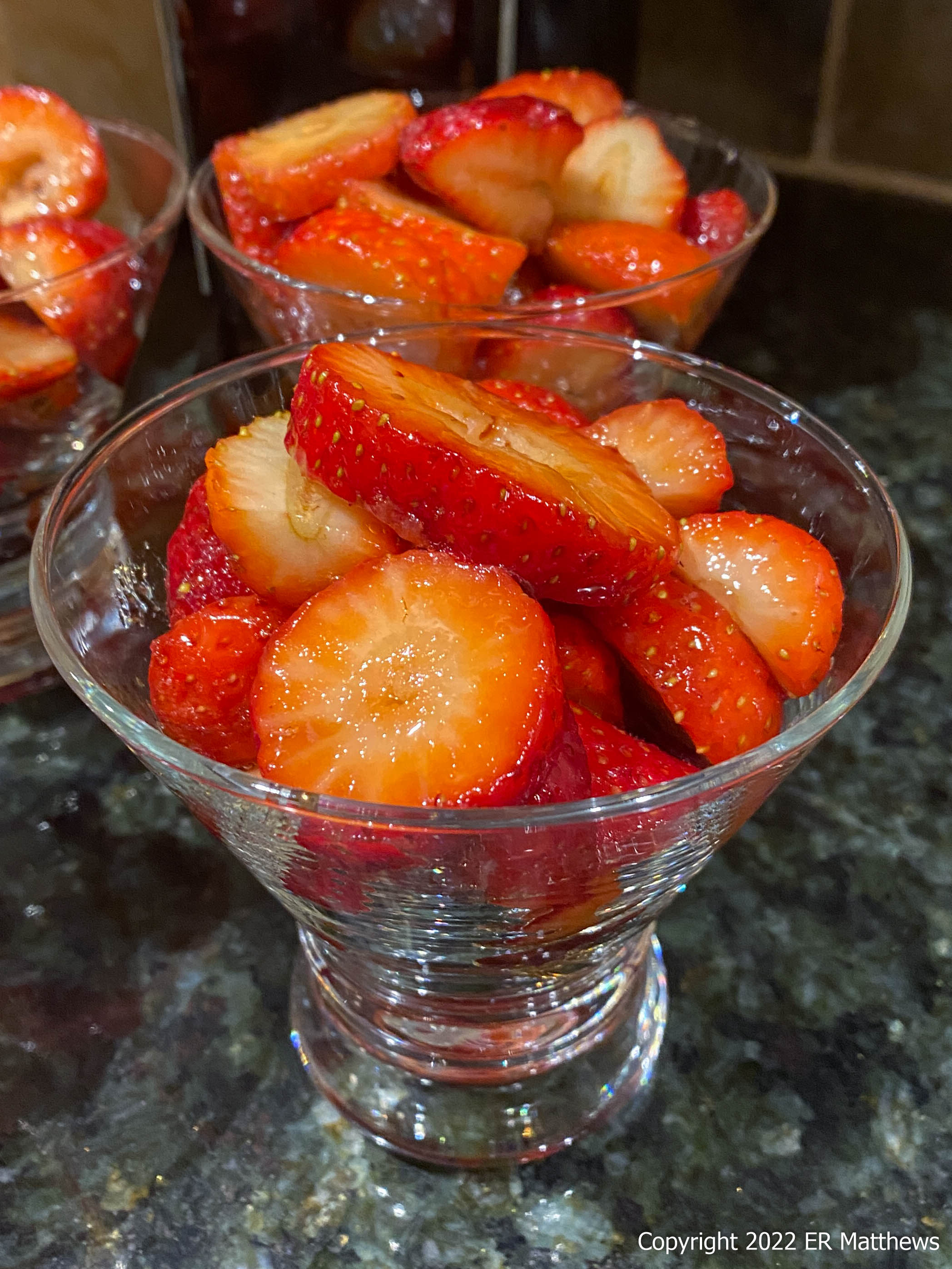
Dessert: Strawberries with Balsamic Vinegar


May 4th was the first day of the Bend Downtown Farmers Market and we were excited to visit it last week. It is still very early days for the market here on account of our weather, but at least some vendors are making the trek across the Cascades to bring us some fresh product from the Willamette Valley, such as these strawberries from the Woodburn area. They were neither super ripe nor super tasty as far as strawberries go, but they were better than nothing. Ann wanted them tossed with a little sugar and a splash of balsamic vinegar and so that's what we had.

Strawberries with Balsamic Vinegar
After several years of not cooking a nice meal for Mother's Day, it sure was nice to get back in the saddle again and to have good friends with whom to share the occasion.

Tuesday, April 19, 2022

Seared Ahi on Mediterranean Salad

Seared Ahi on Mediterranean Salad

Tuna may be the ultimate fish (though in my book, a big slab of Striped Bass is right up there). And it would be a terrible understatement to say that I am picky about my tuna. At the restaurant, I handled a very great deal of very high quality tuna and so most of what I see at the store is several notches below what I used to serve to my customers. Every now and again, which is to say quite rarely, I see a piece of tuna at the store that looks good enough to bring home. As it did back at the end of March.

How to cook tuna is never in question for me. Like scallops, the less cooked it is, the better. If I am going to cook it at all, I will either briefly sear it or lightly grill it, just trying to cook the outer surface. Given that our weather was really cold, I decided to pan-sear this piece rather than to unbury the grill from its mantle of snow.

Here in lovely Bend, Oregon, spring is still a long ways off (with a bunch of snow in our long-range forecast) and yet I yearn for the warmer days. To help put myself in that frame of mind, I thought a really simple chopped salad might just be the ticket.

My so-called Mediterranean salad is grape tomatoes, cucumbers, thinly-sliced red onions, a touch of minced garlic, Italian parsley, and toasted pine nuts. The "dressing" is a simple squeeze of fresh lemon juice, a drizzle of olive oil, and a pinch of Kosher salt.

It's hard to imagine a better warm weather light dinner, even if it is served with snow on the ground!

Tuesday, February 15, 2022

Valentine's Day 2022

As forecast last post, I took six weeks off from blogging to get us relocated from McMinnville, OR to Bend, OR, from the rainy and damp Willamette Valley, across the snowy Cascades, to the arid high desert of Central Oregon. We just got moved into our new house over the weekend. The fact that I am sitting here typing this post is a sure sign that we now have a functional office set up. In fact, getting our internet connection was a big fustercluck, Bend Broadband being a monopoly with terrible customer service.

Sitting at our New Bar for Valentine's Dinner
After spending about twelve hours unpacking and storing our kitchen goods, we were able to use our new kitchen for the first time on Valentine's Day. It's probably safe to say that needing to use the kitchen for Valentine's dinner speeded up the unpacking or at least informed the order in which we unpacked boxes. We could have gone out to celebrate, but we've been out a lot over the last week and don't feel all that well eating somewhat poorly. And then there's COVID, which thankfully is on the decline. We're still trying to avoid being indoors.

Those two reasons aside, Valentine's Day is possibly the worst day of the year to go out. Restaurant staffs, both front and back of house, are stressed, and nobody is doing the best work. Having spent a career in the business, I would never recommend to anyone to go out to eat on Valentine's Day. Yet still, I love to celebrate the day with Annie, unlike all those Valentine's Days where she sat home alone while I catered to all the people celebrating with us at the restaurant, only to stagger home like some nearly dead thing. What a terrible Valentine's Day for her, the chef widow! And so we planned a special meal at home, just for the two of us.

In cleaning out our freezer in preparation for moving, I found a couple of filets mignons that inspired Ann to ask me to make steak tartare for Valentine's. And then remembering the fabulous Argentine red shrimp that we had in Alaska, she also asked for a simple dish of pasta, shrimp, garlic, and butter. How easy was that menu planning? So simple, unlike at the restaurant where we were expected to create seven-course, high-end menus of exotic sounding but approachable dishes for our guests, one regular and one vegetarian.

Our home-cooked celebratory meal gave us a brief chance to test drive both the shopping in Bend and our new kitchen. We came from farm country with minimal shopping opportunities and a house with a top-flight kitchen to a new town with ample shopping opportunities and a sub-optimal kitchen. Now having used the new kitchen, I think we're going to have to gut it and start over in the near term. The awkward layout, barely functional storage, and silly downdraft range on a way-too-small island do not augur positively for my affection.

Steak Tartare, Broadley 2010 "Claudia's Choice"
Steak tartare is one of my favorite ways to prepare beef filet, simply because filet has very little character on its own. Although I find the texture a bit too soft for my liking in tartare, adding capers, shallots, salt, pepper, Dijon mustard, olive oil, and egg yolk is a great way to give the very bland beef a bit of fat and flavor.

Ordinarily, I would have served a lemony Chardonnay blanc de blancs sparkling with this dinner, but I just wasn't foresighted enough to have purchased any. Our usual preference in Champagne tends to the more berry flavors of Pinot Noir and Pinot Meunier, and so that's what we have at the house. And with the moving, buying more wine just to schlep it across the Cascades was a non-starter. As it was, the back of Ann's car was wall-to-wall with cases of wine. Although sparkling would have been my go-to pairing for this dinner, the bottle of 2010 Broadley Pinot Willamette Valley "Claudia's Choice" was  delicious.

Pasta and Shrimp with Garlic Butter
Our main course could not have been any simpler or frankly, better. Our usual diet is low carb, so pasta is a special treat for a special occasion. We were both smitten with Argentine red shrimp up in Alaska this summer when we both tasted them for the first time. These wild-caught shrimp are superbly tender and have a taste much more akin to lobster than typical shrimp. Researching on the internet, Ann found that these shrimp which were unavailable to us in McMinnville are a stock item at the Bend Trader Joe's, a store only dreamed of in McMinnville.

While we were there, we decided to get pasta as well, our nuts-and-bolts grocery store (WinCo) not having a very good selection of brands or cuts. Although our normal instinct would be to make this dish with a long cut, Ann was intrigued by a bag of Trader Joe's brand pasta labeled fusili corti bucati, like little hollow springs. I have had very long versions of this pasta, but never the corti ("cut" or short) version.

I liked the shape well enough, but the pasta itself did not cook very evenly and it was missing that really good al dente bite that I expect of great pasta. Time will tell if this is a one-off or if Trader Joe's brand is only good if we are desperate for pasta.

After several weeks of minimal dining as we packed our kitchen in preparation for the move, and then the few days around the move when we had no kitchen at all, it's great to be back at the range, even if it isn't the most functional!

Ode to the Tortilla

I love tortillas. It wasn't always that way. I am a child of the early 1960s. Then, on the East Coast, our food was influenced by two th...