Showing posts with label potatoes. Show all posts

Thursday, January 1, 2026

New Year's Eve: Latke Board

New Year's Eve 2025 is right at the top of my list of most memorable year-end celebrations. And for all the wrong reasons. Somehow, I picked up a nasty case of food poisoning, and by the time that midnight rolled around, I had all the classic symptoms.

The cautious drive home down the slippery butte in the icy and misting rain-fog-snow mess was excruciating as I fought back wave after wave of gut wrenching nausea. I finally got to sleep around 0300 and when I awoke the next morning, I had strained the ribs on my right side. Fun times.

I should have known something was up earlier; I did not even feel like taking photos which is uncharacteristic.

Small Potato Latkes for NYE Caviar
We made plans with Rob and Dyce to have caviar and Champagne at their house to ring in the new year. All of us really like caviar and I happen to like latkes with my caviar, although the more I think about it, really great potato chips are fantastic and so much easier. In any case, a couple years ago, I came up with an idea for New Year's along the lines of a charcuterie board: a latke board. I had never heard of or seen anyone doing any such thing, but when I typed the phrase into my handy dandy search engine, up popped thousands of photos of people who beat me to the punch.

This reminds me that there is little truly original thought in cooking; dishes are built from a long lineage of precursors. Long ago in my restaurant days, a line cook from another restaurant angrily confronted me outside my restaurant, accusing me of stealing a dish from the menu at his restaurant. As busy as I was, I did not have the time or the energy to look at another restaurant's menu, let alone steal a dish.

I believe that it might have been some kind of beet and goat cheese salad. Because people have been putting beets and goat cheese as long as there have been beets and goat cheese, I am certain that it was not original to either the young cook's restaurant or mine. It was on thousands of menus long before our two.

In any case, my latke board idea reminds me that two people can come up with the same idea independently. My idea was to make several different kinds of latkes, a few pickles, and a few spreads, all of which would work with caviar.

Shallot Pickles and Cucumber Pickles Curing
My Latke Board
Potato, Celery Root, and Sweet Potato Latkes
Cucumber, Shallot, and Cornichon Pickles
Smoked Trout Mousse, Saffron Aïoli, Horseradish-Dill Sour Cream
Smoked Salmon and Caper Mousse
If you can name a root vegetable, I have made latkes from it, and likely fries and chips, or for you Brits, chips and crisps. Of the three vegetables that I picked for this latke board, potatoes will always be the best, but celery root latkes are equally phenomenal. The little sugar in sweet potato latkes is interesting, but makes the latkes want to stick to the pan and want to burn before they are done. Reducing the heat is necessary for making sweet potato latkes.

Latkes with smoked trout mousse was a regular feature of the lunch menu at the restaurant for many years, probably a decade. Ultimately, I believe it was a series of fad diets that did them in. For many years, the ladies who lunch would not order anything fried, no matter how tasty. In any case, apparently I had a reputation for making latkes, as the following cute "diploma" will attest. My oldest daughter, then but a tiny girl, awarded me a "specialty in making potato pancakes." How cute is this!?!

Chef's Diploma with
Specialty in Making Potato Pancakes
For caviar for the restaurant, I always bought from Browne Trading Company in Maine. I still buy from them, but the retail prices are a shock after paying wholesale for decades. Rob bought caviar from a company that is new to me, OM. Their ossetra and Browne's Siberian Supreme malossol were the best of the bunch.

We All Bought Caviar
Potato Chips, Best Vehicle for Caviar

Being the designated driver, I could only but sip a little of the delicious Champagne on offer at Rob and Dyce's. I managed to photograph the two that we bought so that I could remember them. The Gonet-Médeville is a lovely blanc de noirs. The André Clouet "Chalky" looks pretty gimmicky in its white wrap, but it is a fine 100% Chardonnay blanc de blancs. I like it, but I like many others better.

Here's hoping that 2026 proves better than New Year's Eve's inauspicious start.

Monday, June 3, 2024

Memorial Day 2024

Another Memorial Day is in the books. Now that we are starting to have some spring weather, Ann has whipped our courtyard patio into shape and has been looking forward to entertaining out there. So we invited Michelle and Andreas and Jen and Will over for a little cookout and relaxation.

Ann Worked Really Hard to Set Up our Outdoor Space
After a Long Winter
It really didn't take long to put together a menu once we decided that the feature would be ribs. When I look back at our Memorial Day posts, they always feature something on the grill, late May typically signifying the beginning of our outdoor grilling season. The menu we arrived at for this Memorial Day was:

Cannellini and Roasted Red Pepper "Hummus"
Dry-Rubbed Pork Spareribs
Barbeque Sauce
Chimichurri
Potato Salad with Sour Cream and Bacon
Grilled Asparagus
Strawberry-Lime-Chipotle Sorbet

I decided to start with a simple gluten-free appetizer dip for Michelle, a white bean and roasted red pepper "hummus" to be served with almond meal crackers, cucumbers, and sweet peppers. And then there would be pork spareribs for which Ann really wanted me to make chimichurri and potato salad. I wanted to grill some asparagus, because grill. And then Ann asked me to make a sorbet for dessert, and so using really the only fruit that is ripe right now, I made a strawberry-lime-chipotle sorbet as the finale to our dinner. 

When you add in making the barbeque sauce and the dry rub that I call "butt rub," that's a fair amount of cooking. So I took my usual approach of spreading it over three days so as not to overwhelm myself, but mostly so I could do the dishes in shifts and not kill myself washing half the kitchen in the hour before our guests arrived. That hour we reserve for relaxation, showers, and a pre-game glass of wine as we await our guests. 

Saturday, I made the fake hummus, a batch of Carolina "mop sauce" that would be the basis for the barbeque sauce, and a batch of dry rub. The mop sauce recipe is at the bottom of this post; you'll find the recipe is outlined here for the spice mix for the ribs that I call "butt rub." In addition, I made a super simple batch of the white bean and red pepper "hummus," the recipe for which also appears at the bottom of this post.

Vinegar and Pepper Carolina "Mop Sauce"
In my world of pork barbeque, very much influenced by East Carolina barbeque, when you put a hog on the smoker to go low and slow, you baste it (using a mop, hence the name) from time to time with a thin and tangy vinegar, salt, and hot pepper sauce. Mop sauce traditionally contains very little sugar which tends to burn with long hours in the smoker. My recipe appears at the end of this post.

First thing Sunday, I made one of the two more tedious dishes, the base for the sorbet. The tedious bit is spending 20 minutes deseeding the sorbet base, a step that is somewhat optional, but hello, I'm a chef! About the only ripe fresh fruit this time of year is strawberries. Because these strawberries were not supremely ripe and tasty, I decided to trick them up with a bit of lime and a bit of chipotle as a surprise. I put spice in a lot of my sorbets; it is both unconventional and interesting to taste a bit of a fruity sorbet only moments later for the spice to creep in on the back of the palate. My recipe is at the bottom of this post as well.

Deseeding the Strawberry Purée
While deseeding the sorbet base, I brought a pan of salted water to a boil and blanched three bunches of asparagus until just barely tender, about five minutes. I stopped the cooking in cold water and put the asparagus in the fridge to await the grill the next afternoon. When I am grilling asparagus, I almost always blanch it so that all it needs to do on the grill is get beautiful grill marks and a bit of smoke. If asparagus has any thickness at all, you risk charring the outside on the grill in an attempt to get it cooked all the way through. Precooking eliminates this risk.

Next I was on to the potato salad that Ann requested. While a potato salad still warm from the just-boiled potatoes has its appeal, I like to make potato salad the day before so it, like the sorbet base, can repose in the refrigerator and have its flavors mingle and become more pronounced. My potato salad recipe also appears at the bottom of this post.

Potato Salad with Sour Cream, Bacon, Green Onions, and Parsley
Monday I made the other really tedious dish: chimichurri. It is only tedious because when I make it for friends, I like to destem the herbs and cut them by hand. Blitzing everything in the food processor makes short work of the sauce, and I wouldn't blame you for doing it, but the texture does suffer. I have previously published my chimichurri recipe; Monday I made a double batch.

Parsley and Cilantro Flavor the Red Wine Vinegar and Olive Oil Base
Thirty Minutes Later, Destemmed Herbs Ready to Chop
Chimichurri with Hand-Chopped Herbs
Soon after tidying up from making the chimichurri, I set about the ribs, because I wanted them to sit in their coating of spices for a couple hours before starting to cook. I do not have a smoker, given that our only outdoor space is a confined courtyard where the smoke would be unwelcome. So, I opt for cooking my ribs in the oven and then finishing them on the grill outside.

My ribs were the three-pack from Costco, not gonna lie. I don't have a good pork supplier here in Oregon. After skinning them (pulling the silverskin layer off the backside using a towel for grip), I cut each of the three racks into three single-serving pieces. I do this because sparerib racks are typically longer than my half sheet trays and I do not want any drips from overhanging racks hitting the bottom of the oven. It might be sacrilegious, but not having to deep clean my oven trumps pristine racks of ribs.
 
Ribs "Marinating" in Dry Rub
When I dry-roast pork in the oven, I almost always place the pork on a bed of onion slabs. The onions add a little moisture to the pork, they keep the pork off the bottom of the pan in the same way that roasting it on a rack would do, and they are a super-tasty bonus that I planned to use later on in making my barbeque sauce.

After standing for a couple of hours to let the dry rub penetrate a bit, the ribs went into the oven. I planned a 3-step cooking process: covered to cook the ribs through, uncovered to develop the bark, and finally, mopped with sauce and re-covered in dry rub and onto the grill for a final char.

I covered the sheet trays with aluminum foil and sealed them tightly before putting them in the oven. These ribs were really thick so they ended up taking about three hours in a slow oven (275F) to get to the point where a toothpick would easily pierce them. At this point, I removed the ribs to clean sheet trays and put them back into the oven for another 45 minutes to develop a nice crust, a nice bark.

At this point, I turned off the oven and let the ribs sit until I was ready to grill them, at which point, I brushed them with sauce, re-coated them in dry rub, and put them on a hot grill for about five minutes to caramelize the sugar in the dry rub and to reheat the ribs.

Appetizer: Cannellini and Roasted Red Pepper "Hummus"
Feast is Ready!
Three Rib Accompaniments
Chimichurri (left), Dry Rub (top), Onion BBQ Sauce (right)
I'm not a big fan of barbeque sauce in that I often think that it obscures rather than complements the hard work of the pitmaster. Accordingly, I always serve a little more dry rub on the side to dust on the barbeque, if guests desire. As I mentioned earlier, Ann is a big fan of chimichurri (honestly, who is not?) and asked me to make a batch of this salsa verde to go with the ribs. And recognizing that others may indeed want barbeque sauce with their ribs, I made a complementary sauce.

This sauce I made quickly in the blender. When I uncovered the ribs, I separated the onions from the liquid in the bottom of the roasting pans. I put these meltingly tender dry rub-flavored onions, three very large ones in total, into my blender. I added three-quarters of the mop sauce (3/4 of a pint) to the blender and gave it a couple quick pulses. Then after defatting the liquid from the roasting pan, I put enough of it into the blender to yield a sauce of the consistency I wanted, the consistency that you see in the photo above. I left a decent amount of texture in the onions.

Jen, Goofing!
Somebody Must Have Told a Good Joke
Will Holding Court

Recipes


Cannellini and Roasted Red Pepper "Hummus"

Once upon a time, I threw a similar dip together using items on hand in my pantry, and the idea stuck. This is a ratio recipe: 4 parts white beans to one part roasted red peppers.

2 15.5-ounce cans of cannellini, drained
8 ounces roasted red peppers, piquillos preferably
two cloves of finely minced garlic
half a teaspoon of Kosher salt
a quarter teaspoon of smoked paprika
one tablespoon of sherry vinegar
two tablespoons of extra virgin olive oil

Put all the ingredients in a food processor and smooth it out as much, Season it and serve, or refrigerate it for some hours to improve the flavor. After it warms up a bit, taste it and re-season as necessary.

Carolina "Mop Sauce" for Barbeque

Here's my classic vinegar sauce. I roughly respect the recipe, but I always make it to taste. This makes roughly a pint, plenty of mop for several shoulders or many racks. Traditionally in eastern North Carolina, the peppers used would be crushed dried red peppers or ground cayenne and often there's a touch of ketchup for color and a bit of sweetness. I use the peppers I have on hand (there's no ketchup in my house) which tends to be Huy Fong sambal oelek (crushed red jalapeños) and Huy Fong sriracha. Also typical is brown sugar. I don't happen to use it much and when I do, I buy it in bulk and buy just what I need. But I do have Demerara in the pantry, so I use that.

one pint apple cider vinegar
4 tablespoons of Demerara sugar
2 tablespoons sriracha
2 tablespoons sambal oelek
1 tablespoon Morton's kosher salt
one teaspoon of coarsely ground black pepper

Put all the ingredients into a non-reactive sauce pan and bring them to a gentle boil to integrate the sugar and salt. Once cooled, taste for seasoning.

Strawberry-Lime-Chipotle Sorbet

This recipe will yield about a quart and a half of base, enough for 8 servings. I add all the seasonings to taste. This recipe is best when made the day before and refrigerated overnight so that the lime zest has time to do its job. Although it is not necessary to deseed the sorbet base, it's about 1000% better if you go to the effort (and it is effort) to do it.

4 dry pints of strawberries, hulled and halved
2 limes
1 cup sugar, or to taste
half teaspoon of Kosher salt, optional
1 ounce vodka, optional
two tablespoons chipotle adobo, to taste

While I have specified a cup of sugar or to taste, less sugar is not really an option. A good-textured sorbet (I'm not going into theory and Brix levels here) requires sugar even though the fruit might already taste sweet enough. That's why we balance the sugar with additional acid in the form of citrus (or at times a vinegar such as balsamic).

Also, I use salt to help balance the sweet. You'll never know that the salt is there but what you will notice if you taste a base with and without salt, the salted one will likely taste better. Most good pastry chefs will sneak some salt into their recipes for this reason.

Finally, I add a half a shot of unflavored vodka to the base because that tiny amount of alcohol will help break up the large ice crystals in the sorbet and yield a smoother product. By all means, if you cannot have alcohol, omit it.

Before getting started, zest and juice one of the limes. Reserve the other lime for later.

Place the strawberries, sugar, salt, vodka, lime zest, lime juice, and one tablespoon of chipotle adobo in the blender and blend until smooth. Next, push the base through a fine chinois or strainer to remove the seeds. I use a standard 2-ounce ladle to push the base through my chinois. This, unfortunately, is going to take some time and elbow grease.

Zest the other lime directly into the base and taste it. I decided that I needed the juice of half the reserved lime to balance the sweetness and that I wanted another tablespoon of adobo to bring slightly more heat. Refrigerate the base to macerate, preferably overnight. The lime flavoring from the zest will become much more pronounced after sitting overnight.

Taste and adjust seasoning just before putting the base into the freezer. I deemed that this batch of base needed nothing else, but that it not always the case.

Potato Salad with Sour Cream and Bacon

This potato salad is simple and can be served warm or cold or at room temperature. I like to make potato salad the day before I serve it so that it can repose in the refrigerator and have its flavors mingle and become more pronounced. This recipe starts with a ten-pound sack of potatoes and makes a really big bowl of potato salad, because, who doesn't like to eat too much potato salad? I used parsley and green onions in this batch, but you can use the herbs that suit you. How bad would tarragon and chervil be in this? Not at all bad; it would be wonderful.

10 pounds of small potatoes cut into bite-sized pieces
1 pound of bacon cut into lardons and cooked, grease drained
1 pint of sour cream (or more)
1 bunch of Italian parsley, minced
1 bunch of green onions, sliced (or chives, minced)
salt to taste

Place the potatoes in a large pan, add a tablespoon of salt, and cover with water. Cook, about 20 minutes, until the potatoes are just done. Drain the potatoes and while still warm, transfer to a large bowl. Add the the cooked bacon, sour cream, parsley, and onions or chives. Mix well and season to taste with salt.

You can serve this salad warm and it is wonderful. Or place it in the refrigerator overnight to let the flavors of the herbs and bacon bloom. If you refrigerate it, let it warm a bit and then taste for seasoning. Also, you may want to add more sour cream to make it creamier, though I never do because I am lactose-intolerant.

Saturday, April 6, 2024

Easter 2023

Ever since Ann's father passed away in 2016, we really haven't celebrated Easter all that much. With no family to cook for, it has seemed kind of pointless. This year, Rob and Dyce invited us over for Easter ham dinner which was much appreciated. It is very hard to find anyone who is willing to cook for me. People are intimidated by feeding a chef, but paradoxically, as a bunch we are just pretty happy to have anyone cook anything for us at any time.

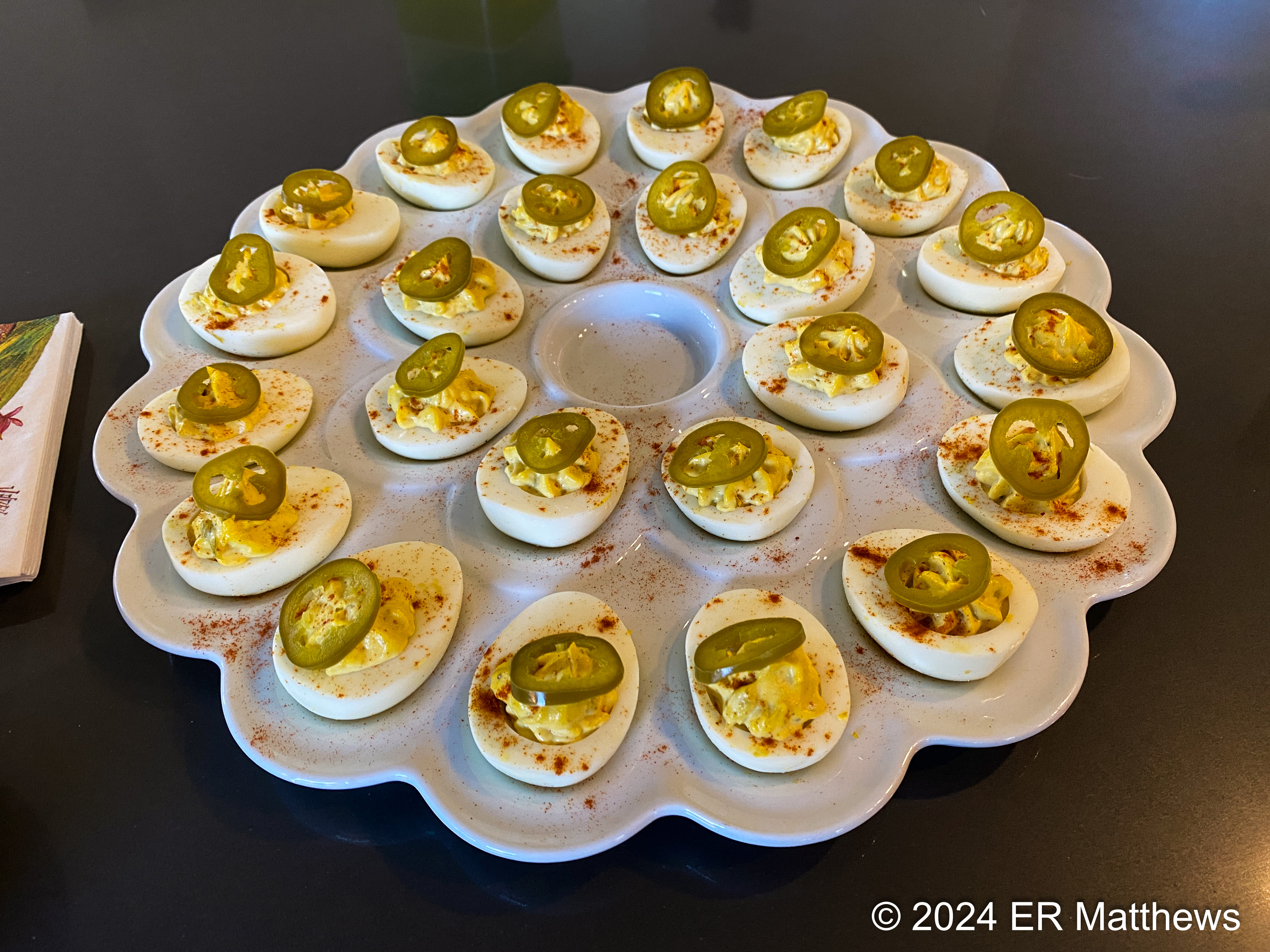
Easter Sunday late afternoon we drove across the river to Rob and Dyce's house on a beautifully sunny day. We were greeted with delicious cocktails whose name I can no longer remember, if ever I knew. As I recall, they consisted of St. Germain, lime, mint, and sparkling wine. They were refreshingly delicious and worked well with Dyce's deviled eggs made with pickled jalapeños.

Deviled Eggs with Jalapeño
Going over to their house is always a treat for us in that we are guaranteed to get our dog fix in visiting with Lola and Reilly. We really miss our dogs and these two help with that. Lola's a crazy bundle of non-stop energy, while the smaller Reilly is much more sedate, but rules the roost.

Busted!
Reilly is Never Far From Rob

Rob smoked a Kurobuta (Berkshire) ham from Snake River Farms, a regional (next door in Idaho) purveyor of fine beef and pork. You'll see a lot of their products in high-end restaurants in this area.

Rob's Ham Fresh from the Smoker
Dyce made a salad to accompany the ham that was equally tasty and unusual. Don't quote me on this as I was too busy eating to dissect it, but I believe the salad was primarily shaved raw brussels sprouts, roasted artichoke hearts, cannellini, Italian parsley, and grated cheese (pecorino or Parmigiano) in a shallot vinaigrette.

Dyce's Salad of Brussels Sprouts, Cannellini, and Artichoke Hearts
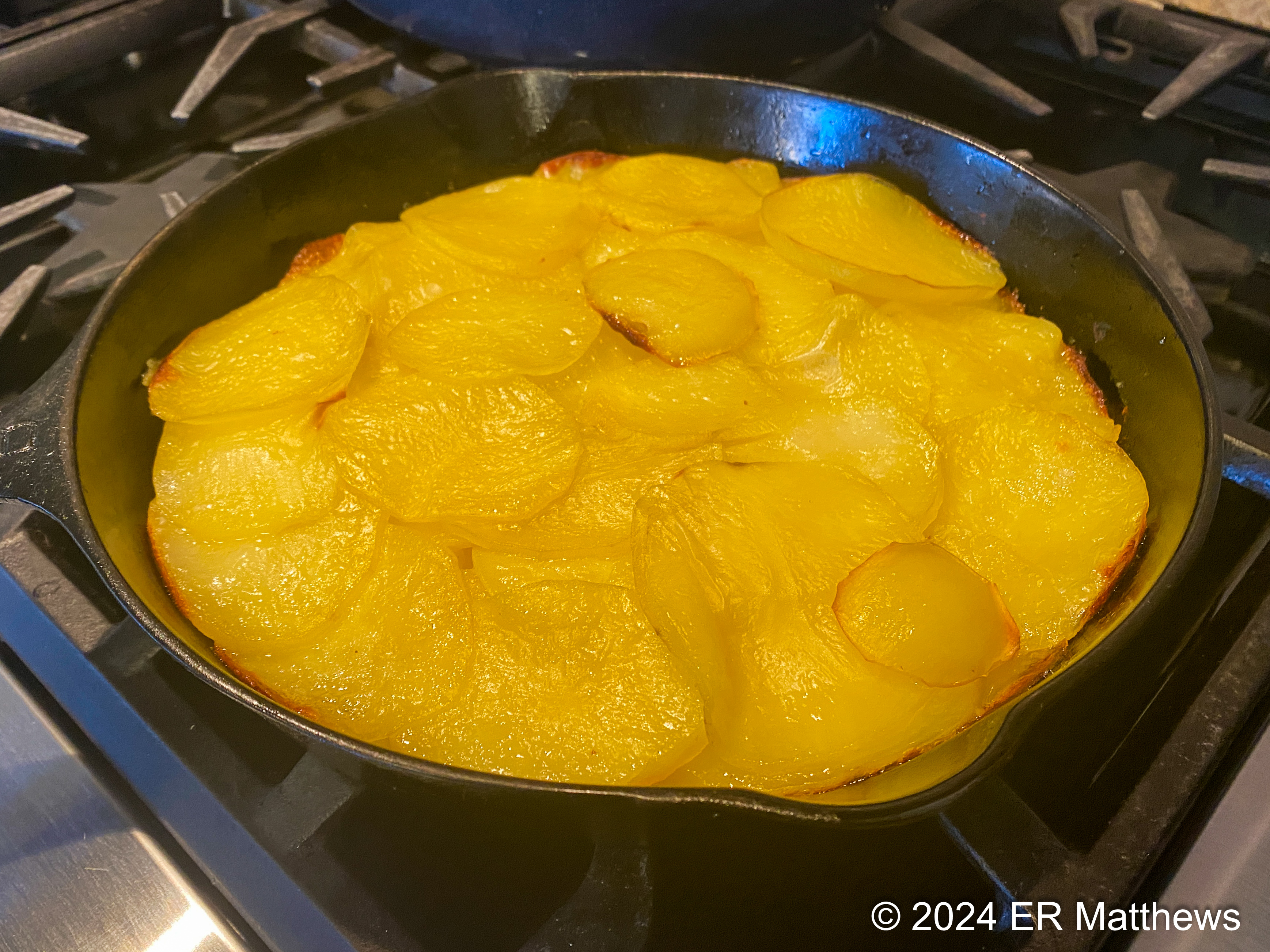
Rob had asked me some weeks ago to make pommes Anna to accompany the ham. When he asked, neither he nor I knew that the vast majority of times that I have made pommes Anna at home, it has been for an Easter celebration. I determined this by looking at all the pommes Anna posts I have made over the years. Some coincidence!

I tried something new for this pommes Anna that I cannot recommend. Because we were having the potato dish at Rob and Dyce's house, I wanted to do the majority of cooking at our house and then finish it at theirs so that it would be hot for dinner. Pommes Anna cooks in two steps: first, covered to essentially steam the potatoes done and then uncovered, to dry them out a bit and finish the dish.

I decided to do the covered cooking at home and transport the potatoes to their house still covered and finish the uncovered cooking part in their oven. While in theory this was a good idea, in reality, during transport, the potatoes glued themselves to the bottom of my cast iron pan and would not release. I put the finished cake back together as well as I could, but it was a disappointing outcome. Now I know.

Pommes Anna with Yellow Potatoes

With the ham and potatoes, Rob opened a stunning dry Riesling from the Nahe, the 2020 Schäfer-Fröhlich Bockenauer Felseneck Riesling Grosses Gewächs. This was a first-class wine and a natural pairing with ham. Ham is a tricky dish to pair with wine because it is often very salty, smoky, or sweet, or really any combination of those three.

While Riesling is a great choice, we don't have any in the cooler from last summer, so what to bring? My pairing rule of thumb has always been, when in doubt: Pinot Noir. Because of the inherent sweetness of ham, I prefer a younger wine that still has a lot of its fruit, so I opted to bring a 2021 Patty Green Pinot Noir Estate Old Vine Ribbon Ridge, which is one of the best of the splendid 2021 Willamette Valley wines that we have tasted.


And finally, a few more photos.


As always, Ann and I so enjoyed our time with Dyce, Rob, and the girls. If we do it again, I won't be splitting the cooking of the pommes Anna between houses!

Friday, March 8, 2024

Riding the Proverbial Bicycle: Killer Potato Gnocchi

Here in beautiful Central Oregon in early March, we've endured an extended stretch of snowy weather that continues to influence our dinners, making us crave warm, filling, slow-cooked meals, rather than the light, crisp, and refreshing meals that warm weather will make us desire.

Potato Gnocchi with Pork Ragù
The other day with snow streaming out of the sky, Ann and I were nestled under blankets on the sofa opposite the fire when she mentioned seemingly out of nowhere that pasta with pork ragù would make an awesome dinner. She was thinking of the bag of ragù that I had stashed in the freezer from the last time that I made a big batch. And no doubt she was thinking that we'd spend some together-time in the kitchen knocking out a batch of fresh pasta.

A few minutes later, I was walking through the kitchen where I spied three big russet potatoes starting to sprout on the counter. These unfortunate-looking spuds sat unused from one of our planned dinners back at the end of the year, a dinner that we cancelled on account of illness. Those potatoes prompted me to ask Ann if gnocchi would scratch her itch, rather than fresh pasta. We agreed on gnocchi to go with the ragù.

It's been a good long time since I made potato gnocchi. At least for the last decade and probably longer, I have been making ricotta gnocchi almost exclusively. But I am no stranger to making potato gnocchi, having made countless of the little dumplings in my life.

In fact, I remember on a dark day at my restaurant spending a majority of the day making a huge batch of potato gnocchi with my friend Frank, a typically brusque New York Italian and a hell of a baker, to serve at a big charity event. That batch started with five 50-pound cases of russet potatoes and a 50-pound sack of flour! So yeah, I have some experience making potato gnocchi.

Making potato gnocchi for the first time in ages was like riding the proverbial bicycle for me. Once you know how to ride, even if years have elapsed since the last time you rode, you can hop right on and pedal away. Like riding a bike, making gnocchi is something that you have to do for yourself to learn. I can write you all the instructions in the world for riding a bike, but that is in no way going to help know what it feels like to maintain your balance. Ditto for gnocchi. Learning what a proper gnocchi dough feels like is 100% a hands-on experience. Fortunately, learning to make gnocchi is much simpler than learning to bicycle.

Two final thoughts on potato gnocchi. First, ideal gnocchi should be light little pillows that remind you of mashed potatoes. The wetter the potatoes, the more flour you have to add to the dough to be able to handle it. The more flour you have to add, the denser and more leaden the gnocchi are and the further away from the ideal they become.

So, a lot of people recommend that you bake your potatoes rather than boil them, the thought being that baked potatoes do not absorb water as boiled potatoes do. While that is true, the gnocchi end up tasting of baked potatoes rather than of good mashed potatoes. For me, baking potatoes results in less than ideal gnocchi, even if they are easier to make and clean up. So I boil them exclusively.

Second, the type of potato that you use for gnocchi really matters. Gnocchi are not the place to showcase fancy potatoes. Save your cute waxy potatoes for potato salad and salade niçoise. What you want for gnocchi is a starchy, dry potato. Fortunately, the ideal gnocchi potato is one that we grow here in Oregon and next door in Idaho. This potato is the most common potato in the US, the russet that you can find at any grocer.

Making Potato Gnocchi

To start, peel the potatoes, cut them into large cubes (I will cut a typical 70-count Idaho into 16 pieces), put them in cold salted water, and boil them until you can pierce them easily. Drain the potatoes well.

While the potatoes are hot, put them through a ricer (at the restaurant, we used a large manual food mill) as in the photo below. Using a large spoon, turn the steaming riced potatoes over a few times while they cool to the point that you can touch them. This will allow some of the steam (and hence the water) to evaporate further.

At this point, start heating the water that you're going to poach the gnocchi in. You want to cook them soon after you shape them. This time, I ladled the potatoes out of the boiling water and added more fresh water to the already hot water in order to conserve both water and time.

Ricing the Boiled Potatoes
My Ricer Has Taken a Beating over 35 Years
Add a sprinkle of salt and some flour to the riced potatoes. I like to start with a large kitchen spoon of flour per large potato, knowing that it will probably take more later.

Add Flour and Salt
Mix the flour in well with your hands, kneading really gently. Taste for salt and adjust as necessary. You want a dough that just barely holds together. I ended up adding a fourth large kitchen spoon of flour to yield the dough that you see in the bowl below.

This is the finesse step of making gnocchi. If you've never made them before, add flour sparingly, knead sparingly so as not to develop the gluten in the flour, and test cook a lone gnoccho or two to see if it holds together during poaching. If so, you're golden. If not, add a bit more flour and retest. Soon enough, your hands will be able to feel when the dough is correct.

I have found that during the course of making gnocchi in a hot (restaurant) kitchen, the later batches of dough seems to take more flour compared to the earlier batches. It seems that as the dough sits, it can require more flour, so the goal is to shape them as quickly as possible. In any case, go easy on the flour and trust your feel.

Gnocchi Dough Ready to Roll
To start shaping gnocchi, cut a long piece of dough. For example, I cut the disk above into four long slices. On a lightly floured board or counter, using flat palms, roll out the dough into a long rope as you did in kindergarten with clay. I like my gnocchi rope to be slightly less than an inch (call it 2cm) in diameter, but the size is up to you. Then with a scraper or bench knife, cut the gnocchi rope into pieces. I like mine just slightly longer than wide, as you can see Ann cutting below with a plastic scraper.

Cutting the Gnocchi Rope into Pieces
Once they have cut the dumplings, a lot of people will roll the gnocchi on the back of the tines of a fork to give them little ridges that will help capture the sauce. I do that sometimes, but this time, I used a technique that I've seen a lot of nonne use: dimple each one with a thumb as you see in the photo below. These dimples are also pretty effective at capturing a bit of the sauce.

Gnocchi, Dimpled with my Thumb
Transfer the Gnocchi to a Lightly Oiled Sheet Tray
Once your gnocchi are ready to poach, adjust your cooking water so that it is lightly simmering. Drop the gnocchi into the water batch by batch taking care not to overcrowd the pan. You will see that they drop immediately to the bottom. And when they're done, they will float to top of the water. Actually, I give the little dumplings 30 extra seconds once they float. The process is quick; these gnocchi floated in about two minutes, give or take.

Gnocchi Just Dropped in Simmering Water
Gnocchi are Cooked When They Float
Scoop the gnocchi onto a well-oiled sheet tray as each batch finishes. If you will be using them later in the day, let them cool completely and then cover them with film such that they do not dry out. If you are using them later, I recommend reheating them one of two ways. First, you can reheat them in butter (or olive oil) in a skillet on the stove top. You can even brown them if you like; this is definitely non-traditional in Italy, but it is damned good. Or second, you can mix them with their sauce in a shallow ovenproof dish and bake them in the oven for 15 minutes or so.

But really what I recommend is to toss the hot gnocchi with their sauce and serve them immediately.

Poached Gnocchi, Ready to Sauce or to Cool
Even though it's probably been longer than a decade since I last made potato gnocchi, it was as easy as getting back on a bike and riding off down the street! This batch of gnocchi was killer and the perfect antidote to a cold, stormy, snowy day.

Mendocino, Part 4 of 4

Friday October 2 As I came to, the raspy gargles of a pair of ravens sitting in the eucalyptus just outside our open balcony door greeted me...