Showing posts with label sausage. Show all posts

Sunday, October 27, 2024

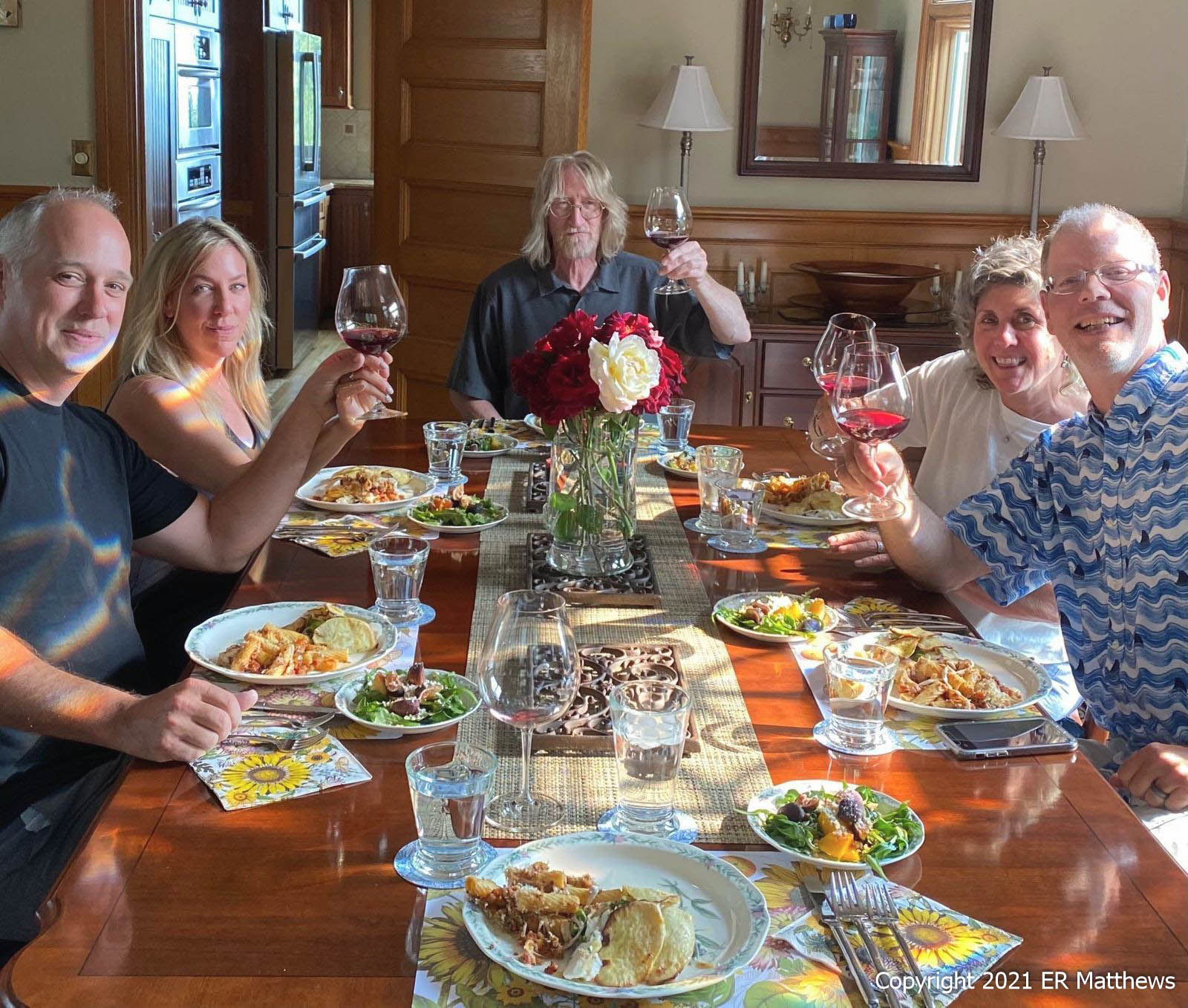
Goodbye Rob and Dyce

While we were in Italy for three weeks, Rob and Dyce decided, quite suddenly as it appeared to Ann and me from the outside, to pack up their belongings and move to Boulder. They told us about a week after we returned from Italy that they would be gone within days, by the end of October. Talk about dropping a bomb!

A Farewell Cassoulet
As sad as I feel about their leaving, I'm a big believer that everyone has to find happiness where happiness can be found. And so, if Bend is not the right place for Rob and Dyce, they should go and find the right place. We wish them all the best in Boulder; it is a great town. When I was a young man, I spent a fair amount of time camped out at the Hotel Boulderado while calling on customers at the IBM locations in and near Boulder and at HP just up I-25 in Fort Collins.

After they shell-shocked us over dinner at their house, a house that was in the process of being dismantled, we all wanted to get together one final time to celebrate. Rather than celebrate at a restaurant, Ann and I preferred to have them to dinner at our house, where we could be assured of a great meal, restaurant quality in Bend being somewhat suspect. We set a date for the final Saturday night that they would be in Bend.

Later on at home, I asked Ann to ask Dyce what they would really like for dinner. Almost immediately came a response that I would have never expected: cassoulet. Of all the dishes in the world, it was going to be cassoulet. Dyce asked if it would be possible. With only three days left before our planned dinner, the answer was yes, but just barely. I did have a pound of really great beans on hand (Steuben Yellow Eye beans rather than Tarbais, different but equally good) and I could just get the cassoulet made in 72 hours. Cassoulet is only as good as the stock you cook it in and great stock takes a long time to make. For me, it's a three-day process and if I started right away, I had three days to make it.

Having done all the shopping and prep on Thursday and Friday, on Saturday morning, I started the cassoulet cooking. By the time they had arrived at 6:30, I had punched the crust down 9 times. Each time you punch the crust into the broth, it enriches and thickens the broth. Traditional lore in France says you must punch the crust into the broth a minimum of 7 times.

What to drink with dinner? Naturally, we are all huge white Burgundy fans and so I met the guys at the front door with a glass of Bouchard Beaune du Château. While it is all well and good to start with a white, a long-cooked cassoulet demands red. But which?

White Burgundy to Start
Those who drink wine at our house know that we have one wine cooler that we designate the do-not-touch cooler. This is the cooler in which we have all our great wines as well as some that will be great after laying down for a long time. If there were ever an occasion to scrounge in this cooler for a wine for dinner, this would be the time. And so, I pulled out a bottle of 1995 Côte-Rôtie the day before and let it stand upright overnight to settle out any solids. Then I gently decanted it about an hour before they arrived.

Gangloff Côte-Rôtie 1995: Brilliant
It is always a crapshoot when opening an older bottle of wine, but it helps to have held the wine in your cooler since it was released as I have this wine. The fill level was great and the cork could have been new, not 30 years old. Thankfully, there was no whiff of cork taint at all. I cannot count the number of times I have opened old bottles just to have to pour them out. This wine was beautiful, with great color, bright acidity, gentle tannins, and aromas and flavors of leather, smoke, and dark fruit. This bottle was brilliant and everything you want a great wine to be. We sipped it with reverence.

I was so off my game that I forgot to take any people pictures and I just barely snapped any at all.


With a heavy meal like cassoulet, I decided not to do any appetizers. None of the four of us is a huge eater. I made a simple salad of arugula and julienned fennel and apples that I dressed with a vinaigrette made with an acidic sherry vinegar. With a heavy dish like cassoulet, you want some bright acidity to counterbalance the long-cooked beans and high fat meats.

Arugula, Fennel, Apple, Sherry Vinaigrette
Cassoulet and Salad
This post is about saying goodbye to friends; there are plenty of others that address how to make a cassoulet. Here's one that discusses a similar cassoulet.

And so here's to Rob and Dyce! It's been great having you as neighbors here in Bend and we wish you all the best on your new adventure in Boulder. We'll see you this summer!

Friday, March 1, 2024

February Celebration: The Luckiest Beans on Earth

Let's Celebrate!

Mid-February has become a time to celebrate at our house. Valentine's Day, my birthday, and our anniversary of having moved to Bend, this year our second so-called Bendiversary, all fall within a week of each other. Accordingly, we aim to have a small party each February to mark these events. What better to do in this bitter cold season than have a party?

Another February Cassoulet in the Books
For this year's celebration, Ann asked me to make a cassoulet. If you have never had cassoulet, it is a bean and meat stew with four components: beans, meat, stock, and a mixture of diced aromatic vegetables called mirepoix. If you look back to all my cassoulet posts, I tend to make them in February at the worst of the cold season for good reason. Cassoulet is arguably the greatest cold weather comfort food in the world. Thank you France for this wonderful celebratory concoction!

Prepping for Cassoulet

For the cassoulet that I would serve on Saturday night, I started the prep work early Friday morning, right after shoveling the overnight accumulation of snow, a pretty typical chore on a February morning. The day-before prep for cassoulet is pretty limited: soaking the beans overnight and making some delicious pork stock in which to cook the beans.

The first step in making stock is to roast your bones. For pork stock, I use pork neck bones that are both inexpensive and contain delicious meat. I am guessing that if they are readily available here in Central Oregon, you can find them just about anywhere. The trick with roasting bones is time. Put them on a lightly oiled sheet tray in the oven and roast them until they are golden brown on all sides, turning them as necessary. It's not a process that you can or should rush. Cassoulet is only as good as the stock that you cook the beans in.

Having turned the roasting pork neck bones on the sheet tray and put them back in the oven to continue browning and getting sexier and sexier, I was standing at my cutting board, my nose reveling in the porky goodness of the aroma emanating from the direction of the oven. I remarked to Ann, ensconced on the sofa by the fire and nose down in her phone, "How do think these beans are going to feel, being slowly cooked in all that porky goodness?" And she replied, "They're going to be the luckiest beans on earth!"

While the bones were roasting, I did some pre-prep on the vegetables for the mirepoix: onions, carrots, leeks, and celery. While I would dice the mirepoix vegetables on Saturday morning, I wanted the vegetable scraps today for flavoring the stock. To that end, I peeled the onion, trimmed the ends of the carrots, peeled off the tough outer leek leaves, and trimmed the leafy ends of the celery. Be sure to wash the leek leaves well; they can accumulate a lot of dirt, or worse, sand.

After the pork neck bones browned, I put them in a stock pot with all the peels, ends, and scraps of the mirepoix vegetables. Filled with water, the stock pot simmered gently for several hours before I separated the solids from the stock. The stock went into the refrigerator to congeal so that I could remove the fat from the top. After the solids cooled, I picked all the neck meat from the bones to put into the cassoulet on Saturday.

Last thing before going to bed Friday night, I put two pounds of beans in a bowl and covered them with a lot of salted water to soak overnight. I had been wrestling with the choice of beans for a few weeks. Two weeks prior, I put an order in to Rancho Gordo for a big box of beans including my two potential candidates for the cassoulet: Tarbais and Steuben Yellow Eye beans.

I have made many cassoulets in my life, about half with the traditional bean from from the Tarbes area in the far southwest of France up against the Pyrenees, the Tarbais bean; and about half with a traditional American bean called the Steuben Yellow Eye, purported to be the original bean in Boston baked beans. Heretofore, I have always slightly preferred the yellow-eyed beans.

Both beans are loved because while holding their shape, they become ultra creamy inside, exactly what you want for cassoulet, which is nothing if not a super peasant dish of pork and beans. After waffling for days on the choice, I decided to go with the original beans, the Tarbais. I was not disappointed; the resulting cassoulet could not have been better. And I still have Steubens to craft into some other delicacy!

Cassoulet Assembly


Would Anyone Manage to Get Here for Dinner?
Overnight Friday into Saturday morning saw a considerable amount of additional new snow and the forecast had it snowing all day. Both of the couples we invited live up big hills that the snow could make impassable, so during the day on Saturday we weren't sure if our party would come off or if we would be eating cassoulet by ourselves. Regardless of the weather, cassoulet is pretty much of an all-day affair and I needed to get started on it. After shoveling snow again, naturally.

The first item of business was to get the beans par-cooking. I drained them and placed them in a stock pot with fresh water and a bouquet garni of fresh rosemary, fresh thyme, and fresh sage. These herbs would impart a slight flavor to the beans while making the kitchen smell amazing for the 90 minutes in which the beans par-cooked.

In my past restaurant days, we had all kinds of meat garnishes for the cassoulet, especially after we butchered one of the hogs that we had a local farmer raise for us. In addition to pig's feet for the stock, we had a lot of trimmings from which I would make traditional garlic sausages. And we would cure, roast, and confit the hog bellies which aged under their bath of congealed duck fat in the walk-in next to vast containers of confited Moulard duck legs. In short, our walk-in contained every kind of meat garnish a cassoulet cook could want.

But now post-restaurant at home in a fairly small city a half a day's drive from anywhere, meats are limited to what I can get at the grocery store, especially because the farmers markets are inoperative at the height of winter; you know, snow and all. Having little alternative, I just decided to go with what I could scrounge at the store. I ended up buying a large tray of chicken thighs and a small tray of breakfast sausage links to use along with all the neck meat that I picked from the stock bones.

While the beans were par-cooking, I browned the chicken and sausages in fat I had saved in the refrigerator from my last couple of batches of chicken confit. And while the meats were browning, I diced all the vegetables I pre-prepped yesterday into mirepoix. This finely diced mix of carrots, onions, leeks, and celery, I cooked in the same pan in which I browned the meats, scraping hard to get all the brown meat bits into the vegetables.

While the mirepoix was cooking, I minced and added an entire head of garlic to give a nice garlicky background note to the cassoulet. The reason for so much garlic is because I would typically have made the dish with a garlic sausage instead of the mild breakfast sausage that I used for this cassoulet.

Once the beans were par-cooked, tender but still a bit crunchy, I drained and mixed them with the mirepoix and then seasoned them to taste with salt. No longer working in the restaurant, I do not have a pan big enough to accommodate this amount of beans and meat, so I decided to use two pans. I put a quarter of the beans in each of the two pans and topped them with 4-5 bay leaves each. Then I split the pork neck meat, chicken thighs, and sausages between the two pans and covered them with the remaining beans.

At this point, I should mention the one cheffy thing about this cassoulet. From time to time, I make chicken confit, that is, chicken cured overnight in a salt and herb mix, then rinsed and slowly poached while submerged under olive oil. Then this chicken gets refrigerated submerged under the fat, which congeals and protects it from spoilage.

After the chicken is all consumed, I melt the remaining fat and pour it into a container to keep in the refrigerator where the fat congeals on top of any juices from the chicken. I reuse the fat for the next batch of confit, but the intensely flavored juices go into a soup or stew. For this cassoulet, I browned the meats and cooked the mirepoix in some of this confit fat and I added the congealed juices (a half cup) to the cassoulet along with the pork neck stock.

After removing the layer of fat from the stock that I made on Friday, I warmed it briefly to liquefy it. Into each casserole, I poured enough stock to cover the beans by a good centimeter and put them in a slow (300F) oven to start the process of becoming insanely good. I checked the beans periodically to make sure they had enough liquid. Each time a crust would form on top of the beans, I would mash it back down into the stock, topping off the stock if necessary.

This process of crusting and breaking the crust and re-crusting over hours is essential to cassoulet. I want to say that the beans cooked slowly for about seven hours and I probably broke the crust four to five times during my forays from the fireside into the kitchen.

While this is a good description of the process of making a cassoulet, a more exact recipe follows just below.

Cassoulet in the Oven
Essential to Let it Crust and Re-crust over Several Hours
Cassoulet Cooling after Seven Hours in Oven

February Cassoulet Recipe


This is a cassoulet, beans aside, that you can make from stock items at the grocery store. In fact, despite the lack of duck confit and other great ingredients, the is the single best cassoulet I have ever made. In other words, don't let lack of ingredients deter you from making a cassoulet. As for the beans, great beans are easily available via mail-order from Rancho Gordo (note that they call them Cassoulet Beans, rather than the Tarbais beans that they are).

This recipe is based on two pounds or a kilo of beans, enough to feed 8-10 hungry people. You'll want to attack a cassoulet over two days, the first given to making the stock and soaking the beans, and the second to cooking the cassoulet itself.

Pork Stock


This stock is made from inexpensive pork neck bones plus the trimmings from all the vegetables that you will use in the cassoulet. If you have a choice, try to select the meatier bones; the meat will go into the cassoulet. This recipe makes a good gallon/4 quarts/4 liters of stock, enough for two pounds or a kilogram of beans.

oil to coat a sheet tray
5 pounds pork neck bones
5 quarts/liters water
tough outer leaves from one large leek, washed well
ends and trimmings from 3 medium carrots
peel of one medium onion
hearts and leafy ends of one bunch celery

Coat a sheet tray with oil and spread the bones out in a single layer on the tray, then place in a moderate to hot oven. Roast until the upper surface is golden brown then rotate the bones to brown another surface. Continue in this fashion until the bones are brown on all sides.

Remove the bones from the sheet tray to a stock pot. Pour enough water onto the hot sheet tray to cover it. With a scraper or spatula, deglaze all the brown bits from the bottom of the sheet tray and pour into the stock pot. Repeat as necessary to get all the brown bits into the stock pot.

Add the remaining water and vegetables to the stock pot and bring to a simmer for a minimum of two hours. I cooked mine for four hours. At the restaurant, we kept stock pots going all the time.

Strain the solids from the stock. When the stock cools, refrigerate it overnight so that any fat in the stock congeals and can be removed easily from the top of the stock. When the solids cool, pick all the meat from the bones and save for the cassoulet.

Cassoulet


This makes a large quantity of beans, enough to feed 8-10 people. Make sure that you have a deep pan or casserole large enough to hold the beans and all the meats. Or use two, as I did. No longer do I work in a restaurant where we had a braiser (called by its French name rondeau) large enough to hold 5kg of beans! When browning the meats, take your time and do it correctly. This is a key step in building flavor.

2 pounds/1 kilogram of Tarbais or other white beans, soaked overnight in salted water
bouquet garni of 1 large sprig each of fresh sage, fresh thyme, and fresh rosemary
1/2 cup oil/lard/duck fat for browning meats
10 chicken thighs, bone-in and skin-on, 5-6 pounds
1 12-ounce tray breakfast sausages
reserved pork neck meat from stock recipe above
1 large leek, in small dice
3 medium carrots, in small dice
2 large stalks celery, in small dice
1 medium yellow onion, in small dice
1 head of garlic, minced
10 bay leaves
salt to taste
1 gallon/4 liters pork stock from recipe above

Drain the beans and cook them in fresh water with the bouquet garni (the fresh herbs, tied together with a string) until tender, but not cooked all the way through. This will take about 90 minutes give or take.

While the beans are cooking, brown the chicken and the sausage thoroughly on all sides. Remove the meats to a platter while you cook the vegetables.

When the meats are browned, in the same pan, add the vegetables and garlic and cook gently until the vegetables are soft and the onions are translucent. Scrape the bottom well to incorporate all the brown bits from the meats into the vegetables.

When the beans are cooked, drain them and mix them with the cooked mirepoix. Season to taste with salt.

Place half the beans in the bottom of your casserole (or a quarter of the beans, if you are using two pans like me).

Give the beans a sprinkle of salt (there's no salt in the chicken, pork neck meat, or stock) and spread the bay leaves on top of the beans.

Next spread the meats over the beans and then top everything with the remaining beans and a final sprinkle of salt.

Pour the defatted, melted stock over the beans to cover by a centimeter or so.

Place the cassoulet uncovered in a slow oven (say 300F) and let it cook slowly. Mine was in the oven for seven hours, so you should get it cooking in the morning to eat at dinner time.

Keep an eye on the cassoulet from time to time. Cassoulet needs to crust, have the crust mixed back into the broth, and re-crust several times. Keep an eye on the stock level and add more as needed. I believe that I broke my crust four times during seven hours and added a bit more stock twice.

The Rest of Our Celebratory Dinner


Cassoulet in the oven, my thoughts turned to an appetizer, something easy and delicious for a cold winter day. We just recently got an order of pantry items in from Amazon (here in Central Oregon, access to less common grocery items is extremely limited), including a tin of fennel pollen, a couple liters of Sherry vinegar, and a couple jars of Calabrian chile paste. Yes, Virginia, these are stock items in a retired chef's pantry and spice drawer.

With these items in mind, I started building the menu. For the Calabrian chiles, Ann had been talking about spicy honey for days and I spent some time musing on what would taste really good with that sweet and spicy sauce. In fairly short order, I came up with using the sauce on some fennel-spiced meatballs that our guests could graze on before dinner. Who doesn't like a good meatball?

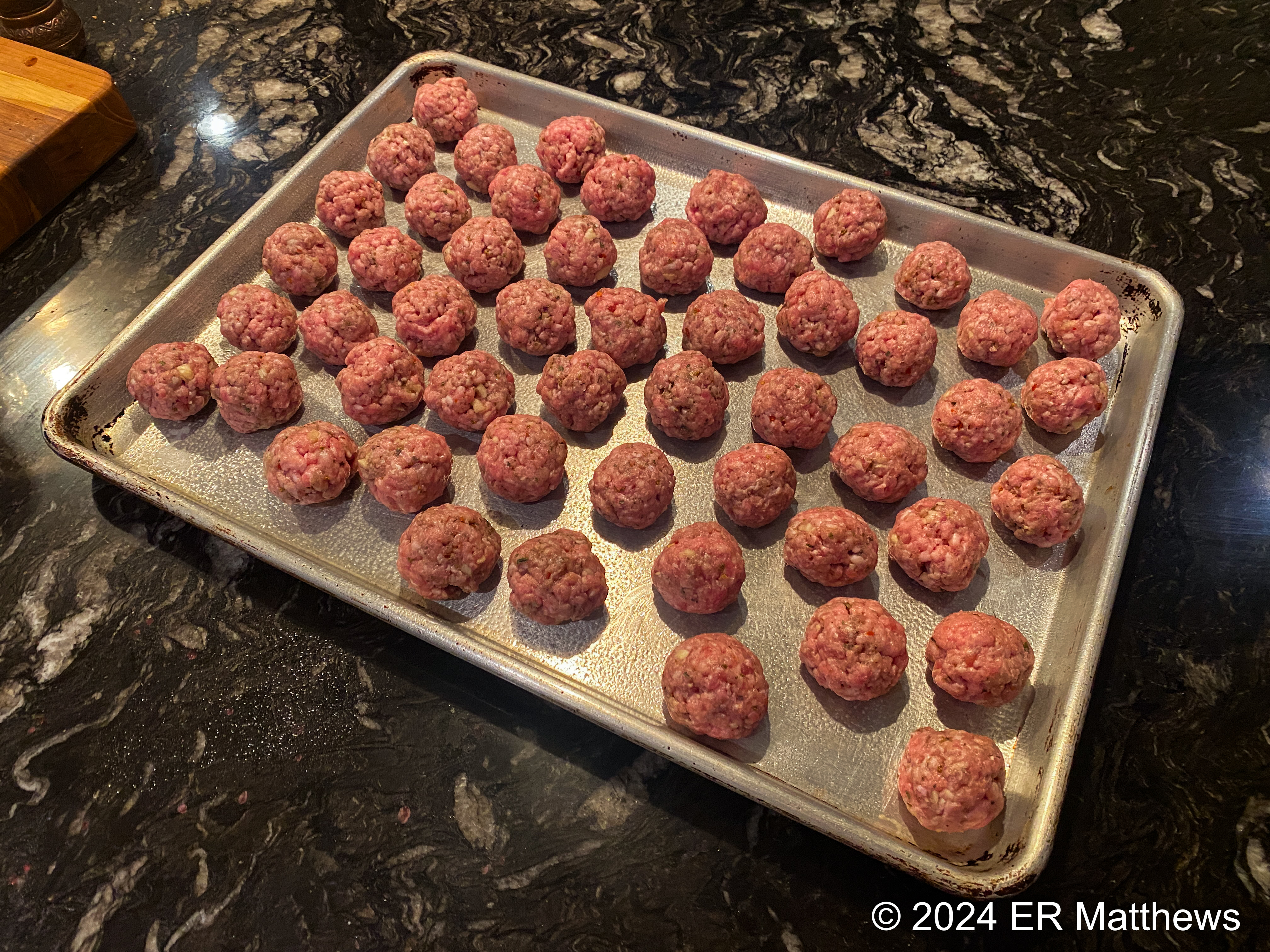
I wanted to keep the meatballs fairly plain to let the Calabrian chile honey be the star of the show, but I did want to incorporate the fennel pollen that had just arrived at the house. The seasoning of the meatballs, made from ground pork, is simple: salt, dried basil, fennel pollen, garlic, and red wine. I mixed this all up in the afternoon and fried a quick test piece to check the seasoning. After adjusting the seasoning to our liking, into the refrigerator went the meatball mix to sit and infuse the seasoning throughout the meat.

After washing up from the meatballs, I made a quick salad dressing for the pound of baby arugula that I had brought home for the store, which is where the Sherry vinegar comes in. I started with one part of sherry vinegar and two parts oil (a splash of French hazelnut oil and the rest extra virgin olive oil) and tweaked it to taste with salt and agave nectar. When I was happy with the taste and acid balance of the dressing, I added a finely minced shallot to the dressing and left it on the counter to be mixed with arugula and thin slivers of pecorino at dinner time.

About a half an hour before our guests were to arrive (still no weather cancellations at this point!), Ann and I rolled the 2-1/2 pounds of meatball mix into small 1" (2.5cm) balls. For ease of cooking, I decided to bake them rather than fry or braise them. The meatballs went in the bottom of the oven under the still cooking cassoulet, which I topped with a bit more stock.

Fennel Pollen Meatballs Ready to Bake
When the meatballs came out of the oven 20 minutes later, I sprinkled them with flaky salt and more fennel pollen, then transferred them to a bowl for serving while Ann made final tweaks to the table, glassware, and so forth. I decided to serve the Calabrian chile honey on the side in case one or more of our guests was not a fan.

Fennel Pollen Meatballs, Calabrian Chile Honey
Just about the time appointed time for our guests to arrive (and knowing full well that the trip to our house would be slow on account of the still pouring snow), Ann cracked a bottle of wine for us to start pre-gaming it . While she was doing this, I went outside to remove the 2.5 inches of snow that had fallen in the the last hour from the sidewalk and to try to clear some space at the curb so that car doors could open without getting stuck in snow mounds.

Cassoulet Wine Pairings 


You've heard the saying, "What grows together, goes together"? It's a philosophy that I have always ascribed to in wine pairings. In other words, a good rule of thumb in wine pairing would be to go with the wine from the area from which the dish originates (when possible).

Living in Oregon, our wine coolers are stuffed with our local wine (Pinot Noir) and are sadly bereft of wines from Southwestern France where cassoulet originates. Unfortunately, these relatively obscure French wines are hard enough to source in major metropolitan areas and pretty much impossible to find out here in the boonies. But still, while Ann was out at her exercise class in the morning, I asked her if she would go by the store near her studio and pick up some French wine for dinner.

Cassoulet is a hearty dish that can pair with a wide variety of reds, anywhere from a light Gamay to a heavy Cabernet. My preference is to match the weight of the dish and the wine, opting for heavier rather than lighter wines. For heavier wines, I really like Cahors (Malbec) or Madiran (Tannat), both sturdy reds, with cassoulet.

Knowing the likelihood of finding such a wine was about nil, plan B was to have Ann grab some southern Rhônes, which are what we call GSMs, being made from any combination of the grapes Grenache, Syrah, and Mourvèdre. She came home with three wines, a Châteauneuf du Pape, a Lirac, and a Gigondas. All were delicious. Alternatively, we could have opened some of our GSMs from Walla Walla and the Rocks District from just north of us along the Columbia River.

Three Southern Rhône Reds for Dinner

Celebrating February


I am afraid that I was so intent on our guests that I forgot to take pictures. Rob and Dyce, sorry! What few I did manage are below.

Pre-Gaming it in Front of the Fire
Ann's Simple Tablescape
with Valentine's Gift Boxes for Guests
Andreas and Michelle
Cassoulet and Arugula Salad
Another cassoulet, my best ever, is in the books. I'm so thankful to have great friends with whom to share it.

Tuesday, September 6, 2022

Labor Day 2022

Labor Day means less to me now than when I was actively working, even though I never really had the chance to celebrate it when I was working. At the restaurant, Monday was a workday for me and at the winery, Labor Day was a decent retail sales day, so no day off for me. But now, it is a chance to celebrate the end of summer. Ann and I both thought that we should do something a little out of the ordinary. Out of the ordinary means meat, which doesn't figure frequently in our diet.

And what better way to celebrate Labor Day than by hitting the grill? Silly me, I forgot we were out of propane, but that comes in a few sentences. We both love great sausages on the grill and recently we have found Bangers and Brews, a local eatery that makes (and retails!) great dogs. Up until now, we have been disappointed in the local sausages. A few trips to Bangers and Brews has solidified for us that their andouille is one of our favorites and so last week, we visited, had a choripan and an andouille, and bought a pound of andouille to bring home with us.

Andouille, Smoked and Spicy
We both love peppers and onions on our sausages, so I picked up extra onions and poblanos at the grocery store, poblano being the only mild green pepper I use (aside from a random Anaheim). I really do not care for the assertive flavor of green bell peppers. When I went to hit the grill on the afternoon of Labor Day, I realized that we were out of propane. Like duh, the empty propane tank is in the house sitting by the back door!

Poblanos and Yellow Onions
So plan B: hit the stove. We decided to eat late afternoon because we had plans to hear a band that evening, doors open at six. We were watching a movie on TV, Casablanca maybe?, and while watching that, I started the onions and peppers cooking. It takes a half an hour or so to get them meltingly tender. Meanwhile, I put the andouille in a dry pan over low heat and let them take their time in browning and getting warm and crispy.

Because our dogs were bunless and we wanted to eat them on the sofa while watching the movie, I sliced them, put the slices in a bowl, topped them with a big pile of peppers and onions, and then slathered on a gracious plenty of chimichurri from a batch I made last week to eat on carne asada.

Andouille, Onions and Peppers, Chimichurri

Recipe: Chimichurri


Folks, chimichurri is not a constant thing that can be captured in a one-size-fits-all recipe. It is a loose sauce that everyone wings based on an inexact formula and everyone's version is no doubt slightly different. I am sure people measure ingredients, but I've never seen it. Following is an idea of how I made mine this time. In looking back at my recipe from 2008 on the restaurant blog, I see that even I am not consistent in how I make it. Whatever! It's all good!

1 bunch cilantro, stemmed and finely chopped
1 bunch parsley, stemmed and finely chopped
4 cloves garlic, finely minced
1 large shallot, finely minced
1/2 teaspoon crushed red pepper flakes
1 teaspoon Greek (not Mexican) oregano
1/2 teaspoon Kosher salt
1/4 cup red wine vinegar
3/4 cup extra virgin olive oil

Mix all ingredients well. Taste for acid and oil balance. I like my sauce fairly tart, but tartness depends on the acidity in the vinegar and all vinegar is different. Here, I have specified one part vinegar to three parts oil. I generally make it closer to 1:2 or sometimes 1:1. If your chimi is too tart, add more oil. Too oily, add more vinegar. Taste for seasoning and add more salt, spice, and oregano as you desire.

Some people like a more fluid sauce, some people like more solids. This version is more solid heavy. If you want closer to a vinaigrette, double the amount of liquids in the sauce. It's easy! Go nuts!

Labor Day Concert


On Monday afternoons, our recent habit is to go to Silver Moon Brewing to partake of half-price beers on locals day. But we skipped it on Labor Day in favor of going later in the day to see a band. They have an outdoor concert space that they call the Moon Room and they book small acts to play there from time to time. It really is a fun place to watch decent bands.

For Labor Day, Silver Moon had booked a group from the Bay Area called Proud Mary, a four woman group self-billed as the gayest CCR tribute band. Even if our kids have never heard of CCR, who in our age bracket doesn't love CCR?

Proud Mary on Stage
Gonzo Girl!
A Horse Great Dane
We had a wonderful time and the band really was a lot of fun and pretty talented too. Moreover, we met a lot of people who aren't the usual crowd that we see on Monday, including a couple of guys who just moved to Bend from New Mexico just seven days prior. We made plans later in the week to show them a couple of our favorite breweries and food trucks. But most of all, we enjoyed the huge and young brindled Great Dane pictured above. He towered above the table at which we were seated and every now and then, I would get a big old slobbery muzzle in my face. We really miss our two dogs Grace and Charlie who we have lost in the past year.

Sunday, August 15, 2021

Pranzo di Ferragosto

A few weeks ago when Greg and Bridget visited from Portland and we went wine tasting at nearby Maysara Winery in the McMinnville AVA, they had discussed the possibility of Ann and I celebrating Ferragosto with them the weekend after we returned from Alaska. This was the first time that I, or my full-blooded Italian wife, had ever heard of Ferragosto, the Italian Feast of Assumption celebrated on the 15th of August.

Having been in the software business with an Italian distributor, I did recognize that much of the country (a lot of Europe too) takes August (or a large chunk of it) off, but I was ignorant that there was a mid-month celebration. Deconstructing the term, I recognized ferr (as in the French jours fériés, holidays, feast days, celebrations) and agosto (the month of August after Augustus Caesar). 

The plan was that on the 15th of August, we would get together at Greg and Bridgets's house in Portland, watch the film Pranzo di Ferragosto, one of Bridget's favorite flicks, pop our pranzo into the oven, then dine on the two principal dishes from the film. Greg would make the fish dish and asked me to make the pasta. He sent me recipes for both dishes.

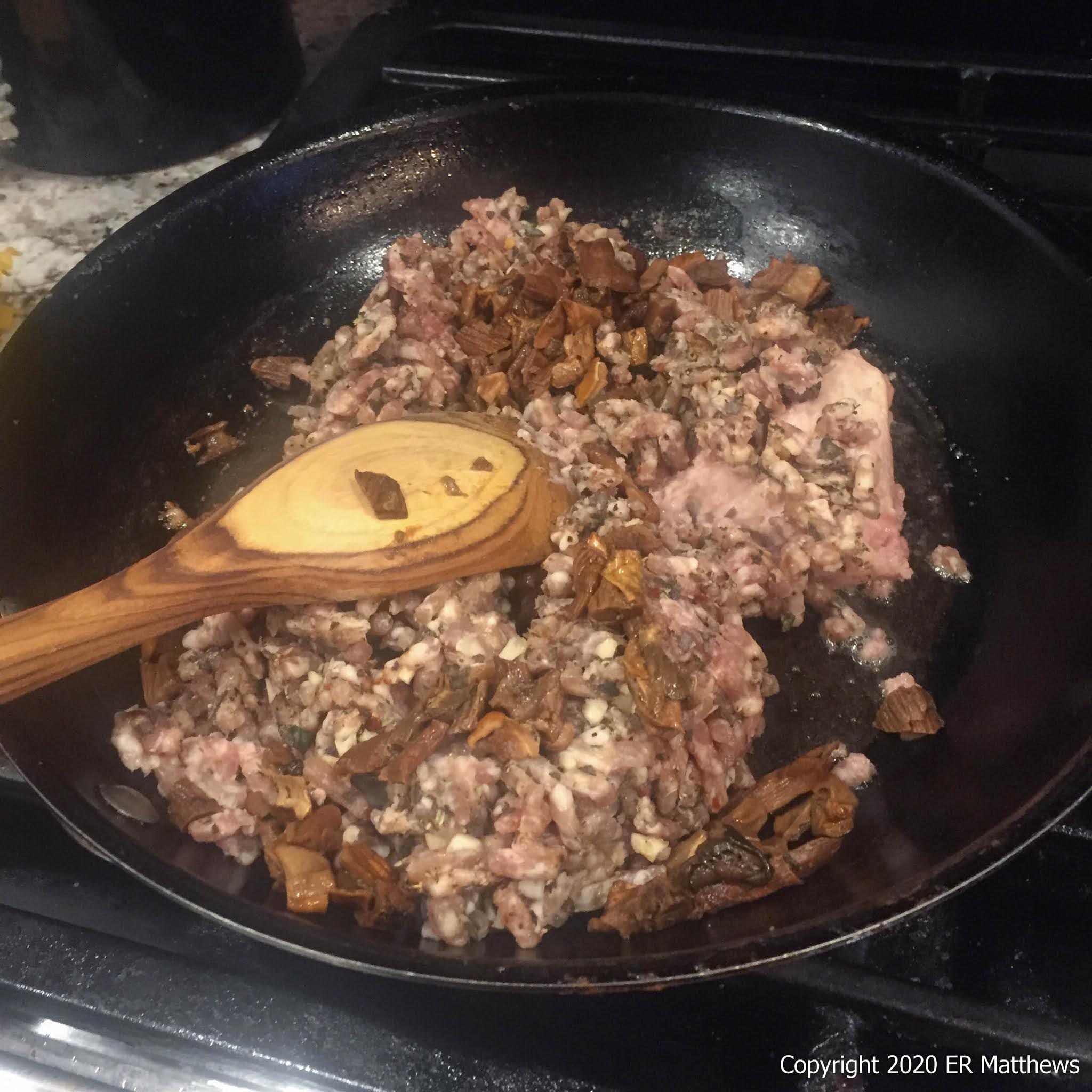
I'm not a recipe guy and in making Pasta al Forno, baked pasta, a dish I have made countless times, while I kind of adhered to the spirit of the recipe, I felt free to do my own thing. And I noticed that Greg did his own take on the perch and potato dish, doing halibut with a covering of white sweet potatoes instead. My meat sauce is made from a bit of home-made sausage, a bit of pancetta, and I augmented the mirepoix with reconstituted dried porcini. I added the porcini broth to the sauce as it cooked down.

Ingredients for my Ragù
Cooking Down the Meat Sauce
One Layer of Pasta, One of Mozzarella
Final Layer of Pasta, Then Pecorino Romano
When we arrived, we met their friends Will and Corinne, down for the weekend from Seattle where Greg and Bridget had lived prior to relocating to Portland. After introductions, we went downstairs to the wine cellar where they had laid out a beautiful array of cheese, charcuterie, and crudités which we enjoyed with sparkling wine.


After appetizers and sparkling wine, we watched Pranzo di Ferragosto, a charming film, if a little short. While the movie was nominally about a guy who gets hoodwinked into babysitting four elderly women, his mother included, while everyone else deserted Rome for the holiday, I found it to be primarily a love story about the main character's home of Rome. Certainly Rome is a major character in a movie full of characters, played largely by non-actors.

Back upstairs after the film, we put the pasta and the fish in the oven to cook and yakked for a good while. Once the two pre-prepared dishes had baked, we relocated to the dining room and started our own feast, followed by Corinne's arugula and fig salad, and then finishing with a delicate fig cake from a local Russian bakery. It's really a lot of fun to sit around a dinner table and chat over a lengthy meal, something that we don't do nearly enough of.

Friday, November 27, 2020

Thanksgiving 2020: Lasagna

[Updated December 20, 2025: Since the inaugural lasagna of 2020, I find myself making this lasagna most Thanksgivings. Naturally, each year, I forget exactly how I made it the preceding year. I added more details and clarification this year to help with next year. I am also sketching out recipes for others who want to recreate this dish.]

Once again, it is Thanksgiving, my favorite holiday. While this infamous year of 2020 has been terrible for many reasons and thankless in many regards, we should all be able to find something in our lives to be thankful for. Despite all the negatives this year, Ann and I are grateful that we and our kids are well, that the girls have not contracted COVID despite working in healthcare, that Carter has chosen a direction for his life by enlisting in the Army (and is currently at boot), and that we are able to make ends meet, even if times are lean.

Our 2020 Thanksgiving celebration will be truly odd, one spent without friends and family. None of our friends want to risk exposure by coming for dinner any more than we want to by going to their homes. Ditto for family, but our family is all back East and getting together wouldn't have been possible anyway. Still, Thanksgiving is a time to gather and celebrate and we will miss that this year. Damn this virus!

Back in September, Ann and I got to kicking around Thanksgiving and what to do, knowing that hosting friends and family was a long shot. I had, some years ago, proposed doing an off-the-wall Thanksgiving meal: a paella, all the traditional turkey and flavors rolled into one totally non-standard pan of rice cooked over a fire in the back yard. That didn't fly at the time and we shelved the idea for the future, maybe next year. In a similar spirit this highly non-traditional year, Ann asked, "Why not make a lasagna?"

Thanksgiving Lasagna: Delicious!
Why not? Ann and I have cooked decades of traditional Thanksgiving dinners, so really, why not something totally off the wall?

For me, a lasagna will be almost new territory, my experience with lasagna being scant. It's not a dish that I ever eat and the first and only lasagna that I ever made was in 1985! You cannot count those times at the restaurant when we would cook a two-foot long sheet of pasta and weave it back and forth in a bowl, putting a filling between each fold, and rushing it to the dining room. Giant pain in the rear to plate? Check. Cool dish and fun presentation? Check. Lasagna? Definitely not.

After a couple days of imagining what a Thanksgiving-style lasagna could be, I proposed to Ann to do two layers of turkey in gravy, and between those a layer of sage pork sausage in béchamel and a layer of "turkey stuffing" ricotta, ricotta flavored with all the aromatics that go into traditional Thanksgiving stuffing. Ann said, "It needs mushrooms." And so I will add some dried porcini to really amp up the pork sausage béchamel (you know that's a fancy term for what we call sausage gravy and put on our biscuits down South!). Finally, I decided to top the whole shebang with cornbread breadcrumbs to give it a great top crust.

Despite its appearance, this dish is not a simple one. It entails significant prep work spread over days: roasting turkey with pancetta butter under the skin, making cornbread and cornbread breadcrumbs, making turkey stock, making turkey gravy, prepping and sweating the mirepoix for the ricotta, making the sausage, and then the sausage béchamel. This is all before par-cooking any lasagne and building and baking the lasagna, the fun part in which Ann and I will make a little mess in the kitchen.

Fortunately, almost all of the work can be done in the days leading up to Thanksgiving, leaving just the easy and fun part for the day of. The best thing about spreading the prep out over several days is spreading the resulting dishes out over several days too. There is nothing quite like making a complicated meal requiring hours of work only to be confronted by mountains of dishes afterward.

The results were fantastic. Sometimes dishes that take a lot of effort to prepare are not worth the effort. This was not one of those times. A highlight for the both of us were the super crunchy cornbread breadcrumbs on top.

The following post outlines how I make the dish over five days. You could certainly do it in fewer; four is easy and three is not bad. Two days is pushing your luck and stamina. The following recipes are scaled to fit a standard restaurant half hotel pan with rough interior dimensions of 11.5"L x 9.25"W x 2.5"D. This will yield up to 12 portions of lasagne, though I often cut it into eight.

You will need the following equipment for this lasagna:

half-hotel pan or other similar sized baking pan
food processor (for pancetta butter)
sausage grinder (for sausage)
stock pot (for stock)
roasting pan (for turkey thighs)

Shopping Day (was Monday November 16, 2020)


Because of COVID, I have no desire to be out at the grocery store shopping along with the crowds the week of Thanksgiving, so I am doing all my shopping the week before. Everything will keep or can go in the freezer. The turkey parts that I want, necks for the gravy and stock and thighs for the turkey layers, are frozen when I buy them at the store, so they go right back into the freezer once home.

My timing at the grocery store proves to be impeccable. After searching for turkey thighs without luck but having been told that they would be for sale, I approach a man stocking a meat case and ask him about them. As he finishes slicing open the box in front of him, he reaches inside and pulls out a package of frozen turkey thighs for me. I am almost too early to get them. I am so glad that I do not have to make another trip to the store with COVID spiking again.

Shopping List


Produce
Orange, seedless, 1 (for relish)
Cranberries, 12 ounces (for relish)
Onions yellow, 2 large (1 for stock, 1 for ricotta)
Leek, 1 large (leaves for stock, remainder for ricotta mix)
Celery, 1 head (for stock, for ricotta mix)
Garlic, 1 head (for sausage)
Italian parsley, 1 bunch (for stock, ricotta mix)
Sage, 1 bunch (for stock, for ricotta mix, for sausage) dried also works well)
Thyme, 2 bunches (for stock, ricotta mix, rillettes, sausage)

Meat
Turkey necks, 4 pounds (for stock and rillettes)
Turkey thighs, 6-7 pounds (for lasagna)
Pancetta, 4 ounces (for pancetta butter)
Bacon, 1/2 pound (for rillettes)
Fatty pork shoulder, 1 pound (for sausage)

Spices
Nutmeg, whole, 1 (for rillettes)
Sage, dried, to taste (if needed, for sausage, ricotta mix)
Salt, to taste
Black pepper, to taste
Crushed red pepper flakes, to taste

Dairy
Ricotta cheese, 1 pint
Butter, 4 ounces
Pecorino romano, 4 ounces
Milk, 1 quart (for cornbread, béchamel)
Eggs, 4 large (for cornbread, for ricotta mix)
Mozzarella, grated, 2-3 cups (for lasagna)

Pantry
Sugar, granulated, 1/2 cup 
Porcini mushrooms, dried, 1 ounce
Cornmeal, 2 cups
Flour, all purpose, 3 cups (for cornbread, béchamel, gravy)
Lasagne, 22 each (2 boxes)
White wine, 1/2 cup (for sausage)
Vegetable oil or pan spray

Sunday (was Sunday November 22, 2020)


Thanksgiving prep begins today, five days out from the big event. I take the turkey thighs out of the freezer to thaw over the next couple of days. Today's job is making the stock from which I will ultimately make the gravy. First thing this morning, four pounds of turkey necks that I thawed over the last couple of days go into the oven at 350F to roast. After an hour or 90 minutes, I flip them over and roast them another 45 minutes to an hour. Timing is not critical as long as they brown well on all sides.

Turkey Necks Ready for the Oven
Turkey necks are one of my favorite parts of the bird and are a source of fine and flavorful dark meat. I always make my stock from them. Besides being great for stock, necks are also delicious eating on their own. One of my favorite ways to prepare them is to brine them and then smoke them low and slow until they are deliciously golden and falling apart, a sinful treat.
Turkey Stock Mise en Place
Great gravy requires great stock and great stock requires patience. After the necks roast for the better part of the morning, the stock takes the entire afternoon, coming down from a gallon to about a quart and a half, all told.

To make the stock, the roasted necks go into a stock pot with all their pan drippings; the tough outer leaves of a leek; a medium onion, chopped with peel on; a heart of celery, chopped; two of my last remaining sprigs of lovage; a bunch of English thyme; and a sprig of sage. This gets covered in water and left to simmer all afternoon. The house smells like Thanksgiving which is so appropriate because it is gray and 37 degrees and raw and miserable outside. The kitchen should be and is a haven, a pleasant respite from outside.

Turkey Stock and Neck Meat
After cooking at the barest simmer all afternoon, the stock is ready. Ann helps strain the stock and I put it into containers for the refrigerator. Once the necks cool enough to handle, I start picking the meat, a favorite task of mine because it reminds me of picking necks with my mother. It is extremely difficult to pick all the meat from the neck bones with your fingers, leaving delicious morsels to eat for anyone willing to suck on the bones. I helped my mom picked neck bones just for this reason, so that I could snack on the remaining meat. I give Ann a few necks bones to try; they are delicious.

Turkey Neck Stock


This recipe will yield a quart and a half of stock, enough to moisten the turkey neck rillettes and to make the turkey gravy. In the days leading up to Thanksgiving, I often collect miscellaneous scraps in a bag in the freezer to augment the stock. This might include chicken bones/skin, thyme stems, parsley stems, onion peels, leek leaves, and so forth. The list below is the bare minimum for making stock.

4 pounds turkey necks
1 cup water, chicken stock, or vegetable stock for deglazing
outer leaves of one leek
1 medium onion, cut in 1/8ths with peel on
1 heart of celery or three outer stalks, roughly chopped
1 small bunch of fresh thyme
1 bundle of parsley stems
1 sprig of sage
Water to cover, several quarts

Roast four pounds of turkey necks, rubbed with oil, in a moderate oven, say 350F. Flip them when they are well browned, after about an hour. Continue to roast, about another 45 minutes, until well browned all around.

Remove the turkey necks to a stock pot. Deglaze the roasting pan with the cup of water or stock, scraping well to incorporate all the brown bits from the bottom of the roasting pan.

To the necks in the stock pot, add the pan drippings and all the aromatics. Cover with water and simmer for 3-4 hours.

Strain the stock and refrigerate to solidify any fat on top of it. The fat will be the base for the gravy later on.

While the turkey necks are still warm from the stock pot, pick meat and reserve for rillettes.

Turkey Neck Rillettes


Rillettes are a happy by-product of having about a quart of turkey neck meat from the stock. Naturally, the neck meat would make a great soup, but it is the holidays and I like to celebrate with rillettes. Rillettes are hard to describe, but let me offer the phrase "meat butter."

Turkey Rillettes with Cranberry Relish
Rillettes are finely shredded meat moistened with stock, butter and/or fat (lard, bacon grease, duck fat) and seasoned with herbs and spices. Rillettes are most frequently made from fatty cuts such as pork shoulder or duck legs slowly cooked (or confited) in their own fat. Turkey necks are lean, so they take additional fat to become an unctuous meat spread.

I like to make rillettes a few days in advance of serving them; they improve in flavor in the refrigerator. They need to come to room temperature so that they are spreadable. We serve them on crackers or crostini, topped with a dab of cranberry relish.

4 cups turkey neck meat
1/2 pound bacon, rendered
1/4 pound butter, at room temperature
turkey stock, up to 1 cup
Fresh thyme leaves, to taste
Salt, to taste
Nutmeg, freshly grated, to taste

Unlike pork shoulder, turkey neck meat can be a bit stringy and tough, so mince it finely with a knife to make it easy to eat.

Render the bacon and use it for something delicious; this dish only needs the bacon grease. Let the grease cool. By all means, if you have duck fat, use that.

Bring the butter to room temperature so that it is spreadable and mixable.

Mix the turkey and the two fats. Add enough stock to make a spreadable paste. Season to taste with fresh thyme, salt, and nutmeg. You can use any spices and herbs you like and some people add a shot of Cognac or Armagnac to their rillettes. 

The rillettes will probably take more seasoning than you expect. Fat dulls the taste buds and so rillettes will benefit from being slightly over-seasoned and served with a wine with good acidity.

Monday (was Monday November 23, 2020)


Today I just have a couple of things that I want to get done: making the cornbread for the cornbread breadcrumb topping for the lasagna and making the pancetta butter to use in roasting the turkey thighs.

Cornbread Hot out of the Oven
Cornbread is a thing of beauty and I have some locally milled corn that will make delicious cornbread. This cornbread is destined to be crumbled and dried out in the oven for a topping, so I am not worried about making hipster, fluffy, tender, melt-in-your-mouth cornbread by adding a lot of leavening and fat. In fact, I am making old school pioneer-grade cornbread: equal parts flour and cornmeal, a bit of baking powder, a bit of salt, an egg, and enough milk to make it into a batter. I measure nothing: this is how I always make cornbread, by feel. The result is outstanding and Ann and I cannot resist nibbling.

Old-School Cornbread


This recipe yields a 9x9 pan of cornbread, about three times too much for this lasagne. This is a good thing; it leaves two healthy portions to eat when it comes out of the oven, say with a good pot of beans.

2 cups cornmeal
1-3/4 cups all purpose flour
2 teaspoons baking powder
1/2 teaspoon kosher salt
2 large eggs
enough milk to make a batter, start with 1 cup and add more as necessary

Grease a 9x9 pan, pour in the batter, bake in a preheated hot oven (450F) until golden brown on top, 25-35 minutes.

After cooling, reserve a third to a half for crumbs to cover the lasagna.

Pancetta Butter


Pancetta Butter
It is tradition now at our house, our 12th Thanksgiving together, to stuff pancetta butter between the skin of the turkey and the breast meat before roasting it to yield a moist, tender, and flavorful result. Being empty nesters, we no longer cook an entire bird to feed a crowd of friends and family. We switched to thighs a few years back because they are so much better than breasts which are prone to dry out and be flavorless. Even so, our tradition remains that we put pancetta butter under the skin of the thighs. All the resulting pancetta-flavored fat in the roasting pan becomes the base for the amazing béchamel layer.

4 ounces pancetta, cold, finely diced
4 ounces butter at room temperature

Pancetta and most fatty meats work best when cold. I suggest that you finely dice cold pancetta, then put the dice back in the refrigerator to chill before processing. Process the pancetta in a food processor until it cannot get it any finer.

Add the butter and process until smooth.

Put the pancetta butter on a sheet of film wrap, roll it into a log, and put it in the refrigerator for use in roasting the turkey. You do not have to roll it into a log, but it makes it easy to slice off a coin that will slide easily under the turkey skin.

Tuesday (Was Tuesday November 24, 2020)


I have a few things to do today: roast the turkey thighs, make cranberry relish, and toast cornbread breadcrumbs. None of these things take a lot of time and in between, I have plenty of projects around the house to keep me busy.

Roast the Turkey Thighs


My four turkey thighs weigh 6.6 pounds, exactly 3 kilos, will take 3 hours to roast at 350F, and will yield a 2-liter container stuffed full of pulled turkey. I put an ounce of pancetta butter under the skin of each, give them a sprinkle of salt and pepper, and put them in the oven. There should be a couple ounces of pancetta butter left over; you will use that in making the sausage béchamel.

Despite not setting a timer, there is no possibility that we could forget them and overcook them: after 45 minutes, the smell of roasting turkey is driving us insane! The timing will be shorter if you use say 6 smaller turkey thighs rather than 4 larger. Your nose and eyes will tell you when they are done.

6-7 pounds turkey thighs
6 ounces pancetta butter
vegetable oil
salt
1 cup of water or stock, for deglazing the roasting pan

Cut off a quarter of the pancetta butter (2 ounces) and reserve it for the béchamel step. Divide the remaining pancetta butter into equally sized pieces, one for each thigh.

Loosen the thigh skin with your fingers. Slide a piece of pancetta butter under the skin and massage it over the meat as well as you can.

Rub the thighs with a little vegetable oil and season with salt.

Place in a 350F oven until the skin is brown and crispy, 2 to 3 hours. It is not necessary to baste the thighs (I do not), but it may help the skin to brown.

Remove the turkey from the pan and let cool enough to pick it. Reserve the meat for lasagna assembly.

Pour the grease from the pan into a small storage container. While the pan is still warm, deglaze it with up to a cup of water or stock, scraping up all the brown bits. The deglazing juices go into the container with the fat and the whole thing goes into the refrigerator. The fat and roasting juices will go into the gravy.

After the turkey cools to the touch, pull it off the bone and put it in the fridge. I save the bones in a bag in the freezer for my next batch of soup or stock.

Turkey Thighs with Pancetta Butter Under the Skin
Roasted Turkey Thighs: That Skin!
For the four huge thighs you see above, I checked them at two hours and twenty minutes The skin was a little pallid and a knife did not pierce to the center as easily as it should. I went off to do some work in the garage, coming back to remove the thighs after three hours. The smell on coming back into the house was intoxicating. Just look at that skin! I confess that Ann and I did sample a bit. We may be watching what we eat carefully, but this is Thanksgiving and were we to pass on eating some crispy insanely good turkey skin, you would have to revoke our foodie cards!

Cranberry-Orange Relish


Cranberry-Orange Relish
My old standby cranberry relish is a single orange, a bag of cranberries, and enough sugar to bring the relish into balance. Since when did cranberries start being packed in 12-ounce bags? They used to be a pound, but I admit that during my restaurant days, we would buy them by the case, probably 10 or 15 pounds of loose cranberries at a pop. It has been a long time since I handled cranberries in retail packaging.

1 seedless orange
12 ounces of fresh cranberries
1/2 cup (or more) granulated sugar, to taste

Quarter the skin-on seedless orange lengthwise. If the orange has a large core or area of pith, cut it out. Slice each quarter crosswise into 3-4 pieces and put them into the food processor it goes, skin and all. Blitz the orange into small pieces as in the photo above.

Add the cranberries and a half a cup of sugar. A few brief pulses is enough to create the sauce in the photo above.

Taste and adjust the sugar to your liking. Ann and I like our sauce rather more tart than sweet, especially when paired with fatty rillettes. This sauce is better after it has worked in the refrigerator for 48 hours, so do not be afraid to make it well in advance.

Cornbread Breadcrumbs


Cornbread Breadcrumbs
The cranberry sauce made, crumble the cornbread onto a sheet tray and put it in the oven below the turkey. Turn the crumbs at ten minutes and remove them at 20 minutes. After they cool, put them in a seal-top bag so that they will not go stale.

Wednesday (Was Wednesday November 25, 2020)


With one day left before Thanksgiving, I have a relatively small list of things to get done with most of the work devoted to prepping vegetables and herbs. I knock out two trivial tasks first: rehydrating porcini and grating pecorino romano for the top of the lasagna. The porcini will go in the béchamel. I save the porcini soaking liquid for another use, often added to a pot of beans.

Rehydrate Porcini and Grate Pecorino


Cover an ounce of dried porcini with water, cover, and leave on the counter overnight. Tomorrow, drain and chop them for the béchamel.

Grate four ounces of pecorino romano, sufficient to put a thin layer on top of the lasagna.

Rehydrating Porcini
Grating Pecorino

Ricotta Mix


Next up is the vegetable prep for the stuffing-flavored ricotta cheese layer. Our stuffing always includes leeks, onions, and celery. For one pint of ricotta, one large onion, one large leek, and two stalks of celery is plenty. For herbs, I go out to the yard and cut parsley, sage, lovage, and thyme. [Oh how I wish I could still go out in the yard and harvest herbs! Not happening here in the high desert.]

Veg for the Stuffing-Flavored Ricotta
1 large yellow onion, finely chopped
1 large leek, finely chopped
2 stalks celery, finely chopped
1 bunch of fresh sage, augmented as necessary with rubbed sage (half for sausage)
1 bunch of fresh thyme (half for sausage)
1/2 bunch of Italian parsley
1 pint ricotta
Salt, to taste
2 large eggs

Finely chop all the vegetables. Destem the herbs and finely mince them. Reserve half of the sage and thyme for the sausage. 

To a large skillet over medium heat, add butter or oil (your choice) and then the vegetables and herbs. Cook until the vegetables are limp and translucent, but do not brown. As I am cooking the mix, I taste it and adjust the herbs. I often find myself wanting more sage and thyme. Be aware that dried sage is much more intensely flavored than fresh.

Add the vegetables to the ricotta in a large bowl. Stir to mix well. Add salt to taste. Stir in two eggs and refrigerate.

Ricotta Mix

Grind the Sausage


I will not hold it against you if you do not make your own sausage, but I do it out of tradition. Over the years, I have made a lot of sausage of many kinds. The one that reminds me most of my childhood in Virginia is flavored simply with garlic, red pepper flakes, thyme, and sage. But surely, I use much greater quantities than most people for I love assertive sausage. Garlic is not common in Virginia sausage, which tends to sage and black pepper, but I have to have it. One pound of sausage is plenty for this dish.

Sausage Seasoning: Garlic, Red Pepper Flakes, Sage, and Thyme
1 pound fatty pork shoulder (or combination of meat and fat)
1/2 cup white wine
1/2 bunch fresh sage leaves, finely minced
1/2 bunch fresh thyme leaves, finely minced
1-1/2 teaspoons salt
1/2 teaspoon coarsely ground black pepper
1/4 teaspoon crushed red pepper flakes
6 cloves garlic, finely minced

Cube the pork shoulder (or pork and fat) into a size that will fit in your grinder. Before grinding with the small grinder plate, I like to put the cubes it in the freezer for 20 minutes to make them easier to work. I do not double grind this sausage; one pass is enough.

In a bowl, mix the white wine and the seasonings, then mix in the pork. Check the seasonings by cooking a tiny bit and adjust as necessary. Refrigerate.

Ricotta Veg and Herbs and Sausage, Ready for Tomorrow
After all the prep was complete, Ann and I made a run to the wine store to pick up a case of local Pinot that has come in as well as to look for a bottle of Barolo to accompany our lasagna. We drink local Pinot all the time, but for this special meal, we want to drink our splurge wine, Nebbiolo. If we could afford it, we would have a cellar full of Gaja Barbaresco. We cannot and rarely can we even pop for a good bottle of Barolo, but for Thanksgiving, we take the plunge.

And that's it. That's all the prep that I can do in advance, spread over four days. Tomorrow, I have to make gravy and mix it with the turkey, cook the sausage with the mushrooms and make a thick béchamel, and par-cook the lasagne. After that, Ann and I will assemble the lasagna and put it in the oven.

Thursday (Was Thanksgiving Day, November 26, 2020)


Ann and I decide that we'd like to eat late afternoon, four or so, which means that we need do nothing in the kitchen before one in the afternoon. After working out in the garage and doing some yard work on the first non-rainy day in many days, I come in, wash up, and get to cooking. The final prep and assembly takes an hour and the lasagne takes 65-70 minutes or so in the oven. Allow an additional half hour or so for the lasagna to cool; it will be far easier to slice and serve when not scalding.

Make Turkey and Gravy


Step one today is to make the gravy which will sauce the pulled turkey meat. The roux (flour) base of the gravy will help set the turkey layers.

Roux for Gravy

fat from top of container of pan drippings from roasting turkey
2 big heaping spoons flour
roasting pan drippings
1 quart of turkey stock
pulled turkey

Separate the fat from the top of the container of pan drippings from roasting the turkey. Turn on the flame to medium and let the fat cook for a couple minutes until it boils off any congealed stock clinging to the fat. It will stop popping.

When the pan stops crackling, add the flour, two big heaping spoonsful. A word of warning: adding damp flour to smoking hot fat is not something you should do haphazardly. The hot fat will flash the water in the flour to steam immediately and it may erupt violently in a volcano of superheated roux. There is a reason in the bayous that they call roux Cajun Napalm. Perhaps you should add flour to cool or cooler fat.

Cook the roux, stirring well and fairly constantly, until it becomes a pretty brown. When it reaches the desired color, carefully add all roasting pan drippings and most of a quart of turkey stock. In no time over high heat, it has become gravy. I season it and mix all but a tiny bit into the turkey, saving that bit to smear in the bottom of the lasagna pan.

Sausage Béchamel


To start the béchamel layer, I first cook the sausage that I made yesterday. I put the sausage, the leftover pancetta butter, and chopped porcini into a large skillet and start it cooking. When the sausage is cooked through, I stir in a spoonful of flour and cook it for a couple of minutes. Then I add milk, a pint or so, maybe a couple ounces more. I cook the béchamel until it becomes thick. My official taste tester checks it out and proclaims it awesome. She says, "Make this next time we have biscuits and gravy!" I am proud that a Manhattan-born Italian girl recognizes it for what it truly is, what we Southerners call gravy. The Italians would call this besciamella and the French béchamel.

Pork Sausage, Rehydrated and Chopped Porcini, and Pancetta Butter
Sausage Gravy Cooking
2 ounces pancetta butter
1 pound sausage
rehydrated porcini, drained and chopped
1 heaping spoonful of all purpose flour
1 pint milk

In a large skillet, cook the sausage and chopped porcini in the leftover pancetta butter.

When the sausage is cooked, stir in a spoonful of flour and cook for a couple of minutes.

Add milk and cook until the sauce is thick. Season to taste.

Par-cook Lasagna Noodles


All three of the layer fillings complete, there's only one thing to do: cook some noodles and get after it. I count out 22 lasagne, four for each of the five layers, and two spares. I cook my noodles until they just become pliable, four minutes, rather than the 8-10 minutes the package suggests. I cool them immediately under running cold water to stop them from cooking further. I have no fear that the noodles will not finish cooking in the oven: I have cooked literally tons of pasta in my life, one, two, or five pounds at a time.

Cook 22 lasagne, four each for five layers, two spares until just pliable, four minutes.

Cool immediately under cold water.

Assemble the Lasagna


Preheat the oven to 375F. Spray the half hotel pan with pan spray (or smear with oil or butter).

Reserve a little gravy and béchamel for the bottom and top of the lasagna.

Mix the turkey and the remaining gravy. Divide (just mentally is fine) the turkey into two portions for two layers. Remember that the mozzarella is just a little neutral glue that you will use in thin layers, perhaps a cup per layer.

Smear the reserved gravy on the bottom of the pan to keep the first layer of noodles from sticking and/or drying out. Build the layers in the following order from bottom to top:

thin layer of gravy
pasta
half the turkey in gravy
scant layer of mozzarella
pasta
ricotta
pasta
béchamel
pasta
the other half of the turkey in gravy
scant layer of mozzarella
pasta
thin layer of béchamel (to keep the pasta from getting hard)
grated pecorino romano
cornbread breadcrumbs

Cover the lasagna with foil, put it in the oven, and set the timer for 45 minutes.

After 45 minutes, uncover the pan and let it go for another 20 minutes to brown the top.

Lasagna Ready to Bake
Lasagna out of the Oven
After cooling for an additional 20 minutes, the lasagna is ready to serve. I cut it into 12 portions, each of which is a massive meal for one person. We head to the table, a pretty table that Ann has set for just the two of us, and start in on our pieces of lasagna. After all the work, it turns out so well, but is so filling that we immediately feel the need to walk around the block before dusk turns to dark.

Thanksgiving Napkin Rings
We sip on glasses of Barolo while the lasagna bakes and finish the bottle with dinner. Though we mainly live on Pinot Noir, we are Nebbiolo fiends. We love it for what it has in common with Pinot: light body and high acidity. And we love it more for how it differs from Pinot: firm tannins and extraordinary complexity of nose and flavors. For us, this particular bottle is in the middle of the pack of all the Nebbiolo we have tasted. It ranks even lower on the price-to-value scale. We are spoiled: we judge it an adequate wine, but the unspoken verdict is that we are disappointed. It should be much better for the price we paid. Still, a bottle of Nebbiolo in a sea of Pinot Noir is a breath of fresh air.

Barolo: It's What's for Thanksgiving
And so ends Thanksgiving 2020. Maybe, just maybe, I'll fire up the paellera and do a Thanksgiving paella next year. We'd need a crowd though: one of my paellas feeds 12-16 people. Now where can I get some turkey wings to put in the paella?

Ode to the Tortilla

I love tortillas. It wasn't always that way. I am a child of the early 1960s. Then, on the East Coast, our food was influenced by two th...