Showing posts with label lamb. Show all posts

Monday, July 14, 2025

July 4 Celebration

Each year, we celebrate the Fourth of July and the country where we live. I am not a political person, but this year, I am decidedly not feeling at all patriotic, nor am proud of certain things that are happening in our country. Still, we persevered with our celebration in the hopes that this country will right itself. Right is a poor choice of verbs in this instance. Perhaps I should have chosen the verb center.

We invited Rob, Dyce, Dyce's parents who are in town from Italy, and new friend Brad to throw down with us.

Lyn, Brad, Neal, Dyce, Ann, and Rob
The menu ended up as a pseudo-Greek affair. I like burgers for the 4th, but had a hankering for my lamb burgers which blow beef burgers out of the water. From there, it was not a stretch to want to pair the burgers with tzatziki and horiatiki. But then, Ann wanted orzo too, so I combined the orzo and horiatiki to create a cold pasta salad. Then I wanted an appetizer I could make in advance, so after a bit of head scratching, decided on tiropitakia, cheese-filled phyllo pastries. Ann volunteered to make her delicious berry and brioche summer pudding and asked me to make a sorbet. We settled on lemon-thyme and the menu was complete. The recipe for the sorbet is in a separate post.

Some wine was drunk; some food was eaten; some fun was had!

Lamb Burger with Feta and Pine Nuts
I love my lamb burgers and this year, for a change, I recorded a rough recipe because I have had requests for it in the past.

Lamb Burger Recipe


This recipe scales well so I have expressed it in terms of seasonings for a single pound of lamb. In reality, I made a 4-pound batch and I eyeballed everything. It is always a good idea when mixing a batch of forcemeat like this, to cook a tiny bit and adjust the seasonings to your liking. Also, this mix gains flavor in the refrigerator so plan on mixing everything a day or even two in advance. I scaled out six-ounce burgers, my preferred size.

Per pound of ground lamb:

1/4 c dry white wine (substitute red wine or water or stock)
2 tablespoons olive oil
1 teaspoon dried Greek oregano
1 pinch crushed red pepper flakes
1/4 teaspoon Pimentón de la Vera agridulce (smoked paprika)
1/2 teaspoon kosher salt
1/4 teaspoon coarsely ground pepper
3 cloves garlic, minced (I used way more than this!)
small handful of toasted pine nuts
2 ounces sheep’s milk feta, crumbled
optional, if you have spice grinder:
pinch dried rosemary, finely ground
pinch dried thyme, finely ground 

Procedure:

Mix liquids and solids well to distribute salt and spices.
Add lamb and gently mix. Using hands is best.
Refrigerate overnight or two nights.
Patty into burgers or shape into kefta (oval meatballs)
Cook to desired temperature. I like medium rare.


Tiropitakia and Tzatziki
Tiropitakia Ready for Oven
Our appetizer was the tiropitakia (little cheese pies) that you see in photos above. I just went with my gut which said to mix chopped kalamata olives, chopped marinated sun-dried tomatoes, oregano, lemon zest, and grated pecorino cheese with a tub of ricotta cheese. For savory pastries like this, I brush the phyllo layers with olive oil (and for sweet pastries, I use butter). I brushed the tops of the little triangles with olive oil and sprinkled them with oregano and coarse salt before baking until browned in a moderate oven. A recipe for tzatiki is in this post.

Orzo Salad
The pasta salad was simple. I mixed a bunch of olive oil, lemon juice, kalamata brine, and oregano (my usual horiatiki dressing) in a large bowl. Then I cut the horiatiki vegetables and cheese smaller than usual, because otherwise, they would dwarf the small orzo pasta. The usual suspects are: tomatoes, cucumbers, olives, and feta. I omitted peppers because I didn't feel like I wanted them. So there.

I put all the salad ingredients into the dressing for about an hour to marinate. The red onions, I sliced very thin and soaked in several changes of cold water to mellow them out. In the morning, I par-cooked the orzo a couple minutes shy of being done, knowing that it would finish softening in the refrigerator. This is a useful technique for all pasta salads. After cooling the pasta under running water, it went into the vegetables and I tasted for salt. Salt this salad carefully because the kalamata brine, olives, and feta are already salty.

Into the fridge to mellow for a few hours the salad went. Just before serving the appetizers, I put the salad in a serving bowl and garnished with the onions. Just before serving dinner, I mixed everything well to distribute the onions and redistribute the dressing.

Ann's Beautiful Summer Berry and Brioche Pudding
Lemon-Thyme Sorbet with Summer Berry Pudding

Sunday, November 17, 2024

Loubia with Lamb Kefta

Andreas and Michelle went to Iceland just before we went to Italy so we haven't seen them in a hot minute. Our schedules finally allowed us to get together to see their absolutely stunning pictures. Iceland is very near the top of our list of places to visit in the next couple of years. I can hardly wait.

Loubia with Lamb Kefta
Andreas likes to cook and likes to pick my brain to learn new things. This time, he wanted to learn about spicing and I believe he mentioned Moroccan food specifically. At the same time, Ann seemed fixated on lamb and white beans, so I decided to do a bean stew common to the Maghreb, a dish called various things in various locales.

Loubia is a stew of white beans that I have encountered often. I know it in French as tagine d'haricots blancs or cassoulet algérienne. I also know that Andreas loves my cassoulet. And I also know that because it requires hours in the oven, it is not a dish that I can show him how to make right before dinner.

So what to do?

I decided keep on with the slow-cooked beans, but show him how to make two condiments for the beans, a red sauce and a green sauce. The red sauce was my version of harissa (red chiles, cumin, coriander, fennel, caraway, cinnamon, salt, garlic, lemon juice, and olive oil). The green sauce was my version of chermoula, an analog of chimichurri (parsley, cilantro, lemon zest, coriander, fennel, salt, garlic, lemon juice, olive oil). Chermoula is a typical condiment for fish, but I love it with meat in the same way that I love gremolata, salsa verde, or chimichurri with meat.

Long-cooked and mild dishes such as this loubia can often benefit from a zesty, acidic sauce to help wake up the taste buds. Also helpful is a bright green salad with an acidic dressing, such as the one I made from arugula, julienne of apple and fennel, and a tangy vinaigrette made with Sherry vinegar.

Lamb Kefta in the Classic Shape

First thing in the morning, I put my beans that had soaked overnight in lightly salted water on to par-cook for 90 minutes. I used my old stand-by beans, Steuben Yellow Eye beans from Rancho Gordo. Into the pot, I tossed a large sprig each of rosemary, sage, and thyme which would subtly flavor the beans.

Meanwhile, I got busy making the kefta (kofta, kafta, kufta: your choice). Because I was going to serve the beans and kefta with two assertive sauces, I did not highly season the lamb as I often do. The seasonings are a lot of garlic, a decent bit of a mild paprika, some salt, and a bit of coriander, cumin, and dried chile flakes. All the seasonings I mixed into a slurry with a couple of eggs and some white wine (definitely a no-no in the Arab world; substitute any stock or cream). Then I added a couple pounds of ground lamb and a half a cup of rolled oats.

I typically do add some type of starch to my meatballs and meatloaf to loosen the texture of the cooked product so that it is not super dense. I have used panko, panade (bread soaked in cream), cooked rice, and raw rolled oats all to success. Because I always have them on hand, I use rolled oats most frequently, a bonus if you have guests who are gluten-free.

After mixing the forcemeat (with the best tool of all, my hands), I put it in the refrigerator to settle and so that the oats could start to absorb the liquid and bind the mixture. When the beans were just about at the end of their 90-minute par-cook, I shaped the kefta, diced a leek and a large carrot, and minced half a bulb of garlic.

Then it was standard cassoulet procedure from there: brown the meat (the kefta), cook the aromatic vegetables in the same pan scraping up all the brown bits (the fond) from the bottom of the pan, drain the beans and save the cooking liquid for soup, mix the vegetables with the drained beans and season, put a layer of beans in the cocotte, add the meats, top with the remaining beans, fill with a deeply-flavored meat stock to just cover the beans, and finally bake in a slow oven, replenishing the stock as necessary and punching down the crust every hour or so.

While I Cooked, Ann Set the Table and Chose Utensils and Plates
I wanted to have something to snack on while the girls chatted and Andreas and I made the harissa and chermoula. I decided on a baked feta to take advantage of the oven since it would be going anyway in finishing the loubia. This couldn't be easier to make by whipping up a roasted red pepper sauce in the blender and layering it under and over slices of feta.

The roasted red pepper sauce is a pint jar of roasted red peppers, a couple tablespoons of my homemade harissa, a couple tablespoons of the intense umami-bomb estratto di pomodoro (Sicilian tomato paste), a couple cloves of garlic (minced), and a touch of salt. Ten seconds of whirring in the blender and it's done.

I also cut up some olives (Castelvetrano) and toasted some pine nuts for garnish. I stole a bit of parsley from the bunch that I picked for chermoula as an additional garnish.

Baked Feta in Roasted Red Pepper Sauce
Olives, Pine Nuts, and Parsley for Garnish
A Couple of Italian Girls

Loubia with Lamb Kefta
Loubia is Generally Saucier; I Made This Just Like Cassoulet
Arugula Salad with Apples, Fennel, and Sherry Vinaigrette
Loubia with Harissa and Chermoula

Sunday, June 16, 2024

McMinnville July 2024

Once spring arrives and before fall closes the summer growing season, we try to get back over to McMinnville in the Willamette Valley to shop at the farmers market and to revisit the town where we used to live before coming across the Cascades to Bend. We have a goal of making the trip once a month, centered around Thursdays, the day of the McMinnville Downtown Farmers Market.


After getting in our morning workouts, we grabbed a couple of to-go trays of sushi at Market of Choice on our way out of town for our combination breakfast-lunch. We got away from Bend at 12:30 and that put us in McMinnville at about 4pm, traffic in Salem trying to get across the bridge into West Salem being a bear.

The timing of our first trip of 2024 could not have been better. It was the prettiest trip we have ever made across the Cascades because the timing placed us right in the middle of an exquisite wildflower bloom.

The wildflower show kicked off between Tumalo and Sisters where the forest floor under the widely-spaced Ponderosa Pines was highlighted with sulfur-yellow blooms of wild buckwheats, spikes of blue lupines, and masses of yellow balsamroots. As usual, traffic is a total pain in the rear in Sisters, but the trip out was far less a pain that the return trip on Friday afternoon when traffic was backed up a mile into Sisters.

As we climbed up toward Santiam Pass, we saw more and more penstemons along the roadside, both Royal penstemons and big patches of mat-forming ones, like Cardwell's. From the pass down into the Willamette Valley, the roadsides were colored by blooming rhododendrons, lupines much larger than we see east of the mountains, acres of oxeye daisies, red and black elderberries, masses of tall yellow dandelion-looking Cat's Ears near Detroit Lake, and ditches full of digitalis, more than I’ve ever seen in one place before. As we descended into the valley proper, masses of fuchsia sweet peas and acres of white to light purple Himalayan Blackberries added to the day.

On arriving in McMinnville, we went back to our old neighborhood and dropped in on friends Pat and Mary Jo. Unfortunately for us, it is hard to go back and see what has become of our magnificent gardens. We spent about 90 minutes catching up with them before heading to check in to our room conveniently located downtown near the county office, court, and jail complex.

After resting for a few minutes and changing into dinner clothes, we walked the block to dinner. This was our first visit to Pinch which opened last December. Located in the former Red Fox Bakery space next door to McMenamin’s Hotel Oregon, it is run by Paul and Emily Bachand, former owners of an old favorite of ours, Recipe, in Newberg.

Having dined at Recipe many times in the past, we already knew that the food would be really good. While it is a new restaurant, it is really pretty much a known quantity to us. 

Champagne to Start
It Would be Rude Not to
Starters: Sardinian Carta da Musica aka Pane Carasau
Olives, Pickled Peppers, Feta, and Manchego
Barbaresco with Dinner
Isn't She Beautiful?
Grilled Octopus, a Gorgeous Plate
Rigatoni with Lamb Ragù
While our preference would have been to have grazed small plates, the menu is a more traditional appetizer-entrée style. No matter; we certainly enjoyed our dinner. While the octopus plate was absolutely gorgeous, the lamb rigatoni stole the show. 

Ann and I agonized over choosing between the two pastas, rigatoni with lamb and cavatelli neri with Dungeness crab. While we much prefer the thicker cavatelli to rigatoni as a shape, really the Barbaresco dictated our choice of lamb over crab. We did not regret the choice at all and the rigatoni could not have been more perfectly cooked. That's our style: simple food, brilliantly executed.

After dinner, while chatting with Emily, Ann had mentioned our indecision and that she was intrigued by seeing a video that they had posted of their cavatelli maker in action making the black cavatelli. Emily retrieved the maker from the kitchen so I could see it. The first thing I did on going back to our room was to order one from Amazon, the price being extremely reasonable. I am not one to buy special purpose kitchen gear, but this machine looks to be a huge labor saver and thus worth finding a place to store it in our kitchen. It will actually fit in the drawer with the rest of our pasta gear.

Coffee at Flag & Wire
Well-served and well-sated, we walked the block back to our room and soon enough it was Thursday morning. The options for good coffee in McMinnville are slim so we always go to Flag & Wire over in the Grain Station building. Their coffee is always good and it is an easy walk from anywhere downtown. If we did not have a more-than-a-decade-long relationship with another Oregon roaster, we might order our beans from Flag & Wire.

After coffee and a brief return to our room, we were on to the main reason for our trip to McMinnville, the farmers market that opens at 11:30 on Thursdays. It is one of the main things that we miss about McMinnville. We managed to fill our cooler to overflowing with green onions, sprouting cauliflower, broccolini, beets, cucumber, cavolo nero, salad mix, small carrots, chives, dill, asparagus, hakurei turnips, sugar snaps, squash blooms, chicken eggs, and duck eggs.

Our Farmers Market Haul
After stowing our two overflowing shopping bags in the refrigerator back in our room, we set out for the half block walk to Two Dogs Taphouse to see our friend Brady. Two Dogs, when it was located on Third Street at Ford, was our old stomping grounds and a must-stop after the farmers market before our walk back to our house on the very northern edge of town.

Lunch at Two Dogs
After lunch at Two Dogs, we headed out to see our former next door neighbor Barb. Her dog Sierra is in a really bad way but was super happy to see us. I'm afraid the poor thing is about at the end of her stay with us and we really feel for Barb. It was great to catch up with Barb and see Sierra, whom we've known since she was a puppy, for perhaps the final time.

Our old neighborhood has really changed. Situated on a hazelnut orchard when we lived there, it felt nestled away and secluded on the far northern edge of town, with lots of wildlife: birds, tree squirrels, ground squirrels, skunks, coyotes, and deer.

The School Board owned the orchards, having bought them some years ago for expansion purposes. The trees were no longer neither young nor in good shape and the production costs for hazelnuts no doubt far exceeded the income that they could generate, so sadly, they decided that trees had to go. And with their demise, the character of the neighborhood changed overnight. Now with the trees all cut, it seems more urban and less welcoming. We moved at a good time.

Speaking of moving, our move across the Cascades took us away from the vast hayfields that hit peak bloom in late May and early June. We could see waves of pollen on the breeze. We arrived back in the valley at peak pollen time and it really hammered Ann. I felt bad for her; on the way back from Barb's, we stopped at the drug store to get some meds for her.

After the drug store, we spent a few minutes resting back at our room before changing for dinner at Humble Spirit on Third Street. We tried this restaurant with Dyce and Rob on our last trip on our last trip over and we were impressed. We were probably even more impressed on this visit.

Pink Shrimp Rolls
Hazelnuts and Pork Belly
Hot Mess Croquette
We started with Champagne and an order of shrimp rolls, hazelnuts with pork belly, and a croquette called a hot mess, a dish we ordered on spec, not really understanding what it was. It turned out to be very similar to a charcuterie dish that I used to make at the restaurant in which I would pick shreds of cooked meat (often turkey neck meat) and pack it into a loaf mold. Then I would set it with highly reduced stock and after refrigerating, would slice it and fry it to serve as an appetizer. In many respects, it is similar to souse or headcheese, but served warm. This one, made of pork, was breaded and fried and served as a croquette. Delicious.

Clams and Chorizo
We still had some Champagne left, so we ordered a dish of small clams braised with chorizo and Sherry to go with it, before moving on to red wine and red wine food. The unusual thing is that it was served on top of a croustade smeared with a beef liver pâté. Ann and I fought over this bread that was soaked in the braising liquid.

2010 Tondonia, Still Too Young
We had been chatting with our server all night long and it is was clear to us that he is as passionate about food as we are. In the course of talking about the restaurant sourcing many of its products from its own farm, Ann mentioned that we are looking for a supplier for a skin-on pork belly from which to make a porchetta for the holidays. She wondered if their farm might be amenable. And while we didn't get an answer other than it would not hurt to ask, it seems a seed was planted.

Unbeknownst to us, the restaurant was hosting a large table of family that evening for which the chef had prepared a special meal, including porchetta. After we ordered a red to accompany dinner, our server asked us to hold off on ordering anything else and went to find out if there was any porchetta we could have. He did; there was; we killed it. As good as the porchetta itself was, the beluga lentils it was sat upon were fantastic, having been cooked with smoky ham hocks. 

Porchetta, Beluga Lentils, Fennel and Herb Salad
Cherry Gastrique

After killing the porchetta, we got a piece of cheese with which to finish our remaining wine. All in all, a terrific meal and one that reinforced for us that Humble Spirit might be the best restaurant in McMinnville.

The following morning, I packed up our vegetables and we set out for coffee once again at Flag & Wire. Caffeined up, we headed south toward Salem, getting gas and sandwiches for lunch along the way. Our goal was to stop at Silver Falls State Park on the way home for a nice walk which is described in the next post.

Tuesday, April 23, 2024

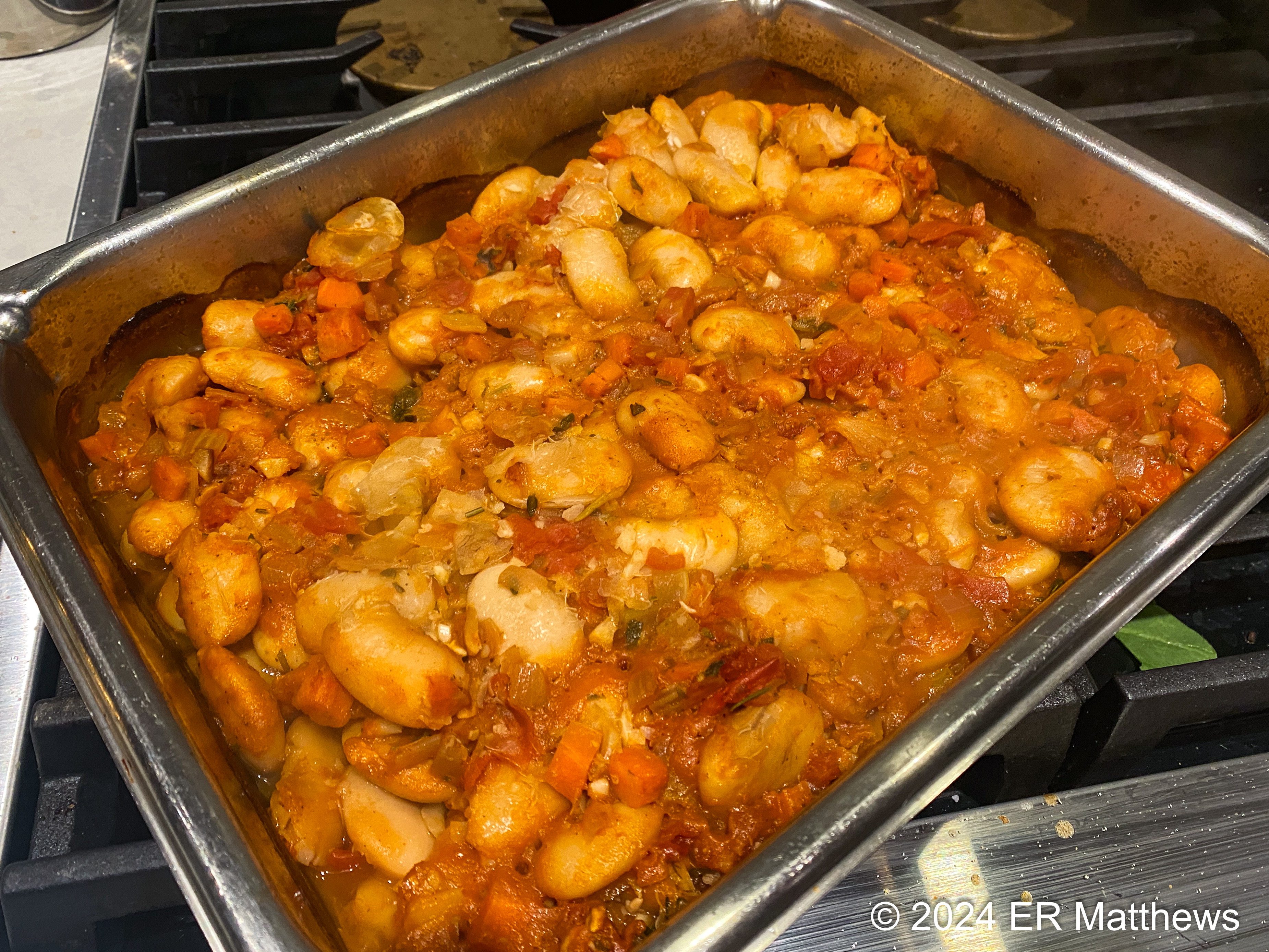
Lamb Chops and Gigantes Plaki

Spring is starting to arrive in fits and starts here in Bend although one day will be warm and sunny and the next brisk and cool. There's likely to be more snow to come but the grass is starting to green. And this is more than enough to get my grilling juices going after a winter of seeing the grill out by the patio under a mantle of snow.

Ann invited Michelle and Andreas over for dinner this past weekend, and Michelle's mom Jean was in town, so of course she was welcome too. I no longer remember the thought process behind the menu for the night, but I am pretty sure it was built around a bag of huge Royal Corona beans from Rancho Gordo.

Grilled Lamb Chops, Spinach with Onions and Dill on Gigantes
I decided to make these huge beans into the classic Greek gigantes plaki, baked beans in tomato sauce. I'm pretty sure that grilled lamb chops followed from this thought. After a sunny day that was great for cleaning up the grill after a winter of disuse, the sky turned partly cloudy and spit a little rain just before our guests were ready to arrive. Nonetheless, we turned on the fire pit and sat outside anyway.

Royal Corona Beans Soaking Overnight
Uncooked Huge Beans
After soaking the Corona beans overnight, I par-cooked them with a couple bay leaves, a few dried rosemary needles, and four smashed cloves of garlic. I started the beans at 2pm, knowing our guests would arrive at 6 and figuring it would probably be 7:30 before we sat down to dinner. At 5:45, I was a bit concerned about the beans. Although they had been softening constantly through the afternoon, three hours on the stovetop was insufficient to render them creamy. After another 90 minutes in the oven though, they were just fine. Whew!

Tomato Sauce for Beans
I made a simple tomato sauce for the beans by sautéing an onion, a large carrot, and two stalks of celery in olive oil with garlic, crushed red pepper flakes, a bit of fresh thyme, and a fair amount of dried oregano. I also added ground cinnamon, just what would fit on the tip of a knife blade. To me, this dish doesn't taste right without it.

Ann, however, has a different opinion. She has a pretty firm rule that anything sweet or any spice that we Americans consider a pie spice does not belong in a savory dish. So, the sauce wasn't her favorite.

Once the vegetables had started softening, I stirred in a tablespoon of really amazingly concentrated Sicilian tomato paste called estratto. Then, I deglazed the pan with the juice of a lemon and added a can of crushed tomatoes and let the sauce bubble away for 20 minutes or so, just to bring the flavors together.

At 5:45, I scooped the still-cooking beans into the sauce and mixed them well. After transferring them to an oiled half hotel pan, I drizzled a little of the bean cooking liquid over the beans and covered the pan. They baked covered at 350F until dinner time, about 90 additional minutes.

Gigantes Plaki
Our guests arrived shortly after I put the beans in the oven and Ann had poured me a glass of wine, a Semillon-Sauvignon Blanc blend from Walla Walla. We headed outside on the patio by the fire pit with a plate of risotto cakes to have for an appetizer. I like finger food for an appetizer and because Michelle is gluten intolerant, bread such as crostini is out. So, I tend to make rice cakes when she comes over.

Plain Risotto Base: Arborio, Onion, White Wine, Chicken Stock
Lemon, Dill, Feta, and Pine Nut Risotto Cakes; Tzatziki
I made a plain risotto with chicken stock, though I often use water. When the rice had cooled, I added a lot of lemon zest and fresh dill, a good sprinkle of crumbled Greek sheep's milk feta, a handful of toasted pine nuts, and two raw eggs. After mixing the rice well, I shaped it into cakes and seared the cakes.

First thing in the morning, I made tzatziki to accompany the cakes. Each time I make tzatziki, I make it slightly differently depending on what I have on hand and how I'm feeling, but I did publish a basic recipe here.

A Touch Chilly Outside Around the Fire
First thing in the morning, I put a bunch of lamb chops in the fridge to marinade. The marinade was quite simple: olive oil, a splash or two of red wine, a lot of chopped garlic, dried rosemary, and dried oregano. I turned the chops in the marinade every couple of hours.

Lamb Chops Ready to Grill
Lamb Chops, Ready to Plate
After I grilled the lamb chops, we headed inside where I cooked a couple pounds of small spinach. I chopped an onion and cooked it to tender in olive oil, then tossed in the spinach which wilted in short order. I added a big handful of fresh dill and seasoned with salt.

I decided to plate at the stove rather than serve everything family style. I put a bed of gigantes on each plate and then scattered some feta, fresh oregano, and salt over the top. After garnishing the gigantes with a healthy drizzle of olive oil, I put some spinach on top and then added the lamb chops.

All in all, it was a very simple meal and scratched my grilling itch. I'm so glad that we were able to share it with Michelle, Andreas, and Jean.

Saturday, January 20, 2024

Lamb Stew

There's nothing really novel about lamb stew. At heart, it's quite a humble dish of lamb, vegetables, and gravy. But there is a vast difference between how professionals and home cooks approach this dish. And a vast difference in the finished dish as a result.

Carefully Constructed Lamb Stew
At home, one often cooks all the stew ingredients together, meat and vegetables until done and then thickens (or highly reduces) the cooking liquid. The vegetables will likely go all at once into the pot once the meat is cooked to avoid overcooking them.

On the other hand, at a high-end restaurant, each ingredient will be pre-cooked just to the point of doneness, combined with a meticulously-made gravy when the dish is ordered, and reheated before service. In this way, each of the constituent ingredients is cooked perfectly with nothing overcooked.

Here's a sketch of how I made this batch of lamb stew which is pretty much identical to how we would have made it at the restaurant, if we could have sold something as pedestrian as stew. Fine dining customers, especially those for whom such a meal is an unusual splurge, usually want to order something "luxurious" that they can brag about to their friends: steak, lobster, foie gras, etc.

This tendency makes it really hard to sell something such as a stew, which you must do if you are running a nose-to-tail restaurant like ours that was based on whole animal butchery. Selling the non-glamorous parts of the animal at such a restaurant involves a precise combination of wording on the menu and pricing ("menu engineering"), but that is a topic that would require an entire chapter in a foodservice textbook. It is a topic in which I am highly versed but which is way beyond the scope of this, or any, blogpost. If you're a chef reading this and need help, I do consult.

Step 1: Make a Great Stock

To make the stock, I had been saving scraps of meat and bones over the last few days. This stock was made from lamb trimmings, steak trimmings, the backbones from spatchcocking game hens, the bones leftover from the roast game hens, and a few chunks of pork neckbones.

To start, toss the bones and some aromatic vegetables (carrots, celery, onions in chunks) with oil and roast in a hot oven (400-450), turning as necessary, until the bones and vegetables are really well browned. 

Stock Bones Before Roasting
Well-Caramelized Bones After Roasting
Once the bones were roasted (about 45 minutes with four turns at about 400F), I removed them to the stock pot, covered them with water, and then poured very hot water onto the sheet tray and scraped up all the brown bits (what we call in chef-ese the fond or "bottom" in French). I then poured the water and brown bits into the stock pot so as not to lose any flavor.

If I were making a super-fancy stock, I would pour lamb stock over the bones instead of water, which would be called a double-stock. I often make chicken soup by cooking raw chicken in chicken stock, yielding a double stock just to get a more intense chicken flavor, our poultry in the US largely being bland.

Once the bones and liquid are in the stock pot, I added other flavorings such as leek leaves, onion peels, parsley stems, a sprig of rosemary, and a couple sprigs of thyme. These items add depth of flavor; the onion peels also add brown color and they were used as a dye in olden days. I often collect these bits in a bag in the freezer to add to my stocks.

Step 2: Prepare Each Ingredient Separately


Once the stock had cooked slowly for about 4-5 hours, I removed it from the heat, strained out the solids, and returned the stock to the stockpot. While the stock was coming back to a light boil, I cut into bite-sized cubes the remainder of a lamb shoulder that I had roasted to medium rare.

I then cut a couple yellow potatoes and a couple large carrots into the same size pieces as the lamb and poached first the potatoes and then the carrots in the stock until they were done. Then I put a bag of frozen pearl onions into the stock to cook. I am not ashamed to admit that I use frozen pearl onions; the labor and cost savings in using them is immense.

At the restaurant, we would have focused on using baby vegetables rather than cut ones, just to up the wow factor of the dish. I would have asked my growers to harvest tiny carrots and new potatoes and my crew and I would have probably stood around and peeled small shallots in place of the pearl onions.

It's likely we might have used baby hakurei turnips and tiny chanterelle mushrooms as well, in the appropriate seasons. All these ingredients and all this work would yield what we call in chef-ese a very soigné ("carefully prepared" in French) dish, but man, that's too much expense and labor for home cooking!

Mid-Stream in Cooking Each Ingredient Separately

Step 3: Finish the Gravy and Reheat the Stew


Once all the vegetables were cooked in the stock (and thereby lent their flavors to the stock), I then continued to reduce the original gallon and a half (six quarts, roughly 5.5 liters) down to the final volume of gravy that I wanted, concentrating the flavors. I then seasoned the stock with salt and white pepper to taste. You really don't want to season a stock before it is reduced because you'll end up concentrating the seasoning and will end up with an oversalted stock.

A professional hint that I have passed on to many, many young cooks: if your highly reduced stock tastes flat, add a drop or two of vinegar (I like sherry vinegar for this) and see how that helps. Highly reduced stocks are likely to be flat and bland because of the highly concentrated amount of gelatin that they contain. Acid will bring new life to such a stock.

Once I seasoned my stock to my taste, I made a batch of beurre manié, roughly equal parts flour and room temperature butter kneaded into a paste. Kneading the flour and the butter creates a great sauce thickener that you can whisk into a stock, eliminating any worry of lumps in your sauce.

I added small lumps of beurre manié to my simmering sauce, whisking it in, until the gravy was as thick as I wanted. A decent rule of thumb is that one tablespoon of flour and one tablespoon of butter will thicken one cup of liquid to a heavy cream consistency.

A lot of chefs will skip the beurre manié altogether, opting to sauce their meat and vegetables with a glace or demi-glace, both highly concentrated and very thick stocks. I find these sauces to be too thick and too sticky for my liking, but that's just me. YMMV: your mileage may vary.

All that is left is to combine the stew ingredients with the gravy and reheat. You can do this in any fashion; this time, I put everything into a casserole and reheated it in the oven. At the restaurant, we would have assembled an individual portion up on the range top and then put the hot stew in an oven-proof serving dish into a very hot oven for five minutes or so before calling for a runner to take it to the dining room. [More than likely, we would have covered it with a sheet of puff pastry and baked it until the pastry was golden and risen.]

Lamb Stew, Ready to Serve
These are a few hints on how a professional chef might approach a humble stew with an eye to elevating it slightly. There's nothing difficult about this method, but it does involve a significant amount of time to do. If you have time to do this, it will elevate your stew game. If not, at least you may better appreciate all the pains to which chefs go to assemble even the most humble of dishes for you.

Saturday, January 13, 2024

Quick Pastitsio

Although Ann and I generally save our big splurge meals (high carb deliciousness) for the weekend, after a weekday morning spent snowshoeing, the urge for carbs was undeniable and Ann asked that I move our weekend pastitsio up a few days.
Quick Pastitsio
The impetus for pastitsio was our watching Afrim Pristine's series "Cheese: A Love Story" on TV. Specifically, he filmed a show on Greek cheeses and while in Greece, a chef made his version of pastitsio causing Ann to ask me if I would make a batch. I love pastitsio and more than just saying yes to her request, I bought ground lamb and pasta on my next foray to the grocery store.

Pastitsio is often referred to as Greek lasagne and it has its origins in Italy. Originally a dish wrapped in pastry, hence its name, it has come to be over the last 100 years a simple baked pasta consisting of layers of pasta, sauce, and béchamel.

Ann and I set out to make a very quick version of pastitsio and within twenty minutes, had ours in the oven baking to golden brown on top. We tag-teamed the effort: while she got the pasta water and pans going on the stove, I cut an onion finely and minced a fair amount of garlic. She cooked the onion and then browned the lamb while I chased down the ingredients for the béchamel.

Ann Driving the Stove
L to R: Lamb Ragù, Bechamel, Pasta
Once the meat was browned, we added a small can of tomatoes that we had blitzed into a rough sauce in the can using an immersion blender. And while that and the pasta par-cooked, we made the béchamel, the whole thing taking no more than 20 minutes.

Grating Pecorino Romano on the Pasta and Sauce Mix
Pasta Topped with Layers of Lamb Sauce, Béchamel, and Pecorino

Quick Pastitsio


If there is such a thing as a traditional pastitsio, ours is a touch different. Many people make the sauce with ground beef rather than lamb, but I prefer lamb. That aside, we used the cheese and pasta that we could find locally. Typically this dish would be made with a cut called macaroni #2, a long tubular cut similar to (if not identical to) ziti lunghi. In Greece, the pasta is often arranged prettily in the bottom of the baking dish, but we were on a mission to eat dinner, not make the prettiest dish ever. The cheese would be either the milder kasseri or the more assertive and pecorino-like kefalotyri. We used our handy-dandy block of pecorino romano that always resides in our fridge.

For the pasta:
1 pound or 500 grams of pasta (ziti, ziti lunghi, macaroni #2, perciatelli, etc.)
salt for pasta water

Before starting on the meat sauce, start the pan of salted pasta water and when it comes to a boil, add the pasta and cook until is is nearly done. I cooked the ziti for about 8 minutes, about two to three minutes shy of being al dente. While the pasta water is heating, start on the meat sauce. The meat sauce should be done when the pasta is done.

For the meat sauce:
olive oil
1 small onion, in small dice
4 cloves garlic, minced
1 generous pinch ground cinnamon
1 teaspoon dried oregano
1 pound ground lamb
1 small can (15 ounce net weight) tomatoes or tomato sauce

Film a sauté pan with olive oil and cook the onion and garlic until the onion is translucent. Add the cinnamon and oregano and stir well. Add the meat and break it apart, cooking until it is browned. If using whole tomatoes, blend them and their juice to make a chunky sauce. Add the tomato sauce to the pan and cook at a simmer until the pasta is done and drained. If the sauce is still fairly liquid, turn up the heat for a couple of minutes to thicken. Season to taste.

While the pasta and sauce are cooking, make the cream sauce.

For the béchamel/mornay:
3 tablespoons of butter
3 tablespoons of flour
2 cups of milk
freshly grated nutmeg, salt, pepper to taste
1/2 cup grated pecorino

In a small pan, heat the butter and whisk in the flour well such that no lumps remain. Cook the mixture for a couple of minutes, then add the milk. Stir as the sauce thickens. Stir in the pecorino and season to taste with a few scrapings of nutmeg and a bit of salt and black pepper.

For the assembly:
baking pan
pan spray
1/2 cup grated pecorino

Heat the oven to moderate, say 350F. Spray a half hotel pan or other small baking dish with pan spray. Mix the cooked pasta with half the meat sauce and stir gently to coat well. Place in the bottom of the baking dish. Spread the remaining meat sauce in a layer over the pasta. Top with the cream sauce and sprinkle on the remaining pecorino. Bake in the oven until nicely browned on the top, about 25 minutes.

Sandy Hook, Oregon

Over the past few years, I have found I process trauma by hiking and by writing. On Thursday October 15, my town, Bend, Oregon joined the in...