Showing posts with label halibut. Show all posts

Thursday, December 7, 2023

Playing with Halibut

Contrary opinion here: halibut has no place on my table. It is in the same class of insipid and boring white proteins as chicken breast. No thank you. Ann feels the same way. You are allowed to feel differently and you can go pay $30-40 per pound for it if you like, but Ann and I, we're going to pay $4-6 per pound for local Pacific rockfish.

Aside: lots and lots of similar and related species are lumped under the moniker rockfish and none of them are to be confused with the amazing Striped Bass on the East Coast which also goes by rockfish, at least in the Chesapeake Bay area from where I come.

Dry-Brined Halibut with Roasted Broccoli and Curry Butter
Ann and I do make an exception to the no-thank-you halibut rule: both the cheeks and the collars are delightful and worth every penny that we pay for them. But they cook up and taste way different than the insipidly dull and low-fat fillet meat.

So why am I even posting about halibut? Because I have a freezer full of it. And why do I have a freezer full? Because, when we were in Alaska, I wanted to go halibut fishing for the experience of it; I love fishing especially out on the ocean. And I have a rule about hunting and fishing: if I am going to take an animal, I am going to use every piece of that animal that gave its life so that I could eat. So, I am going to cook and eat every piece of halibut (the cheeks are long, long gone) in the freezer.

Another aside: halibut fishing is pretty damned boring and I don't need to ever do it again. You anchor and put a bait just off the bottom and the halibut takes your line. Then you use brute force to haul the fish, feeling like a barn door on the line, to the boat. There's no fight and not a lot of skill in taking a halibut; it's just brute force work.

As a chef, I do not have much experience in cooking halibut because I have never really cared for it, but more importantly because my restaurant was located on the mid-Atlantic Coast where we have no halibut fishery. I wasn't going to waste the jet fuel in flying these fish in from Atlantic Canada, Scandinavia, or the West Coast, not when I could make a nightly call to the nearby docks, talk about the day's landings, and have my order arrive the very next morning.

So, ever since Ann and I landed our limit of halibut in Alaska, I have been playing with it trying to make it as palatable as possible. I have learned some things that other chefs more well versed in halibut probably already know. First, dry-brining does help the fish have better flavor and retain a bit more moisture. Second, halibut is extremely temperature sensitive and I am having the best results when I pull it at about 120 degrees Fahrenheit, then rest it just like a steak. Third, it's a fish that really demands a fatty sauce.

With those things in mind, I dry-brined the latest batch by giving them a good coating of a 2/3 salt, 1/3 sugar mixture and letting them sit for 45 minutes before roasting them to 120F and then letting them stand for 6 minutes, just like a steak. And then, I topped them with a simple sauce of melted butter into which I had mixed and gently cooked a spoonful of Madras-style curry powder.

Final aside: I use curry powder in my Indian food as often as Indian cooks do and that is never. I keep a little bit of it on hand for American dishes such as curried chicken salad. For Indian food, I use a mix of individual spices keyed to the particular dish that I am making. But for a simple butter to adorn a plate of roasted halibut and roasted broccoli, it worked just great.

This was the most successful halibut fillet that I have ever eaten. Still, I cannot wait for it to be gone from my freezer.

Thursday, June 1, 2023

Halibut Cheeks with Spring Vegetables

While we love living in the exquisite beauty of Bend, Oregon, it is not without its issues. Among the biggest issues for foodies like Ann and me is the lack of foodstuffs: we're not near the ocean and we live in a very arid area that is not conducive to a lot of agriculture.

Halibut Cheeks with Spring Vegetables

Last week, we returned to McMinnville over in the Willamette Valley, a lush agricultural region close to the ocean, and where we lived before moving to Bend to be closer to the mountains and areas to hike. We took advantage of our trip to visit the McMinnville Farmers Market, a wholesale produce outlet, and our favorite fish market. We also stocked up on Willamette Valley wines while we were there.

One happy result of the trip is that we returned to Bend with halibut cheeks, asparagus, and sugar snaps. I resolved to cook all three items and finish them in a white wine, caper, and butter sauce.

Wondra-Coated Halibut Cheeks Cooking
Vegetables Cooked Separately from Fish
Before starting to cook the fish, I bought a pot of water to a boil in which to briefly cook both the asparagus and sugar snaps to doneness. Cooking each vegetable separately is a bit of labor, but it ensures that each one is done correctly because each vegetable has a different optimal cooking time. Another reason for cooking them separately is that if I cooked them in the same pan with the fish at the same time that I made the pan sauce using white wine, the acid in the wine would turn the brilliant green vegetables a boring and drab olive color.

Once I started cooking the fish, I started poaching the vegetables, sugar snaps first, asparagus next. When the asparagus was done, the fish and sauce was done and I mixed the lot in bowl before serving.

The halibut cheeks got a thin coat of Wondra flour seasoned with salt before going into a skillet. I turned them when they were half done, about three minutes, and after just a minute on the second side, I added a half a cup of dry white wine and a big spoonful of capers in brine to the pan. While the fish finished up, the wine reduced and also thickened just a bit as a result of the flour on the fish.

Finally, I removed the fish from the pan and reduced the liquid over high flame for just a few more seconds. After turning off the flame, I stirred in about three tablespoons of cold butter in small cubes and gently whisked them into the sauce, making effectively a beurre blanc.

The result was a dish as good and as simple as you can find in any bistro anywhere.

Sunday, August 15, 2021

Pranzo di Ferragosto

A few weeks ago when Greg and Bridget visited from Portland and we went wine tasting at nearby Maysara Winery in the McMinnville AVA, they had discussed the possibility of Ann and I celebrating Ferragosto with them the weekend after we returned from Alaska. This was the first time that I, or my full-blooded Italian wife, had ever heard of Ferragosto, the Italian Feast of Assumption celebrated on the 15th of August.

Having been in the software business with an Italian distributor, I did recognize that much of the country (a lot of Europe too) takes August (or a large chunk of it) off, but I was ignorant that there was a mid-month celebration. Deconstructing the term, I recognized ferr (as in the French jours fériés, holidays, feast days, celebrations) and agosto (the month of August after Augustus Caesar). 

The plan was that on the 15th of August, we would get together at Greg and Bridgets's house in Portland, watch the film Pranzo di Ferragosto, one of Bridget's favorite flicks, pop our pranzo into the oven, then dine on the two principal dishes from the film. Greg would make the fish dish and asked me to make the pasta. He sent me recipes for both dishes.

I'm not a recipe guy and in making Pasta al Forno, baked pasta, a dish I have made countless times, while I kind of adhered to the spirit of the recipe, I felt free to do my own thing. And I noticed that Greg did his own take on the perch and potato dish, doing halibut with a covering of white sweet potatoes instead. My meat sauce is made from a bit of home-made sausage, a bit of pancetta, and I augmented the mirepoix with reconstituted dried porcini. I added the porcini broth to the sauce as it cooked down.

Ingredients for my Ragù
Cooking Down the Meat Sauce
One Layer of Pasta, One of Mozzarella
Final Layer of Pasta, Then Pecorino Romano
When we arrived, we met their friends Will and Corinne, down for the weekend from Seattle where Greg and Bridget had lived prior to relocating to Portland. After introductions, we went downstairs to the wine cellar where they had laid out a beautiful array of cheese, charcuterie, and crudités which we enjoyed with sparkling wine.


After appetizers and sparkling wine, we watched Pranzo di Ferragosto, a charming film, if a little short. While the movie was nominally about a guy who gets hoodwinked into babysitting four elderly women, his mother included, while everyone else deserted Rome for the holiday, I found it to be primarily a love story about the main character's home of Rome. Certainly Rome is a major character in a movie full of characters, played largely by non-actors.

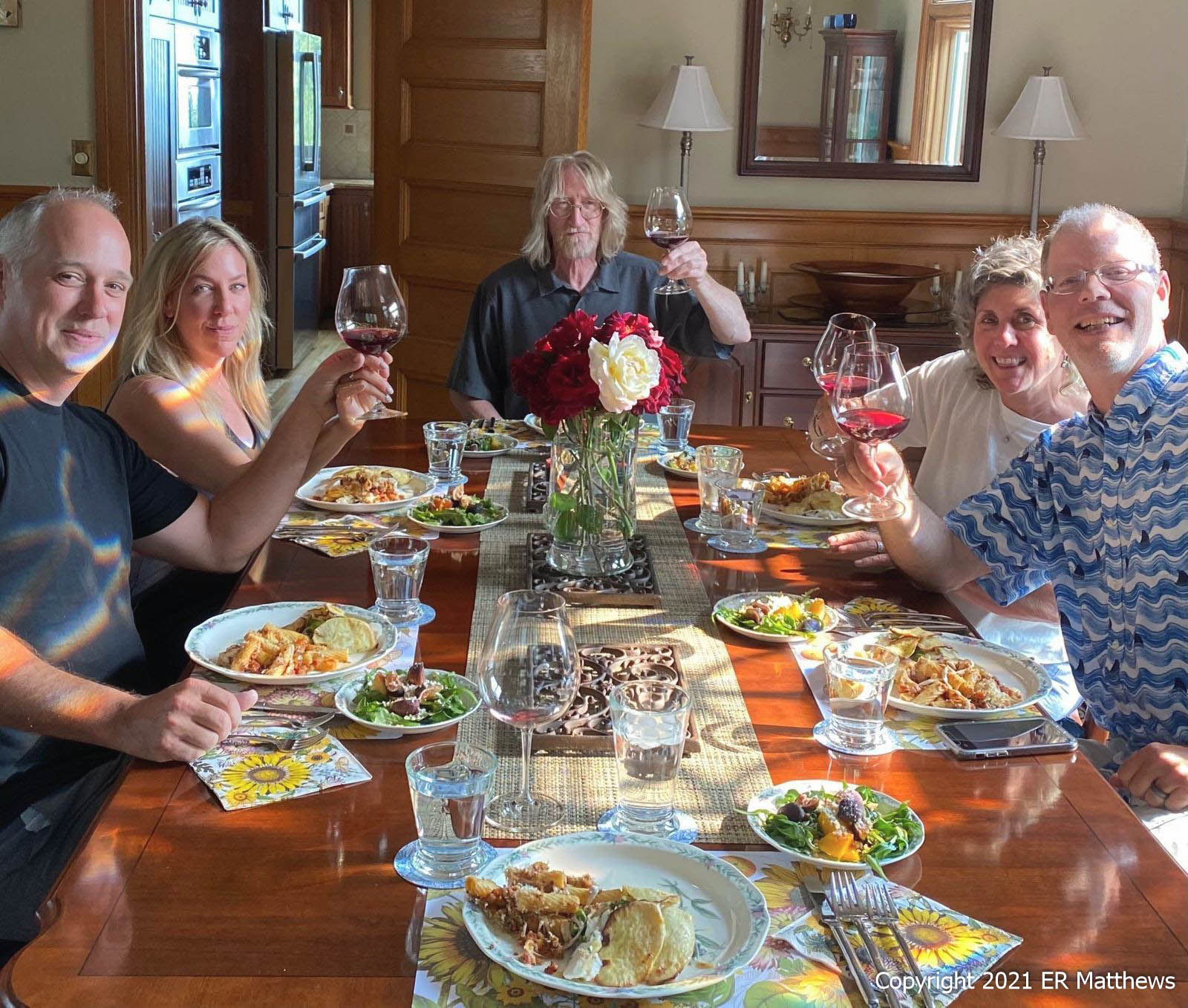
Back upstairs after the film, we put the pasta and the fish in the oven to cook and yakked for a good while. Once the two pre-prepared dishes had baked, we relocated to the dining room and started our own feast, followed by Corinne's arugula and fig salad, and then finishing with a delicate fig cake from a local Russian bakery. It's really a lot of fun to sit around a dinner table and chat over a lengthy meal, something that we don't do nearly enough of.

Friday, August 6, 2021

Alaska Day 12: Homer, Halibut and Salmon Fishing

When in Homer, the Halibut Fishing Capital of the World, I suppose that one has to go halibut fishing. Well, anyway, I wanted to. I'm not a big fisherman, but I enjoy it, especially going out on the ocean to fish. I have hooked marlin, bluefin tuna, and yellowfin tuna out in the ocean and was eager to add halibut to that list. 

Needing to be down on the Spit at 0600, I set my alarm for 0500, but I needn't have bothered. Sleep is not one of those things that I do well. I awoke at 0300 and couldn’t get back to sleep. I turned off the alarm and woke Ann at 0500. As I stepped outside, I could see, for the very first time during our stay in Homer, the lights on Homer Spit. The days in Alaska during the summer are very long and it has been mostly light while we have been awake.

0500: First Time Dark Enough to See Homer Spit Lights

Parking at 0545 on the Spit is a non-issue. Sure, there were plenty of vehicles there from others like us going out to fish for the day, but finding a spot to leave the car was a breeze. At 0600 we rolled into the office for Inlet Charters and let them know that we were there. While waiting for our captain to arrive, we walked a couple of storefronts down the boardwalk and grabbed coffee and breakfast burritos at an espresso takeout window.

Getting Some Chum, er, Breakfast

About 0625 or so, our Captain, Chris, met us at office and walked us across the street to the harbor where we set to looking for the other four members of our 6-pack crew. We were supposed to leave the dock at 0630, but the other four didn’t show until 0635. When they did show, it was clear that they had good reason. They were a family of four from southern Idaho, a grandfather, his two sons, and one grandson. The grandfather had had a stroke and his mobility was limited. The hunt for handicapped parking caused them to be late.

Making our way down the steep ramp to the harbor, we quickly arrived at our ride for the day. It was a beat old boat, well past its glory days, but it did have a spacious cabin so we could stay in out of the wind. First mate Ben helped us board through a transom gate and we were immediately greeted by the reek of diesel exhaust, cigarette smoke, and chum.

As you can see in the photo below, we were looking at overcast skies with relatively calm 1-2’ seas as we left the harbor and made our way out west towards Cook Inlet.

Sadie Peak Appearing in the Dawn Sky
At least for the first 15-20 minutes of our trip, we saw tons of sea otters way away from land, including a raft of ten or so. As we headed about 30-35 miles out, we would see a good number of sea birds, especially puffins looking like flying bowling balls, murres, storm petrels, and shearwaters. About 90 minutes out, we throttled back and started to anchor. Away from the bay, the seas were higher at about 2-3 feet with increasingly rough whitecaps.

Riding at anchor, we were at the mercy of the sea. Ben rigged four lines with whole herring and showed us how to hold the bait just off the bottom and we started fishing for halibut. Every now and then, a wicked wave would sweep over the stern. I had on my rain pants which kept my legs dry, but my shoes were soaked. With my wool socks on, they never got cold though. I was layered up to stay warm against the stiff wind.

Soon enough, we started getting halibut in the boat, small ones though, chickens. Good eating, but not big fish. I landed the one you see below fairly quickly, but then I was last to catch my limit of two halibut. I ended up wrestling a monster skate for 30-45 minutes before we cut the line. We saw the fish surface about 25 yards behind the boat and could clearly see its pink wings about 5 feet wide. It proved too big for the tackle we were using, stripping line off at full drag like it was nothing. I was worn out after fighting it. Ultimately, I would get my second fish and then Ann's second fish.

Sitting in the cabin, Ann was clearly feeling the effects of the lumpy seas, the boat corkscrewing in the chop. The seas deteriorated as we fished. I nearly got tossed by a really rough wave. I felt bad for Ann, but I was busy trying to get that damned skate to the boat so we could re-bait and get the line back in the water. Of course, until we saw the fish on the surface, we did not know for sure that it was not a huge halibut.

Somewhat Green in Lumpy Seas

Our limit of halibut on board, we hauled anchor and headed further into the Cook Inlet to start trolling for salmon. We trolled for five minutes or so unsuccessfully before Chris moved to another nearby location and we started putting salmon in the boat. By contrast to being the last to limit on halibut, I was the first to limit out on silver salmon, landing the first and biggest salmon of the day. My first silver was a healthy 15-pound fish, the largest Coho that I have ever laid eyes on. In a coincidence, the largest halibut landed was the first halibut landed.

Tired after wrestling a skate all morning, I was fortunate to catch my three silver salmon within 20 minutes. This gave me lots of time to retire to the cabin and look around. I saw either two minke whales breach or the same one breach twice in a row. Then minutes later I spotted a whale spout followed by seeing a humpback roll on the surface.

As we were trolling for salmon, I noticed that of the two lines in the water, fish were only hitting the starboard line. In fact, I was the only one to catch a fish up to that point on the port line. The starboard line was rigged with a lime green hoochie, a plastic skirt disguising the hook, while the port side line was rigged with a silver Coho killer, a metal troll bait shaped to resemble the sand lance, the bait species that the hungry Coho are targeting. I suggested to Ben changing out the Coho killer for a hoochie just seconds before Chris yelled out to Ben to change it. I rigged the hoochie while Ben helped others get their fish in the boat with a dip net.

Speaking of Ben, he was a walking caricature, a caricature of what I do not know. Effusively happy, short, stocky, bearded, and sporting fluorescent orange Grundens bib overalls over rubber boots and a white undershirt, he completed the look with a plaid tweed fisherman's cap and a stub of a corncob pipe. Popeye came to mind more than once.

Where fishing for halibut is more about brute force in getting the fish into the boat after it has swallowed the circle hook, salmon fishing is more like a ballet. The very active silvers are great fighters and are quite likely to get off the hook if you try to manhandle them. Bringing the salmon to the boat is a matter of keeping smooth tension on the line: too much, you pull the hook; not enough, the salmon spits the hook. I saw one salmon come out of the dip net with nothing in its mouth. It really is a dance.

The seas had eased off with the changing tide, the sun had come out, and the wind had died making fishing for salmon a lot more fun than for halibut. Ann joined us out on the stern and caught her fill, including a small pink salmon as a bonus fish.

After we pulled our limit of salmon, Chris pointed us back at the harbor and Ben got to work filleting the fish on the stern while we sat inside and watched. He invited me to fillet out my fish, but I was reticent of handling a knife while the boat was rocking from being underway. Besides, I had filleted my fill of fish on Monday. A convoy of sea gulls followed us back to port as Ben tossed the carcasses overboard. He cut open the gut of one of the salmon to show us the tiny sand lances in it. I have seen them before hanging out of the mouths of puffins.

Back at the dock, we were met by a guy from Homer Fish Processing who took our fish to have them processed and shipped back to Oregon. We would receive 45 pounds of frozen fish the following week. We were done by 3:30 and not having to be at the Inn until later, we decided to make one final stop at Grace Ridge Brewing where we each had a beer before leaving.

Read All About Alaska's Crazy Brewery Laws

Earlier in the week, Mike had invited us to have dinner on Friday night with him and his daughter and her family who were to fly in from California. Mike had thawed a bunch of Argentine red shrimp and asked me to cook them while he cooked some rice to go with them. I rummaged the kitchen to find some tomatoes, garlic, and yellow peppers. I wanted to add something green but Mike had nothing of the sort on hand. Then I remembered the stinging nettles right off the patio, so I picked and blanched a bunch.

Shrimp Mise en Place
I seared the big red shrimp, then made a pan sauce of tomatoes, yellow peppers, stinging nettles, anchovies, garlic, white wine, and butter. This we served over the rice that Mike cooked. I had never had Argentine red shrimp before. Wow are they good!

After cleaning up from dinner, we said our goodbyes to Michael and gave him our thanks for a wonderfully memorable week with him and Sammy. He and his family would be gone in the morning, gone to take his two grandchildren halibut fishing as we had done today. And so brings our final day in Homer to a close.

Tuesday, August 3, 2021

Alaska Day 9: Halibut Cove and The Saltry Restaurant

For dinner this evening, Ann had long planned to go to The Saltry Restaurant, a fine dining restaurant on tiny Ismailof Island in Halibut Cove situated across Kachemak Bay from Homer. Open since 1984, the restaurant has become something of an institution that has garnered nationwide press and acclaim. Diners sit on the boardwalk and eat with some of the most gorgeous views anywhere. We were both very excited for our experience there especially because it is the one thing that our innkeeper, Michael, had insisted that we must do while in Homer.

Because of its location, Halibut Cove is reachable only by boat or floatplane. To get to The Saltry, we booked round-trip tickets on their ferry, the Danny J, which runs between Homer and Ismailof Island twice a day, once for lunch and once for dinner. I thought it was pretty neat that we had to catch a ferry to dinner.

Knowing that the parking situation in late afternoon down on the Homer Spit across from the harbor is extremely difficult, we left the inn at 3:30, an hour before we needed to check in at 4:30 for our 5:00pm departure time. Naturally (and thankfully) we found parking immediately. After checking in and receiving our ferry passes, we spent 45 minutes walking the marina where I took a bunch of photos, the best of which I posted previously.

Kachemak Bay Ferry, the Danny J

At around 4:35 or so, the Danny J came puttering into the harbor and with all the loading zones full of charter boats letting off fishing clients, moored a few slips away. The Danny J is a 42-foot wooden, immaculately maintained, white-over-Kelly green fishing boat built in 1941 by Olson & Winge in Seattle. It has been in service as a passenger ferry and as a tour boat since 1966.

Among the last to board, Ann and I headed for the stern, where we could duck out of the wind behind the small, perhaps 6-passenger, cabin. It was also the ideal place from which to take photos as we made our way across the bay to Ismailof Island, perhaps 6 miles distant.

Masked Up and Ready to Back Away
Just about 5:00 we backed away from the dock and after a quick safety briefing, we got underway for the approximately 55-minute trip. Compare this with a 20- or 25-minute trip in a water taxi equipped with twin 250 or 350 motors. The Danny J putters along slowly: it is after all a historic boat with an old motor, but with the majority of the riders deckside and exposed to the elements and seas, slow and steady is the order of the day.

USCGC Hickory
As we pulled out of the harbor, we motored past the 225-foot USCGC Hickory buoy tender, aka Bull of the North, home ported in Homer. As a buoy tender, the Hickory is primarily tasked with maintaining aids to navigation, but serves multiple roles as do most Coastie boats. We also passed the 110-foot USCGC Naushon moored dockside in the deeper water inside the harbor.

Motoring along ever so sedately across the water, we had really good visibility, a vast change from our trip over to Halibut Cove yesterday. Our pilot would slow every now and again to show us several sea otters as we passed. I also managed to catch a few sea birds in focus while we were underway.

Red-necked Phalaropes
Poot Peak and Grewingk Glacier
Water Level View of Homer Spit
After about 50 minutes of sedate motoring across the bay, we arrived at the opening of Halibut Cove, a secluded waterway sandwiched between Ismailof Island and the mainland and Kachemak Bay State Park. The opening to the channel called The Narrows was flanked on the mainland side by a bald eagle and on the island side by a retired lighthouse, now high-end lodging.


Halibut Cove has a small contingent of year-round residents whose number swells in the summer months. Many of the residents make their living fishing or raising oysters. Along the raised boardwalks, several artists have galleries. The Saltry gets its name from extensive herring salting and packing operations in the 1910s and 1920s, before the herring fishery died. Most of the village was torn down and the lumber repurposed in building the town of Homer.

We pulled in to the dock just below The Saltry and climbed up the gangway to the boardwalk above. Everyone from the Danny J was seated at once, first come, first serve for the tables. Ann and I selected a round two-top right on the railing and just outside the open, covered seating area bearing an oval Saltry sign and a pair of shed moose antlers.

Seating with a View
View over Ann's Shoulder
The Danny J, Just Below Us

After the initial chaos of getting a boat load of diners situated at tables, servers started to come around with silverware and menus. As I understand it from speaking with a couple of employees, most of them work the ski resorts in the winter and The Saltry in the summer, bumming around in the shoulder seasons. Sad to say that our server was just phoning it in, having a captive audience and not really needing to compete for business.

After Ann and I got drinks, we started looking at the very limited menu. This is not a criticism of the menu in that if the crew can focus on fewer dishes, they should be able to execute them extremely well. Also sad to say, three of our four dishes we could not recommend. The halibut seviche was nearly unseasoned. The pickled salmon was tough, crudely executed, and would have made a Scandinavian pickled fish lover cry.

Halibut Seviche
Pickled Red Salmon
For entrees, we ordered halibut collar (a special offering made in the same manner as their regular halibut dish) and sablefish. The halibut collar was well executed and the only dish that met our approval. The halibut collar has a higher fat content and is therefore moister than the fillet flesh, which tends to be drier. The crew did a great job with the halibut and the carrots underneath were perfect.

Halibut Collar
As for the sablefish, the portion was small, on the order of 4-5 ounces, which was not a good value for the $30 asking price. I'm not a big eater, so portion size is neither here nor there in my evaluation, but I am big on proper cooking. I have always told my line cooks that sablefish comes with training wheels; that is, anyone can cook it well because it has enough fat so that it will not dry out if you overcook it a little. Moreover, it comes with its own figurative pop-up timer: the flesh will start to flake apart when it it nears readiness. In short, it is a chef's dream fish. I never knew that you could overcook sablefish, but congratulations to The Saltry crew for dispelling that silly notion.

Terribly Overcooked Sablefish

After our exceedingly disappointing dinner, we consoled ourselves that at least we had a great time sitting and dining in one of the more stunning locations that we have ever visited. Before the Danny J boarded for the 2100 trip back to Homer, we had about 40 minutes for a brief walk along the boardwalks and trails of Ismailof Island, taking in more wildflowers and vistas of this special place. I would have liked to have spent more time walking about, but we were constrained by our ride back home.

Bells-of-Scotland Grow All Over on Rock Faces
Bells-of-Scotland Detail
Alpine Forget-Me-Mot, Myosotis alpestris, the Alaska State Flower

The return trip took about 50 minutes into the setting sun which cast a golden glow on everything around us.

Sea Arch on Islmailof Island
Salmon Purse Seiner
Common Murres in Glow of Setting Sun
10pm Homer Harbor
We returned to the harbor just before 10:00, tired and disappointed by what we had hoped would be a meal stellar enough to compete with the off-the-charts scenery of Halibut Cove. After being in the bustling harbor three days running when it was overrun with people coming and going, it was a bit strange to be the only ones making our way out of the harbor, up the ramps, and across the now deserted highway to the parking lot where we left our car, now sitting all alone in a mostly vacant lot. Even more surreal was the sensation of having to wear sunglasses at 10:00pm as we drove back home, the setting sun low on the horizon and directly in our eyes. These Alaska summer days are truly long.

Ode to the Tortilla

I love tortillas. It wasn't always that way. I am a child of the early 1960s. Then, on the East Coast, our food was influenced by two th...