Showing posts with label preserved vegetable. Show all posts

Tuesday, January 10, 2017

Jook

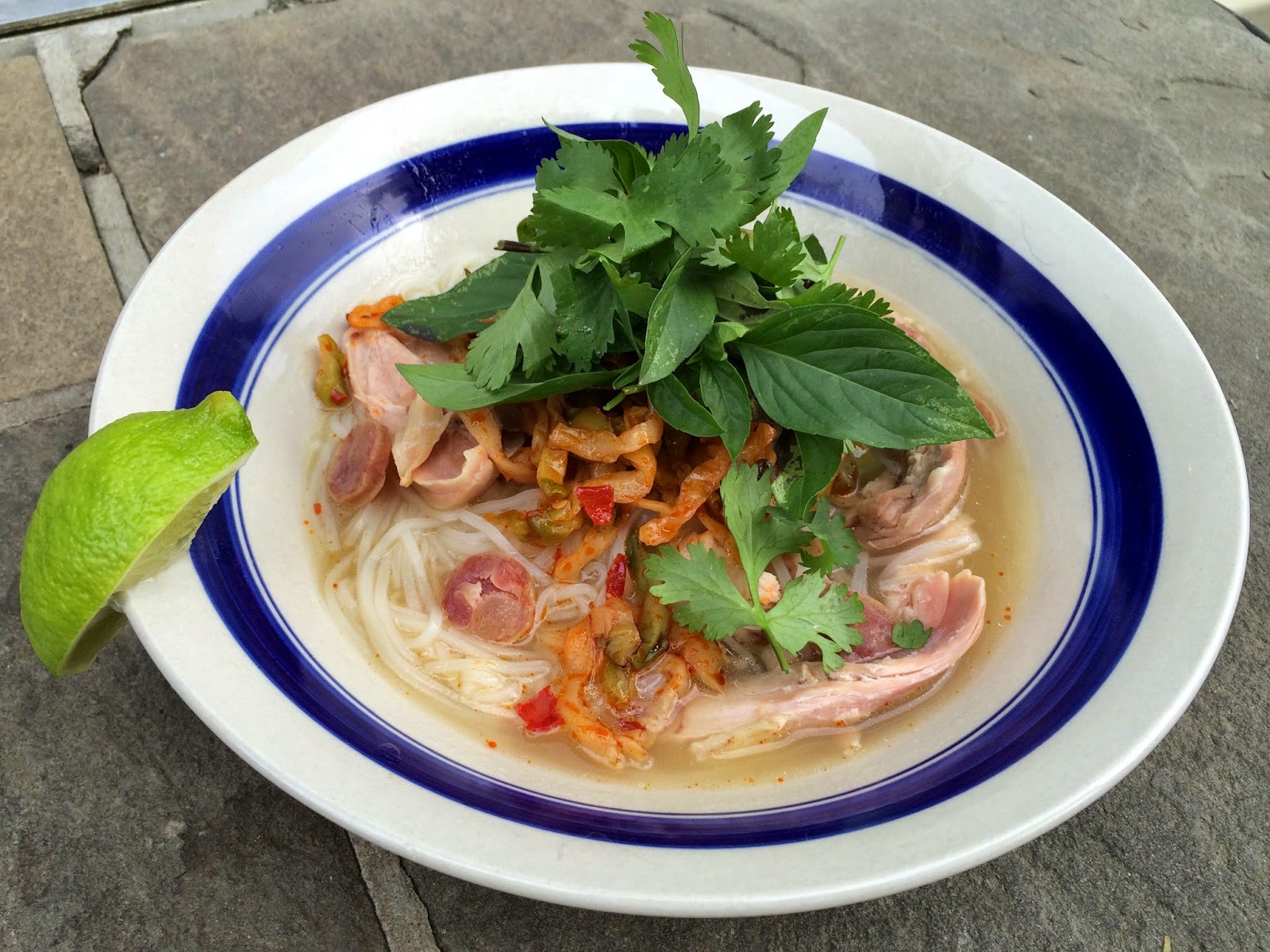
Monday night I was kind of hoping to go out, but Ann still isn't feeling well. I grabbed a couple of chicken thighs at the store on the way home to make some stock and ultimately a pot of jook, one of China's great contributions to the world. Jook is a rice porridge that hits the spot when you are not feeling well, such as when you have the flu, Irish or otherwise. Often served as a breakfast food, jook is used comparably in China to the way we use grits, porridge, oatmeal, or cream of wheat.

Jook with Zha Cai and Sesame Oil
Jook doesn't really need a recipe as it is merely rice overcooked in a lot of liquid and seasoned any way that you want. I use short-grained rice and a chicken stock-to-rice ratio of about 4:1. I'm not super good about measuring things.

2 quarts of chicken stock
8-10 slabs fresh ginger
2 cups of short-grained sushi rice
salt to taste

How you come by your chicken stock is up to you. I always poach chicken thighs or legs in water with a lot of slabs of ginger to get my stock, ginger being good for you especially when you are ill. Bring your strained chicken stock to a rolling boil and add the rice, stirring well. The rice will start to swell after a couple of minutes and I turn the pot way down low and walk away. Perhaps I will stir it every 20 minutes. 90 minutes seems to be about the appropriate cook time for the rice I use: the rice should no longer have any real texture. Add more liquid if necessary to yield a porridge in which a spoon will not stand. Season to taste.

You can garnish your jook anyway that you see fit. If I'm sick, I don't want anything in it. Otherwise, I like to garnish with some of the chicken meat used in making the stock, some sautéed shiitakes or some rehydrated black mushrooms, pickled mustard stems (zha cai), cilantro, and often, a drizzle of sesame oil.

Last night, I just went for a pile of zha cai, a bit of cilantro, and a drizzle of sesame oil. I think Ann just had hers with a pat of butter and some salt. Jook is a classic comfort/invalid food that should be in your repertoire.

Monday, March 28, 2016

Turkey and Shrimp Lettuce Wraps

Monday was one of those days that I just couldn't get inspired about food. It happens. Ann and I were on the phone trying to plan dinner before I hit the grocery store and I could tell she was getting frustrated by my lack of input and lack of enthusiasm for her ideas. I just wasn't feeling anything. She started surfing through something on her computer when she came across and suggested lettuce wraps. And that finally struck a chord with me.

Turkey and Shrimp Lettuce Wraps with Thai Basil

Mise: Thai Basil, Mystery Vegetable, Green Onions, Sugar Snaps, Shrimp, Ginger
I started off by quickly cooking minced ginger, garlic, and cilantro stems in a very hot pan. Next went in the ground turkey and Ann stirred it until it was almost cooked. I then added about a tablespoon each of sambal oelek, sugar, and black pepper. Once this was stirred in well, I added a fair amount of fish sauce, liberally sprinkling it over the meat. Finally, in went the green vegetables (sliced sugar snaps, mystery vegetable aka preserved mustard stems, chiffonade of Thai basil, and green onions) along with the shrimp. I let this cook for another two or three minutes just to reduce the sauce to thick and sticky.

Tuesday, March 31, 2015

Shrimp and Vegetables

"I want something light!" Ann said on Monday when I asked her what she wanted for dinner. "Your choice, but make it light." We were both suffering from overindulging in meatball subs on Sunday evening. Knowing that we had some shrimp in the freezer, I stopped at the market on the way home and picked up some vegetables.

Shrimp and Vegetables
And knowing that we had a meeting that would keep us out until nearly 8pm, when I got home from the market, I marinated the shrimp in garlic and a couple of packets of sweet-and-spicy pickled turnips and steamed the larger gai lan (Chinese broccoli) stems, then refrigerated them for later. The other vegetables are sugar snaps and baby corn.

When we got home, it was not more than five minutes on maximum flame to bring this stir-fry to the table. We each finished our own bowls with a bit of soy sauce and a touch of spicy chile paste.

Light, bright, easy.

Friday, January 30, 2015

Hot and Sour Chicken Soup

Hot and Sour Chicken Soup
It was about 25 years ago in San Francisco's Chinatown that I discovered that hot and sour soup could really be a thing of beauty. I was splitting my time between Virginia and a residential hotel in Sunnyvale, down the 101 from San Francisco and I was spending most of my free time between Napa/Sonoma and Chinatown, learning both wine and Chinese food. This was back in the day before most of the good Chinese food had fled the city.

I was already a disciple of Henry Chung, at whose Kearny Street hole in the wall I was a frequent visitor before the scary 1989 Loma Prieta earthquake shuttered it for good. The storefront was tiny: five or six tables and a counter, my haunt, where I could watch the ladies making the dishes. What amazing smoked ham and scallion cakes came out of that kitchen! Thanks to the Chung family's help and that of many other generous souls in Chinatown, I was just learning how amazing real Chinese food could be and I was cooking a lot of it back at home in Virginia, learning the ingredients, the techniques, and the metaphors. And already I knew enough to know that I didn't like hot and sour soup, that insipid gloppy crap that every Americanized Chinese restaurant served.

Once I got invited to a fancy fixed menu dinner at one of the big touristy Chinese restaurants in Chinatown, a place that hole-in-the-wall-spelunker-me would never have entered. One of the early courses in our banquet was a cup of hot and sour soup that blew me away with its rich broth, carefully curated spice, and fresh vegetables. A light went on that evening!

Yesterday was a wan, bleak day. Schools closing right after lunch signaled the coming rain, sleet, and ice and scared off all our lunch and dinner customers, so I decided to take the night off and cook dinner at home. The weather had me thinking soup. I proposed chicken soup to Ann and somehow we arrived at hot and sour chicken soup.

A quick stop at the market yielded some chicken legs, straw mushrooms, pressed tofu, lop cheung, slivered bamboo shoots, and a couple kinds of pickled vegetables. There are two kinds of preserved vegetables at the market of which I am especially fond right now, the one that is mainly stem mustard in chile oil labeled "Tasty Vegetable Good with Meal," and a sweet-and-spicy turnip pickle that is not labeled at all in English.

Ordinarily, I would make a rich pork stock for my soup, but given that this was a spur of the moment dinner, I went with chicken and added sliced pork lop cheung for the pork component. I poached the chicken in water with a splash of soy sauce, ginger, whole garlic, a couple of star anise pods, and a half a cinnamon stick, just enough spice for a background hint and nothing more. Once the chicken was tender, I fished it out and strained the seasonings out of the stock.

Into the stock went dried daylily buds, tree ear and straw mushrooms, tofu, both preserved vegetables, slivered bamboo shoots, and the lop cheung. I'm not a big fan of straw mushrooms, but Annie is and so I added them for her. Next, I picked the chicken and added the meat to the soup and let the whole simmer for about 15 minutes to rehydrate the dried vegetables. At this point, I then started to season, working the balance of sweet (rock sugar), salty (soy sauce), sour (Chinkiang black vinegar), and spicy (ground white pepper).

The very moment I was happy with the seasoning, I swirled in the tiniest amount of cornstarch just to amp the body slightly (something I wouldn't have done with a super-rich pork stock) and served the soup with a scattering of green onions over the top.

This was the soup I was meant to make on this dreary day. Not only was it warm and comforting, but it brought back some great food memories from my days in California, of a time when each new dish was a revelation, a discovery. Those days are mainly long behind me now, but the memories are vibrant still.

Tuesday, August 26, 2014

Egg Drop Soup


Egg Drop Soup
We had planned to have guests over for dinner on Monday night, but Ann texted early morning saying she wasn't feeling well and had cancelled dinner. And then she texted to ask if I would make some soup even though we had just made soup the week before. She knows that I don't like to repeat the same things.

I decided this time rather than going the Vietnamese route, to do more of a classic Chinese soup. And then when I got home, I mentioned that I might poach an egg right in the soup so that we could break open a nice runny egg into the soup. But she asked me to make her stracciatella, the Italian version of egg drop soup.

And so I put on a big pot of water with a couple pounds of chicken necks, half a pound of ginger, some garlic, some green onion bulbs, some cilantro stems, and some celery leaves. After this cooked very slowly for about 90 minutes, I put in a whole chicken and let it poach until it was done, another couple of hours. I fished the chicken out and let it cool while I strained the broth.

From here, just a small matter of some vegetable prep: thinly sliced snow peas, straw mushrooms, bamboo shoots, pickled mustard stems, sliced green onions, and tiny baby bok choy.


Garnishes (except the chicken) Ready for Soup Bowls
Once the garnishes were prepped, I put them straight into our soup bowls and then beat a couple of eggs while the stock came back to a wicked boil. Into the stock went the eggs. And then I ladled the boiling stock into our soup bowls.

Soup Bowl Ready for Broth
I love soup. So really, no real hardship to make it two weeks running.

Tuesday, August 19, 2014

Phở Gà (Vietnamese Chicken Noodle Soup)

Tough weekend. I couldn't eat all day Sunday for a minor medical procedure on Monday and after getting out of that, I needed something really comforting to eat. Enter phở gà.

Phở Gà (Vietnamese Chicken Noodle Soup)
When I make pho, it is typically the more common beef version, but when I am not 100%, chicken suits me (and most of us) better. It was Ann's idea that I make chicken noodle soup: good call!

Here are my tips for making phở gà:

1. Poach the chicken until it is done, remove it from the broth, pick the meat from the bones, and return the bones to the stock to keep enriching it. This way, you achieve both goals: rich broth and tender chicken. Leaving the chicken meat in too long just renders it tough.

2. Char the onion and ginger on the flame for a few minutes before adding to the stock. It adds great depth of flavor.

3. Sweetness is optional. I almost never add sugar to chicken pho. But I often add just a touch of Chinese sausage (lop cheung) to the broth at the last minute. It imparts a certain sweetness. This is certainly non-traditional, but it's my bowl of soup, damn it, and I will cook it the way I want.

4. Have a light hand with the seasonings. To a half gallon of stock, I added four star anise and half a stick of cinnamon for just 20 minutes so that the flavor was there, but really in the background. You want the delicate chicken flavor to come through.

5. Knock yourself out on garnishes. I love pickled mustards stems from China, so I garnish my soup with them, but not with so many that I mask the delicate chicken broth.

6. I don't add either hoisin or sriracha to my bowl with chicken as I would with beef. Again, I want the chicken to be front and center.

Tuesday, May 20, 2014

Pork and Snow Peas

I got up super early yesterday and as a result, I was home from doing all my paperwork by noon. My last stop before home was FoodMaxx where I scored some ground pork and snow peas for lunch.

Pork and Snow Peas
I got a large sauté pan hot and tossed in a half pound of prepped snow peas* along with a splash of water so that they would steam. Removing the steamed snow peas to a big bowl, I then put a half a pound of ground pork in the pan with a touch of oil and stirred while cooking. When 2/3 done, I added about an inch of ginger root, finely minced, and 6-8 garlic cloves (this is what we call a little), also finely minced. After stirring for a minute, in went the remaining ingredients: a diced orange pepper, a half a cup of mustard stems preserved in chile oil (cutely labeled "tasty-vegetable-go-with-meal"), half a bunch of green onions in one-inch slices, and about a dozen to fifteen garlic chives from the garden, sliced. After tossing together for a second, I splashed the pan with a touch of soy sauce and plated.

Delicious, light, low carb, quick, and moderately healthy. Not bad for a Monday lunch out on the patio with my wife.

*To prep all edible pod peas, snap the ends off, being sure to pull any fibrous strings running down the seams.

Sunday, February 2, 2014

Veggies

Veggies with Roast Pork and Lop Cheung
Sometimes I get a real hankering for a big plate of stir-fried vegetables, whatever's on hand. I love vegetables of all kinds and always have. As a kid, I had two rather finicky siblings who didn't like a good number of veg between them, and so I often got double helpings of those things that they wouldn't eat. Score!

Today, we went to the store in anticipation of the snow storm tomorrow and in anticipation of having red-cooked chicken tomorrow night to score some chicken and some rock sugar for the braise. While we were there, we grabbed a can of baby corn, some gai lan (Chinese broccoli), a few hon-shimeji (Beech mushrooms), and a few snow peas to augment what we already had in the refrigerator.

From the refrigerator, I grabbed a lop cheung, a small piece of roasted pork (from the last post), nappa cabbage, cilantro, pickled mustard stems, garlic, and ginger. I had hoped to put in a bit of pressed tofu, but our leftover bit was infected with a yeast and so I decided not to take a chance.

Fifteen minutes of prep et voilà!

High heat is the key to a great stir-fried dish. If you don't have a professional wok and wok burner (I don't and most fire codes prohibit them in residential kitchens and in many restaurant kitchens as well), you need to get a pan really hot and work in batches so that you don't overload your pan. You are looking for the elusive wok hei (breath of the wok) that comes from scorching heat. If you overload your pan, your vegetables steam and don't stir fry at all. A splash of stock or water added once the vegetables begin to brown will flash steam them to a perfect crunchy cooked texture.

My little stir fry here took four batches. I started with the items that wouldn't overcook while waiting for the other batches to get done (corn, lop cheung, pork, Chinese broccoli stems, pickled mustard stems) and ended with the most tender vegetables that would overcook most easily (snow peas, Chinese broccoli blooms, and green onions).

Vegetables to warm a heart!

Tuesday, January 28, 2014

Roast Pork Soup

What to eat that is filling, warm, comforting, low-carb, and low fat? How about some terrifically delicious soup with roasted pork?

Roast Pork Soup: As Beautiful as it is Delicious!
There are several tricks that we chefs use to make first-rate soups. We start by jamming as much flavor into the soup stock as possible. And then we cook each of the garnishes separately so that they are at the peak of goodness. And everything is assembled at the last second before going to the table to preserve freshness of and prevent muddling of flavors. This soup is an exercise in just that.
Garnishes for the Soup
This soup has both raw and cooked garnishes, which you see in the photo above, staged for cooking. The cooked garnishes are the pork in the foreground and the green plate in the background. The raw garnishes are the cilantro, snow peas, and pickled mustard stems on the right of the photo.

Just before serving dinner, I quickly sautéed the nappa cabbage, shiitakes, carrots, pressed and spiced tofu, lop cheung sausage, and Chinese chives with finely minced ginger and garlic. After just a minute in the pan, I divided these among our deep soup bowls. Over this, I scattered the snow peas and the mustard stems. On top, I placed three small slices each of roast pork and then over all, I ladled on boiling soup stock, garnished with fresh cilantro, and rang the dinner bell.

Stock, the Key to any Great Soup
While I was prepping vegetables, I put together a stock, starting with a base of chicken stock. Into the stock I put several slabs of ginger, six lightly crushed cloves of garlic, a bunch of cilantro stems from last week, the bulb ends of a bunch of green onions from last week, the stems from the shiitake mushrooms, and the pièce de résistance, four or five fresh double kaffir lime leaves. I hadn't planned on adding lime leaves, but when I saw fresh ones in the market, I couldn't resist. Who can resist their unique and haunting citrus flavor? The stock simmered away while we watched a movie.

Hoisin-Agave Roasted Pork Loin
Early on in the afternoon, I rubbed a piece of very lean pork loin with hoisin sauce, agave nectar, and black pepper and let it sit on the counter to warm slightly before cooking. I roasted it at very high temperature for about 25 minutes to an internal temperature of 135F (knowing it would carry through to 145 or slightly higher while cooling).

All these steps and separate cooking or not of garnishes, really, is arguably a lot of fuss for a bowl of soup. But I'm a chef and this is what we do. And the results? You can't argue with them.

Tuesday, January 14, 2014

Hot and Sour Catfish

Hot and Sour Catfish
For dinner, Ann wanted me to reprise the fried catfish dish with mapo dofu topping that I did this time last year. But I was in a soup mood, so I split the difference. This didn't stop Ann from giving me grief about not cooking exactly what she wanted, for doing some riff, but that's what Eds do: they take inspiration from whatever source and then map that inspiration onto something deliciously edible (and I don't think that judging from her happy noises that she really has any grounds to complain about the results). ;)

Earlier in the afternoon, I simmered for a couple of hours a couple pounds of chicken necks in chicken stock with garlic, ginger, and cilantro stems. Meanwhile, I soaked a handful of dried daylily buds and tree ear mushrooms in hot water.

Just before dinner, I strained the chicken stock and added the rehydrated lily flowers and mushrooms, broth and all, to the stock. To this, I added soy sauce and vinegar in equal parts to the soup until I got just the right amount of salt and sour. I added three parts rice vinegar to one part black vinegar. Into the soup went finely diced tofu, chopped Shanghai bok choy, and spicy preserved mustard stems. I didn't add any more spice to the soup, but if I had, the classic hot and sour soup spice is ground white pepper (which I did add to Ann's soup because she wanted more spice). I did not add cornstarch to the soup: I am not a fan of the gloppy consistency. If that's your speed, go for it.

While finishing up the soup stock, I roasted a whole sheet tray of catfish in the oven (to have something to eat for dinner late night when I get home later this week) and then placed a small filet in the bottom of a soup bowl. Over this went a couple ladles of soup and on top, fresh cilantro and green onions. And presto! Hot and sour catfish.

Tuesday, September 24, 2013

Zhajiangmian

Zhajiangmian with Snow Peas
Zhajiangmian ("fried sauce noodles") is one of my all-time favorite comfort dishes: there is something about noodles with a rich earthy pork and bean paste sauce that makes me tremendously happy. I first encountered it twenty or so years ago in a little hole in the wall Chinese restaurant where I ordered (it and lots of other delicious and unusual dishes) blindly from the Chinese-language only menu by pointing. I raised some eyebrows playing palette roulette this way, but I got to try a lot of great dishes and I finally trained the staff so that they would suggest dishes that I should try. It took a long time for them to figure out that they weren't going to scare me by serving pig's ears or dried jellyfish. Of all the dishes that I tried though, fried sauce noodles was one of my favorites and one of those that I have learned to make. And beyond making it, I now feel comfortable in making my own versions.

It is one of those dishes that varies each time I make it depending on what I have on hand in the refrigerator and pantry. The theme is thick wheat noodles and a sauce of bean paste and ground pork. The variations are endless.

Yesterday's variation involved two kinds of bean paste, regular Korean soy bean paste (doenjang) and spicy Korean fava bean and chile paste (dobanjang), along with soy sauce, Chinkiang black vinegar, and dark sesame oil. Garnishes always vary, but I almost always insist on pickled mustard stems (zha cai), five spice-pressed tofu, and a green vegetable, in this case, some beautiful fall snow peas. The sauce was flavored with copious amounts of both ginger and garlic and I tossed raw green onions and cilantro leaves into the noodles while tossing them with the sauce. The noodles themselves: udon.

I no longer worry about the cultural mash-up that is my zhajiangmian, for this is a dish that has been adopted all over Japan, Korea, and China and is made with whatever suitable local ingredients are available. The best noodles I can get happen to be udon and the best bean pastes I can get happen to be Korean. And who cares? The results are spectacular!

Cultural Mash-Up: Japanese, Chinese, and Korean


Thursday, March 28, 2013

Udon with Pork, Shiitake, and Tofu

Udon with Pork, Shiitake, and Tofu
At 4pm on Sunday, it went from hazily overcast to snowing so hard that we couldn't see across the street. Nothing like blizzard conditions to put me in the mood for comfort food and I had gone to FoodMaxx earlier in the morning with this dish in mind, so I was fully prepared. Slurping a big bowl of udon is comforting to me, seriously comforting.

I tossed the udon with a sauce of ground pork, diced spiced and pressed tofu, shiitake mushrooms, pickled mustard stems (zha cai), doenjang (Korean bean paste), Chinkiang black vinegar, ginger, garlic, green onions, and cilantro.

There were zero complaints from the peanut gallery about this dish, just dead silence while we all wolfed the noodles down!

Tuesday, February 5, 2013

Haddock, Sichuan Style

When I spoke to Ann early yesterday morning, she wanted something for dinner last night but just couldn't put her finger on it. So she went back to this blog and looked at what we were doing at this time last year. When she came across the Sichuan-style catfish from February of last year, she knew what she was in the mood for.

At the market, I couldn't find a catfish, but I did find some reasonable looking haddock filets. Haddock is mild and white and pretty forgettable: it would be a fine foil for the super tasty Sichuan sauce I was about to put on it. I wouldn't dare put this complex and spicy sauce on a really good piece of fish.

Mise en Place
Each time I make this dish, I do it differently, based on how I am feeling and what I have available. Isn't that how most people cook? Once you learn the theme of a recipe, each time you make a dish after that it is all about subtle variation. Where I would typically use dried black and tree-ear mushrooms, this time I had fresh shiitake on hand. And I happened to want five spice-flavored and pressed tofu instead of plain tofu. The recipe theme is the same, but the slight variations make the particular instance of the dish.

The ingredients clockwise from the little red bowl of ground Sichuan peppercorns: five spice-flavored pressed tofu, bamboo shoots in chile oil, dobanjang (more about which in a minute), garlic, cilantro, green onions, shiitake, zha cai mustard stems, doenjang bean paste, and ginger.

The market I shop at is run by Koreans and so their selection of Korean foods is really good; their Chinese less so. But fortunately, there are a lot of ingredients in common. Take the dobanjang for example, the bright red fermented fava bean and chile paste in the small jar to the extreme left of the photo. It is also known in China as doubanjiang and is the heart and soul of Sichuan sauces. The same sauce made with soybeans instead of favas is known as gochujang and it is very different to tell the two apart. I mention this because the tiny jar of dobanjang you see above cost an exhorbitant $8. You can make your own gochujang facsimile by mixing chile paste with doenjang, the bean paste that you see on the right of the photo, for next to nothing. Although the flavor isn't quite the same, with all the chile spice going on, it is very difficult to tell them apart in a finished dish.

Haddock, Sichuan Style

To pull this dish off, I first rubbed one side of the fish in a touch of sesame oil and then sprinkled the filets with finely minced garlic, finely minced cilantro stems, freshly ground Sichuan peppercorns, and a little corn starch. After they were browned on the corn starch side, I flipped them and removed them to the casserole dish. Then I built the sauce by cooking the mushrooms, tofu, ginger, garlic, bamboo shoots, and mustard stems over high heat. To this I added a bit of dobanjang and a lot of doenjang bean paste along with enough water to just make a sauce. After this cooked for a minute, I poured it over the fish and put the whole thing in the oven for about 4 minutes, until the fish just cooked through. Just before serving it got a topping of green onions and cilantro leaves.

Just delicious served with plain rice!

Tuesday, December 18, 2012

Chow Mein

Monday a week ago (I'm getting behind in posting) Ann really wanted "those noodles you make." Those noodles I make are classic chow mein, fried noodles. First you fry a pound of fresh wheat noodles on both sides:

Fry Noodles on Both Sides, Tossing to Flip
and then you top them with something delicious. In this case, a stir fry of snow peas, lop cheung, pressed tofu, dried daylily buds, tree ear mushrooms, preserved vegetable (pickled mustard stems, zha cai), garlic chives, and lots of ginger and garlic.

Chow Mein: a Thing of Beauty
If you've seen a lot of chow mein on this blog, it's because we love it, it's easy to do, and there's never a problem getting Carter to eat it.

Friday, December 7, 2012

Red-Cooked Duck

Back in July (the first of July to be exact), Yael and Dan had us over to their farm for a splendid dinner feast and we have been trying to return the favor forever. Such is the nature of the restaurant life and the resulting 2-3 days off per month that it was the first of December before we could actually all get together for dinner at our house.

I have had duck on the brain for a month, red-cooked duck specifically, so I built a (non-traditional) Chinese menu around that.

Turkey and Black Truffle Rillettes
We had an extra jar of truffled turkey rillettes in the refrigerator from Thanksgiving that we started with. The flavor is now better than ever and it would probably get even better still except that now all three jars are gone, gone, gone.

Jook, Fully Garnished


Jook Garnishes: Cilantro, Spicy Cowpeas, Green Onions, Mustard Stems
Now that the weather is cold, my brain is about all things braised/slow-cooked and I have been on a jook tear recently. Jook, also known as congee, is quintessential Chinese comfort food: rice cooked in broth until it disintegrates and becomes a thick porridge.

For mine, I cooked down several chicken hind quarters and a bunch of chicken feet with about a pound of fresh ginger and a bunch of cilantro stems to make the stock. I picked the chicken meat and reserved it. Into the stock went some Carolina Gold heirloom rice and after simmering for about four hours, it had turned to a silky soup. Just before serving, I mixed the chicken back in and prepped a plate of garnishes: cilantro, spicy salted cowpeas, green onions, and preserved mustard stems (zha cai).

I know that jook is traditionally breakfast food, invalid food, and/or a meal by itself, but I like it as an appetizer in a western format meal.


Mise en Place for Pan-Fried Noodles
Because we had rice as a first course, I didn't want to serve it again with the main meal, so I decided to go with pan-fried noodles topped with a variety of vegetables and fungi: shiitakes, tree ear mushrooms, dried daylily blossoms, spiced and pressed tofu, snow peas, garlic chives, green onions, shallot rings, ginger and garlic. I finished the vegetables with a splash of soy sauce and sugar.

Red-Cooked Duck and Bok Choy with Pan-Fried Noodles in Background
Red-cooking is one of my all time favorite braising methods. I cut the duck into serving pieces and browned them. Then cut up the carcass and browned it very deeply in the oven. From this I made a rich duck stock. The duck slowly braised in the duck stock, soy sauce, brown sugar, and a really nutty Sherry with lots of green onions, a dried clementine peel, crushed garlic, and loads of sliced ginger. For spices, I added a sachet containing a few star anise pods, a cinnamon stick, and a handful of Sichuan peppercorns. The duck braised on Saturday for about three hours after which I removed the duck, defatted the stock, and reduced it to the point where I was happy with the flavor. Highly reduced soy-based liquids can get way too salty in a hurry.

Sunday, I put the stock back with the duck in a very slow oven and let it rewarm gently. Then at service, I pulled the duck and lightly thickened the sauce by adding a touch of hoisin sauce. I plattered the duck with some bok choy and poured the sauce over. Really, really good.

Binyamina's Farmer Series, Cab-Shiraz 2009
And speaking of really good, Dan and Yael brought this Cabernet Sauvignon-Syrah blend from Binyamina Winery, one of the largest wineries in Israel. The soft fruit went beautifully with the duck!

Tuesday, September 18, 2012

Chicken Noodle Soup

Chicken Noodle Soup
Yesterday, Monday, was a long day for me and I knew I wouldn't be getting home early and wouldn't feel like making dinner, so Ann and I made plans to go out, just the two of us, and relax. All couples do discuss dinner first thing in the morning, correct?

But around 4:00, I got a text saying that Ann didn't feel up to dinner, that she was nauseated from her meds. That changed everything. Even though I was looking forward to a dinner out and a night of not having to cook, there was only one thing to be done: make a big pot of chicken noodle soup full of ginger, a natural antiemetic.

On the way home, I bought a big package of chicken leg quarters, a kilo of udon, ginger, garlic, cilantro, green onions, and preserved vegetable (pickled mustard stems in chile oil). The result, seasoned with soy sauce and ginger salt, was better than any dinner we could have had at any restaurant in town. This is my bowl topped with a lot of spicy, crunchy preserved vegetable.

Tuesday, June 12, 2012

Pad Thai

Pad Thai
Yesterday was one of those rare days when I just didn't have any idea about what I wanted for dinner. It happens from time to time. Ann and I talked in the morning and she didn't have a lot of input other than she wanted something Asian, something light and refreshing. This didn't spark anything for me until late in the afternoon when I got to thinking that it has been years since I had Pad Thai. While I was writing out a list of ingredients that I'd need to make sure we had on hand, Ann texted me out of the blue, "Carter says he loves Pad Thai." That's kind of freaky coincidental!

It's been years since I had Pad Thai because it's been years since I found a restaurant that actually made good Pad Thai. All the ones in this area serve a dumbed down Americanized Pad Thai. Pity. I love the interplay of tamarind, palm sugar, lime juice, and fish sauce that gives Pad Thai it's wonderful flavor, the flavor that is missing in many restaurant versions of the dish.

Mise en Place for Pad Thai
In the photo above, you see most of the ingredients for our dinner. From the little crock of tamarind pulp in the upper left, you see a hunk of palm sugar, garlic chives, a shallot and a lime, bean sprouts, preserved vegetable, firm tofu, peanuts, shrimp, and rice stick. Missing are the egg, fish sauce, white pepper, and sriracha.

The rice noodles need to be soaked, but not all that long. Start them soaking before prepping the rest of the ingredients and you will be fine. I buy tamarind pulp in blocks, then rip off a chunk, soak it in warm water, and then work it well with my hands to separate the pulp from the seeds. I strain the pulp to make sure I have got all the seeds out.

I like to make my sauce separately from my noodles, because palm sugar is nearly rock hard and in the time that it takes to dissolve into the sauce, the noodles would be overcooked. I melt about equal quantities of tamarind pulp and palm sugar together and then add a little sriracha for heat. Traditionally, ground red pepper is used but I find that the liquid sriracha mixes into the sauce better. I adjust the sweet-sour balance according to my taste and then add a little fish sauce to get the salty component to my liking.

Then it is just a matter of stir-frying from here. First go in the ingredients that you want to really sear or caramelize such as the peanuts and shallots and then each item in its turn according to cooking time, save for the soaked noodles which go in next to last. Last in the pan are some of the sauce and an egg that gets scrambled in as I sprinkle in a bit more fish sauce and white pepper. Done.

Tuesday, May 29, 2012

Chow Mein

Snow Pea and Shrimp Chow Mein
Ann and I went all over town on Sunday running errands and doing things that I would normally do on Monday, which would not be possible because of the Memorial Day holiday. Needless to say, all those errands and food shopping on an empty stomach made for a couple of hungry people. Good thing Food Maxx was one stop on the way home! Ann wanted noodles, Asian, of some unspecified variety. I'm easy that way. All I need is an idea and I am off cooking.

We bought some udon, preserved vegetable, green onions, and snow peas and during the drive home, I was thinking soup with udon, but then it was 90+ degrees in the shade and I don't think either of us were feeling a hot bowl of soup, no matter  how good. So while I was prepping, I asked Ann about the udon, "stir-fried or in a broth?" "Stir-fried!" we both blurted out simultaneously. Jinx.

At that point I was thinking lo mein, noodles mixed with the vegetables, but then that all went out the door when I remembered how awesome good chow mein is, crispy pan-fried noodles topped with a garnish, not the gloppy crap that they used to (and I presume still do) serve in the 60's and 70's in bad American Chinese restaurants.

I put the udon into a large skillet and crisped them first on one side and then on the other, making a cake of crispy goodness that I transferred to a platter while I quickly stir-fried the garnish: snow peas, garlic, ginger, preserved vegetable, pre-cooked shrimp, and green onions. Once this was going, I added a large pinch (1/2 a teaspoon or more) of ground white pepper, a big splash of fish sauce, and a bit of water. I let this reduce for a minute or so and poured the whole over the noodles.

Mise en Place: It Makes Cooking so Much Simpler
 Our lunch, this mutt of a dish, classic Chinese preparation mixed with Japanese noodles and Thai spicing, was absolutely amazing, one of the best off-the-cuff dishes I've ever made. Paired with a delicious Riesling halbtrocken, it made for a memorable lunch.


Tuesday, April 3, 2012

Singapore Noodles

Yesterday was such a beautiful spring day and I had finished all my Monday paperwork and errands and was home by the civilized hour of 4pm. By 5, it had cooled off enough to move outside and enjoy some Garnacha on the patio. What you see below is a classic Ann-pour. Our glasses are marked with a pour line so that the servers pour a consistent amount for each glass. The bottom of the W logo represents a 5-1/2 ounce pour or a fifth of a bottle. When Ann pours for herself, note how far up on the W logo it comes! Also note last year's parsley bolting to the right of the water bottle in our little garden.
I very rarely get in the mood for any kind of food. I'm a classical omnivore; if it's for dinner, I'm all about it. But yesterday I had Singapore noodles on the brain. By the way, Singapore refers to a style of noodle flavored with Madras curry powder, not a noodle dish that you might find in Singapore. While it's not a dish from Singapore, it's also not an American one either, being more of a pan-Asian fusion dish that is common in Hong Kong. Moreover, it is one of my favorite of favorite noodle dishes.

Below you see the mise for this dish, absent the bean sprouts, thin egg noodles, Madras curry powder, and fish sauce. From the chorizo clockwise you see ginger, garlic, preserved vegetable, green onions, edamame, and cilantro.

Before you go getting all technical on me, I'm going to state that I have had Singapore noodles hundreds of times and I know that they are traditionally made with very thin rice noodles. I also know that the best I ever ate in a crazy good hole in the wall Chinese place was made with wheat noodles like I used here. And chorizo? Yes, chorizo because it was what was in the fridge. Traditionally the dish is made with char siu, Chinese roasted pork. Well, damn it, I didn't feel like making my own char siu, which is the only way to get it around these parts. And, consider the role of the char siu in the dish. It is there for its bright reddish color and for a little punch of flavor. And that's exactly the role of the chorizo in the dish. A thrifty Chinese cook would approve.

The edamame are definitely not traditional either, but you'll find every kind of vegetable garnish known to man in some version somewhere. I was just looking for bright green color and there were edamame in the freezer. Typically, I make the dish with slivered yellow onions, because Madras curry and onions is a match made in heaven, but I had these gorgeous green onions that needed to be used.

In other words, it's my dish and I'll fry if I want to, fry if I want to! All I am saying is relax: noodles, like soup, are a great vehicle for whatever ingredients are at hand.

Below you see the finished dish, a result of sautéeing all the ingredients while the noodles were cooking, adding the drained noodles to the toppings, and finishing to taste with copious amounts of curry powder and fish sauce.

Tuesday, March 27, 2012

Noodles with Pork, Green Onions, and Snow Peas


I wasn't feeling well yesterday and the weather was turning chilly again: I needed comfort food. In the morning, when Ann and I were discussing dinner—isn't that a primary topic of conversation for all couples?—she said, "It's getting cooler; let's have something wintery one more time before it gets hot." Both of us on the same page is always a good place to start. "Or let's go out!" Oops, maybe both of us not on the same page.

I just didn't feel up to going out and so I brought home a few things to make a bowl of noodles. Noodles and soup noodles are my go-tos when I am not feeling well. Here you see my mise for dinner: wheat noodles, green onions, doenjang, preserved vegetable, sambal oelek (the jar just barely in the photo), snowpeas, garlic, ginger, and ground pork. I didn't bring the snow peas home; they were a lucky find in the refrigerator. Doenjang is a Korean soybean paste. I like it better than most Chinese bean paste because it still has some whole or partial beans in it for texture. Preserved vegetable is a mustard green that has been cured in salt and chile. Sambal oelek is ground fresh red jalapeño chiles.

Ode to the Tortilla

I love tortillas. It wasn't always that way. I am a child of the early 1960s. Then, on the East Coast, our food was influenced by two th...