Showing posts with label mussels. Show all posts

Monday, April 22, 2024

Leek and Dill Mussels

Ann and I love mussels. Living in Central Oregon in the desert affords us no real opportunities for access to mussels, however. I took it upon myself to special order a bag of mussels at the store in hopes of surprising Ann.

The store notified me when they arrived and I hurried to get a 5-kilo (11-pound) sack of mussels from Puget Sound west of Tacoma. Sadly, I got no price break on the full bag and ended up paying a small fortune for them.

The mussels ended up being European mussels, no doubt farm-raised, very thin shelled and quite fragile, with extensive beards but otherwise clean, unevenly sized, almost all alive, and with tiny meats. I was disappointed and would not buy them again. Ann was happy just to have mussels and was less disappointed than I.

My disappointment comes from my experience with East Coast mussels. At my restaurant I started off serving farmed PEIs but their erratic quality and supply chain issues convinced me to switch to wild Cape Cod blues, the best mussels I've ever eaten. These Cape blues are now the gold standard by which I judge all mussels and these Puget Sound mussels sucked in comparison.

Quality issues aside, the following discussion about cleaning and preparation applies to mussels from any source. The goal is to clean the mussels of any foreign matter, to remove the so-called beards with which they attach themselves to surfaces, and to discard any broken or dead mussels.

Step One: Cover the Mussels in Water
The first thing that I do is to cover the mussels in fresh water. This will cause any live mussels to close their shells. Any mussel that floats is alive; in closing, they can trap enough air to float. You know that these mussels are good and you can start cleaning them.

Mussel with Beard
I've cleaned hundreds of thousands of mussels in my life and I believe that the best thing to use is a dishtowel, as unpopular as that may be at your house. [Hence why I buy bundles of bar mops from a restaurant supply house and discard them once I mess them up too badly.] Use the towel to get a grip on the slippery beard and pull it down towards the hinge, the pointy end of the mussel that is closest to the camera in the photo above. With a little tug, it should pull right out. Then using the towel, wipe any dirt off the mussel.

As you work your way through the mussels, you will run out of floaters. Just because mussels have sunk to the bottom of the bowl does not mean that they are bad or even dead. It may mean that they remained fully closed without any trapped air inside their shells or it may mean that they were a little slow to close on contact with the water and filled with water.

As you consider a mussel, if its shell is broken, discard it. If it is closed tightly, wiggle the shells a bit between your fingers to see if you can move the two shells apart. Sometimes the closed shells are full of mud and no mussel; these shells will separate fairly easily.

If a mussel is slightly open, you need to determine if it is alive. Give the two shells a gentle squeeze together. If the mussel is alive, this will trigger it to close. If it does not respond to this stimulus, throw it out.

Once the mussels are cleaned, they are ready for the pot. Cook them in a covered pot (or as we did at the restaurant, using two skillets, one inverted over the other as a makeshift lid). I generally start by sautéing a bit of onion, garlic, leek, or shallot in olive oil or butter.

Once that starts to smell good, I add the mussels to the pan making sure to leave head room for them to open their shells. Then I splash the wine with a small amount of cooking liquid, generally white wine. I have used and you could use just about any liquid including tomato juice, red wine, beer, broth, coconut milk, and so forth depending on how you want to sauce the mussels. You only need a little liquid because when the mussels open, they will release plenty of their own liquid.

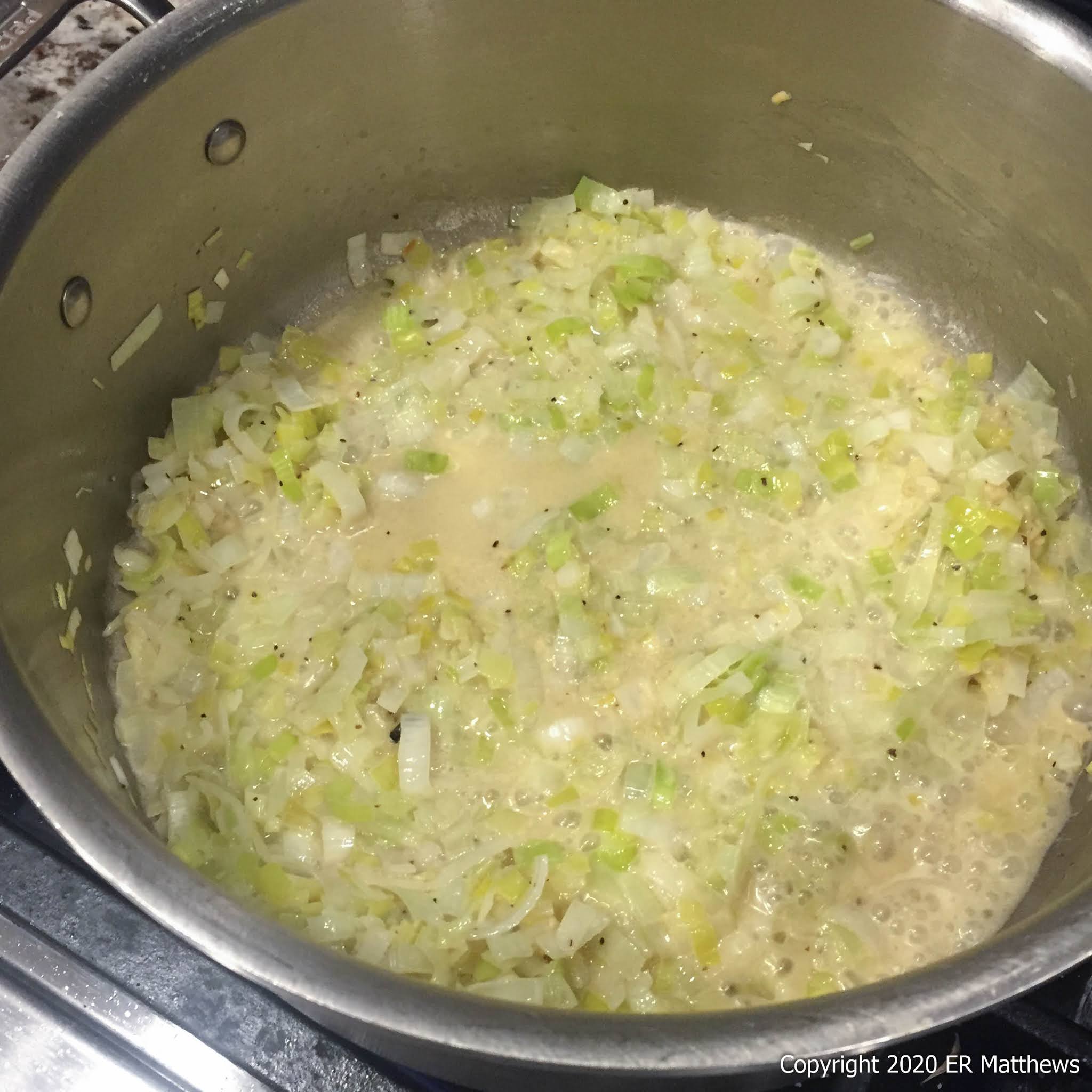
Mussels Steaming in Sautéed Leeks and White Wine
In very short order, the mussels will open and the meats will go from translucent to solid color. At this point, I remove them to a service bowl discarding any mussels that failed to open.

At this point, I finish the sauce to pour over or enjoy on the side with the mussels. In this case, I added fresh dill to the mussel broth and whisked in some cold butter to lightly thicken the sauce. You really want to be careful with mussel broth not to reduce it no matter how great the temptation. Mussel liquid is highly briny and often tastes lightly of iodine, both flavors of the sea.

I once, as a young chef, had the bright idea to highly reduce the mussel liquid and use the resulting sauce to nap the cooked mussels, two mussel meats put into one half shell. Nice idea. But after a long time gently bringing the sauce to napping consistency, I tasted it to correct the seasoning. And I immediately spit the over salty, iodine-tasting mess in the trash. Don't be like young Ed. Learn from his lesson.

Butter and Dill for Finishing the Mussel Sauce
Steamed Mussels, Leek and Dill Broth on the Side
For me, the primary reason for cooking mussels is the resulting tasty broth. Sometimes I serve mussels in a bowl of broth; sometimes I put the broth on the side for dipping the mussel meats in. One of the joys of mussels is drinking all that great broth after you have eaten the mussels, or more hedonistically, using lots of great bread to sop up the broth. It irked me to no end to have customers at the restaurant not eat the broth after I spent all that time and effort in making it.

Leek and Mussel Soup
I'd never throw away any mussel broth and we had a lot left over after eating the mussel meats. The following evening, I put it in a soup pan, added a couple more leeks, and a splash of half and half. When the leeks were tender, I blended it to ultra-smooth and served it, still frothy from the blender, in coffee cups accompanied by slices of quesadilla for dipping.

Bottom line, I was terribly disappointed in the quality of these spendy mussels, but the two dinners from them made me very happy.

Saturday, December 26, 2020

Mediterranean-Inspired Mussels

Ann and I bought a couple pounds of delicious Washington State wild-caught mussels on a recent trip to the seafood market.

Mediterranean-Inspired Mussels
I had in mind to reprise a version of mussels that we did sporadically at the restaurant. We had mussels on the menu every day, but the preparation would change every other day or so, including new preparations and old stand-bys such as this one. Annie, I'm sorry that we're not eating bread now with which to sop up the juices.

Mediterranean-Inspired Mussels

At the restaurant, this dish would have also contained little bits of hard Spanish chorizo, but we're not eating that much meat at home, otherwise, this dish is almost identical. It depends on the spicy Calabrian chile, which has a salty and smoky flavor that other chiles cannot match.

The following quantities are sufficient for two pounds of mussels, which makes two hearty bowls or up to six appetizer portions.

1 tablespoon olive oil
4 cloves garlic, slivered
1 teaspoon Calabrian chile paste
4 piquillo peppers, sliced
zest of one orange, in long strips
1 pinch saffron
1/4 cup dry white wine

Warm the olive oil over high flame in a pan large enough to steam the mussels and add the garlic slivers. Cook until they start smelling good.

Add the chile paste, piquillos, orange zest, and saffron. Stir for a few seconds.

Add the white wine and then the mussels.

Cover and steam the mussels until they open, 90 seconds for this size, up to four minutes for the really large blues we used to get at the restaurant from Cape Cod.

Saturday, October 10, 2020

Mussels Steamed with Leeks and Mustard

Ann and I love mussels. They make a wonderful and easy-to-cook meal that never fails to satisfy us. I picked up about three pounds, a generous meal for two, a couple weeks back. We had them the night we got back from our coast run to Cannon Beach, a night on which I did not feel like cooking anything intricate after driving for four hours or so.

Mussels Steamed with Leeks and Mustard
Scrubbed and Debearded Blue Mussels
The mussels that I bought are wild blue mussels from Washington State. The woman at the seafood shop told me the area from which they came, but I promptly forgot. I have served thousands of pounds of mussels in my life, half farmed and half wild. While some people swear by one or the other, I don't know that there is that much difference between the two, all other things being equal.

I do know that at the restaurant, I switched from rope-grown Prince Edward Island (PEI) mussels to wild Cape Cods one winter when the Canadian farms were iced in, this on top of decreasing size and increasing price of the PEIs. I found that the larger wild mussels from Cape Cod were a lot tastier than the smaller PEIs and three or four dollars a bag cheaper.

A downside to wild mussels is that they are generally dirtier and have more beard than farmed mussels, increasing the labor needed to clean them. This particular batch of mussels was the hardest to clean that I have ever experienced.

Cleaning Mussels


Here is what you need to know to store and clean mussels:

Mussels are alive and they need oxygen to remain alive. You should never eat a dead mussel. To store mussels, put a layer of ice in a container and put the mussels uncovered on top of the ice. I put the ice in a plastic bag to keep the mussels from being submerged in all that fresh water. Drape a wet towel over the mussels and keep it wet.

You can store mussels as long as they remain alive. You will lose a fraction of the mussels each day until they are all dead and the longer you store them, the more that die each day, so plan to use them quickly. At the restaurant, mussels were delivered three days a week.

A dead mussel will not close, so the first thing I do is to dump the mussels in a big bowl of fresh water. The live mussels will automatically close. In fact, any mussel that is floating, you know is alive. It's the ones on the bottom of the bowl that you must investigate.

I use a kitchen towel (fortunately, they're cheap!) to clean mussels, starting with the floaters. Wipe any mud, grit, and other detritus off the shell.

Next comes removing the beard, if any. Farmed mussels will often be clean enough to cook without further cleaning, but wild mussels are generally going to have formidable beards, the fibers that they use to anchor themselves to rocks, pilings, and so forth. Using the towel for grip, grasp the beard firmly and pull the beard down towards the hinge end.

Look at the very bottom photo in this post if you are confused about which end I mean. If you imagine that an open mussel is a butterfly with rounded wings at the top and a narrow body at the bottom, you want to pull the beard towards the narrow end (on the right in the photo).

Once you get to the mussels that are not floating, if they are closed tight, they're OK. If they are open or partially open, pull them out and tap them on the counter. If they are alive, they will close in response to being tapped. Discard any that do not close.

After cooking, do not serve any mussel that has not opened.

Leeks, Dijon-style Mustard, White Wine
After cleaning my batch of mussels, I wanted to cook them very simply. The first thing I saw in the refrigerator was a leek, so I grabbed it, a bottle of dry white wine, and a jar of Dijon-style mustard. In the pan in which I was going to steam the mussels, I sautéed the cleaned leek in a touch of canola oil until translucent, then stirred in a couple of big spoonsful of mustard. Then I splashed the pot with a scant half a cup of white wine and stirred everything well.

You do not need to add much wine at all. The mussels are full of juices that will add to the wine and create a lot of broth, that delicious nectar that is the whole reason for steaming mussels. Sure, the mussels are fabulous, but the broth is incredible and the best part of the meal, especially with some good crusty bread.

We worked so hard to make exquisite broth at the restaurant and it pained me to no end when diners would return their bowls to the kitchen full of broth. Don't be like them. Don't make your chef mad. The broth is the best part, especially if the cook slipped in a tablespoon of butter before plating!

Mussels Ready to Steam
Cover the Mussels
Once you put the mussels in the pan, cover it to steam the mussels. Mussels vary in cooking time: the larger they are, the longer they take, but even so, they cook quickly. Check every minute or two until the mussels are open. When the bulk of the mussels are open, discard any that failed to open; they're probably dead.

Notice my ghetto lid on the mussels. We always cooked individual orders of mussels in a standard skillet with another inverted over it for a domed lid. I don't know too many restaurants that purchase lids for their pans. There's always aluminum foil, a sheet tray, or another pan that will make an impromptu lid. If I recall correctly, I owned two stock pot lids for about 15 stockpots and perhaps 50 skillets.

This is a long way of saying that when buying pans, you should not spring for the matching lids. Moreover, you should never buy pans in sets: they're going to sell you stuff you absolutely do not need, like bunches of lids that will collect dust somewhere.

Et Voilà! A Perfect Steamed Mussel
These mussels with a leek, some mustard, and a splash of white wine made a tremendous dinner. Despite being the filthiest mussels I have ever encountered, they were among the very best in flavor that I have ever eaten. Good on you Washington State!

Monday, October 31, 2016

Paella

Ann has been talking about me cooking a paella for months. Our last experience in doing paella at the beginning of October was that the weather was brutally hot, so she scheduled it this fall for the end of the month. Naturally, it was the hottest day we have had in a month, topping out at 83 degrees and somewhat uncomfortable in the sun. Fortunately, the gusty winds out of the south made it somewhat bearable.

The Guest of Honor
Once guests started arriving, we could see the telltale darkness on the horizon out west and several of us started looking at the radar to see how bad and how soon the rain would be. How soon? A lot sooner than the predicted 6:30. How bad? Some gusty wind and a bit of rain, not enough to send us inside, the wisteria vines on the arbor giving us enough cover.


Searing the Chicken and Chorizo; Look at the Wind!

Sofrito Cooked, Stock Coming to Boil

Rice About Half Done, Adding Mussels

Mussels Just Open, Shrimp in, Max Flame for Soccarat
With all the wind, I couldn't get the paella done as quickly as usual; the heat was blown off the pan. Such is cooking outdoors over a fire. Of the hundreds of frames I shot, these are all the photos worth looking at and many of these are pretty terrible. I'm afraid I'm not very good with the camera. I was trying to use my 50mm prime lens and I still don't have it figured out. I need to find another strategy for shooting handheld interior shots in low light without resorting to flash. (The little voice is saying, "use the iPhone, idiot!").

Monday, April 25, 2016

Great Smoky Mountains National Park: Afternoon and Dinner

After lunch, we retraced our path west out of town back towards the Visitors Center. On the way into town, we noticed a footbridge across the Little Pigeon River and I made a mental note to stop on the way back past it.

Us on the Footbridge Over the Little Pigeon River
Notice the Great Blue Heron in the lower left corner of the photo above. I managed to get a shot of it just before it flew off croaking away. Ann was somewhat surprised to see it, associating herons with her time in Florida. I've come upon them in the oddest places, in all bodies of water all over the east, and in creeks not 18 inches across.

Great Blue Heron; Little Pigeon River
From the footbridge we proceeded west along the river in the direction of Cade's Cove and saw the first of many, many turkeys that we would see in the park and along the Blue Ridge Parkway. Most were toms casually foraging on the side of the road. We never saw any hens; they're probably all up in the woods on nests.

One of Many Turkeys
Shortly past the Visitor's Center, we came to the parking area for Laurel Falls and it was full, even on a Monday afternoon. We parked a quarter mile down the road and backtracked, taking us past some yellow trilliums in full bloom. They don't have the prettiest of blooms, but the foliage is outstanding.

Yellow Trillium
The path to Laurel Falls is a paved and easy path with way too much company, including a ton of kids. I would skip this on a subsequent visit. The crowds outweighed the beauty of the falls for me. Still, it was a quick hike that fit into our jammed itinerary.

Laurel Falls

Annie at Laurel Falls
It's a good 45- to 60-minute slog from Gatlinburg to Cade's Cove along a beautiful stretch of two-lane road that meanders alongside the river, at places with overhanging rock. The drive is slow and twisty but a lot of fun if you're into that kind of thing. Cades Cove is wide green valley surrounded by both mountains and trees, making it an ideal foraging spot for wildlife. The major attraction here is the bears and the traffic on a Monday afternoon was nearly intolerable. I would not make the drive again, preferring to be in much more peaceful, wooded, and less populated parts of the park.

Cade's Cove, a Sea of Green Surrounded by Mountains
About two-thirds of the way around the one-way loop, we came across this little yearling bear foraging for leaf buds in what appears to be a sycamore tree along a hidden creek.

Yearling Bear Foraging for Leaf Buds
After a few minutes of watching it and wondering where the mother was, we finally spotted her in the brush about 50 yards away. She was encouraging junior to come back to her and he very reluctantly climbed back down the tree and headed slowly back down the creek to her location.

Mom is Calling Junior Back to Her; He Reluctantly Climbs Down
The yearling, after touching base with mom, decided to go back up the tree and continue snacking. After a few minutes, we finally saw why the mother was in the brush: she had a little baby with her. She and the baby finally joined the yearling in the tree.

Mom and Baby Come to Join Yearling
The photo below shows all three of them, the mother on the main trunk, the yearling up to the far right, and the baby is the black spot on the lower left along the creek bank.

Mom and Her Two Cubs
It's quite amazing how limber and agile these big creatures are. Note to self, climbing a tree isn't going to keep a bear away from you! It's also amazing how hungry they must be right now just having emerged from hibernation to be eating fairly non-nutritious buds of a tree. It was pretty cool to see how relaxed these bears were. Around here, we generally see their rear ends as they are running away from humans though we do have them in town each spring raiding bird feeders and scavenging pet food and trash.

Mother Bear in on the Act, Eating Leaf Buds
By this point, it was getting to be very late afternoon and we had to hustle back to get showered and make our dinner reservation at the Lodge at 7pm. There really wasn't any hustling with all the traffic but we made it back in time to relax for a moment before dinner. On a slow Monday night, we were able to secure the last table outside on the porch with a fantastic view of the mountains. We decided to eat at this restaurant before we left because it is really the only fine dining restaurant in the area.

Beautiful View from Restaurant Porch
Despite the beautiful view, there were warning signs almost immediately that our night was heading south. We came into the restaurant with typical fine dining expectations and wanting to spend a leisurely dinner over a bottle of wine.

Those expectations seemed doomed almost immediately upon looking at the wine list which comprises a handful of wines. Still holding out hope, I asked if perhaps there were a full wine list. No such luck. The list is the list, a few very commonplace and ordinary wines with huge markups. We got a bottle of Champagne that was served in really clunky flutes. That seemed to be a trend for the trip: none of the restaurants in which we dined had really good stemware. Why is that?

The menu was equally limited with four appetizers, two salads, and five entrées. So much for our preferred method of ordering many appetizers to share: it wasn't going to happen with this menu. We bit the bullet and ordered traditionally, scallops and filet for Ann and mussels and pork shank for me. It was barely light enough (with a lot of help from Photoshop) to get pictures of the appetizers. It was too dark to record the entrées, not that we would have wanted to remember them. More on that in a moment.

Scallops with Peppercorn Sauce

Saffron Mussels
I really hate to beat up a restaurant because being in the business, I know how hard people work and how deflating a bad word can be. Still, I would be lying if I did not say that this was perhaps the worst executed meal for the dollar that I have ever had. I don't mind paying for food, but if you are going to charge top dollar, you are going to get judged against top standards. Our meal, against these standards, was a failure.

Our sampling of the tiny and unimaginative menu led us to conclude that the food here is characterized by overuse: too much smoke on the smoked shrimp amuse bouche, too many peppercorns in the beurre blanc for the scallops, too much cheap saffron in the mussels. I've never had worse mussels; these reeked of sulfur (gunflint) and were tiny and flavorless. Ann's steak was buried in an obscuring sauce redolent of A-1; we have no idea how the meat tasted. My pork shank ($36 for an entrée that cost maybe $4) could have been cooked a bit longer, was not super flavorful pork to begin with, and was served off the bone on a wad of not well executed lukewarm to cold-in-the-center mash. I ate a third of the mussels, maybe half the pork, and none of the mash.

After we beat a hasty retreat without risking dessert, Ann wondered aloud and probably only half in jest if we could get pizza delivered: we both went to bed hungry. The experience made the decision to skip breakfast again the next morning a no-brainer. It's really a shame that a first-class property such as the Lodge at Buckberry Creek does not have a restaurant of comparable quality.

Friday, March 18, 2016

Moqueca Baiana

Moqueca Baiana
We've been plagued with cancellations at the restaurant and last night was no exception. Moreover, it was St. Patrick's Day, a historically robust night for bars and an extremely slow one for restaurants, I decided to take the night off. Ann wanted something nice for dinner last night and I struggled with that. I hadn't planned to make dinner and retty much everything we have on the menu, I don't want to eat because I've seen too much of it. Moreover, I was really tired and didn't want to put a lot of effort into dinner. Finally, it dawned on me that I could put together a shellfish moqueca in no time at all.

At work, I diced some red, yellow, and orange peppers along with a bit of onion, sliced some green onions and fresh tomatoes, minced a bit of garlic, and chopped a bit of cilantro, about three cups in total for three portions.

This dish couldn't be any simpler to make. I heated a soup pan on high flame and sautéed the vegetable sofrito in palm oil, then added a can of coconut milk, juice of a key lime, and a bit of water. Next, in went the clams, followed a minute later by the mussels, and then all at once the scallops, shrimp, and cubes of rockfish. I stirred this and let everything cook another two minutes, then turned it off for two minutes for everything to carry over to doneness. And done.

Tuesday, August 11, 2015

Penne ai Frutti di Mare all’Arrabbiata

On our way back from Skyline Drive on Sunday, Ann and I started kicking around what to have for dinner. We tried to talk about dinner on the drive down to no avail: we both think better about food when we are hungry. And hungry we were starting to get after our hike whetted our appetites.

Ann started things off with shrimp seviche, which morphed into cellophane noodle salad or some combination of the two dishes. I thought we were done with dinner planning and had arrived at the "light and fresh" dinner that Ann was craving. Then scallops got into the picture, still light and fresh. But then things took a left turn: "in a spicy tomato sauce." Next, "what kind of pasta do you have at the restaurant?" At this point, I knew light and fresh was out the window and I threw in the towel offering that we also had beautiful mussels to add to the arrabbiata/puttanesca sauce.

And what an awesome dinner it turned out to be!

Penne ai Frutti di Mare all’Arrabbiata
 This pasta turned out to be even better tasting than it looks!

Warm-up Wine During Prep
When we got home from hiking, we opened this 2010 Hodder Hill Bordeaux blend from Glen Manor. I thought it fitting because we spent the day hiking very near the winery.

Sauce Mise en Place
Here you see the majority of the sauce components ready to go, from top left clockwise: red pepper flakes, olives, tomatoes, garlic, capers, mussels, and basil. Missing are white wine and fish sauce, my alternative to anchovy filets. The olives are the little ones very similar to those from Nice and are cured in the Niçoise fashion. These happen to be from Spain where they are called Coquillos.

Searing Scallops
To start the sauce, I first seared the scallops and the shrimp in a black steel pan, trying to build as much fond (the brown caramelized glaze on the bottom of the pan) as possible.

Searing Shrimp
As each batch of seafood was just barely cooked, I transferred it to a large pasta bowl. Once all the seafood was cooked, I deglazed the pan with a half a cup or so of dry white wine, a bit of leftover Chablis from the fridge. I moved the black steel pan off the range, dropped the pasta in the water, and moved a large pan onto the flame to make the sauce. I used a large, shallow pan because I wanted as much surface area as possible so that the sauce reduced as quickly as possible: it needed to be done in the time that the pasta took to cook, about 10 minutes.

Sauce Just Starting to Work
First into the pan were olive oil, red pepper flakes, and garlic, healthy quantities of each on the order of 3 tablespoons. Once the garlic started to brown, in went the capers, the mussels, the olives, and the tomatoes. I also added half the sliced basil, the deglazing liquid, and a good shot of fish sauce (rather than anchovies). The other half of the basil went into the pasta bowl with the shrimp and scallops.

Final Reduction on the Sauce
The mussels will in all likelihood cook before the sauce is completely reduced, so when they open, remove them to the bowl with the other seafood. When the pasta is cooked and drained, add it to the seafood and once the majority of the liquid has evaporated from the sauce, check it for seasoning and add it to the pasta. Toss everything and serve immediately with a little grated cheese, if you like. I tend not to add grated cheese to seafood dishes.

A Perfect Wine for This Sauce
The perfect wine for this spicy tomato-based dish is a high-acid, light-bodied Italian red. Barolo might be overkill but I sure didn't mind. A Langhe Rosso Nebbiolo would have been a more budget conscious choice.

Mendocino, Part 4 of 4

Friday October 2 As I came to, the raspy gargles of a pair of ravens sitting in the eucalyptus just outside our open balcony door greeted me...