Showing posts with label doenjang. Show all posts

Saturday, May 6, 2023

Doenjang Noodles

Ann has been feeling her kitchen oats a bit recently, coming up with dishes that she wants to make. And I could not be happier. She's a wonderful cook and I love the break from having to come up with dinner all the time. Well, that's a bit of a lie just now. My foot is just healed and out of the cast and I am starting to walk gingerly and I'm itching to get back into the kitchen. Despite my jones to be back in the kitchen, I'm still happy to sit at the counter and watch Ann work.

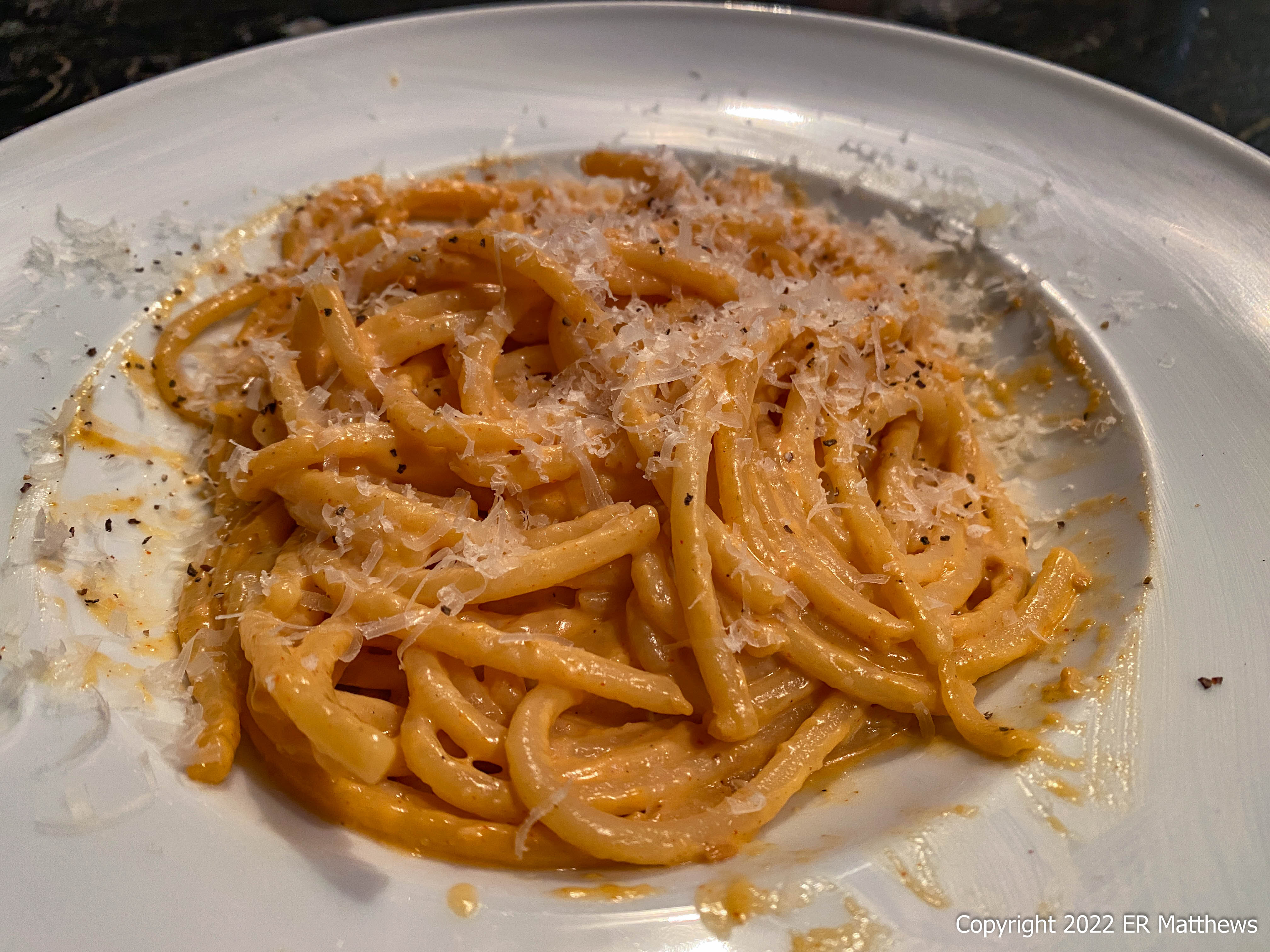
Doenjang-Gochujang Perciatelli
Last night being my first tentative foray into walking unassisted by crutches in almost three months, we decided to celebrate with a bottle of Champagne. As we were sitting on the sofa chatting over Champagne, Ann decided that she would make a dish for me that she has been planning for some weeks. The dish in question hails from the NY Times and is called quite unimaginatively Doenjang Noodles.

Doenjang Noodles is pretty much the recipe, too. The par-cooked noodles are finished in a sauce of a quarter cup of doenjang whisked into a pint of milk, end of story. The dish is garnished with a few grinds of black pepper and a grate or two of pecorino romano.

Measuring the Doenjang and Milk
While I believe that the idea of the NYT recipe was to be an umami-laden ersatz alfredo, we like a bit more flavor in our pasta. After tasting the pasta, Ann ended up doubling the inoffensive amount of doenjang in the original recipe along with adding a big glob of spicy gochujang. 

I Love This Woman!
What a really easy and tasty pasta for a quick meal!

Tuesday, September 24, 2013

Zhajiangmian

Zhajiangmian with Snow Peas
Zhajiangmian ("fried sauce noodles") is one of my all-time favorite comfort dishes: there is something about noodles with a rich earthy pork and bean paste sauce that makes me tremendously happy. I first encountered it twenty or so years ago in a little hole in the wall Chinese restaurant where I ordered (it and lots of other delicious and unusual dishes) blindly from the Chinese-language only menu by pointing. I raised some eyebrows playing palette roulette this way, but I got to try a lot of great dishes and I finally trained the staff so that they would suggest dishes that I should try. It took a long time for them to figure out that they weren't going to scare me by serving pig's ears or dried jellyfish. Of all the dishes that I tried though, fried sauce noodles was one of my favorites and one of those that I have learned to make. And beyond making it, I now feel comfortable in making my own versions.

It is one of those dishes that varies each time I make it depending on what I have on hand in the refrigerator and pantry. The theme is thick wheat noodles and a sauce of bean paste and ground pork. The variations are endless.

Yesterday's variation involved two kinds of bean paste, regular Korean soy bean paste (doenjang) and spicy Korean fava bean and chile paste (dobanjang), along with soy sauce, Chinkiang black vinegar, and dark sesame oil. Garnishes always vary, but I almost always insist on pickled mustard stems (zha cai), five spice-pressed tofu, and a green vegetable, in this case, some beautiful fall snow peas. The sauce was flavored with copious amounts of both ginger and garlic and I tossed raw green onions and cilantro leaves into the noodles while tossing them with the sauce. The noodles themselves: udon.

I no longer worry about the cultural mash-up that is my zhajiangmian, for this is a dish that has been adopted all over Japan, Korea, and China and is made with whatever suitable local ingredients are available. The best noodles I can get happen to be udon and the best bean pastes I can get happen to be Korean. And who cares? The results are spectacular!

Cultural Mash-Up: Japanese, Chinese, and Korean


Thursday, March 28, 2013

Udon with Pork, Shiitake, and Tofu

Udon with Pork, Shiitake, and Tofu
At 4pm on Sunday, it went from hazily overcast to snowing so hard that we couldn't see across the street. Nothing like blizzard conditions to put me in the mood for comfort food and I had gone to FoodMaxx earlier in the morning with this dish in mind, so I was fully prepared. Slurping a big bowl of udon is comforting to me, seriously comforting.

I tossed the udon with a sauce of ground pork, diced spiced and pressed tofu, shiitake mushrooms, pickled mustard stems (zha cai), doenjang (Korean bean paste), Chinkiang black vinegar, ginger, garlic, green onions, and cilantro.

There were zero complaints from the peanut gallery about this dish, just dead silence while we all wolfed the noodles down!

Tuesday, February 5, 2013

Haddock, Sichuan Style

When I spoke to Ann early yesterday morning, she wanted something for dinner last night but just couldn't put her finger on it. So she went back to this blog and looked at what we were doing at this time last year. When she came across the Sichuan-style catfish from February of last year, she knew what she was in the mood for.

At the market, I couldn't find a catfish, but I did find some reasonable looking haddock filets. Haddock is mild and white and pretty forgettable: it would be a fine foil for the super tasty Sichuan sauce I was about to put on it. I wouldn't dare put this complex and spicy sauce on a really good piece of fish.

Mise en Place
Each time I make this dish, I do it differently, based on how I am feeling and what I have available. Isn't that how most people cook? Once you learn the theme of a recipe, each time you make a dish after that it is all about subtle variation. Where I would typically use dried black and tree-ear mushrooms, this time I had fresh shiitake on hand. And I happened to want five spice-flavored and pressed tofu instead of plain tofu. The recipe theme is the same, but the slight variations make the particular instance of the dish.

The ingredients clockwise from the little red bowl of ground Sichuan peppercorns: five spice-flavored pressed tofu, bamboo shoots in chile oil, dobanjang (more about which in a minute), garlic, cilantro, green onions, shiitake, zha cai mustard stems, doenjang bean paste, and ginger.

The market I shop at is run by Koreans and so their selection of Korean foods is really good; their Chinese less so. But fortunately, there are a lot of ingredients in common. Take the dobanjang for example, the bright red fermented fava bean and chile paste in the small jar to the extreme left of the photo. It is also known in China as doubanjiang and is the heart and soul of Sichuan sauces. The same sauce made with soybeans instead of favas is known as gochujang and it is very different to tell the two apart. I mention this because the tiny jar of dobanjang you see above cost an exhorbitant $8. You can make your own gochujang facsimile by mixing chile paste with doenjang, the bean paste that you see on the right of the photo, for next to nothing. Although the flavor isn't quite the same, with all the chile spice going on, it is very difficult to tell them apart in a finished dish.

Haddock, Sichuan Style

To pull this dish off, I first rubbed one side of the fish in a touch of sesame oil and then sprinkled the filets with finely minced garlic, finely minced cilantro stems, freshly ground Sichuan peppercorns, and a little corn starch. After they were browned on the corn starch side, I flipped them and removed them to the casserole dish. Then I built the sauce by cooking the mushrooms, tofu, ginger, garlic, bamboo shoots, and mustard stems over high heat. To this I added a bit of dobanjang and a lot of doenjang bean paste along with enough water to just make a sauce. After this cooked for a minute, I poured it over the fish and put the whole thing in the oven for about 4 minutes, until the fish just cooked through. Just before serving it got a topping of green onions and cilantro leaves.

Just delicious served with plain rice!
Tuesday, March 27, 2012

Noodles with Pork, Green Onions, and Snow Peas


I wasn't feeling well yesterday and the weather was turning chilly again: I needed comfort food. In the morning, when Ann and I were discussing dinner—isn't that a primary topic of conversation for all couples?—she said, "It's getting cooler; let's have something wintery one more time before it gets hot." Both of us on the same page is always a good place to start. "Or let's go out!" Oops, maybe both of us not on the same page.

I just didn't feel up to going out and so I brought home a few things to make a bowl of noodles. Noodles and soup noodles are my go-tos when I am not feeling well. Here you see my mise for dinner: wheat noodles, green onions, doenjang, preserved vegetable, sambal oelek (the jar just barely in the photo), snowpeas, garlic, ginger, and ground pork. I didn't bring the snow peas home; they were a lucky find in the refrigerator. Doenjang is a Korean soybean paste. I like it better than most Chinese bean paste because it still has some whole or partial beans in it for texture. Preserved vegetable is a mustard green that has been cured in salt and chile. Sambal oelek is ground fresh red jalapeño chiles.

Ode to the Tortilla

I love tortillas. It wasn't always that way. I am a child of the early 1960s. Then, on the East Coast, our food was influenced by two th...