Showing posts with label vegetarian. Show all posts

Wednesday, October 15, 2025

Quick Dinner for Ann's Girlfriends

Ann invited Erika and Michelle over for dinner just so that they could catch up with each other. I cooked a quick gluten-free vegetarian dinner and we sat around the counter and yakked for a few hours.

Erika Makes Gorgeous Flower Arrangements
My First Time Seeing the Yellow Kangaroo Paw Flowers

I Shoot a Bunch of Candids When People Are Not Expecting It
Sometimes, I Get a Gem

Chips with Pineapple Salsa
Posole Casserole with Poblanos and Fresh Corn
Michelle Made Mexican Chocolate Mousse

Sunday, January 29, 2023

Gochujang-Roasted Carrots and Brussels Sprouts

I love gochujang, that somewhat spicy, funky, thick and sticky, fermented Korean paste of red chiles, glutinous rice, soy, and barley. Although many people would find gochujang highly spicy, in my world, it's pretty mild as spicy things go.

Gochujang-Roasted Carrots and Brussels Sprouts,
Ann: "Damn it! You're Trying to Get Me to Eat Vegetables!"
Back during the height of COVID sequestration, I started toying with the idea of gochujang and carrots, using those carrots as a base for a fish dish. Initially, I tossed the carrots in a gochujang-based sauce before roasting them, but in more recent iterations, I have taken to roasting the carrots first, then tossing them in the sauce after cooking, à la Buffalo wings. I prefer this method because I can roast the carrots just to doneness without having to worry about the sauce burning in the high heat of the oven.

Last night, in expanding on the theme I decided to do a strictly vegetarian dish of roasted carrots and brussels sprouts in gochujang sauce over rice. From the get-go, Ann was asking, "What protein are you going to serve that on?" She's not quite of the "if it's not meat, it's not a meal" ilk, but vegetarian is harder for her than for me. I could happily live on vegetables without any meat at all, but that would really test Ann's limits.

Gochujang Sauce
My new iteration of gochujang sauce shows some evolution from the original as well. Last night, I mixed a lot of gochujang with a little rice vinegar, some agave nectar to balance, a little soy for salt, a touch of sesame oil for complexity, and finely minced garlic. A couple of tablespoons of warm water helped make the sauce fluid enough. This would make a really tasty Buffalo wing sauce, come to think of it.

Thursday, May 5, 2022

Chickpea Salad with Yogurt Dressing

Chickpea Salad with Yogurt Dressing
This post is mostly a note to myself to remember this salad, because Ann really loved it. I made it last evening from odds and ends I had in the kitchen that needed to be used. It's a two-part salad, the base of which is arugula tossed with lemon juice, olive oil, and salt. The chickpea salad on top is chickpeas, olives, green onions, and grape tomatoes tossed in a yogurt-based dressing.

The dressing, very much a spur of the moment thing, is plain Greek yogurt flavored with garlic, cumin, and salt, spiced with chipotle adobo, and thinned with water. If I were making a true Mediterranean-inspired dressing, I would have used some other kind of spice, such as Urfa or Aleppo pepper, or even a bit of harissa, but I have a can of chipotles open in the refrigerator that needs to be used.

Update: I have cooked so much food in my life that I have forgotten much of what I have done. In cruising through old posts, I came across a recipe for this dressing that I published back in 2020. I totally forgot about it.

Sunday, March 20, 2022

Hummus with Sweet and Spicy Carrots


Hummus with Sweet and Spicy Carrots
I've got this thing for roasted carrots with dobanjang and honey going on lately. I love the texture and flavors.

Last trip to the store, I bought some chickpeas and some carrots, knowing that Ann wanted to dip carrots into a batch of hummus for a light dinner. But the weather is still cold here in Central Oregon and I wasn't really feeling such summery fare. I thought instead to roast the carrots and serve them still warm out of the oven on a bed of hummus.

Right now, it is just too much effort to come up with a recipe for the two major ingredients here, hummus and the dobanjang honey sauce in which the carrots are tossed. Both of these I make at the drop of hat in the quantities that I want, spiced like I want. It robs my cooking of all spontaneity to measure and to assign a precise ingredient list to such whimsy. In short, codifying a dish robs all my joy. Sorry. Not sorry.

The hummus is chickpeas, lemon juice, pimiento-stuffed manzanilla olives with some brine, garlic, pimentón, salt, a splash each of sriracha and sesame oil, with enough water to smooth it out to a rough paste. I'm not the biggest fan of super smooth hummus. It's great and all that, but I really do prefer more texture.

The sweet and spicy sauce could be made from anything spicy and anything sweet, but this version is about equal parts dobanjang and honey with a touch each of soy sauce and rice vinegar, to add salt and to tame the sweet a bit.

Maybe someday I will get around to codifying these two recipes, especially if I ever decide to write about creative vegan fare.

Friday, March 18, 2022

Recipe: Roasted Potatoes and Asparagus with Salsa Verde

Roasted Potatoes and Asparagus with Salsa Verde

The other day, our store had a big bag of small potatoes on special and we brought one home along with a bundle of asparagus whose price has plummeted with the arrival of spring in a lot of parts of this hemisphere, here excepted. We won't see spring temperatures for a few weeks, but a guy can live vicariously via the produce in the stores, can he not?

I ended up roasting one sheet tray of asparagus and another of the baby potatoes, then mixed the asparagus with some of the potatoes for our dinner. We liked the combination so much that I decided to do it again.

But meanwhile, leftover from this dinner was a small container of roasted potatoes and being a hungry guy, I pulled them out of the fridge for my lunch. Right next to them was a container of recently made salsa verde and I thought, "Self, wouldn't these two be good together?" And I put them together and they were good and I filed that note away for our next roasted potato and asparagus dinner.

And that brings us to dinner last evening, pictured above. While the potatoes and asparagus roasted, I made a batch each of salsa verde and another of my pimentón (smoked paprika) sauce, recipes below. This salsa verde is a new sauce that I started making in the last year; the pimentón sauce, I've been making since before opening the restaurant, some 20-plus years ago.

The combination of vegetables with the bright and spicy green sauce contrasted with the rich and smoky orange paprika sauce was as good as I had imagined it would be. And it made a fantastic dinner on a cold March night, warm, comforting, spicy, smoky, low calorie, lowish fat, and most importantly, delicious.

Recipe: Roasted Potatoes and Asparagus with Salsa Verde

You don't need a formal recipe or fixed amounts to serve this dinner. For entrée-sized portions, for every two people, start with a pound and a half each of baby waxy potatoes and asparagus. This would also make a wonderful side for a grilled steak, in which case, this amount would likely serve four people.

1.5 pounds small waxy potatoes
1.5 pounds asparagus
olive oil
salt and pepper
1/2 cup salsa verde
2 tablespoons pimentón sauce

Preheat your oven to hot, about 400F. Toss the potatoes with olive oil, salt, and pepper and put on a sheet tray. Break off the tough ends of the asparagus and cut the remaining tender stalks to serving size; I cut each stalk into three pieces. Toss with olive oil, salt, and pepper and put on another sheet tray. Place the two sheet trays in the oven and roast the vegetables until done. The asparagus will likely take 20-25 minutes while the potatoes, depending on size, will take 35-45 minutes.

Combine the roasted vegetables with the half cup of salsa verde and toss well. Divide into two serving bowls and drizzle with the pimentón sauce.

Recipe: Salsa Verde

This is a recipe that I have published before, but it's a short one and easier to include it here than to go and chase it down. I mainly like to use fresh vegetables versus canned ones, but this sauce is a great use for canned tomatillos because it avoids you having to cook the tomatillos before making the salsa.

I specify serrano chile in the recipe simply because it is a reliably spicy chile that is available everywhere all year round. In practice, I make the sauce with whatever spicy green chile I happen to have. Last year, it was most frequently Sugar Rush Peach peppers because a friend gave me a plant.

You'll need a good blender to make this sauce. Here's a plug for my venerable VitaMix, veteran of the restaurant kitchen. At one point, we had five of them between the kitchen and the bar at the restaurant. And we probably went through about a dozen of them total over the 15-year life of the restaurant. 

1 28-ounce can whole tomatillos, drained
2-3 large cloves garlic
1 serrano chile, sliced
1 bunch cilantro, roughly chopped
1/2 teaspoon Kosher salt (to taste)

Place all the ingredients in the blender and starting on low speed, gradually increasing the speed as the ingredients liquefy, blend until you achieve a smooth sauce. Season to taste with additional salt, if necessary. Will keep, tightly covered under refrigeration, about a week.

Recipe: Pimentón Sauce

This sauce is such a good flavor enhancer and color booster for a dish that we used to make it by the gallon at the restaurant, about a week's supply. Quantities are approximate in that I never measure exactly. Quality matters: use a great brand of real Pimentón de la Vera from Spain, not some knock-off. And restraint matters: pimentón gets really bitter when used in large amounts, so go easy until you get a feel for how you like it. The following recipe yields about a cup of sauce.

1/2 cup mayonnaise
1 tablespoon Pimentón de la Vera
1/2 cup water
salt to taste

Start by putting the mayonnaise in a bowl and sprinkling the pimentón and a dash of salt over it. Mix thoroughly with a spoon, pressing the pimentón against the bowl as needed to remove any lumps. Mix until the paste is evenly colored throughout. Add water in small amounts, mixing it in well before adding more. Thin the sauce to the consistency that you desire. Season with salt as necessary. Store under refrigeration almost indefinitely. I typically load the sauce into a squirt bottle to make garnishing easy.

Sunday, July 25, 2021

Alaska Day 0: Portland

“We have earned this vacation. We’ve been to Hell and back the last couple of years.” quoth Ann. This trip to Alaska would be our first vacation in a very long time. Four years if you count as a vacation our drive from Virginia to Oregon in moving across the country in 2017. Before that, we had a few days off here and there, but rarely a true vacation since 2011, true vacations being nearly impossible in the restaurant business.

A glance at the local weather reminded us that this was a great time to head to Alaska because after a few weeks of reasonable temperatures, things in Oregon are headed north of 90 towards 100 by week’s end (and would be over 110 when we got back). Meanwhile the Anchorage forecast is for highs in the 60s with a lot of clouds and some rain.

Given our 6:30am flight from PDX to ANC on Monday morning, there was no profit in trying to get up early enough in the morning on Monday to drive to the airport, to risk commuter traffic. Our usual routine is to drive to the airport the evening before, grab a beer and some grub at Culmination Brewing (permantly closed 2025), and stay at a hotel at the airport.

Getting Ready

On Sunday morning, uncharacteristically for me, I was extremely anxious and uncomfortable. In the software business (before restaurant), I used to fly all the time without any anxiety, flying 100s of thousands of miles a year. Why so many nerves this time? I think it was the dogs. Leaving them was hard, so hard this time.

They were so clingy all day; it’s amazing how intuitive they are and how they can note the slightest difference in how we humans behave. It didn’t help that top of mind was that Charlie could die while we were away. He’s been on borrowed time for a year, his body riddled with tumors.

Packing helped. After weeks of mulling over what clothes and gear to take on our adventure, actually packing them was a relief. I packed super light, everything fitting into my small 33-liter backpack along with a tiny camera bag. I basically packed as if I were doing a thru hike, hiking also playing a huge part in our Alaskan agenda. I added a pair of shorts and jeans to kick around in. Alaska is less formal even than Oregon: blue jeans are formal restaurant attire.

My Gear Sprawl on the Kitchen Table
Back in June, I invested in a new camera setup. Because the majority of my photography happens when we are hiking, weight is of significant concern. I had been lugging my old Nikon D80 out in the field because its small format is a lot lighter than the full-frame F bodies. Still, that D body and 18-135 zoom lens weighed a ton.

For the field, I had rigged the big Nikon to hang across my chest on short straps attached to my backpack straps. While that was effective in keeping the camera at the ready, the camera bounced and swayed uncomfortably, especially if I were booking it down a trail.

My 25-Ounce Camera Setup
Since I put together the Nikon setup, technology has changed radically and I took advantage of that, purchasing the lightest Sony mirrorless camera, the a6000, also a small-format APS-C body. The absence of mirrors (lots of heavy glass) keeps the body weight to a minimum. And I purchased an optically stabilized Sony 18-135 zoom lens that weighs a fraction of the old Nikkor lens and appears to be optically superior.

The body and lens are shockingly light, coming in at under two pounds (25 ounces with battery/lens cap/etc.) in comparison to the old rig coming in around five pounds. And the picture quality is vastly improved over that of the old Nikon. If the body were any smaller I wouldn’t be able to hold it in my big mitts.

Dreaming on, I'd love to have a faster lens with more reach than the f5.6 approximate 200mm that the 135mm lens mounted on the small sensor yields, but I don't want to carry the weight of a bigger lens. At the other end of the spectrum, 18mm is pretty decent for landscapes. It's all a trade-off and for me, this very lightweight zoom lens works best in most situations.

Technology is also helping to carry the camera in the field. In recent years, camera clips have come a long way and I purchased one from Peak Designs that bolts onto my backpack strap. It has a quick release mechanism that the tripod plate on the bottom of the camera clips into. The camera clip proved to be extremely useful and stable, but I did have to remember to tighten the bolts holding the clip onto the backpack strap on a daily basis. All in all, a tremendous purchase.

I also purchased a Peak Designs leash for the camera, for when I wasn't actively hiking and using the camera mount on my backpack. The quickly detachable leash around my wrist gave me a lot of peace of mind, especially when shooting from the upper deck of a boat tossing in 10-12 foot seas.

The leash is designed to be worn as a bracelet when not in use, but I found that the magnet in it was insufficient to keep it around my wrist as a bracelet. Also, I don't recommend the leash when carrying the camera on a backpack. If unfurled, the leash dangles and sways annoyingly on your chest; if leashed around the camera lens, it impedes focusing the camera. I ended up rarely taking the leash when backpacking; if I did, it stayed in my pants pocket until needed.

Because the camera and lens is so small, I was able to forego my large camera backpack in favor of my tiniest camera bag which holds the camera, with lots of room left for my backpacking tripod, spare batteries, battery charger, Garmin, two pairs of compact binoculars, sunglasses, and other miscellaneous stuff such as cleaning gear, filters, and memory cards. In short, the new camera is a game changer for travel.

Summing up from my experience with the camera on the trip, I found that the Sony controls are somewhat awkward to use compared to the Nikon controls that I know by heart. Sony's menus suck as well. Finally, I found that I was quite often accidentally changing ISO, shooting mode (single shot v. multishot v. bracketed exposure), and f-stop when shooting in aperture priority. Despite these issues, I'd buy the camera and lens combo all over again for a lightweight hiking camera. 

Cleaning out the Fridge

For lunch, I cleaned out the remaining few items in the refrigerator and put together a frittata. We did not know it at the time, but this would be the best food we would have in a good while. We now know that one does not go to Alaska expecting decent (or, sad to say, even competent) food.

Clean Out the Fridge Frittata

Culmination Brewing

At 4 pm, after feeding the dogs, we walked out the door and headed north into town. This was our easiest trip in to Portland ever, an hour and five minutes to Culmination Brewing in the northern part of Southeast, ten minutes from the airport. Living in an area with some of the worst traffic in the nation, we are very thankful for small miracles like no traffic on the way to the airport!

Things have changed at Culmination since our last visit in 2019. Let me rephrase that. COVID has changed things at Culmination since we were last there: there's a lot of new covered seating outdoors, most of the indoor space and the bar are closed to seating, and gone is their kitchen, in favor of a vegan food truck operation called Miami Nice. Our bartender was pretty snippy too, but I don't think that was COVID related. She got better as the evening went on, but still, a snippy bartender is not what any business wants or needs.

Seating is Outdoors, Phaedrus IPA

One of the benefits of being outdoors was interacting with all the neighborhood dogs who came with their owners to have a beer. We were already missing our two dogs, so sitting at the next table from Copper, an extremely pretty Wooly Husky, was just the excuse Ann needed to go play with him.

Copper, the Wooly Husky
Mugging for the Camera
Queen of Hazy Beer

Vegan Food Truck


We didn't know that Culmination had closed their kitchen and replaced it with a vegan food truck. While we weren’t looking for a vegan meal, we have nothing against vegan food, and our vegetarian meals at home often happen to be vegan. That happens a lot especially when you’re lactose intolerant like me and mainly avoid dairy.

My personal opinion on vegetarian and vegan food is that if you are going to avoid eating meat, you should celebrate vegetables rather than putting effort into making your vegetables look and taste like meat. Ann is more blunt about not eating vegan food that resembles meat, humorously preferring a more Italian approach, “I could live on pasta, fruit, wine, and bread, but…how big would my ass be?” Nor does she understand why you would avoid dairy, “You feed a child with your tits.” But we're cool with everyone making personal dietary choices.

Vegan Loaded Tots and Vegan Cubano

The ersatz “cheese” on our loaded tots looked okay but tasted and felt all wrong. A former sous chef and good friend Tony has created a business making vegan cheese down in San Diego. I am sure he has put a lot of effort into creating better mouthfeel in his cheese and I am looking forward to tasting what has has accomplished. This vegan cheese wasn't high art.

The Cubano was a mixed bag as well. The bread and the pickles were OK. The jackfruit fake pork was interesting but could have been mistaken for slaw. The fake ham was a mess though, slices of some kind of non-meat tasting soy protein “sausage.”

Vegan food can be a whole lot better than this. I should know, having cooked creative vegan dishes almost every night of my restaurant career for years and years. As I have already alluded to, our mediocre food at Culmination was a harbinger of things to come in Alaska.

Ramada Portland Airport

The Ramada just off of 82nd Avenue offers a Park and Fly service which bundles parking, shuttle service to and from the airport, and a room for a very reasonable price, barely more than the cost of a room for a night. At easily $15 per day for parking, we would have been out nearly $300 for parking. 

In normal times, the Ramada has a van that runs regularly to the airport to shuttle guests, but they advised us in advance that they would be booking a Uber for us. When we arrived at the hotel, they let us know that they would be putting their van back in service for the first time since COVID. We could take the very first shuttle at 5:00am. 

The bed was a bit squishy, but for the price and convenience, our stay at the Ramada was well worth it.

Sum Total of Our Baggage, Less Ann's Small Carry-on
IPA Night Cap to Ensure Good Sleep
We hit the sack super early with our alarms set for 4:40am to give us time to catch the 5:00am shuttle to the airport.

Thursday, February 4, 2021

Pan-Fried Noodles with Vegetables

In recent weeks, we've taken to celebrating our collective weight loss (about 55 pounds now) on weigh-in days, every Monday, by having a bit of a splurge dinner. The long and short of it is that we allow ourselves a few simple carbs: all stick and no carrot is no fun. This week, it was noodles. We love noodles in any way: in soup as in ramen, wet with sauce such as in lo mein, dry fried as in chow mein, and of course, Italian-style as in spaghetti aglio e olio.

This week, I decided to serve a mound of stir-fried vegetables on a cake of pan-fried noodles, a quasi Hong Kong-style dish. Call it chow mein, pan-fried noodles, or yakisoba as you will. I call it a delicious way to eat a couple hundred calories of simple carbs while still eating a pile of vegetables.

Pan-Fried Noodles with Vegetables
Frying Noodles
It all started by making a stir fry of nappa cabbage, bean sprouts, shiitake mushrooms, snow peas, green onions, garlic, and lots of ginger, with a splash of soy sauce for salt. And while that was cooking, I steamed some wheat noodles briefly in the microwave to limber them up and put them in a large skillet to brown into a cake, flipping halfway through.

And that's it. The vegetable prep takes a while, but the cooking is done quickly. Given that I prepped the vegetables sporadically during the afternoon, dinner was on the table in under fifteen minutes, a win all the way around.

Saturday, January 30, 2021

Tacos de Calabaza

It's no secret that we love tacos and we love really tasty vegetarian food, so I've been making a lot of vegetarian tacos: rajas con crema, grilled vegetable, spaghetti squash and black bean, and now, butternut squash and poblano pepper.

I thought of these orange and green tacos some weeks ago but I hadn't committed the time to roast butternut squash cubes until yesterday. The idea came from a vegetarian green chile with butternut that I made about the beginning of December. I knew the sweet roasted flavor of the squash would pair tremendously with the mildly spicy earthy flavor of the poblanos. The result was wicked good.

Tacos de Calabaza: Butternut Squash and Poblano
To make the taco filling, I cubed and roasted a butternut, then made a quick sauté of large dice of poblano, diced red onion, sliced green onion, minced garlic, and minced cilantro stems, with just a hint of ground mild Numex chile. I added the squash to the sauté and seasoned it before serving it on corn tortillas with chipotle adobo, cotija cheese, and cilantro leaves. Keeper!

Tuesday, January 12, 2021

Spaghetti Squash and Black Bean Tostadas

Spaghetti Squash and Black Bean Tostadas
The last time that I made spaghetti squash with black beans and baked it into a casserole, Ann commented that she'd really like the dish if I were to make it as a tostada topping. You can find the recipe for the topping at the link above. Last evening, I baked a spaghetti squash and made the tostadas that she asked for.

Making Tostadas

Although I see bags of tostadas flying off the shelves at the local supermarket, I don't see the point of buying them, if you have time to make them yourself. All it takes is a bag of corn tortillas, two sheet trays, an oven, and about 45 minutes. Although I lay out the process below, there is a step-by-step photo shoot of how to do it here.

To make tostadas, I lay 8 corn tortillas on a sheet tray, 3 along each side and two in the center. Then I top the sheet tray with another such that the tortillas are trapped between the two sheet trays. This will keep the tostada shells relatively flat.

The tortillas go into a moderate (350F) oven for fifteen minutes, at which point I pull them out of the oven and take the top sheet tray off. This lets the water vapor escape. Then I flip the tortillas over. At this point, you will see that they have shrunk to the point where all eight fit on the sheet tray with almost no overlap.

Re-covering the tortillas, I put them back into the oven for another 15 minutes and repeat the same process for a final 15 minutes. At this point, the tortillas should be dry and crisp. Pull them out and leave them uncovered until you are ready to eat. The hot tortillas will continue to evaporate any last bits of water in them as they cool.

You should eat the tostadas right away, but if you cannot, once they have cooled to room temperature, you can store them for a very long period in a tightly covered container. Humidity is their enemy so keep them cool and dry.

Vegetable "Lasagna"

Ann put me onto the idea of making a vegetarian lasagna a week or so ago. It was kind of a fun dish to assemble and eat. Naturally, it would have been a lot better if I weren't working so hard to minimize the fat in it, but it was delicious.

Vegetable "Lasagna"
Once I assembled the lasagna, it baked in a moderate (350F) oven for an hour to heat through and crisp the pecorino romano that I grated over the top. I filled the oiled 9x9 baking dish level with the top rim and as you can see in the photo, the lasagna puffed up about a half an inch above the rim of the dish. It later settled back as it cooled.

Baked Squash Slices for "Noodles"
I started by cutting several (let's call it 9 or 10) small zucchini and Lebanese squash (the light green, small straight squash) into 5-6 slices each and placing the slices on two sheet trays sprayed with pan spray. They went into a moderate oven (350F) with a turn every fifteen minutes for about an hour.

The point of pre-cooking them is to evaporate much of the water in the squash so that it does not bleed into the lasagna. I jammed the slices together as closely as possible until both sheet trays were full. You can see how much shrinkage there was in the oven; that's water that will not dilute the dish.

I know that Ann wanted me to use eggplant in the dish as well but it is winter now. While we have a year-round supply of decent summer squash at the store, the eggplants tend to be terrible out of season. I just want Ann to note that I have bent my rule about using out-of-season produce (the squash) to make her what she requested.

Extra Thick Marinara
To make the tomato sauce, I roughly blended two drained 28-ounce cans of diced tomatoes and then put them on the flame to reduce and thicken. To the pan, I added four cloves of garlic (minced), a tablespoon of dried basil, and a pinch of red pepper flakes. I never salt dishes that are going to be highly reduced until the end for fear of overly concentrating the salt.

When reducing tomato sauce, you really want to watch the flame so that you don't send geysers of red sauce all over the kitchen, especially as the sauce becomes thick. It took about an hour of cooking to reduce the sauce to the point you see above, with me getting up from my movie every 10 minutes to check the flame and stir the sauce.

White Bean and Pesto Purée
For the alternating layers, I decided to make a purée of white beans and pesto. I drained four 15-ounce cans of white beans and put them in the food processor with a tablespoon and a half of pesto. It took several minutes for the food processor to convert the very dry beans to a smooth but stiff purée. I seasoned it to taste with salt.

Then came the assembly: a thin layer of marinara, a layer of squash, a layer of beans, a layer of squash, a layer of marinara, a layer of squash, a layer of beans, a layer of marinara, and a grating of pecorino romano.

This was a fun dish for a lazy and cold winter Sunday afternoon.

Saturday, January 9, 2021

"Warm" Greek Salad: White Beans with Horiatiki

I'm a big fan of mixing textures of foods in the same dish, witness my vegetable tacos in which I mix cooked vegetables with raw ones to achieve the final product. In the same vein and in response to wanting something warm for dinner in this cold season, but also wanting something fresh, bright, and cheerful, I started thinking about combining two dishes: a humble pan of white beans and horiatiki, the classic chopped Greek salad.

"Warm" Greek Salad: White Beans with Horiatiki
White Beans with Red Onion, Spinach, and Garlic
Horiatiki Without Feta
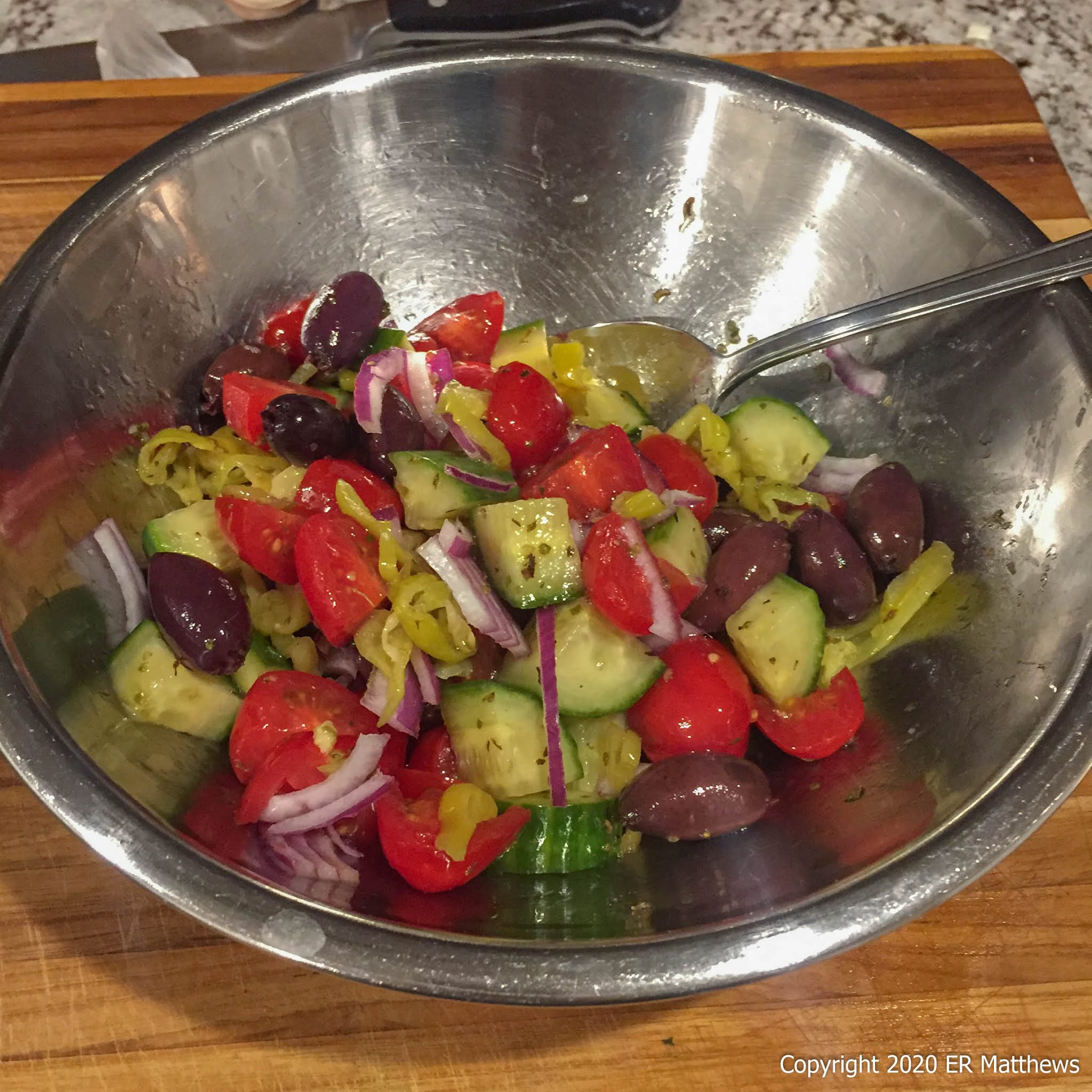
It's quite simple really: cook some onion and garlic in olive oil, add spinach and white beans to warm through and wilt the spinach. Assemble a chopped salad of tomatoes, cucumbers, olives, red onions, and peppers and dress them with olive oil, lemon juice, oregano, and salt. Lay the beans in a bowl and top with the horiatiki.

Feta would be great in this salad or crumbled into the beans or over the top of the plate but we are watching our fat intake and my gut has issues processing a lot of cheese. It's a shame because a great sheep's milk feta is one of the world's great cheeses.

Ann asked me to make this dish again. It really is tasty and it's a great vegetarian dish that can be on the table in under ten minutes start to finish.

Wednesday, January 6, 2021

Savory Bread Pudding: Shiitake, Leek, and Goat Cheese

Way back in the Thanksgiving time frame, Ann expressed a desire to have a savory bread pudding for Christmas Day brunch, by way of celebrating. We haven't been eating many simple carbs at all since August and the bread pudding would be a rare treat. I proposed making one with shiitakes, leeks, and goat cheese and she agreed, further asking if I could make it with challah. So I made a loaf of challah and assembled the bread pudding on Christmas Eve, baking it in early afternoon on Christmas Day.

Savory Bread Pudding: Shiitake, Leek, and Goat Cheese
I really love doing dishes like this for brunch because I can assemble everything the night before, leaving only to pull it out of the refrigerator and put it in the oven the next day.

Starting the Flavorings: Leeks and Shiitakes
Cooking the Leeks and Shiitakes with Thyme
I started by cooking sliced leeks and shiitakes with a bit of thyme. Thyme is one of my favorite herbs and I think it pairs extremely well with shiitakes.

Measuring the Bread
When making any kind of bread pudding, I always use the baking pan to measure the bread. I keep cutting cubes until the pan is full. That way, there's no guessing. Because challah is so soft, I cut it into very large cubes so that it will not fall apart when I add the custard. I prefer to use more substantial bread for bread puddings. When using bread with more body and a tougher crust, I would cut it much smaller.

You can use any bread you like. For example, I have made bread pudding with croissants and my grandmother used to smear store-bought white bread with butter and jam and shingle (overlap) the whole slices of smeared bread the length of her baking dish.

Dry Ingredients Before Mixing with Custard
Bread Pudding Ready to Bake or Refrigerate
The custard for bread pudding can be flavored or unflavored. In the restaurant days, I would infuse the cream for the custard with garlic, herbs, spices, and dried mushrooms, among other flavorings. For this bread pudding, I did not want to take that extra step, mainly because I had just made the challah and spent three days making French onion soup for Christmas Eve Dinner. Also, I wanted to reduce the fat in the custard by using low fat milk rather than the 40% heavy cream that I used to use at the restaurant.

A decent rule of thumb is that each egg will set one cup of liquid, so each quart of liquid requires four eggs. I always use five eggs. It's always a good idea to know how much custard volume you need for the size pan you will be using. A full shallow hotel pan will take a gallon (plus 20 eggs), a half hotel will take a half gallon (plus 10 eggs), and this 9x9 pan will take a quart (plus 5 eggs).

At the restaurant, in addition to making large puddings, we used to bake bread puddings in individual molds, in which case, we'd fill each mold full of bread and then ladle custard into the mold until the mold was full.

This 9x9 pan contains, in addition in addition to the bread and custard, a leek, a half a pound of shiitakes stemmed and sliced, and four ounces of fresh goat cheese.
 
Bread Pudding Coming Out of the Oven
Baking bread puddings is a simple matter of putting them uncovered in a moderate oven (350F) and waiting for them to set up and brown on top to the degree that you want. A bread pudding of this depth will take about 90 minutes, a good bit longer than many people expect. A full hotel pan of bread pudding is going to take about two hours to set in the center and brown. If you're wanting to eat your bread pudding while it is still warm, you'll probably want it to cool for 20 minutes before you cut it so that it has a chance to solidify a bit. All this is by way of saying that you should allow plenty of time to cook and cool your bread pudding before you want to eat it.

Prosecco: A Great Match for Goat Cheese
The slightly acidic flavor of the goat cheese in the bread pudding seems to go incredibly well with Prosecco, so we put a bottle in the refrigerator and had a glass while the pudding was in the oven and another glass with the pudding.

Saturday, December 26, 2020

Poached Eggs with Chana Makhani

Annie is great at giving me ideas for dinner and something she said sparked me to poach some eggs and smother them in a low-fat chana makhani. I have a hard time eating a traditional makhani sauce, tomatoes with onions, spices, and lots of cream. Granted that it is one of the classic Indian sauces, but the cream gives my stomach fits. So I decided to try to fake the sauce with a bit of low-fat yogurt instead of cream and the results, while not the same as a classic makhani, were delicious.

Poached Eggs with Chana Makhani
Chickpeas, chana dal (or the black ones, kala chana), are one of my favorite legumes. I especially love popping the fresh ones right out of their pods and snacking them, but in any form, they are wonderful.

To start this dish, I sautéed some finely minced onion with whole cumin seeds until the onions started to brown a bit on the edges and the cumin seeds started to pop, then added a bit of ginger, a good bit of garlic, and a quick garam masala that I threw in my spice mill. Next in, a rough purée of  tomatoes and some chickpeas. I added a half a cup of low-fat yogurt along with water to cover the chickpeas and let the dish simmer for 90 minutes.

The resulting dish as you see above was delicious, the egg yolks blending into the sauce and adding some of the unctuousness that the heavy cream would have added. Still, the sauce was missing the silky texture and harmonious flavors that cream brings to the party. The low-fat yogurt with all its binders will never fully integrate with the sauce and leaves little speckles of white in the sauce.

All in all, it was a good compromise for a waist-friendly dish that is light on dairy and fat.

Friday, December 25, 2020

Hearts of Palm Seviche

I don't regularly surf for recipe ideas. Between my brain that thinks in flavors and Ann's wonderful incessant stream of "make this" and "make that," I never want for ideas. But still ideas do come at me from various places, such as when I am wandering through the produce section of the grocery store and the sight of some piece of produce gets my mind riffing. Recently, in something of a surprise, at least to me, one came from an advertisement.

Like a lot of folks, we cut the cord a long time ago and don't watch regular broadcast or cable TV, but we have a couple of streaming channels. We were watching a show the other night when some kind of pre-roll ad starting talking about Hearts of Palm Seviche. And that's all it took to spark an idea.

We both looked at each other and said, "Hearts of palm seviche sounds great."

Hearts of Palm Seviche
It probably sounded great because we have been eating fall vegetables for a couple of months now and are looking for a summery change-up for our vegetarian dinner entrées. Next trip to the store, I bought a couple cans of hearts of palm and all the vegetables that I wanted for the seviche.

It turned out so well that I made it again the week following and it is certain to go on our wintertime dinner menu. 

Hearts of Palm Seviche


You can add whatever you like to your seviche. I thought my first impromptu version was outstanding, so I wrote it down and haven't changed a thing in subsequent versions. This recipe makes two healthy portions or 4-6 appetizer portions.

1 cup grape tomatoes, diced
1/2 seedless cucumber, diced
1 yellow pepper, diced
1 red pepper, diced
1 orange pepper, diced
1/2 red onion, in fine dice
1 avocado, diced
2 15-ounce cans of hearts of palm, sliced into coins
1 bunch cilantro, destemmed and chopped
1 teaspoon Kosher salt, to taste
juice of two limes

Chop and mix. Season to taste. Serve immediately.

Sunday, December 20, 2020

Vegetable Tacos

Vegetable tacos are something that I started making seriously this summer during grilling season and because they are so delicious, have become a regular quick dinner chez nous. Since I first posted about them back in October, I have formulated a strategy for making them that I will outline below, using vegetables that I prepared stovetop.

Vegetable Tacos
As I have been experimenting with dozens of veggie tacos, I have fallen into a procedure which involves mixing cooked ingredients with raw ingredients just before serving. This yields a warm, but super fresh taco.

Preparing the Raw Ingredients
In a large bowl, I mix the raw ingredients: green onion, cilantro, tomatoes, cotija, and finely minced chipotle. In season, I would likely include raw corn in this mix.

Searing the Cooked Ingredients
For the cooked ingredients, which I grill in good weather, the mix varies depending on what I have on hand. This pan contains onions, poblanos, yellow squash, and asparagus. Almost anything goes in veggie tacos and I have used eggplant, zucchini, and green beans this past summer. To mimic the intense cooking on the grill, sear the veggies hard if you are using a pan.

When the veggies are done, mix them immediately with the raw ingredients and season to taste with salt and spice. Serve with slices of lime on warm corn tortillas.

Although veggie tacos don't sound all that great, I assure you that they are delicious and addictive.

Wednesday, December 16, 2020

Shakshuka

It's cold, gray, and dreary here in Oregon during the shortest days of the year and only about 2 and a half months into our 8-month rainy season, there's no relief in sight. This drab weather has put me in the mood for warm, comforting, bright, and sunny food so I have planned to make shakshuka for dinner.

Shakshuka, a dish of eggs poached or baked directly in a tomato-based sauce, is common to North Africa and the Mediterranean. It's probably most commonly known as an Israeli breakfast dish, but the dish feels African to me, and I believe that it came to Israel when Jews from North Africa emigrated to Israel.

But who really knows. It is quite likely that eggs baked in tomatoes developed simultaneously in a lot of places, eggs and tomatoes both being inexpensive and common foods. Certainly the dish is also common on the northern side of the Med (think uova in purgatorio from Italy and oeufs à la provençale in France) and who among us in America has not feasted on huevos rancheros at our local Mexican restaurant?

No matter the dish's provenance, it is what I wanted to chase the dreary skies away and bring me back to summer for a few minutes.

Shakshuka: Baked Eggs
With shakshuka in mind, last week at the grocery store, I bought bright and cheerful yellow, orange, and red peppers, the best reminders of summer that I could find.

Garlic, Onions, Poblanos, and Colored Bell Peppers
Although the vegetables for shakshuka are traditionally chopped, I prefer to slice mine to give the resulting dish more texture.

Peppers and Onions Starting to Cook
In a deep sautoir, I heated enough olive oil to cover the bottom of the pan and then added all the sliced onions and peppers. Stirring frequently, I cooked the vegetables until they started to go limp. At this point, I added minced garlic, a little bit of cumin (not more than a teaspoon and a half for this large pan), and my secret spice, the barest hint of cinnamon. A touch of crushed red pepper flakes complete my spicing.

In a departure from many versions of shakshuka, mine is not a spicy dish in either of the senses: neither piquant from pepper nor containing a lot of spices. I've not found cinnamon to be a typical spice in other people's shakshuka, but for me, the barest pinch of ground cinnamon adds that mysterious hint of je ne sais quoi. It is at once subtly exotic, but wholly unrecognizable as cinnamon.

After Adding Tomatoes and Juice
To this large pan, after the vegetables became limp, I added a couple of large (28-ounce) cans of diced tomatoes in juice and I let it cook down for a good 45 minutes, wanting all the flavors to meld into a deliciously chunky sauce.

Eggs Ready to Cook
Once the sauce is thick and ready to eat, I season it and moderate the flame so that it just simmers. I make small wells in the sauce with a spoon and crack an egg into each hole. At this point, I will either place the pan into a moderate oven and bake uncovered or I will leave the pan on the stove top and cover it with a sheet tray. In both cases, I will serve the eggs with a copious amount of sauce once the egg whites have set.

Ode to the Tortilla

I love tortillas. It wasn't always that way. I am a child of the early 1960s. Then, on the East Coast, our food was influenced by two th...