Showing posts with label mustard. Show all posts

Tuesday, February 15, 2022

Valentine's Day 2022

As forecast last post, I took six weeks off from blogging to get us relocated from McMinnville, OR to Bend, OR, from the rainy and damp Willamette Valley, across the snowy Cascades, to the arid high desert of Central Oregon. We just got moved into our new house over the weekend. The fact that I am sitting here typing this post is a sure sign that we now have a functional office set up. In fact, getting our internet connection was a big fustercluck, Bend Broadband being a monopoly with terrible customer service.

Sitting at our New Bar for Valentine's Dinner
After spending about twelve hours unpacking and storing our kitchen goods, we were able to use our new kitchen for the first time on Valentine's Day. It's probably safe to say that needing to use the kitchen for Valentine's dinner speeded up the unpacking or at least informed the order in which we unpacked boxes. We could have gone out to celebrate, but we've been out a lot over the last week and don't feel all that well eating somewhat poorly. And then there's COVID, which thankfully is on the decline. We're still trying to avoid being indoors.

Those two reasons aside, Valentine's Day is possibly the worst day of the year to go out. Restaurant staffs, both front and back of house, are stressed, and nobody is doing the best work. Having spent a career in the business, I would never recommend to anyone to go out to eat on Valentine's Day. Yet still, I love to celebrate the day with Annie, unlike all those Valentine's Days where she sat home alone while I catered to all the people celebrating with us at the restaurant, only to stagger home like some nearly dead thing. What a terrible Valentine's Day for her, the chef widow! And so we planned a special meal at home, just for the two of us.

In cleaning out our freezer in preparation for moving, I found a couple of filets mignons that inspired Ann to ask me to make steak tartare for Valentine's. And then remembering the fabulous Argentine red shrimp that we had in Alaska, she also asked for a simple dish of pasta, shrimp, garlic, and butter. How easy was that menu planning? So simple, unlike at the restaurant where we were expected to create seven-course, high-end menus of exotic sounding but approachable dishes for our guests, one regular and one vegetarian.

Our home-cooked celebratory meal gave us a brief chance to test drive both the shopping in Bend and our new kitchen. We came from farm country with minimal shopping opportunities and a house with a top-flight kitchen to a new town with ample shopping opportunities and a sub-optimal kitchen. Now having used the new kitchen, I think we're going to have to gut it and start over in the near term. The awkward layout, barely functional storage, and silly downdraft range on a way-too-small island do not augur positively for my affection.

Steak Tartare, Broadley 2010 "Claudia's Choice"
Steak tartare is one of my favorite ways to prepare beef filet, simply because filet has very little character on its own. Although I find the texture a bit too soft for my liking in tartare, adding capers, shallots, salt, pepper, Dijon mustard, olive oil, and egg yolk is a great way to give the very bland beef a bit of fat and flavor.

Ordinarily, I would have served a lemony Chardonnay blanc de blancs sparkling with this dinner, but I just wasn't foresighted enough to have purchased any. Our usual preference in Champagne tends to the more berry flavors of Pinot Noir and Pinot Meunier, and so that's what we have at the house. And with the moving, buying more wine just to schlep it across the Cascades was a non-starter. As it was, the back of Ann's car was wall-to-wall with cases of wine. Although sparkling would have been my go-to pairing for this dinner, the bottle of 2010 Broadley Pinot Willamette Valley "Claudia's Choice" was  delicious.

Pasta and Shrimp with Garlic Butter
Our main course could not have been any simpler or frankly, better. Our usual diet is low carb, so pasta is a special treat for a special occasion. We were both smitten with Argentine red shrimp up in Alaska this summer when we both tasted them for the first time. These wild-caught shrimp are superbly tender and have a taste much more akin to lobster than typical shrimp. Researching on the internet, Ann found that these shrimp which were unavailable to us in McMinnville are a stock item at the Bend Trader Joe's, a store only dreamed of in McMinnville.

While we were there, we decided to get pasta as well, our nuts-and-bolts grocery store (WinCo) not having a very good selection of brands or cuts. Although our normal instinct would be to make this dish with a long cut, Ann was intrigued by a bag of Trader Joe's brand pasta labeled fusili corti bucati, like little hollow springs. I have had very long versions of this pasta, but never the corti ("cut" or short) version.

I liked the shape well enough, but the pasta itself did not cook very evenly and it was missing that really good al dente bite that I expect of great pasta. Time will tell if this is a one-off or if Trader Joe's brand is only good if we are desperate for pasta.

After several weeks of minimal dining as we packed our kitchen in preparation for the move, and then the few days around the move when we had no kitchen at all, it's great to be back at the range, even if it isn't the most functional!

Saturday, October 10, 2020

Mussels Steamed with Leeks and Mustard

Ann and I love mussels. They make a wonderful and easy-to-cook meal that never fails to satisfy us. I picked up about three pounds, a generous meal for two, a couple weeks back. We had them the night we got back from our coast run to Cannon Beach, a night on which I did not feel like cooking anything intricate after driving for four hours or so.

Mussels Steamed with Leeks and Mustard
Scrubbed and Debearded Blue Mussels
The mussels that I bought are wild blue mussels from Washington State. The woman at the seafood shop told me the area from which they came, but I promptly forgot. I have served thousands of pounds of mussels in my life, half farmed and half wild. While some people swear by one or the other, I don't know that there is that much difference between the two, all other things being equal.

I do know that at the restaurant, I switched from rope-grown Prince Edward Island (PEI) mussels to wild Cape Cods one winter when the Canadian farms were iced in, this on top of decreasing size and increasing price of the PEIs. I found that the larger wild mussels from Cape Cod were a lot tastier than the smaller PEIs and three or four dollars a bag cheaper.

A downside to wild mussels is that they are generally dirtier and have more beard than farmed mussels, increasing the labor needed to clean them. This particular batch of mussels was the hardest to clean that I have ever experienced.

Cleaning Mussels


Here is what you need to know to store and clean mussels:

Mussels are alive and they need oxygen to remain alive. You should never eat a dead mussel. To store mussels, put a layer of ice in a container and put the mussels uncovered on top of the ice. I put the ice in a plastic bag to keep the mussels from being submerged in all that fresh water. Drape a wet towel over the mussels and keep it wet.

You can store mussels as long as they remain alive. You will lose a fraction of the mussels each day until they are all dead and the longer you store them, the more that die each day, so plan to use them quickly. At the restaurant, mussels were delivered three days a week.

A dead mussel will not close, so the first thing I do is to dump the mussels in a big bowl of fresh water. The live mussels will automatically close. In fact, any mussel that is floating, you know is alive. It's the ones on the bottom of the bowl that you must investigate.

I use a kitchen towel (fortunately, they're cheap!) to clean mussels, starting with the floaters. Wipe any mud, grit, and other detritus off the shell.

Next comes removing the beard, if any. Farmed mussels will often be clean enough to cook without further cleaning, but wild mussels are generally going to have formidable beards, the fibers that they use to anchor themselves to rocks, pilings, and so forth. Using the towel for grip, grasp the beard firmly and pull the beard down towards the hinge end.

Look at the very bottom photo in this post if you are confused about which end I mean. If you imagine that an open mussel is a butterfly with rounded wings at the top and a narrow body at the bottom, you want to pull the beard towards the narrow end (on the right in the photo).

Once you get to the mussels that are not floating, if they are closed tight, they're OK. If they are open or partially open, pull them out and tap them on the counter. If they are alive, they will close in response to being tapped. Discard any that do not close.

After cooking, do not serve any mussel that has not opened.

Leeks, Dijon-style Mustard, White Wine
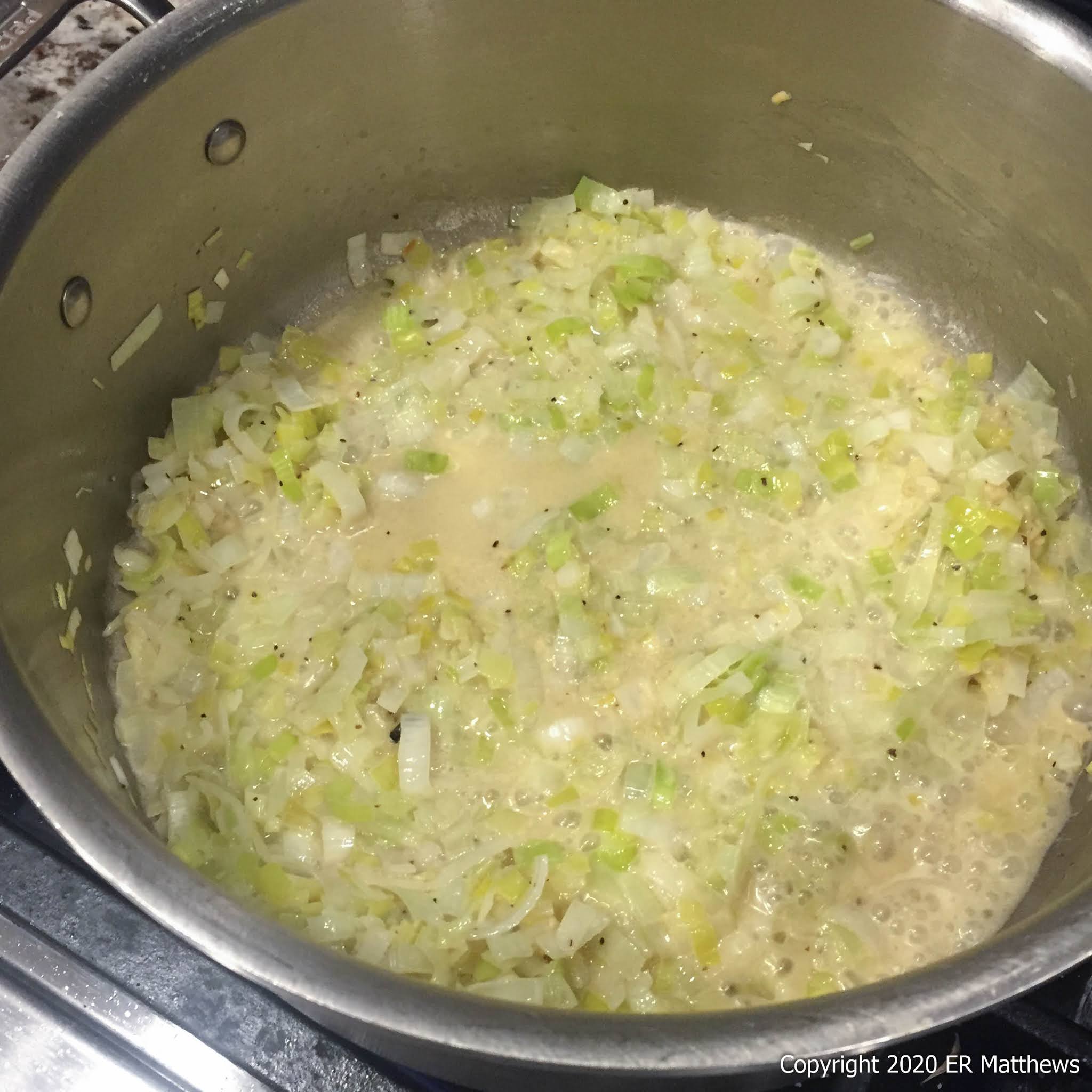
After cleaning my batch of mussels, I wanted to cook them very simply. The first thing I saw in the refrigerator was a leek, so I grabbed it, a bottle of dry white wine, and a jar of Dijon-style mustard. In the pan in which I was going to steam the mussels, I sautéed the cleaned leek in a touch of canola oil until translucent, then stirred in a couple of big spoonsful of mustard. Then I splashed the pot with a scant half a cup of white wine and stirred everything well.

You do not need to add much wine at all. The mussels are full of juices that will add to the wine and create a lot of broth, that delicious nectar that is the whole reason for steaming mussels. Sure, the mussels are fabulous, but the broth is incredible and the best part of the meal, especially with some good crusty bread.

We worked so hard to make exquisite broth at the restaurant and it pained me to no end when diners would return their bowls to the kitchen full of broth. Don't be like them. Don't make your chef mad. The broth is the best part, especially if the cook slipped in a tablespoon of butter before plating!

Mussels Ready to Steam
Cover the Mussels
Once you put the mussels in the pan, cover it to steam the mussels. Mussels vary in cooking time: the larger they are, the longer they take, but even so, they cook quickly. Check every minute or two until the mussels are open. When the bulk of the mussels are open, discard any that failed to open; they're probably dead.

Notice my ghetto lid on the mussels. We always cooked individual orders of mussels in a standard skillet with another inverted over it for a domed lid. I don't know too many restaurants that purchase lids for their pans. There's always aluminum foil, a sheet tray, or another pan that will make an impromptu lid. If I recall correctly, I owned two stock pot lids for about 15 stockpots and perhaps 50 skillets.

This is a long way of saying that when buying pans, you should not spring for the matching lids. Moreover, you should never buy pans in sets: they're going to sell you stuff you absolutely do not need, like bunches of lids that will collect dust somewhere.

Et Voilà! A Perfect Steamed Mussel
These mussels with a leek, some mustard, and a splash of white wine made a tremendous dinner. Despite being the filthiest mussels I have ever encountered, they were among the very best in flavor that I have ever eaten. Good on you Washington State!

Monday, October 5, 2020

Salmon Burgers

Once again, Ann was the impetus for bringing a dish to the table. The September Oregon Coho season was just open for 24 hours when the quota was met and as luck would have it, our store had a couple of the fish. I came home with a 2-pound chunk of late-season wild Oregon Coho salmon and I asked her how she'd like me to serve it. To be honest, I hadn't even thought of salmon burgers until she suggested it.

Her suggestion was great. Coho is not a very fatty salmon to begin with, not like chinook or king, and adding a bit of fat and flavor is a great thing to do to this kind of salmon. And we had just had some seared Coho earlier, from hatchery fish, so a change would be welcome. I would never put a fat piece of king in the food processor like this Coho. It would get seared or grilled to medium rare and the scrap would become salmon tartare, full stop.

I call the patties that you see in the photo below salmon burgers, made from raw salmon, to distinguish them from salmon cakes, made from cooked flaked salmon. These salmon patties are more akin to hamburgers than to fish or crab cakes. 

Salmon Burgers sans Buns
We used to make similar salmon burgers for our lunch menu at the restaurant, where we would usually serve them seared medium on a grilled brioche bun with cucumber slices, lettuce, red onion, and an herb- and caper-mayonnaise. At home, however, we omit the buns and the condiments.

Salmon Burger Mise en Place
The photo above shows all the ingredients for salmon burgers, starting in the lower left: Italian parsley, shallot, capers, Dijon-style mustard, an egg, Coho, and cayenne pepper. I don't typically add salt because both the capers and mustard are salty; in fact, that's why they are in the recipe: to add salt. To be certain, after I spin the mix up in the food processor, I taste it for seasoning and adjust as necessary.

The egg is not necessary. I add it only because I am working with lean Coho (right, you see no cream-colored stripes of fat in the red flesh) and I wanted to add a bit more fat and moisture to the burgers. If I were making this with fatty farm salmon rather than lean wild salmon, I would omit the egg.

Also, the herb or herbs that I use varies from batch to batch. Although this batch was made with Italian parsley, I more often use dill. If I had it, I would use chervil and in the very early spring before anything else had come up, I would use chives. Any or any mixture of the classic fines herbes will work just fine.

Please note that I only ever use flat-leafed Italian parsley. It is so much easier to work with and more flavorful than curly parsley, so it is all I ever grow. Now that I think about it, I don't think that my grocery store even carries curly parsley. If you ever read the word parsley on this blog, I'm talking about Italian parsley.

Note also that just as you wouldn't think about a binder in a hamburger, you shouldn't think about adding panko or other breadcrumbs to salmon burgers. The raw flesh has plenty of protein to bind the cake into a decent patty without any filler.

Ready to Process
To ready the ingredients for the food processor, pull or cut out the pin bones, if any, from the salmon. Skin the salmon and cut the filet into large cubes. Mince the parsley and the shallot. Add the ingredients to the food processor and pulse until you have a workable paste with quarter-inch chunks of salmon in it.

Four-Ounce Salmon Burgers Ready to Cook
Patty the burgers into whatever size you want. Because I am serving each person two cakes, I opted to make four-ounce cakes. At the restaurant, to have the patties fit our buns, we served one seven-ounce cake. I prefer my patties to be on the thicker side so that I can get a good sear on both sides while still having the center be warm but not cooked, about medium.

Salmon Burgers

Here's a decent starting point from which you can make your own modifications to suit your taste. Makes 8 4-ounce cakes.

2 pounds Coho salmon
1 shallot, minced
1/2 bunch parsley (or other herb such as dill), minced (1/2 cup in total)
2 tablespoons Dijon-style mustard
1/2 cup capers
1 egg
1/4-1/2 teaspoon cayenne pepper, to taste 
salt as needed

Bone and skin the salmon. Cut into large cubes. Put in a food processor with the remaining ingredients. Pulse on and off until the salmon just forms a paste similar to hamburger. Season to taste. Patty. Sear in a hot pan until brown on both sides, but warm and uncooked in the center.

Friday, September 18, 2020

Steak Tartare

Steak tartare, that decadent appetizer, is a fixture of a great many restaurants. Why is that? As a retired chef and restaurant owner, the answer is obvious to me: economics. Beef is expensive and one of the most expensive items on the entire menu. Because it is so expensive, it is very hard—given what diners are willing to pay for a meal—very hard indeed to mark beef up to the extent that less expensive items can be marked up. So it is vital to sell every bit of that beef.

Steak Tartare, Egg Yolk, Cornichons
Think about it this way: all the trim and scrap off of the beef that I purchased cost the same $20 per pound as all the steak cuts. At that price, a restaurateur who wants to stay in business has got to find a way to cover some of the expense of the scrap meat. Steak tartare to the rescue. Ditto for tuna: when I would pay upwards of $20 a pound for #1 tuna, any little scrap was highly likely to end up as tartares. What a delicious way to recoup some of the expense!

Tartare isn't limited to beef. I've had delicious lamb kibbeh at Middle Eastern and Afghani restaurants and even served it at my own. On our tasting menu, we served tartares of elk, antelope, and yak. And during salmon season when we would get fresh king salmon flown in, the belly flaps and other trim would often end up minced and served as salmon tartare, a riff on sashimi. 

We Americans are not alone and we surely did not invent the concept: most cultures have a raw meat preparation that is similar to steak tartare. Think of crudo in South America, carpaccio in Italy, and yukhoe in Korea.

Tartare also is not limited to fully raw meat. Stepping out of the tartare rut, I would do mi-cuit (half-cooked) preparations in which I would briefly sear or grill the meat before chopping it. In France, if you sear a patty of tartare on both sides like a very rare hamburger, you call it steak aller-retour or tartare aller-retour ("steak round trip"). In addition, I used to cold smoke chopped tartare over ice at times. If you use a light hand, the smoke is a wonderful addition to tartare and really wonderfully unexpected to most diners.

I would also note that tartare is not limited to tenderloin. Of all the steak tartares that I have enjoyed at restaurants, my favorite beef version was made from skirt steak and my least favorite from tenderloin. My favorite lamb version was made from heart. Most people are squeamish about heart, but it is one of the cleanest, most flavorful cuts, albeit with a bit of chew. While most people lean toward the soft texture of tenderloin, I find it a bit mushy for my liking. I definitely prefer more texture to less.

As a trained food professional, I'd be remiss if I did not mention that eating any raw food is a risky proposition. E. coli is a very real thing as are other foodborne illnesses. Each person has to decide whether that risk is acceptable. For my part, I will only eat raw meat at a restaurant that I trust.

Capers, Minced Beef, Shallots, Mustard Prior to Mixing
Having run a restaurant, it is ingrained in me to use every single bit of every ingredient and so when I recently purchased a beef tenderloin, it was a no-brainer that we would soon be having steak tartare. When cutting the beef into steaks, I saved all the small bits of scrap from the tenderloin, plus the parts of either end that were too small to cut into steaks.

To make the tartare, I diced the pieces of tenderloin very fine with a knife. Yes, it takes a long time compared to running the meat through a grinder, but the two textures are incomparable. At the restaurant, we always cut the tartare with a knife and as long as we had the labor, we would cut it to order as the tickets came into the kitchen.

What you add to your tartare for flavorings is up to you, in the same way that what you add to your guacamole is up to you. For my part, I default to classic seasonings. I generally add capers, minced shallots, Dijon mustard, salt, and pepper as I did in this case. That said, tartare is a wonderful blank canvas that lends itself to experimentation. For example, a favorite from my restaurant days was a Korean-inflected tartare with minced kimchee, green onions, soy sauce, sesame seeds, sesame oil, and dobanjang.

Tartare is easy to make at home, especially if you are buying meat in bulk and breaking it down yourself. But beyond that, it is a really approachable and decadent restaurant-style appetizer to have in your home-cooking arsenal.

Friday, August 14, 2020

Rack of Lamb from Hell

Recently, I happened to find a rack of lamb at an affordable price and decided to make a great meal out of it. I also brought home from the farmers market a bunch of cavolo nero and a quart of new potatoes, stopping by the store for a bottle of Nebbiolo, probably our very favorite varietal. This was going to be a celebratory meal: we just can't afford rack of lamb or Nebbiolo very often.

Rack of Lamb, Roasted New Potatoes, Cavolo Nero

It's not often that I cook a restaurant-quality meal at home. I don't have the ingredients, the kitchen, the staff, a commercial dish machine, or, if I'm being honest, the driven desire to do it any longer. But every once in a while, I do like to make a great meal for my favorite diner, Annie. I don't do it to impress her: she's seen all my tricks by now. I do it because I want to do it for her; in short, it's the principal way that I show her that I love her.

You'd think that with me being a chef, that everything would go along just great in the kitchen. You'd be wrong. Life happens to chefs too, but I think we're probably more accustomed to stuff going wrong in the kitchen and figuring out how to get dinner on the table anyway. The photo below is proof of that.

At the restaurant, when things would go wrong, I was so focused on solving the problem while managing an entire kitchen and a board full of checks that I had no time or energy for getting upset. Here at home, however, when things go wrong, I have plenty of time to get mired in anger and rant and fume.

I'm having a hard time letting go of the mindset that everything must be perfect. That's hard to do after a career in an industry that expects perfection and is unforgiving of even small mistakes. Restaurant Gods forbid that lamb chops go out medium instead of medium rare: you're going to get crucified on the review sites.

When you own a small restaurant and you and your staff depend on you to keep the doors open, the pressure to avoid negative reviews that might slow traffic is overwhelmingly intense. That pressure cooker mentality is not good for anyone's mental health.

So, while this is a story of how to prep a frenched lamb rack like you might find in a restaurant, it is also the story of a cascading series of problems that erupted while putting this dinner together. It is also an introspective story in my quest to let go of the restaurant mindset. It's not a particularly noble story, but it is an honest one.

Lamb Rack as Bought
So here is the lamb rack, before it turned into the rack from hell, just as it came from the butcher. It has been frenched by cutting away the meat from the tips of the bones. While most people would be satisfied with this lamb rack as is, I'm used to running a restaurant at a higher caliber. For my standards, there is way too much fat cap left on the rack and the bones are not nearly clean enough. You can see how especially sloppily the first bone has been frenched.

Trimmed Lamb Rack
I spent about ten minutes prepping the rack, a not insignificant amount of labor. First, I trimmed the fat cap back to what I wanted. I didn't want all the fat on top because I wanted to put a crust on the rack. In addition, there is another layer of fat that you cannot see below this top layer. You can see this in the first photo where I have cut the rack into chops. Also, you can see the pile of trimmings that I have removed from the so-called cleaned bones by scraping them down with a knife.

Mustard Glaze Ingredients
For this presentation, I wanted to coat the rack in breadcrumbs and to get the breadcrumbs to adhere to the meat, I made a glaze of mustard, olive oil, rosemary, and garlic. This is a classic French technique that you can detect from the phrase à la diable, in the style of the devil, on old-school menus. The reference to the devil results from the spicy piquancy of the mustard.
 
Mustard Glaze
I use olive oil to thin the mustard mix to the point where I can brush it on the lamb rack. I coated both the top and bottom sides of the meat and then rolled the rack in panko, pressing the panko into the mustard glaze. Other breading will work, but I really prefer the crust that panko gives. Panko for the restaurant came in the same size bags as 50-pounders of flour. We used to blow through those giant bags of panko.

Breaded Rack of Lamb
You can see the breaded rack above. I don't put breadcrumbs on the end, but you could if you wanted. It would be more difficult, but not impossible, to brown the breadcrumbs on the ends.

Seared Rack of Lamb
Next up, I browned the rack in a pan, to give the breadcrumbs some color and to firm the crust. Here is where things started to go south. I don't have a pan that is big enough to really sear the rack, as you can see from the bones hanging over the edge of the pan. Also, on the far left of the photo, you can see where a lot of the crust fell off. I was getting pretty irritated at this point, asking myself quite loudly why I put all this effort into dinner, just to have it start falling apart. To be fair, I was raging.

Back in the restaurant days, we would keep mustard and panko handy. We'd repair the damage and brown the patched spots by basting them with boiling oil until they were as browned as the rest of the crust. I just wasn't equipped to do this at home, having already cleaned up the breading station.

I was so invested in the labor in prepping the lamb rack to this point that I got really torqued, beyond any rational basis. All the while, Annie kept urging me to let it go and telling me that it didn't have to be perfect.

New Potatoes and Rosemary, Ready to Roast
A few minutes before the lamb went into the oven, I put the new potatoes in to roast and gave the cavolo nero a quick sear. Cavolo nero, black cabbage in Italian, is also called lacinato, Tuscan black kale, and dinosaur kale, my least favorite name for this wonderful green. I'll have to do a post on it sometime. It took years at the restaurant to find someone who would grow it for us. Once I found that person, cavolo nero was a near constant on the menu.

Roasted Rack of Lamb, Resting
When the potatoes were about halfway done, I put the lamb rack in the oven. This is where things really, really started to piss me off. Not using my brain, I put the lamb rack on a sizzle platter, as I have done a million times before at the restaurant.

This reminds me of a table of 18 people, 14 of whom ordered lamb racks. And naturally, they ordered them all five temperatures from rare to well done. It's pretty intense not only to cook fourteen racks simultaneously, but to time them such that they all come up to different temperatures at the same time. And then there is the small problem of keeping track of which is which. I was a crazy lamb-cooking chef that night!

This night, however, I thought to go sit down with Ann while the rack roasted to temperature. Shortly after doing so, she asked me, "Why is smoke pouring out of the oven?" And before I could get to the oven, the smoke detector started blaring and would continue to go off for the next ten minutes.

If you think I was irritated by the crust falling off, that was nothing compared to opening the oven, being blinded by smoke, and seeing a pool of lamb fat burning on the bottom of the oven, all the while being serenaded by the @#%$#! deafening klaxon of the smoke detector.

Remember the second layer of fat that I mentioned earlier? It started melting in the heat of the oven and ran down the bones which, of course, were hanging over the edge of the sizzle platter. Drip, drip, drip all over the scorching gas flame cover at the bottom of the oven. Idiot!

I transferred the rack to a sheet tray, like I should have done in the first place. And while cleaning molten fat from the bottom of the blazing oven while the gas was roaring, in not quite my finest hour, I yelled obscenities at the f'ed up nature of our kitchen, our super-sensitive smoke detector, the shitty ventilation, and less than ideal home cookware.

With Annie's soothing words, I finally got myself calmed enough to move on with dinner.

Timing lamb racks, especially whole 7- or 8-bone racks, is tricky. One end of the rack is much larger than the other. Half racks, 3- or 4-bone racks, are a lot easier because the size difference between the two ends is much smaller. It's the same for the rack of any animal, but larger racks such as pork, elk, or beef are so much bigger that the timing is not nearly so critical. Antelope racks are smaller and also a bit trickier to time.

When I cook a whole lamb rack, I am looking to take the rack out of the oven when the large end is still bleeding rare. After resting, it will finish medium rare while the small end will end up an acceptable and juicy medium. When I plate a whole rack for two, I divide the chops between the two plates so that each diner gets some less done chops and some more done chops.

When the large end of the lamb rack reached 118F, I pulled it and set it up on the cutting board to rest for 20 minutes. There is no profit in cutting a roast right out of the oven. It will bleed out all over. To allow for resting, you need to count on an additional 5-7 degrees cook up while it rests, which is why I pulled the rack when the large end was very rare. As you can see in the photo, it ended up at very pretty medium rare, just where I wanted it.

Reducing Petit Verdot
While the rack was resting, I went about making a sauce, a modified beurre rouge, a classic French butter sauce. To do so, I reduced a glass of inky dark Petit Verdot until it was syrupy and then stirred in a couple large spoonfuls of the leftover mustard glaze which thickened quickly. I set the pan on the counter to cool, an important step for making any butter sauce.

Red Wine and Mustard Reduction
When I was ready to finish the sauce, I put it back on a moderate flame and added enough water to thin it so that I could whisk it. As I was gently warming the sauce, I whisked in a couple tablespoons of ice cold butter, cut into small cubes. As the butter melts, it thickens the sauce. You have to do this at cool temperatures or the butter sauce will break, leaving a separated oily mess in the pan. So it is always best to let your pan cool before trying to finish the sauce with butter.
 
Finishing the Beurre Rouge
Finally, I plated everything while Annie poured us glasses of Nebbiolo. Being retired, our budget rarely stretches to afford Barolo or high-end Barbaresco, so we have to drink around the edges of the area. And Vietti makes a great declassified Nebbiolo that can only be labeled as Langhe Rosso. For the budget conscious Nebbiolo fan, year in and year out, Perbacco is a smart buy.

The plate up was simple as you can see in the photo at the very top of this post. I put a bit of cavolo nero on top of a pile of roasted potatoes in the middle of a large plate. Then after making a teepee of lamb chops around the potatoes, I napped the edges with the beurre rouge.

Vietti Perbacco, A Great Inexpensive Nebbiolo

In the end, after all the disappointment and fuming on my part, the rack from hell provided a wonderful, sumptuously luxurious meal, our first in a very long time. I thank Annie for putting up with my irritability.

Revisiting the beginning of this post, I see part of my problem letting go. Annie is not a diner; she's my wife. She's not reviewing my food on Yelp. She's my biggest cheerleader and her dinner doesn't have to be perfect. She loves me regardless. And paying our mortgage no longer depends on what comes out of the kitchen. Someday, I hope to really take that to heart. It's an ongoing struggle.

As for dinners from hell, remind me sometime to regale you with the story of the packed house Saturday night when we had to, unknown to guests, shut the kitchen down to fight a blazing grill fire. For twenty long minutes, nothing came out of the kitchen, a night that I will never forget and one that puts my trivial lamb rack trials in perspective.

Monday, December 29, 2014

Cuban Sandwich

Cuban Sandwich
Ann and I have been discussing Cuban sandwiches a lot recently. César used to make great Cubans on bread he would bake daily at Sweet Sunset Bakery, but it's been years ago now that he closed up shop and moved back to California. We have heard about good Cubans at Throx Market, but haven't had the time to get there. So, today, I took matters into my own hands.

It was a hell of a long day at work (especially since it is in theory a day off), getting all my ducks in a row for the upcoming New Year's Eve circus and by the time I got ready to leave, it was late in the day and I was tired. I needed something I could make quickly and I didn't even ask Ann for suggestions. I just grabbed what I would need to make Cubans and got home as quickly as I could.

Easy, delicious, and what a classic sandwich! I made six. Ann and I split three; Carter ate three.

Tuesday, June 17, 2014

Father's Day

My Father's Day this year started out pretty rough: I'm juggling too many balls right now and that's got me in a miserable frame of mind. But my Annie and the prospect of having my daughters over for dinner helped me crawl out of my hole a bit and in the end, it was a good day for me.

Awesome Burgers: I Ground Them Myself
These burgers don't look like commercial burgers because they are not. I ground them myself from some really fantastic skirt steak from Martin's Angus Beef, our suppliers at the restaurant. They also don't taste like commercial burgers. They have amazing beef flavor.

Burger, Caramelized Onion-Bacon-Stout-Blue Cheese Jam, Chipotle Mustard
I decided to do a couple of different condiments this year (and at the last second, I decided that my burger was just too good to go on a bun). The first is a caramelized onion-bacon-stout-blue cheese jam made from two very large yellow onions caramelized with a pound of diced bacon then cooked in a bottle of Tröegs JavaHead Stout until the beer evaporated, and then a half pound of really good blue cheese stirred in until melted. The other condiment is a chipotle mustard made from half Maille whole grain mustard and half adobo from a can of chipotle peppers.

No Complaints about the Burgers Here...

...or Here

A Fitting Finish to a Fine Father's Day Dinner

Sandy Hook, Oregon

Over the past few years, I have found I process trauma by hiking and by writing. On Thursday October 15, my town, Bend, Oregon joined the in...