Showing posts with label fennel pollen. Show all posts

Sunday, June 28, 2026

We Needed a Celebration

It's been a long time since we had a get-together at our house. Spring was busy: I'm volunteering a couple days a week, I traveled to Philly to watch Ellie graduate, and we had a few health problems along the way. We needed a reason to celebrate at home. Ann set it up, inviting Rob and Dyce and Michelle and Andreas for dinner.

Pregaming with Chenin Blanc
Superstar Wine: Anjou Blanc
Chenin from Thibaut Boudignon
Whipped Feta with Spicy Honey and Pine Nuts
We had been saving a magnum of Anjou Blanc from Thibaud Boudignon for just such an occasion. He is a winemaker who came from obscurity to global reknown (at least among sommeliers) in a blink, now making some of the best wines in the Loire. These are not old school wines, however. They are precise and angular and suit my palate to a tee. Although he is best known for his outstanding Savennières, I prefer his base level Anjou Blanc for its simplicity and laser-focused acidity.

I let the wine guide the appetizer course, selecting a cheese dish that would be a great foil for the incredible acidity of the Boudignon wine. Over the years I have done many versions of baked feta and whipped goat cheese, but never whipped feta.

For garnishes, I made spicy honey (half a cup of honey and a tablespoon of sambal oelek) and toasted a handful of pine nuts. I chose to garnish with honey expressly to echo the honey and beeswax aromas and flavors of the Chenin Blanc.

Whipped Feta


For the whipped feta, I decided to add 20% goat cheese by weight to help loosen the feta which I was afraid would be too grainy whipped alone. I was quite happy with the results as apparently were all the others—none was left at the end of the evening.

400 grams of excellent sheep's milk feta
100 grams of fresh goat cheese
squeeze of lemon juice
drizzle of extra virgin olive oil

Soften both cheeses at room temperature. Place both in a food processor and process until whipped, scraping down the sides of the bowl as needed.

The raw whipped cheese tasted flat so I squeezed in the juice of an end of a lemon that I had left on the cutting board from making lemon slices for the chicken. I drizzled in an equal amount of olive oil; call it a tablespoon of each. The feta is salty enough; the whip did not need more salt.

Setting the Table: First Time in a Long Time
Ann and I went back and forth on the menu for a few days. At first, she wanted a reprise of a chicken tagine that I made some years ago, actually, an entire meal that I had made before. I resisted repeating myself, feeling that it is a cop out of sorts. But then she changed her mind to simple roasted chicken on white beans.

She was dead set on the tomato salad flavored with fennel pollen from the menu that I did not want to replicate. She talks about that salad often, but it's funny how I barely remember the dishes (so many thousands) that I have cooked. Thankfully, this blog is a repository of dishes that I have made, so there is a record even if I no longer recall them.

Roasted Chicken
with White Beans, Artichokes, and Garlic
The orginal roast chicken, as I conceived it, had no white beans. But I added them to subsequent iterations because something magical happens when you roast chicken on top of them. As always, quality matters. Use the best beans you can find. In this case, I used yellow eye beans from Rancho Gordo. These are among my favorite all purpose white beans ever and a stalwart at the restaurant.

Roasted Chicken with White Beans, Artichokes, and Garlic


6 heads of garlic, broken into cloves and peeled
3 lemons, sliced
1 pound of dried white beans, cooked
3 400-gram cans artichoke hearts
1 bunch of Italian parsley, destemmed and roughly chopped
2 large sprigs of rosemary, destemmed
drizzle of extra virgin olive oil
12 chicken thighs
salt
pepper

Mix the garlic, lemon slices, white beans, artichoke hearts, parsley, and rosemary with a drizzle of olive oil. Season as necessary. Place the mixture in the bottom of a roasting pan. Toss the chicken thighs with salt and pepper and arrange on the bed of vegetables. Roast in a hot oven (400F) until the chicken skin is crisp, about two hours. Check the beans occasionally. If they are drying out, moisten them with a little bean broth or chicken stock.

Tomatoes with Fennel Pollen and Shallots
Nobody needs a recipe for this simple tomato salad that is as surprisingly delicious as it is easy to make. It is merely a mixture of halved grape tomatoes, minced shallots, fennel pollen, lemon juice, olive oil, and salt, all to taste. 

Shout Out to El Mentridano
Ann and I, we are fans of light bodied reds with good acidity and some structure, wines that let their aromatics do the talking. While we are not fans of the usually overripe Spanish Garnacha, we both agree that El Mentridano, a high-altitude, lightly expressed Garnacha from Méntrida, near Madrid, is delightful. It offers a nose of cranberries, cherries, black tea, and a slight earthiness, all positives in our book. Color is light and tannins are polished, all backed by an attractive sour cherry acidity that keeps the wine vibrant. It reminds me of Nebbiolo in many ways. We had real problems, likely bottle shock, with this wine about six months ago, but after sitting in the rack for that period, it is back to normal. We must buy more—it is an indispensable summer red that pairs with a vast range of foods.

Herding Cats Again: Impossible to Get Everyone to Cooperate
Ann Made Her Delightful Summer Pudding (Berries and Brioche)
Michelle Made Her Best Batch Yet of Lemon Bars
We needed a night to sit back with friends and catch up. The simple menu is just what we needed, tasty and yet easy to prep in advance, with zero à la minute cooking that let us enjoy the company of our guests.

Friday, March 1, 2024

February Celebration: The Luckiest Beans on Earth

Let's Celebrate!

Mid-February has become a time to celebrate at our house. Valentine's Day, my birthday, and our anniversary of having moved to Bend, this year our second so-called Bendiversary, all fall within a week of each other. Accordingly, we aim to have a small party each February to mark these events. What better to do in this bitter cold season than have a party?

Another February Cassoulet in the Books
For this year's celebration, Ann asked me to make a cassoulet. If you have never had cassoulet, it is a bean and meat stew with four components: beans, meat, stock, and a mixture of diced aromatic vegetables called mirepoix. If you look back to all my cassoulet posts, I tend to make them in February at the worst of the cold season for good reason. Cassoulet is arguably the greatest cold weather comfort food in the world. Thank you France for this wonderful celebratory concoction!

Prepping for Cassoulet

For the cassoulet that I would serve on Saturday night, I started the prep work early Friday morning, right after shoveling the overnight accumulation of snow, a pretty typical chore on a February morning. The day-before prep for cassoulet is pretty limited: soaking the beans overnight and making some delicious pork stock in which to cook the beans.

The first step in making stock is to roast your bones. For pork stock, I use pork neck bones that are both inexpensive and contain delicious meat. I am guessing that if they are readily available here in Central Oregon, you can find them just about anywhere. The trick with roasting bones is time. Put them on a lightly oiled sheet tray in the oven and roast them until they are golden brown on all sides, turning them as necessary. It's not a process that you can or should rush. Cassoulet is only as good as the stock that you cook the beans in.

Having turned the roasting pork neck bones on the sheet tray and put them back in the oven to continue browning and getting sexier and sexier, I was standing at my cutting board, my nose reveling in the porky goodness of the aroma emanating from the direction of the oven. I remarked to Ann, ensconced on the sofa by the fire and nose down in her phone, "How do think these beans are going to feel, being slowly cooked in all that porky goodness?" And she replied, "They're going to be the luckiest beans on earth!"

While the bones were roasting, I did some pre-prep on the vegetables for the mirepoix: onions, carrots, leeks, and celery. While I would dice the mirepoix vegetables on Saturday morning, I wanted the vegetable scraps today for flavoring the stock. To that end, I peeled the onion, trimmed the ends of the carrots, peeled off the tough outer leek leaves, and trimmed the leafy ends of the celery. Be sure to wash the leek leaves well; they can accumulate a lot of dirt, or worse, sand.

After the pork neck bones browned, I put them in a stock pot with all the peels, ends, and scraps of the mirepoix vegetables. Filled with water, the stock pot simmered gently for several hours before I separated the solids from the stock. The stock went into the refrigerator to congeal so that I could remove the fat from the top. After the solids cooled, I picked all the neck meat from the bones to put into the cassoulet on Saturday.

Last thing before going to bed Friday night, I put two pounds of beans in a bowl and covered them with a lot of salted water to soak overnight. I had been wrestling with the choice of beans for a few weeks. Two weeks prior, I put an order in to Rancho Gordo for a big box of beans including my two potential candidates for the cassoulet: Tarbais and Steuben Yellow Eye beans.

I have made many cassoulets in my life, about half with the traditional bean from from the Tarbes area in the far southwest of France up against the Pyrenees, the Tarbais bean; and about half with a traditional American bean called the Steuben Yellow Eye, purported to be the original bean in Boston baked beans. Heretofore, I have always slightly preferred the yellow-eyed beans.

Both beans are loved because while holding their shape, they become ultra creamy inside, exactly what you want for cassoulet, which is nothing if not a super peasant dish of pork and beans. After waffling for days on the choice, I decided to go with the original beans, the Tarbais. I was not disappointed; the resulting cassoulet could not have been better. And I still have Steubens to craft into some other delicacy!

Cassoulet Assembly


Would Anyone Manage to Get Here for Dinner?
Overnight Friday into Saturday morning saw a considerable amount of additional new snow and the forecast had it snowing all day. Both of the couples we invited live up big hills that the snow could make impassable, so during the day on Saturday we weren't sure if our party would come off or if we would be eating cassoulet by ourselves. Regardless of the weather, cassoulet is pretty much of an all-day affair and I needed to get started on it. After shoveling snow again, naturally.

The first item of business was to get the beans par-cooking. I drained them and placed them in a stock pot with fresh water and a bouquet garni of fresh rosemary, fresh thyme, and fresh sage. These herbs would impart a slight flavor to the beans while making the kitchen smell amazing for the 90 minutes in which the beans par-cooked.

In my past restaurant days, we had all kinds of meat garnishes for the cassoulet, especially after we butchered one of the hogs that we had a local farmer raise for us. In addition to pig's feet for the stock, we had a lot of trimmings from which I would make traditional garlic sausages. And we would cure, roast, and confit the hog bellies which aged under their bath of congealed duck fat in the walk-in next to vast containers of confited Moulard duck legs. In short, our walk-in contained every kind of meat garnish a cassoulet cook could want.

But now post-restaurant at home in a fairly small city a half a day's drive from anywhere, meats are limited to what I can get at the grocery store, especially because the farmers markets are inoperative at the height of winter; you know, snow and all. Having little alternative, I just decided to go with what I could scrounge at the store. I ended up buying a large tray of chicken thighs and a small tray of breakfast sausage links to use along with all the neck meat that I picked from the stock bones.

While the beans were par-cooking, I browned the chicken and sausages in fat I had saved in the refrigerator from my last couple of batches of chicken confit. And while the meats were browning, I diced all the vegetables I pre-prepped yesterday into mirepoix. This finely diced mix of carrots, onions, leeks, and celery, I cooked in the same pan in which I browned the meats, scraping hard to get all the brown meat bits into the vegetables.

While the mirepoix was cooking, I minced and added an entire head of garlic to give a nice garlicky background note to the cassoulet. The reason for so much garlic is because I would typically have made the dish with a garlic sausage instead of the mild breakfast sausage that I used for this cassoulet.

Once the beans were par-cooked, tender but still a bit crunchy, I drained and mixed them with the mirepoix and then seasoned them to taste with salt. No longer working in the restaurant, I do not have a pan big enough to accommodate this amount of beans and meat, so I decided to use two pans. I put a quarter of the beans in each of the two pans and topped them with 4-5 bay leaves each. Then I split the pork neck meat, chicken thighs, and sausages between the two pans and covered them with the remaining beans.

At this point, I should mention the one cheffy thing about this cassoulet. From time to time, I make chicken confit, that is, chicken cured overnight in a salt and herb mix, then rinsed and slowly poached while submerged under olive oil. Then this chicken gets refrigerated submerged under the fat, which congeals and protects it from spoilage.

After the chicken is all consumed, I melt the remaining fat and pour it into a container to keep in the refrigerator where the fat congeals on top of any juices from the chicken. I reuse the fat for the next batch of confit, but the intensely flavored juices go into a soup or stew. For this cassoulet, I browned the meats and cooked the mirepoix in some of this confit fat and I added the congealed juices (a half cup) to the cassoulet along with the pork neck stock.

After removing the layer of fat from the stock that I made on Friday, I warmed it briefly to liquefy it. Into each casserole, I poured enough stock to cover the beans by a good centimeter and put them in a slow (300F) oven to start the process of becoming insanely good. I checked the beans periodically to make sure they had enough liquid. Each time a crust would form on top of the beans, I would mash it back down into the stock, topping off the stock if necessary.

This process of crusting and breaking the crust and re-crusting over hours is essential to cassoulet. I want to say that the beans cooked slowly for about seven hours and I probably broke the crust four to five times during my forays from the fireside into the kitchen.

While this is a good description of the process of making a cassoulet, a more exact recipe follows just below.

Cassoulet in the Oven
Essential to Let it Crust and Re-crust over Several Hours
Cassoulet Cooling after Seven Hours in Oven

February Cassoulet Recipe


This is a cassoulet, beans aside, that you can make from stock items at the grocery store. In fact, despite the lack of duck confit and other great ingredients, the is the single best cassoulet I have ever made. In other words, don't let lack of ingredients deter you from making a cassoulet. As for the beans, great beans are easily available via mail-order from Rancho Gordo (note that they call them Cassoulet Beans, rather than the Tarbais beans that they are).

This recipe is based on two pounds or a kilo of beans, enough to feed 8-10 hungry people. You'll want to attack a cassoulet over two days, the first given to making the stock and soaking the beans, and the second to cooking the cassoulet itself.

Pork Stock


This stock is made from inexpensive pork neck bones plus the trimmings from all the vegetables that you will use in the cassoulet. If you have a choice, try to select the meatier bones; the meat will go into the cassoulet. This recipe makes a good gallon/4 quarts/4 liters of stock, enough for two pounds or a kilogram of beans.

oil to coat a sheet tray
5 pounds pork neck bones
5 quarts/liters water
tough outer leaves from one large leek, washed well
ends and trimmings from 3 medium carrots
peel of one medium onion
hearts and leafy ends of one bunch celery

Coat a sheet tray with oil and spread the bones out in a single layer on the tray, then place in a moderate to hot oven. Roast until the upper surface is golden brown then rotate the bones to brown another surface. Continue in this fashion until the bones are brown on all sides.

Remove the bones from the sheet tray to a stock pot. Pour enough water onto the hot sheet tray to cover it. With a scraper or spatula, deglaze all the brown bits from the bottom of the sheet tray and pour into the stock pot. Repeat as necessary to get all the brown bits into the stock pot.

Add the remaining water and vegetables to the stock pot and bring to a simmer for a minimum of two hours. I cooked mine for four hours. At the restaurant, we kept stock pots going all the time.

Strain the solids from the stock. When the stock cools, refrigerate it overnight so that any fat in the stock congeals and can be removed easily from the top of the stock. When the solids cool, pick all the meat from the bones and save for the cassoulet.

Cassoulet


This makes a large quantity of beans, enough to feed 8-10 people. Make sure that you have a deep pan or casserole large enough to hold the beans and all the meats. Or use two, as I did. No longer do I work in a restaurant where we had a braiser (called by its French name rondeau) large enough to hold 5kg of beans! When browning the meats, take your time and do it correctly. This is a key step in building flavor.

2 pounds/1 kilogram of Tarbais or other white beans, soaked overnight in salted water
bouquet garni of 1 large sprig each of fresh sage, fresh thyme, and fresh rosemary
1/2 cup oil/lard/duck fat for browning meats
10 chicken thighs, bone-in and skin-on, 5-6 pounds
1 12-ounce tray breakfast sausages
reserved pork neck meat from stock recipe above
1 large leek, in small dice
3 medium carrots, in small dice
2 large stalks celery, in small dice
1 medium yellow onion, in small dice
1 head of garlic, minced
10 bay leaves
salt to taste
1 gallon/4 liters pork stock from recipe above

Drain the beans and cook them in fresh water with the bouquet garni (the fresh herbs, tied together with a string) until tender, but not cooked all the way through. This will take about 90 minutes give or take.

While the beans are cooking, brown the chicken and the sausage thoroughly on all sides. Remove the meats to a platter while you cook the vegetables.

When the meats are browned, in the same pan, add the vegetables and garlic and cook gently until the vegetables are soft and the onions are translucent. Scrape the bottom well to incorporate all the brown bits from the meats into the vegetables.

When the beans are cooked, drain them and mix them with the cooked mirepoix. Season to taste with salt.

Place half the beans in the bottom of your casserole (or a quarter of the beans, if you are using two pans like me).

Give the beans a sprinkle of salt (there's no salt in the chicken, pork neck meat, or stock) and spread the bay leaves on top of the beans.

Next spread the meats over the beans and then top everything with the remaining beans and a final sprinkle of salt.

Pour the defatted, melted stock over the beans to cover by a centimeter or so.

Place the cassoulet uncovered in a slow oven (say 300F) and let it cook slowly. Mine was in the oven for seven hours, so you should get it cooking in the morning to eat at dinner time.

Keep an eye on the cassoulet from time to time. Cassoulet needs to crust, have the crust mixed back into the broth, and re-crust several times. Keep an eye on the stock level and add more as needed. I believe that I broke my crust four times during seven hours and added a bit more stock twice.

The Rest of Our Celebratory Dinner


Cassoulet in the oven, my thoughts turned to an appetizer, something easy and delicious for a cold winter day. We just recently got an order of pantry items in from Amazon (here in Central Oregon, access to less common grocery items is extremely limited), including a tin of fennel pollen, a couple liters of Sherry vinegar, and a couple jars of Calabrian chile paste. Yes, Virginia, these are stock items in a retired chef's pantry and spice drawer.

With these items in mind, I started building the menu. For the Calabrian chiles, Ann had been talking about spicy honey for days and I spent some time musing on what would taste really good with that sweet and spicy sauce. In fairly short order, I came up with using the sauce on some fennel-spiced meatballs that our guests could graze on before dinner. Who doesn't like a good meatball?

I wanted to keep the meatballs fairly plain to let the Calabrian chile honey be the star of the show, but I did want to incorporate the fennel pollen that had just arrived at the house. The seasoning of the meatballs, made from ground pork, is simple: salt, dried basil, fennel pollen, garlic, and red wine. I mixed this all up in the afternoon and fried a quick test piece to check the seasoning. After adjusting the seasoning to our liking, into the refrigerator went the meatball mix to sit and infuse the seasoning throughout the meat.

After washing up from the meatballs, I made a quick salad dressing for the pound of baby arugula that I had brought home for the store, which is where the Sherry vinegar comes in. I started with one part of sherry vinegar and two parts oil (a splash of French hazelnut oil and the rest extra virgin olive oil) and tweaked it to taste with salt and agave nectar. When I was happy with the taste and acid balance of the dressing, I added a finely minced shallot to the dressing and left it on the counter to be mixed with arugula and thin slivers of pecorino at dinner time.

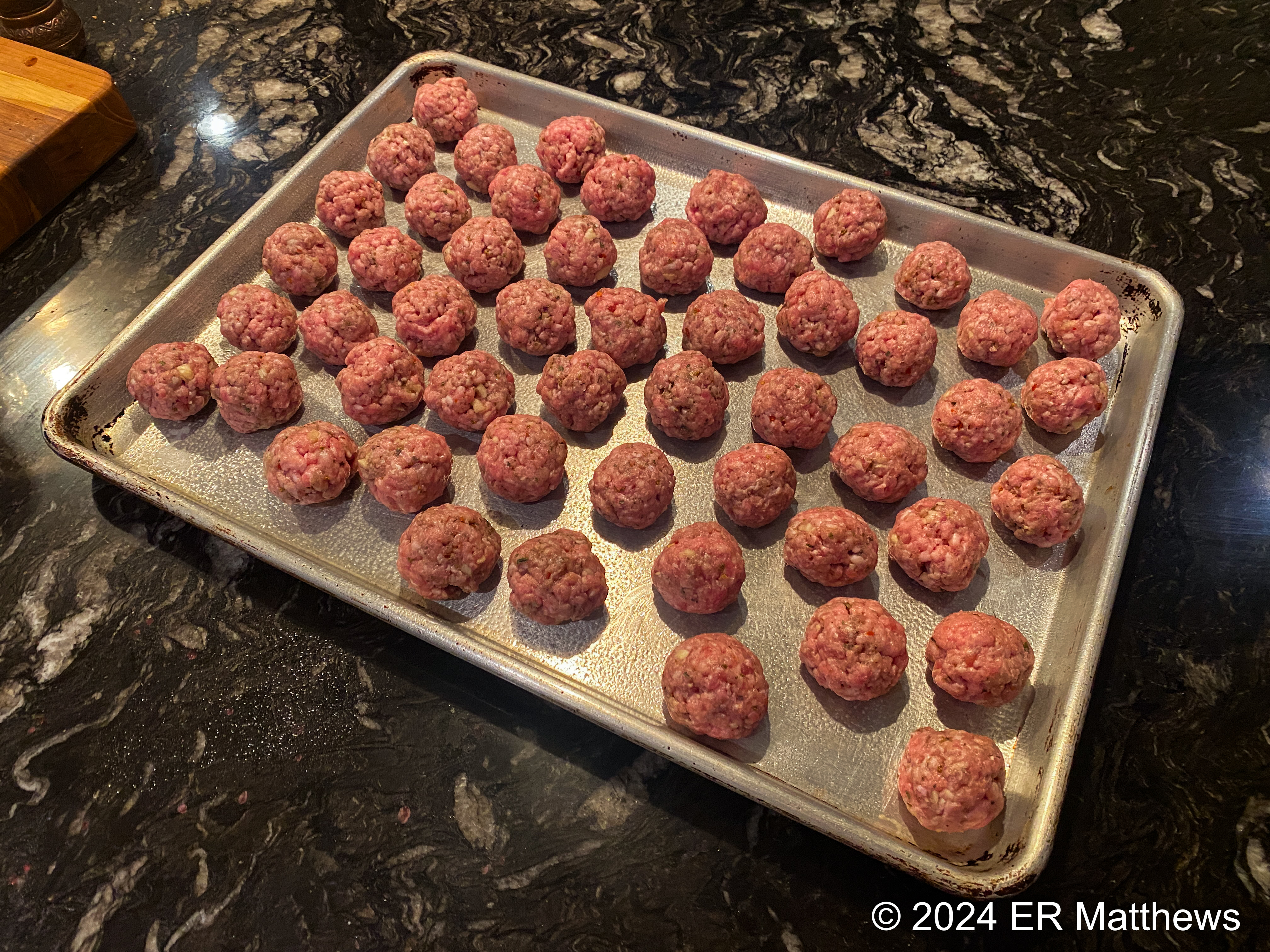
About a half an hour before our guests were to arrive (still no weather cancellations at this point!), Ann and I rolled the 2-1/2 pounds of meatball mix into small 1" (2.5cm) balls. For ease of cooking, I decided to bake them rather than fry or braise them. The meatballs went in the bottom of the oven under the still cooking cassoulet, which I topped with a bit more stock.

Fennel Pollen Meatballs Ready to Bake
When the meatballs came out of the oven 20 minutes later, I sprinkled them with flaky salt and more fennel pollen, then transferred them to a bowl for serving while Ann made final tweaks to the table, glassware, and so forth. I decided to serve the Calabrian chile honey on the side in case one or more of our guests was not a fan.

Fennel Pollen Meatballs, Calabrian Chile Honey
Just about the time appointed time for our guests to arrive (and knowing full well that the trip to our house would be slow on account of the still pouring snow), Ann cracked a bottle of wine for us to start pre-gaming it . While she was doing this, I went outside to remove the 2.5 inches of snow that had fallen in the the last hour from the sidewalk and to try to clear some space at the curb so that car doors could open without getting stuck in snow mounds.

Cassoulet Wine Pairings 


You've heard the saying, "What grows together, goes together"? It's a philosophy that I have always ascribed to in wine pairings. In other words, a good rule of thumb in wine pairing would be to go with the wine from the area from which the dish originates (when possible).

Living in Oregon, our wine coolers are stuffed with our local wine (Pinot Noir) and are sadly bereft of wines from Southwestern France where cassoulet originates. Unfortunately, these relatively obscure French wines are hard enough to source in major metropolitan areas and pretty much impossible to find out here in the boonies. But still, while Ann was out at her exercise class in the morning, I asked her if she would go by the store near her studio and pick up some French wine for dinner.

Cassoulet is a hearty dish that can pair with a wide variety of reds, anywhere from a light Gamay to a heavy Cabernet. My preference is to match the weight of the dish and the wine, opting for heavier rather than lighter wines. For heavier wines, I really like Cahors (Malbec) or Madiran (Tannat), both sturdy reds, with cassoulet.

Knowing the likelihood of finding such a wine was about nil, plan B was to have Ann grab some southern Rhônes, which are what we call GSMs, being made from any combination of the grapes Grenache, Syrah, and Mourvèdre. She came home with three wines, a Châteauneuf du Pape, a Lirac, and a Gigondas. All were delicious. Alternatively, we could have opened some of our GSMs from Walla Walla and the Rocks District from just north of us along the Columbia River.

Three Southern Rhône Reds for Dinner

Celebrating February


I am afraid that I was so intent on our guests that I forgot to take pictures. Rob and Dyce, sorry! What few I did manage are below.

Pre-Gaming it in Front of the Fire
Ann's Simple Tablescape
with Valentine's Gift Boxes for Guests
Andreas and Michelle
Cassoulet and Arugula Salad
Another cassoulet, my best ever, is in the books. I'm so thankful to have great friends with whom to share it.

Friday, September 1, 2023

Seafood Supper

Without a doubt, seafood is one of our favorite food groups and last night I made a couple of seafood dishes that I'd like to remember, hence this post. Sadly, I have cooked so many dishes in my life and professional career that I have forgotten more than I remember. Seafood features much less frequently in our diet than we would like, because despite being only 3-1/2 hours from the coast, good seafood is really hard to come by out here in the high desert. Believe it or not, our best source of seafood is often Costco. That's kind of hard to admit for a chef who used to buy directly from the boats, but it's true if a little sad.

John and Heidi came over for dinner last night and we all gathered around the kitchen island to eat. We had really hoped to at least have appetizers if not dinner out in the courtyard around the firepit. But wouldn't you know that it rained, albeit lightly, for the first time since spring? And after some really warm and smoky summer days of late, there was a marked chill in the air and way more humidity than we are accustomed to. Is fall here already on the last day of August? For goodness sake, it just finished snowing on the 19th of June!

Goat Cheese Crostini with Pink Shrimp and Fennel Pollen
Summer here in Oregon is pink shrimp season. Though these tiny shrimp are harvested in the ocean close to shore, they are often called Bay Shrimp. They are netted, then cooked and peeled and are available pretty reliably through the summer. I have been trying to find ways to work with them, an opportunity that I have not had before this summer. Last time, I made them into delicious shrimp cakes. This time, I made them into a quick salad to sit atop crostini.

The crostini are topped with a schmear of softened goat cheese and pink shrimp seasoned with a really great olive oil, lemon zest, salt, and fennel pollen. After I put these delicious appetizers together, I drizzled them with more olive oil, salt, and fennel pollen, then topped each with a fennel frond.

Roasted Steelhead Trout on Fines Herbes Israeli Couscous
I really love the marriage of fish with fines herbes, so I put the two of them together in this dish. Fines herbes is an herb mix used in classic French cooking with seafood, poultry, and other very light proteins. The canonical mix is parsley, chives, tarragon, and chervil, but I use whatever I happen to have on hand. This time the herbs would be Italian parsley, tarragon, and dill. Why is chervil so hard to find? I used it quite a bit at the restaurant, but I had to grow my own.

I boiled the couscous to almost done, then drained and mixed it with a steelhead cream sauce to finish cooking. Just as the pasta was finishing, I added sugar snaps (mange-touts) cut into one centimeter lengths, a big mound of finely chopped herbs, and a quick grating of pecorino romano. The steelhead cream sauce I made by cooking two minced shallots in butter, then adding a quarter cup of brined capers and roughly a quarter pound of diced steelhead trim leftover from portioning the fish. After the fish cooked a bit, I added a pint of cream and let it reduce by half. I made the sauce ahead and rewarmed it before adding to the couscous.

After roasting the fish, each portion went onto a bed of the couscous (which intentionally mimics the look and feel of risotto) and I topped each with a dollop of saffron aïoli and a dill sprig.

Friday, August 25, 2023

Morocco via Marseilles

It's not a big secret that I love the food of North Africa; at the restaurant, my tasting menus often included dishes from or in homage to Tunisia, Algeria, and Morocco. I find the use of spices fascinating and second only in the world to Indian cooking, another love of mine. North African cuisine also relies heavily on my favorite style of cooking, the braise, in the form of its ubiquitous tagines. Tagines are stews, essentially, cooked in the flat earthenware dish with the conical lid which gave its name to the dish.

Ann and Michelle
And I am a big student and lover of French provincial cooking, the more rustic dishes of the countryside versus the haute cuisine of Paris and the Michelin-starred restaurants. Provence, as a region, really excites my palate with its broadly Mediterranean cuisine, a far cry from the more pan-European cuisine of Paris and the north. I have fond memories of eating exciting and for me at the time, novel, dishes in Aix, Nice, Cassis, and Marseille.

What do these two regions on opposite sides of the bright sunny blue Mediterranean have to do with each other? A lot, as it turns out. People and their food have been coming and going across the water from continent to continent for millennia. And as people and cultures have mixed, each side of the sea has influenced the other in innumerable ways. The second language of the North African nations is French and the second cuisine of the south of France is North African, interpreted through the French lens. Highly spiced tajines, for example, are widespread along the Mediterranean coast of France.

I am always truly fascinated how distinct cuisines meet across political boundaries to inform each other. Think of Tex-Mex or the Polish influence in Pittsburgh and the Rust Belt. The mixing of African and French cooking to form une cuisine afro-française delights me.

We had new friends Andreas and Michelle over for dinner last evening and in the process of brainstorming the menu, Ann was pushing in the Moroccan direction. This naturally had me thinking of a tajine. And then I remembered a subtly spiced chicken tajine that I had once in Provence spiced merely with cumin, garlic, and olives. I would make a version of this tajine but naturally, I would make it my own, adding both saffron and preserved lemons to the dish in my food memory for a subtle, yet complex dish.

What to serve with a tajine? Well, naturally, one would make a very plain couscous to soak up all the delicious braising juices. But a dietary restriction precluded any gluten in the dinner. Ann suggested (she's very good at helping me to focus in my menu-making) panisse, the delightful chickpea French fry replacements from Marseille, the major French port on the Med. Why not panisse? It and other chickpea flour dishes (such as socca from Nice) are so common to Provence though they are likely to originate from another close neighbor, Italy.

That left one more dish for the menu, a side salad. Chopped tomato salads are common across the entire Mediterranean from North Africa to the Levant and back through Turkey, Greece, Croatia, Slovenia, Italy, and France. Everyone has a simple salad of chopped tomatoes simply dressed. I thought to make a Moroccan version spiced with cumin until a sachet of fennel pollen arrived in the mail the afternoon of our dinner. Fennel pollen would make a tremendous substitute for cumin. And with that, the menu was largely set: panisses, tomato salad, and chicken and olive tajine.

Any time we have people over for dinner for the first time, I like to set a menu of dishes that I can execute in advance so that I can spend my time socializing rather than cooking. We save guest participation dinners for those who like to cook for future gatherings. However, Ann conveyed to me that Andreas was really into cooking or at least seeing some cooking, to pick the mind of a chef, and so Ann and I did minimal prep beforehand and left much of the actual cooking for after Andreas and Michelle arrived.

Cooking Chickpea Flour for Panisses
Bartender Annie Pre-Mixing a Batch of  Cocktails
About a week before the dinner, I started the process of preserving a lemon, cutting it into lengthwise quarters, coating it in salt mixed with a touch of cinnamon and thyme, and covering the whole with some kalamata olive brine (rather than lemon juice). I used to keep big batches of preserved lemons in the refrigerator, but they take up too much space, so now I just make them to order. They will cure fairly well in a week on the counter, but two weeks is better.

As an aside, we used to make preserved lemons (and dozens of other pickles) in huge containers at the restaurant and pray that the health inspector would not come in during the two-week period that we left them on the counter before refrigerating them. Health inspectors are notoriously bad at overlooking food items that are traditionally not refrigerated: butter, eggs, cured hams, cheeses, and all manner of pickles including sauerkraut and preserved lemons.

Also, I made a batch of harissa, the super spicy chile and spice paste that is ever so common in North Africa, especially Tunisia. I did not know when I made the batch what I would use it for other than as a condiment to accompany the tajine. I have made my own harissa for so long now that I can barely remember the process of reading through recipes for it and trying a bunch of commercial versions to come up with my own version.

One thing I don't like in a lot of commercial versions is a dependence on tomatoes or tomato paste in the sauce. If it's supposed to be a chile sauce, why use tomato as a filler? And so my version came over time to be a mixture of crushed red ripe jalapeños (easily available in the US), smoked paprika, spicy Hungarian paprika, garlic, lemon juice, olive oil, a pinch of cinnamon, and spices. For my spices, I add texture to the sauce by leaving half of the spices whole. My spices include roughly equal parts of fennel, caraway, and cumin. The whole spices soften after about a week while all the flavors marry in the refrigerator. In my not so humble opinion, my harissa beats any that I have ever tasted.

Later in the week when talking with Ann about the menu, she clarified for me that her idea was to serve the panisse as a first course rather than as a couscous replacement with the main course. I loved that and immediately thought that we needed a dipping sauce for the crunchy sticks of cooked chickpea flour. Out of seemingly nowhere, the idea of harissa aïoli jumped into my mind and so the sauce issue and how I would use the harissa were settled.

Early yesterday morning, I ground a bunch of cumin and chopped a lot of garlic which I mixed with olive oil to make a paste. I then rubbed this paste into a batch of chicken thighs and put them in the refrigerator to marinate all day until needed at dinner time. Next, I pounded out a couple of cloves of garlic into a paste in my big green granite mortar and made a batch of plain aïoli that I flavored with a bunch of harissa to give a spicy sauce the color of Russian dressing.

After that, I made a batch of batter for the panisses by whisking water, salt, and olive oil into chickpea flour, bringing it a boil while stirring, then cooking over low heat while stirring constantly for ten minutes. Finally, I would spread the super thick batter into a greased dish to cool to room temperature on the counter. My basic recipe is roughly 250g of chickpea flour to a liter of water with a teaspoon of Kosher salt and a drizzle of olive oil. This is the perfect amount to put into a 9"x9" brownie pan.

In the afternoon, Ann mixed up a bunch of her Oaxacan Old Fashioneds (reposado tequila, mezcal, bitters, and agave nectar). She also rimmed four coupes with smoked salt, meaning that all she had to do when Andreas and Michelle arrived was to chill the drinks and strain into the cups. 

Panisse with Harissa Aïoli
When our guests arrived, I fired two frying pans on the cooktop, one for browning the chicken and one for frying the panisse. While the first batch of chicken was browning, I flipped the panisse cake onto my cutting board and cut it into fingers which Andreas and I fried in olive oil to crispy goodness.

While everyone was enjoying dipping these crunchy fingers into the spicy aïoli, I drained the excess oil from the chicken pan and added diced onion, preserved lemon, and saffron. The onions cooked until translucent at which point I added both green and black olives, both pitted, and moistened the mixture with a bit of chicken stock. Once the sauce was boiling rapidly, I poured it over the chicken which went into a 400F oven, covered, until the chicken was tender, about an hour.

Star of the Show: Tomato Salad
Between sips of wine and while the chicken was cooking, I made a quick tomato salad. It is so hard to get decent tomatoes in this part of Oregon, so I rely on grape tomatoes year round. They aren't awesome, but they aren't bad either. After splitting the tomatoes in half, I minced a quarter of a red onion and a big handful of Italian parsley from the farmers market. These I mixed into the salad with the juice of a lemon, some olive oil, salt, black pepper, and a big sprinkle of fennel pollen.

Fennel pollen is something that I used to use frequently at the restaurant, mainly by sprinkling it over a finished dish. There is something special about a big piece of roasted Striped Bass garnished with a slug of great olive oil, a grating of lemon zest, a sprinkle of coarse salt, and a sprinkle of fennel pollen.

Fennel pollen is exactly what it sounds, the dried pollen from fennel plants created by harvesting fennel blooms, letting them dry, and then shaking them to release the pollen. Fennel pollen is wickedly expensive but its unique and inimitable flavor makes it so worth the price. And a very little goes a long way as it is extremely flavorful. At first taste, the flavor is clearly of fennel, like fennel seed. But unlike fennel seed, the flavor is stronger, deeper, richer and finishes with a delightful fruitiness. Get you some today and play with it. You are guaranteed to fall in love with it as much as Ann and I have.

I had not set out to create a salad that would upstage every other thing that we ate or drank, but that was the happy result of substituting fennel pollen for cumin. Everyone was blown away by this simple salad. I will never forget it. The combination of fennel pollen and tomatoes yields a result that is far, far greater than the sum of the two parts. Happy, happy belly!

Chicken and Olive Tagine
Once the chicken was tender, I pulled it out of the oven and placed it on the stovetop where I boiled it rapidly to evaporate and concentrate the braising liquid. The result as you see in the photo above was as delicious as it was simple. To recap, the chicken was marinated in cumin and garlic, browned, and mixed with onions cooked in olive oil with saffron and preserved lemon to which I added green and black olives and chicken stock.

Ann, Andreas, Michelle

Ode to the Tortilla

I love tortillas. It wasn't always that way. I am a child of the early 1960s. Then, on the East Coast, our food was influenced by two th...