Showing posts with label fish sauce. Show all posts

Monday, December 21, 2020

Pad Thai

Last week, after our weekly weigh-in in our battle against COVID lethargy, our weight totals continued to drop and this caused Ann to ask, "After we weigh in next week, I feel like a treat. Would you make pad thai?"

Pad Thai with Tofu and Dried Shrimp
Of course I would make pad thai, for it is one of my favorite foods, so much so that I continue to blog about making it. It seems that I make it so infrequently that I feel compelled to blog about it on those occasions when I do make it. If you want to see how my versions vary, here is one from 2015 and another from 2012. Each dish is different, yet they all share the same common steps and ingredients.

Making pad thai is really our only option, if we want to eat it. If going out for pad thai weren't a non-starter because of COVID, we still wouldn't go out for it here. We have one Thai restaurant and one Thai food truck and neither make food that we would pay for. Both make especially un-noteworthy pad thai. It's probably a good thing. If either made a decent version, I might have real trouble keeping the weight off.

Soapbox alert. Why is the average dish of pad thai in the US so terrible? Even restaurants that I really respect make crap for pad thai. Why? There's nothing hard about it. Is it because it is the one Thai dish that every American knows and will order and therefore restaurants knowingly serve slop to these unadventurous diners? Maybe as pizza is to Italian food in the US, so goes pad thai for Thai food: Americans will eat anything you put in front of them as long as it is cheap, massive in portion, and not challenging. Off my soapbox now.

I don't keep the ingredients that I need for pad thai at home, so our dish had to wait for a run to the grocery store to pick up tamarind, dried shrimp, and rice stick. Rice stick especially, along with all forms of pasta, is in that class of carbs that we would decimate were it in our pantry. So we don't keep it in our pantry. That forces me to make a special trip to buy it eliminating the temptation to carb out after a couple of glasses of wine. Don't judge. It works for us.

Pad Thai Mise en Place
Similarly, we cannot have peanuts in the house. We're down a combined 38 pounds now during COVID and all that might go out the window if we had peanuts to feast on, because neither of us has any self control when it comes to roasted peanuts. So, as a salty crunch for our pad thai, I substituted some tiny dried shrimp. Not peanuts exactly, but not bad either.

The rest of the ingredients are eggs, bean sprouts, green onions, firm tofu, and lime wedges for garnish.

Pad Thai Sauce


Pad Thai Sauce: Tamarind, Palm Sugar, and Fish Sauce

To sauce the rice stick, I make a sauce separately from the noodles and combine the two at the last minute. First, palm sugar is hard to get into solution. Second, I don't have enough firepower on my range to reduce the sauce ingredients quickly and efficiently without overcooking the noodles.

1/2 cup tamarind water
2 tablespoons palm sugar
1 tablespoon fish sauce

Mix the ingredients in a small sauce pan and cook until the sugar is well dissolved. Follow this link for a primer on making tamarind water. Adjust to your taste.

Pad Thai Procedure


This makes enough for two nice portions.

1/2 pound rice stick
2 eggs, beaten
4 ounces firm tofu, in bite-sized pieces
1 ounce dried shrimp
2 green onions or a few Chinese or garlic chives, in 1-inch lengths
1 cup bean sprouts
1 recipe of Pad Thai sauce, above

Soak the rice stick in hot water until it is pliable and ready to eat.

In a very hot pan, add the beaten eggs and scramble.

Add the tofu, dried shrimp, chives, and bean sprouts. Cook for a minute.

Add the soft noodles, then the sauce.

Cook, tossing until the sauce coats the noodles and everything is hot. Serve immediately.

My only regret about this dish? I wish I had some preserved vegetable to put in it, some radish or mustard pickles.

Saturday, August 29, 2020

Sweet and Salty Chicken and Rice Soup

I love Asian broth-based noodle soups of all kinds: ramen, pho, Thai roasted duck noodle soup. Sadly, living here in wine country (aka farmland), access to the ingredients I need to make those soups is tough. We have got to bite the bullet and drive in to Portland (or Beaverton, more likely) for a supply mission. I love living out here in the country, but....

The other day, I wanted such a soup so badly that I decided to improvise with what I had on hand.

Caramelizing Shallots and Ginger
From classic pho technique, I wanted to get color in the soup by caramelizing some shallots. In Vietnamese technique, you would char an onion and some garlic to get color. After the shallots colored darker than you see above, I added a quart or so of chicken stock.

While I wanted noodles in my soup, there's no source for them here and none in the pantry, so I added rice and let it cook until soft, about 20 minutes.

Similar to Thai roasted duck noodle soup, I wanted a sweet-salty component that I would normally get from balancing fish sauce and palm sugar. Having no palm sugar, I used agave syrup with fish sauce. It worked really well as a substitute.

I love soft-boiled eggs in ramen, so at the last minute, I poached a couple of eggs right in the soup. 

Sweet and Salty Chicken and Rice Soup
with Poached Egg, Green Onion, and Cilantro
This turned out to be a really great soup with all the flavors I wanted, even though I had almost none of the ingredients that I wanted. Necessity, as they say, provided us with a soup that I want to remember.

Monday, June 22, 2020

Summer Rolls

When the temperatures soar, we always go looking for cooler foods at home, especially ones that we can eat outside on our shaded front porch. Summer rolls fit that bill nicely. With almost no effort and with about anything in the refrigerator/garden, you can have a cool delicious dinner. Thank you Vietnam!

Ready for Summer Rolls


Step 1: Soak the Rice Paper


Step 2: Build the Roll


Step 3: Dip Away

I usually make nước chấm, a fish sauce based dipping sauce, for our summer rolls, but alas, out here in farm country fish sauce is hard to come by and I was almost out. Instead, we made do with a sauce of peanut butter, lime juice, fish sauce, sriracha, and garlic.

It was a blast for us, eating our first outdoor meal of the year out on the porch, rolling the little packages like burritos and stuffing our faces. There is something that we really enjoy about eating with our hands: it seems so much more intimate in a way.

But I found out in the restaurant business that Ann and I are in the minority. While Americans will make exceptions for hot dogs and corn on the cob, many, the majority I would wager, have an issue with eating food with their hands. I remember seeing customers in the dining room of the restaurant struggling to eat mussels, summer rolls, pork belly tacos, and flat breads with a knife and fork.

At least for our tasting menus, I would have the servers discreetly let customers know that it was OK and even preferable to eat a particular course with their fingers. Still, a significant percentage of customers couldn't forgo the knife and fork. We Americans have a built-in bias: eating without utensils is somehow improper and low class.

I wonder what they would make of our late night dinners at Shiv's restaurant where there were no utensils on the table, only a basket of naan, straight out of the tandoor. Or a foray to an Ethiopian restaurant where injera stands in for the naan.

If sight, smell, taste, and sound (think of the hiss of sizzling beef on a black iron skillet) are all part and parcel of the dining experience, why make an exception for touch?


Monday, March 28, 2016

Turkey and Shrimp Lettuce Wraps

Monday was one of those days that I just couldn't get inspired about food. It happens. Ann and I were on the phone trying to plan dinner before I hit the grocery store and I could tell she was getting frustrated by my lack of input and lack of enthusiasm for her ideas. I just wasn't feeling anything. She started surfing through something on her computer when she came across and suggested lettuce wraps. And that finally struck a chord with me.

Turkey and Shrimp Lettuce Wraps with Thai Basil

Mise: Thai Basil, Mystery Vegetable, Green Onions, Sugar Snaps, Shrimp, Ginger
I started off by quickly cooking minced ginger, garlic, and cilantro stems in a very hot pan. Next went in the ground turkey and Ann stirred it until it was almost cooked. I then added about a tablespoon each of sambal oelek, sugar, and black pepper. Once this was stirred in well, I added a fair amount of fish sauce, liberally sprinkling it over the meat. Finally, in went the green vegetables (sliced sugar snaps, mystery vegetable aka preserved mustard stems, chiffonade of Thai basil, and green onions) along with the shrimp. I let this cook for another two or three minutes just to reduce the sauce to thick and sticky.

Tuesday, March 15, 2016

Fish Caramel Wings

I have this thing for fish sauce caramel, ever since I first tasted it 30-35 years ago. It's glorious on catfish, pork, and even chicken wings. We are currently serving it on scallops at the restaurant. Even Carter, who is fairly teenager picky about things, has really enjoyed the pork tenderloin that I have done in fish caramel.

When Ann told me on Sunday that we had some chicken wings in the freezer that she wanted for dinner, my mind immediately went to fish caramel wings, a dish that I first had at a Cambodian restaurant maybe 30 years ago. We have also fish caramel wings more recently, at Pok Pok in Portland, where I was impressed by the size of the wings, but not the caramel.

Fish Caramel Wings
I marinated the chicken for a couple of hours in a little oil, sriracha, fish sauce, garlic, salt, and black pepper. Then I tossed them in a bit more oil with a bit more salt and a lot more black pepper and put them on a sheet tray in a very hot convection oven with the fan on and turned them three times over the course of a half an hour until they were very crisp.

Meanwhile I made a caramel by slicing a couple of shallots and cooking them in a bit of oil, then adding sugar and caramelizing it. At this point, I added a lot of fish sauce and a lot more black pepper and let the sauce cook for a couple of minutes, thinning with water as necessary.

Out of the oven, the wings went into a big bowl and I tossed them in the sauce. A delicious sticky mess by all accounts!

Tuesday, December 15, 2015

Pad Thai

Pad Thai

Yesterday was a Monday, my short paperwork and erranding day at work, and I was in high gear from 7am on to make it home by early afternoon to spend time with Ann. Dealing with her father's stroke has been wearing us both thin, her more than me, and she has been away a lot, so we just needed some us time. When it was clear that I would be getting home on the late side of lunch, I asked her if I could bring something home for lunch. By the time she suggested Thai, I was long gone from downtown where I could get some carryout Thai. She then asked if I could make pad thai at home. Fortunately, I was at the market where I could grab some fresh rice stick and tamarind.

It's been a long while since I have made pad thai or even eaten it. It's a dish that I love but don't ever order out. I have yet to find a Thai restaurant in these parts that makes this simple food cart food well. So I make it at home and although the prep takes a little while, the dish itself takes almost no time to make.

Ingredients for Pad Thai
The setup for this pad thai is as follows from the bowl of beaten egg clockwise: cilantro, pickled turnips, pad thai sauce in the sauce pan, lime wedges, kaffir lime leaves, garlic, fresh rice noodles, and shallots.

The first thing to do is to make the pad thai sauce, which I always make separately from the noodles because the palm sugar is difficult to dissolve if put directly into the pan with the noodles. The sauce is roughly equal portions of palm sugar and tamarind paste, a half portion of fish sauce, and a half portion of water.

Tamarind Pods
Tamarind paste is fairly easy to make. If you are working with a block of tamarind pulp, cut off a chunk and cover it with water. I find a little heat helps dissolve the pulp, so I put it in the microwave for a minute. I find it easier to work with tamarind pods than with block tamarind. As you can see above, the pods have a loose bark and then longs strings under that running along and through the pulp. Pull off the bark and pull out the strings, then break the pulp apart between the seeds. Cover with water, and warm. At this point, no matter whether you're working with block or whole tamarind, use a spoon to agitate the warmed tamarind, then work it through a sieve to separate the tamarind pulp/paste from any seeds and debris.

To start making pad thai, I like to caramelize my shallots and garlic and this time I added lime leaves for their haunting scent. I added spicy pickled turnips instead of red pepper for spice. This would be the point where I would have added shrimp and/or tofu if I were using them. Next come the rice noodles. After tossing them for a few seconds, I start adding the sauce in small additions along with more water as needed to steam-fry the noodles until they are just ready to eat. At the last second, I add the beaten egg and stir it in.

I garnished with lime wedges and cilantro. And usually I garnish with crushed peanuts, but I didn't have any. I serve it at the table with white pepper and fish sauce for those who want a little more in their noodles.

Wednesday, August 12, 2015

Bonus Dinner: Cellophane Noodle Salad

Tuesday was about as odd a day in the restaurant business as one could imagine. School just started so we had no reservations and not much hope of any dinner business either. Worse still, our disgruntled dishwasher called out sick after posting on Facebook on the weekend that he hates his job and never wants to wash dishes again, so we were stuck with no dishwasher.

However, one of our line cooks volunteered to come in and wash dishes for the extra hours on his paycheck. And with the extra line cook in the kitchen, there was really no need for me to be there, so I took the night off and stopped by the grocery store to pick up some items to make that cellophane noodle salad that Ann and I had discussed as a possibility for Sunday's dinner.

Cellophane Noodle Salad with Shrimp
This light, refreshing salad was just what the doctor ordered. Ann and I ate it while catching up on some TV.

Salad Ingredients Save for Shrimp and Noodles
This is a freeform salad that takes little time to prep, cook, and devour and should be in everyone's culinary arsenal. Five minutes of prep included cutting up two bunches of cellophane noodles with kitchen scissors and covering them in warm water, defrosting eight big shrimp, slicing a quarter of a small red onion, cutting half a bunch of green onions into batons, likewise for a small pickling cucumber and a small orange pepper, picking some cilantro leaves, harvesting some Thai basil leaves from the garden, and making a batch of nước chấm from lime juice, fish sauce, garlic, sambal oelek, and agave nectar.

When we were ready to eat, I quickly cooked the shrimp, drained the noodles, and mixed everything together. A quick scattering of crispy fried shallots on top finished the dish.

Ann said to me during dinner, "It's almost like we're normal." Almost, girlfriend, almost.

Easy. Fresh. Delicious. Quick. Try it.

Friday, April 17, 2015

Thai Chicken Salad

On Monday, Ann and I were both running different directions and we missed the opportunity to discuss what was for dinner, so I ended up making an executive decision. Given that it was a warm day, I wanted something cool, light, and highly flavorful.

Thai Chicken Salad
And so I decided to grab a pre-roasted chicken, some herbs, some lettuce, some vegetables, and throw together a salad. I'm calling this Thai Chicken Salad, but I doubt seriously that it has a counterpart in Thailand, though Thai cooks would recognize the spirit of the dish.

Salad Fixings
The first thing I did was to throw together a quick dressing, which you see in the bowl at the top of the photo, of freshly squeezed lime juice, fish sauce, sambal oelek, and agave nectar. Agave isn't used in Thailand but it has the benefit of dissolving readily in a cold dressing. It works better than sugar and I am all about works better.

Then I diced some of the chicken breast and gave it a quick marinade in the dressing while I tossed cilantro and Thai basil leaves with some lettuce leaves. I put the undressed leaves on a platter and then put tomatoes, sweet orange peppers, cucumber, and red onion rings over that. Then I spooned on a good bit of dressing and tossed the chicken on top.

I love crunchy bits in a salad, so on top of everything, I scattered some roasted peanuts and crispy fried shallots.

This was a delightful salad that we gorged ourselves on while sitting in a chair and eating right out of the platter with two forks!


Thursday, March 12, 2015

Shrimp and Lemongrass Soup

Shrimp and Lemongrass Soup
Monday I was in the mood for light fare and I wanted soup too, so I combined the two into a very colorful bowl for dinner. This soup is all about the broth as are most soups. I made a stock from water, chicken stock, galangal, kaffir lime, smashed lemongrass, smashed garlic, shiitake stems, and snow pea trimmings. The stock simmered for 90 minutes, at which point I strained it, seasoned it with fish sauce and lime juice, brought it to a slight boil, and added the shrimp and shiitakes. Once the shrimp were nearly cooked, about two minutes, I added the fresh rice noodles for another minute.

Then I transferred some rice noodles and shrimp to each bowl, garnished with sweet pepper rings, snow peas, and cilantro, and then ladled the boiling broth over the top.

Tuesday, August 19, 2014

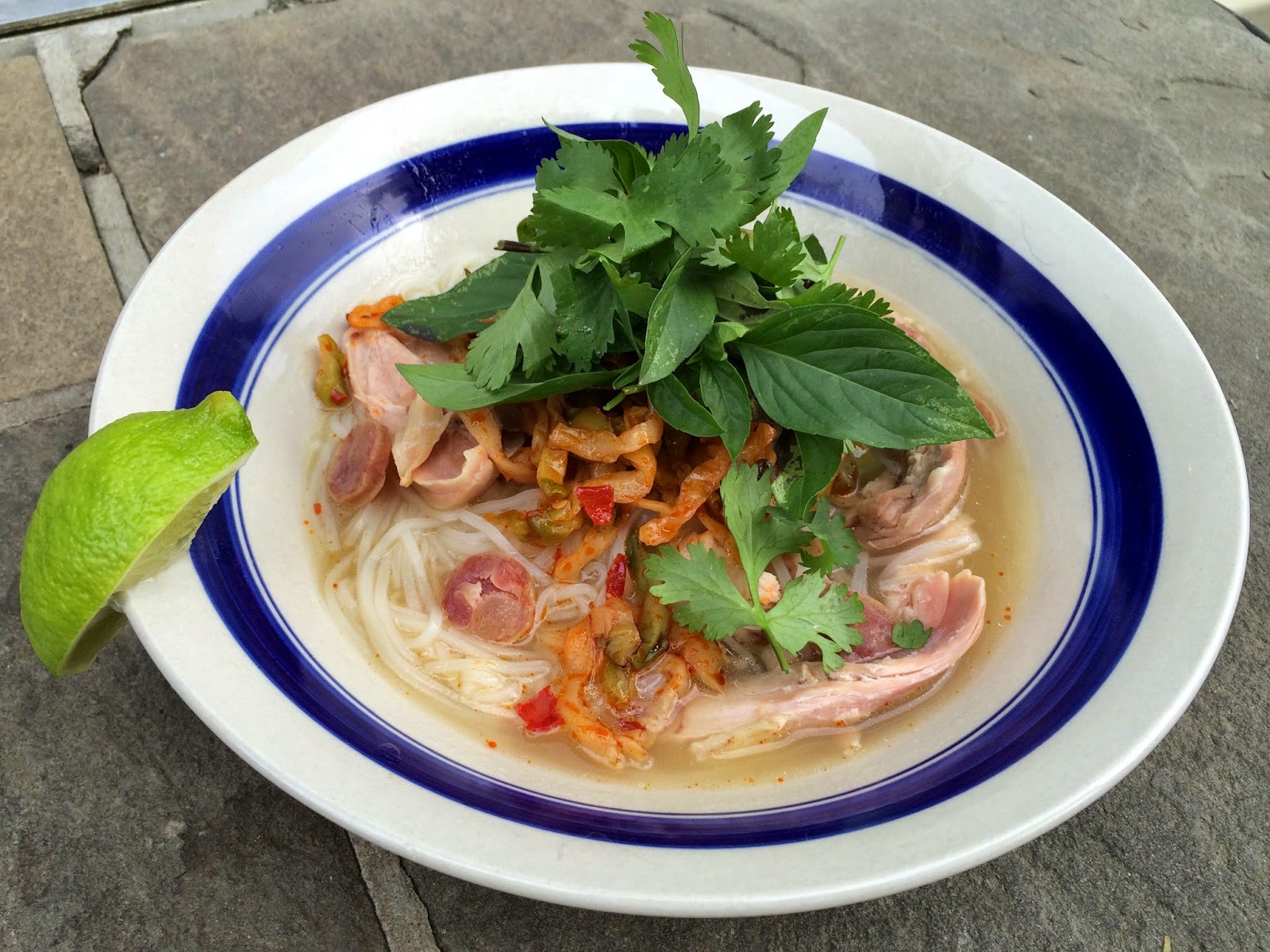
Phở Gà (Vietnamese Chicken Noodle Soup)

Tough weekend. I couldn't eat all day Sunday for a minor medical procedure on Monday and after getting out of that, I needed something really comforting to eat. Enter phở gà.

Phở Gà (Vietnamese Chicken Noodle Soup)
When I make pho, it is typically the more common beef version, but when I am not 100%, chicken suits me (and most of us) better. It was Ann's idea that I make chicken noodle soup: good call!

Here are my tips for making phở gà:

1. Poach the chicken until it is done, remove it from the broth, pick the meat from the bones, and return the bones to the stock to keep enriching it. This way, you achieve both goals: rich broth and tender chicken. Leaving the chicken meat in too long just renders it tough.

2. Char the onion and ginger on the flame for a few minutes before adding to the stock. It adds great depth of flavor.

3. Sweetness is optional. I almost never add sugar to chicken pho. But I often add just a touch of Chinese sausage (lop cheung) to the broth at the last minute. It imparts a certain sweetness. This is certainly non-traditional, but it's my bowl of soup, damn it, and I will cook it the way I want.

4. Have a light hand with the seasonings. To a half gallon of stock, I added four star anise and half a stick of cinnamon for just 20 minutes so that the flavor was there, but really in the background. You want the delicate chicken flavor to come through.

5. Knock yourself out on garnishes. I love pickled mustards stems from China, so I garnish my soup with them, but not with so many that I mask the delicate chicken broth.

6. I don't add either hoisin or sriracha to my bowl with chicken as I would with beef. Again, I want the chicken to be front and center.

Tuesday, August 12, 2014

Pork Larb Lettuce Wraps

I didn't have a clue what to make for dinner last evening. I wasn't hungry and I wasn't really craving anything. So when Ann sent me an email in the morning asking if we could have pork lettuce wraps for dinner, I was totally jazzed at not having to think about dinner. The figuring out dinner part is the hard part; the execution is always the easy part.

Pork Larb Lettuce Wraps
Last week, I made shrimp larb for dinner and I thought I would reprise that with pork this week. While Ann was off at a meeting, I went out to the garden and picked Thai basil and mint, whose leaves I mixed with cilantro leaves and very thinly sliced red onion in a bowl. And then I sliced some shallots, some Thai chiles, and minced some garlic. The final step in getting set was to mix some lime juice, brown sugar, fish sauce, and Thai chiles to make a sauce to drizzle over the wraps.

When Ann texted me to say she was coming home, I browned the shallots hard in a pan, then threw in a bunch of minced garlic and sliced chiles. Next went in the pork, a touch of brown sugar, and a splash each of fish sauce and water. When the pork was cooked through, I removed it carefully to the bowl containing the herbs and red onion, and returned the liquid to the stove where I reduced it to a syrup and then poured it back over the pork.

I omitted the toasted rice powder: we're watching our carbs. We hate watching our carbs but it is working. I could kill for a bowl of pasta now after three months of low-carbing it!

Tuesday, July 8, 2014

Pad Woon Sen: Thai Mash Up

Pad Woon Sen

Ann left dinner up to me yesterday. I knew immediately that we needed to do a krapow dish because the Thai basil in the garden is coming in fast and furious now. So I texted her: shrimp and Thai basil or squid and Thai basil. Squid was her choice (and I knew it would be, but I wanted to ask). That girl loves squid; so do I. And that settled it: Squid Krapow for dinner.

Because I am trying to watch my carbs, I decided to forgo the rice with the squid. To complement the spicy squid, I wanted to do Som Tum, green papaya slaw. And so at the market, I grabbed everything I would need that I don't have at home: squid, green papaya, bird chiles, and green beans. I bought green beans because they are fresh and seasonal. I could have bought the traditional long beans, but they looked like hell. Always choose quality over authenticity.

In the afternoon, I prepped both dishes but assembled neither and then went to watch a movie with Ann. After the movie, she insisted that she wanted Pad Thai. I don't keep rice noodles at home because I can buy them fresh at the market when I need them. And I wasn't in the mood for Pad Thai, having just prepped Som Tum and Squid Krapow. But I find it very hard to not please her, so I found a couple bundles of woon sen, cellophane noodles, in the pantry.

From there, I made Pad Woon Sen with the traditional Krapow sauce of oyster sauce, soy sauce, and lots of fish sauce and tossed in all the ingredients for Som Tum: grated papaya, peanuts, green beans, tomatoes, lime juice, and brown sugar. I made this dish grudgingly and probably with a few grumbles, but do you know what? It turned out to be a fantastic dish!

What to Drink with Thai Food? Yep, a Big Bordeaux Blend
I think my restaurant customers might freak out if they saw what I drank with my spicy Thai food, a big Bordeaux blend from nearby Delaplane Cellars. People put way too much emphasis on what goes with what. I always tell people to drink what they like and don't worry about it. At least I practice what I preach.


Tuesday, July 1, 2014

Thai Vegetable Chow Mein

The usual Monday morning conversation centered around what to make for dinner. No surprise there for a couple of hardcore foodies. We had hung up with a baseline consensus around pho or other rice noodle soup. A few minutes later I get a text from Ann: "Can you do those noodles in a pancake?"

Of course, I thought, but didn't really get to thinking about what to do other than a basic chow mein until much later in the afternoon when I remembered that when I had been weeding in the garden very early in the morning and that I had noticed that we have lots and lots of Thai basil that needed to be used.

From there, it wasn't a big stretch to combine Thai flavors with Chinese technique.

Thai Chow Mein
I decided as long as was mixing metaphors that it wouldn't hurt too bad if the vegetables were a mish-mash too. After work as I was heading home, from the market I collected sugar snaps (ours got pulled out of the garden this past weekend, sadly), an orange pepper, grape tomatoes, a pineapple, a knob of galangal, cilantro, bamboo shoots, and a pound of fresh noodles. From the pantry, I got fish sauce, ground white pepper, and dry roasted peanuts. And from the garden, I got lots of fresh Thai basil and garlic (Chinese) chives.

Flavoring Paste Basics
I made a seasoning paste to flavor the dish with from cilantro stems, galangal (aka kha or Thai ginger), shallots, white pepper, and fish sauce. Fresh galangal is very assertive, much more so than ginger, so I only used a few slices, finely minced, in my seasoning paste.

I fried the noodle cake and removed it to a platter, then I fried the seasoning paste and added the vegetables. After everything was warmed through, I added a few more splashes of fish sauce and tossed in the basil and chives.

A bit of prep work, but easy to execute and delicious!

Wednesday, October 2, 2013

Bánh Mì Thịt Nướng

Monday was our anniversary and we spent the evening at Carter's football game. Most people would go out on their anniversary and we might have too, because Monday night is usually date night. But during football season on Monday nights, well, we are obliged to go cheer on Carter and his mates (who, incidentally, were crushed 35-0, ouch!) instead of going out or (given the lack of decent restaurants in our area) staying in and fixing a nice dinner.

After a long, hard slog at the restaurant on Monday, I needed an easy dinner and, for obvious reasons, a somewhat special one. And it seemed pretty clear that rather than trying to bolt something down before rushing out the door for the almost hour-long drive to the game, that I would pack a dinner for us to take to the game. So I got to thinking about portable, easy-to-eat food and naturally, sandwiches fit that bill really well. I don't eat many sandwiches, so when I do, I want them to be spectacular, especially for my anniversary dinner.

When I think sandwich now, I think bánh mì if for no other reason than we just launched a very successful pork belly bánh mì on our new fall lunch menu at the restaurant. I wanted to change it up because pork belly is more successful when it is hot and hot food and football games just don't mix. So, on my way home, I stopped at the market and picked up some lemongrass and a package of very thinly sliced pork, labeled both bistek de cerdo and pork cushion meat. Grilled marinated pork is common in Vietnam and is known as thịt nướng, grilled meat, and the meat is understood to be pork.

Now I don't know about you, but I understand bistek de cerdo a lot more than I understand pork cushion meat, and I am a professional chef who butchers whole hogs from time to time. Because I butcher hogs, I recognized that the meat came from the shoulder, which is what I wanted. But the whole cushion thing is still a mystery to me even after looking it up. [I looked it up in the IMPS where USDA specs it as a real cut, 405B, that we never use at the restaurant.]


Pork Shoulder in Marinade, Ready for Grilling
Anyway, thank you to the butcher that put this boneless piece of Boston butt on the slicer and converted it to thin steaks for me. I marinated the steaks in a rub of lemongrass, garlic, black pepper, palm sugar, and fish sauce. They probably sat in the fridge for 90 minutes before grilling.

Pork Steaks Grilled; Baguettes Toasted
The steaks were on the super hot grill about 60 seconds on each side. I brought them and the toasted baguettes into the kitchen where I built them into sandwiches. I have come up with a spicy mayonnaise that I love on my bánh mì, rather than the traditional, yet boring plain mayo. I mix equal parts of sriracha, hoisin, and finely minced garlic and cilantro stems with two parts of mayo. This goes on both sides of the bread.

I made a quick slaw of julienned carrots and daikon mixed with nước chấm, which I make from time to time and keep in the refrigerator as needed. My nuoc cham is a heavy syrup of rice vinegar and white sugar thinned out with fish sauce, lime juice, crushed red chiles, and minced garlic. Yours might be different.

On the spicy mayo-slathered baguette went a layer of sliced cucumbers, a layer of carrot-daikon slaw, grilled lemongrass pork, tons of fresh cilantro, and a good sprinkling of crispy fried shallots. A lot of people add a layer of bird chiles or other chiles, but I just build the spice into the mayo. I like an even distribution of heat and am not very happy when the fresh chiles squirt out of the side of the sandwich when I bite into it!

Mango and Red Pepper Salad
To accompany our sandwiches, I made a savory mango and red pepper salad by roughly dicing the two fruits, and dressing them with lime juice, fish sauce, the merest hint of agave nectar, and a lot of Thai basil, fresh from our garden. I love the salty, citrusy nature of this salad, primarily because it is so unexpected. Your brain expects mango to be sweet, yet this salad is anything but sweet.

And that is the saga of our anniversary dinner. It was probably the best food that I have ever had at a football game anywhere. I know the people in the stands around us were jealous! Sorry for no pictures: they weren't going to come out in the dark anyway. You'll have to use your imagination.

Tuesday, September 10, 2013

A Salad Riff on Shrimp Bánh Mì

Last night for dinner, I had shrimp bánh mì on the brain, but I just wanted everything in the sandwich without the bread, without any mayo, so I came up with a quick salad.

Salad with Fish Sauce-Garlic Shrimp and Lop Cheung
The salad itself is torn butter lettuce, cilantro, and Thai basil from our garden all tossed with a dressing of caramelized sugar, rice vinegar, lime juice, sambal oelek, and fish sauce. This is topped with raw vegetables: julienne of carrot, julienne of sweet peppers, thinly sliced red onion, Mexican Midget and Sun Gold cherry tomatoes, cucumber, and green onions. And then this is topped with a quick sauté of fish sauce-garlic shrimp and lop cheung and the whole is sprinkled with deep-fried shallots. Lime wedges finish the salad.

Mise-en-Place
Ten minutes of prep work after we got home let us have a glass of wine and relax for ninety minutes before three minutes of assembly.

Shrimp in the Marinade
For the two of us, I put six ounces of shrimp in a bowl with lots of chopped garlic, a splash of sambal oelek, and a healthy dose of fish sauce. These guys hung out in the refrigerator until they were ready to go in the pan. I lifted the shrimp and garlic out of the marinade and then put them into a hot pan. Once the shrimp were cooked on one side and flipped, I added the three ounces of sliced lop cheung, and poured the marinade over. Total cooking time, three minutes, if that.

The best part of the whole dinner was cuddling in a chair with Ann and both of us eating the salad right out of the salad bowl while watching a movie! Great dinner!

Note to self: Ann said she wants peanuts in the salad for crunch next time. Can do.

Tuesday, June 4, 2013

Cellophane Noodle Salad with Grilled Red Drum

After a really unpleasantly hot and humid weekend full of nasty thunderstorms, Monday started out to be a carbon copy, but turned out to be a pretty decent day and cool enough to sit outside. Finally! And I was able to move a late afternoon meeting up by an hour so that I could get home to enjoy the nice weather that developed during the day.

Note to self: I am under strict orders from my wife to give her credit for the following dinner.

During the morning and early afternoon, it was pretty humid and it looked like the day was going to be a rehash of the weekend: soupy air and threat of thunderstorms. And the morning is when we discuss what we want for dinner. Given the weather, we were looking for something light and Ann had Asian on the brain and specifically mentioned cellophane noodles (the credit, folks, is all hers). I wanted grilled fish, so I put the two together.

After we picked the kids up from school at 5:00, I started prepping dinner, making a quick cellophane noodle salad (yum woon sen), the dressing for the salad, and prepping a side of red drum.


Standard Thai Salad Dressing

Dressings in Thailand are very simple and although I make mine from slightly different ingredients than they would in Thailand, the end result is almost identical. The dressing above is a mix of lime juice, sambal oelek, fish sauce, minced garlic, and agave nectar. I use sambal so that I don't have to crush the chiles in a mortar and I use agave nectar so that it goes directly into solution without a lot of stirring. A basic recipe idea is:

    juice of 3 limes
    3 tablespoons agave nectar (to taste)*
    3 tablespoons fish sauce
    2 tablespoons sambal oelek*
    2 cloves garlic, minced

Mix well. Adjust seasonings to your taste. Makes enough for a large salad.

*or your favorite sweetener/your favorite heat

Cellophane Noodle Salad without Fish and Dressing
Cellophane noodles, aka glass noodles, bean thread, woon sen, among other names, is a noodle made from various kinds of starch, most typically mung bean. They have a slippery-crunchy quality that makes them perfect for cold salads (although they are often stir-fried, see pad woon sen). They come in small bundles, each of which is typically enough for a single serving. Cover the bundles with boiling water and let stand for 5-10 minutes, then drain the noodles, and spread them out to cool off. When cool, chop into manageable lengths with a knife (or some people use scissors).

Mix with your favorite crunchy raw vegetables and herbs and toss with dressing. Add a protein if you like. My salad above has noodles, orange peppers, red peppers, carrots, cilantro leaves, and Thai basil leaves, green onions, lots of each. I love sliced red onion in this salad too, but didn't have any. No worries, it's just a salad!

After prepping all this, we went outside and enjoyed a glass of wine while the noodles were chilling and the grill was heating. I congratulated my wife on her brilliant choice of dinner.

Asprinio d'Aversa, our new Favorite Summertime Sipper
The wine that we opened is our new favorite summer sipper, a sparkling Asprinio from the town of Aversa, near Naples in Campania. We just love this lightly creamy wine: it feels more like beer in the mouth than sparking wine and it is a touch cloudy. The nose to me is of yeast, beer, apple cider, pear cider (perry), and apple sauce. The flavor on the palate reminds me of similar things but with really nice and refreshing acidity. It kind of reminds me of Mauzac a bit and some of the Blanquettes de Limoux that I have tasted, only a lot better than any Mauzac that I have ever had. This particular bottling from Grotta del Sole is also famous for being made from grapes from vines that are trained to grow up poplar trees. It's a pretty cool sight to see.

Dinner! All Ann's Idea!
When we were good and relaxed and the grill nice and hot, I put two big slabs of drum skin side down on the grill and closed it up, checking every few minutes until each piece had just turned opaque. I scraped the fish off the skin into the salad and tossed it all with dressing, all the while complimenting my beautiful wife on her wonderful dinner idea.

Dead Soldiers at Dusk
I am so glad that Ann had this idea for dinner tonight. She deserves all the credit.

Monday, September 3, 2012

Ribs for Labor Day

For our ribs for Labor Day, I decided to do something totally off the wall and do my own version of an Asian barbeque. I don't have a lot of experience with ribs. Ribs and fine dining are not exactly synonymous, are they? And I don't have any equipment either. But then I can MacGyver a smoker out of just about anything and who said they had to be smoked anyway?

I started with six St. Louis racks of commodity pork. Time got away from me and I forgot to order Berkshire racks from my supplier. I prefer the St. Louis racks (squared off spareribs) to the back ribs (the so-called baby backs) because the spareribs are larger and meatier. Spareribs are the lower half of the rib cage that wraps around and protects the chest cavity. The back ribs are the upper half that attach to the spine. Anatomy lesson over.

Peeling the Silverskin

On Wednesday afternoon, I started prepping the ribs and getting them in a marinade. First thing, I pulled the silverskin off the back side of the ribs. While not necessary, it is what the pros do and as a professional chef, I aim to be professional about my food. Then I trimmed any excess fat and silverskin from the front of the racks.

Herbs: Anise Hyssop, Cilantro, Lemongrass, Kaffir Lime, Thai Basil

From there it was into the marinade which I assembled from a bunch of stuff from the walk-in, mostly from herbs that were on their way out. There's no point in throwing out herbs just because they are unsightly, especially when they still taste good. I made a half gallon of slurry from Thai basil, cilantro stems, lemongrass, some really beat kaffir lime leaves, a huge bunch of blooming anise hyssop, garlic, ginger, star anise, black pepper, cinnamon, fish sauce, brown sugar, oil, and water. The slurry was primarily oil-based on the theory that oil extracts more flavoring compounds from the seasonings than does water. I kept the salt and sugar to a minimum because I wanted the ribs to take on flavor over several days without becoming jerky-like.

Straining the Marinade over the Racks

Saturday morning dawny hot, sticky, and rainy. Not a good day to contemplate firing up the smoker outside. Good thing. I don't have a smoker outside. Right off, I headed into the kitchen to concoct my dry rub, a rub that I have been thinking about on and off for a couple of days. I mixed up the rub that I had been working out in my mind, tasted it, and then tweaked the salt. I'm pretty happy with it and I think I have the long, mild white pepper burn just right.

The formula that I arrived at is:

   4 parts five-spice mix
   4 parts white sugar
   2 parts kosher salt
   1 part onion powder
   1 part garlic powder
   1 part ground white pepper

My five-spice mix is a bunch of things and certainly more than five spices, but as its creator, I am allowed, no? The mix is heavy on ground ginger, allspice, and star anise. It contains lesser amounts of cloves, cinnamon, anise seeds, Sichuan peppercorns, and white pepper.

Initial Dry Rub on top of Marinade

After taking the ribs out of the marinade, I rubbed them to get a nice even coat of the marinade and then dusted them with dry rub on both sides. They then went on sheet trays in a very slow oven for about 3-1/2 hours. Once out of the oven and while still hot, both sides of the racks got a coat of a wet rub of hoisin sauce, sesame oil, rice vinegar, fish sauce, and cayenne pepper. I then covered them in foil to let them cool slowly in the wet rub.

Wet Rub on Warm Racks
After a night in the walk-in in the wet rub, I put a final dry rub on the racks. In retrospect, it was too much. One dry rub application was plenty. Then it was on to the "smoker."

Racks Just out of "Smoker"
After trying several approaches that were just not going to work, I finally partially disassembled our gas grill and sat a foil packet of soaked applewood chips on the rightmost burner. Fortunately, our grill is big enough to hold three racks off to the left of the one lighted burner, plus another rack up on the warming shelf. After about 10 minutes of the burner on low, there was no smoke and the temperature in the grill was just about 100 degrees—too low. So I cranked the righthand burner and the temp went to about 215 after 10 minutes, with a modest amount of smoke. I smoked the ribs for 45 minutes and they turned out as you see above.

Hot off the Grill! My Biggest Fan!

The ribs were pretty good overall. The texture was spot on: not falling off the bone, but tender to the tooth. The amount of smoke was just right. But the final dry rub was too much. Next time I finish with the wet rub and let it caramelize without the final dry rub. Live and learn.

Tuesday, June 12, 2012

Pad Thai

Pad Thai
Yesterday was one of those rare days when I just didn't have any idea about what I wanted for dinner. It happens from time to time. Ann and I talked in the morning and she didn't have a lot of input other than she wanted something Asian, something light and refreshing. This didn't spark anything for me until late in the afternoon when I got to thinking that it has been years since I had Pad Thai. While I was writing out a list of ingredients that I'd need to make sure we had on hand, Ann texted me out of the blue, "Carter says he loves Pad Thai." That's kind of freaky coincidental!

It's been years since I had Pad Thai because it's been years since I found a restaurant that actually made good Pad Thai. All the ones in this area serve a dumbed down Americanized Pad Thai. Pity. I love the interplay of tamarind, palm sugar, lime juice, and fish sauce that gives Pad Thai it's wonderful flavor, the flavor that is missing in many restaurant versions of the dish.

Mise en Place for Pad Thai
In the photo above, you see most of the ingredients for our dinner. From the little crock of tamarind pulp in the upper left, you see a hunk of palm sugar, garlic chives, a shallot and a lime, bean sprouts, preserved vegetable, firm tofu, peanuts, shrimp, and rice stick. Missing are the egg, fish sauce, white pepper, and sriracha.

The rice noodles need to be soaked, but not all that long. Start them soaking before prepping the rest of the ingredients and you will be fine. I buy tamarind pulp in blocks, then rip off a chunk, soak it in warm water, and then work it well with my hands to separate the pulp from the seeds. I strain the pulp to make sure I have got all the seeds out.

I like to make my sauce separately from my noodles, because palm sugar is nearly rock hard and in the time that it takes to dissolve into the sauce, the noodles would be overcooked. I melt about equal quantities of tamarind pulp and palm sugar together and then add a little sriracha for heat. Traditionally, ground red pepper is used but I find that the liquid sriracha mixes into the sauce better. I adjust the sweet-sour balance according to my taste and then add a little fish sauce to get the salty component to my liking.

Then it is just a matter of stir-frying from here. First go in the ingredients that you want to really sear or caramelize such as the peanuts and shallots and then each item in its turn according to cooking time, save for the soaked noodles which go in next to last. Last in the pan are some of the sauce and an egg that gets scrambled in as I sprinkle in a bit more fish sauce and white pepper. Done.

Tuesday, May 29, 2012

Chow Mein

Snow Pea and Shrimp Chow Mein
Ann and I went all over town on Sunday running errands and doing things that I would normally do on Monday, which would not be possible because of the Memorial Day holiday. Needless to say, all those errands and food shopping on an empty stomach made for a couple of hungry people. Good thing Food Maxx was one stop on the way home! Ann wanted noodles, Asian, of some unspecified variety. I'm easy that way. All I need is an idea and I am off cooking.

We bought some udon, preserved vegetable, green onions, and snow peas and during the drive home, I was thinking soup with udon, but then it was 90+ degrees in the shade and I don't think either of us were feeling a hot bowl of soup, no matter  how good. So while I was prepping, I asked Ann about the udon, "stir-fried or in a broth?" "Stir-fried!" we both blurted out simultaneously. Jinx.

At that point I was thinking lo mein, noodles mixed with the vegetables, but then that all went out the door when I remembered how awesome good chow mein is, crispy pan-fried noodles topped with a garnish, not the gloppy crap that they used to (and I presume still do) serve in the 60's and 70's in bad American Chinese restaurants.

I put the udon into a large skillet and crisped them first on one side and then on the other, making a cake of crispy goodness that I transferred to a platter while I quickly stir-fried the garnish: snow peas, garlic, ginger, preserved vegetable, pre-cooked shrimp, and green onions. Once this was going, I added a large pinch (1/2 a teaspoon or more) of ground white pepper, a big splash of fish sauce, and a bit of water. I let this reduce for a minute or so and poured the whole over the noodles.

Mise en Place: It Makes Cooking so Much Simpler
 Our lunch, this mutt of a dish, classic Chinese preparation mixed with Japanese noodles and Thai spicing, was absolutely amazing, one of the best off-the-cuff dishes I've ever made. Paired with a delicious Riesling halbtrocken, it made for a memorable lunch.


Tuesday, April 17, 2012

Thai-Style Cellophane Noodle Salad with Lamb

It was blazing hot yesterday, just like a day in late July, and we were in the mood for something cool and refreshing. With a leftover roasted leg of lamb in the fridge to use, I set about a variation on the classic Thai beef salad mixed with a cellophane (mung bean) noodle salad.

It's a salad, so there isn't really a recipe, except for the dressing (and then there's only an idea and not really a recipe). I trust you can pick out the bowl of rehydrated cellophane noodles and then below that on the right, the dressing and a half a cup of dry roasted peanuts.

On the plate on the cutting board, clockwise from the julienne of sweet red pepper are yellow tomatoes, red onions, spearmint from the garden, cilantro and cilantro blossoms from the garden, and Thai basil.

On the other plate from the sliced lamb clockwise, there are lime wedges (for garnish), mung bean sprouts, cucumbers, and Thai chile.

The dressing is sugar and rice vinegar in equal portions cooked into a syrup and then flavored with sambal oelek (crushed chile paste), fish sauce, and lime juice.

And finally, I leave you with the food porn version of this salad.

Ode to the Tortilla

I love tortillas. It wasn't always that way. I am a child of the early 1960s. Then, on the East Coast, our food was influenced by two th...