Showing posts with label soy sauce. Show all posts

Saturday, May 6, 2023

Xi'an Cumin Lamb with Scissor-Cut Noodles

Now that my foot is almost better and I am in a walking boot, I can at long last get back in the kitchen and start cooking again. Ann showed me a photo a few times recently of a dish that is something of a current-day internet phenomenon, cumin lamb noodles modelled after the New York restaurant chain Xi'an Fine Foods.

Xi'an Cumin Lamb with Scissor-Cut Noodles
And so on our last foray to the grocery store, my first since early February (you don't know what a blessing it is to be able to do your own shopping until you cannot), we got some lamb to make the dish. We would have liked to have got some shoulder or loin, but that's really only available at the as-yet-unopened-for-the-season farmers market, so we settled for ground lamb.

Our original thought was to make some of our typical pasta dough (egg pasta of about half all-purpose flour and half semolina) hand-cut into wide flat noodles, but that egg pasta did not sit well with me because it is atypical in China. Meanwhile, I had been reading about various styles of Chinese noodles and decided to make some wonderful looking scissor-cut noodles.

Noodle Dough Resting
The noodle dough is merely a couple cups of all-purpose flour, some Kosher salt, and enough water to bring it together into a shaggy dough. I kneaded the dough just enough to bring it into a ball and let it rest on the counter under film for a couple of hours to hydrate. Then later in the afternoon, I kneaded the dough into a smooth paste to develop the gluten. I let it rest for another hour or so before we started on dinner.

Right after making the dough, I toasted the spices, one part Sichuan peppercorns and three parts cumin. At the same time, I heated a quarter cup of oil with a tablespoon of chile flakes to make some chile oil (which is much better made to order than in bulk because it goes rancid fairly quickly).

Toasting Sichuan Peppercorns and Cumin
Oil and Chile Flakes Becoming Chile Oil
When we were ready to eat dinner, Ann and I attacked it together. She started the lamb while I cut pieces of dough into a pan of boiling water. The lamb is a quick sauté of onions, spicy green chiles, and ground lamb seasoned with the ground spices that I toasted earlier. To finish the sauce, she added some soy sauce, chile oil, sesame oil, black vinegar, and a bit of sugar.

Ann Making the Lamb Sauce
Cooking the Noodles
In cooking the noodles, I treated them just like gnocchi or spätzle, removing them from the pan once they floated. It could not have been simpler. The final dish we garnished with (much) more chile oil, sesame seeds, and cilantro.

Delicious Xi'an Cumin Lamb with Scissor-Cut Noodles
We're definitely making these noodles again, one, because they are so easy to make, and two, because they satisfy our desire for pasta with body (you might guess by that, that we are no fans of capellini). The sauce needs work. We hewed closely to a recipe from the web, but now we feel free to make it our own.

Our next version needs to be spicier and funkier, plus I feel like I want a higher ratio of Sichuan peppercorns in the spice mix. I'm thinking of starting with fermented soy paste and creating a dish more akin to zha jiang mian. Good thing the farmers market opens in a week or so, giving us access to locally raised lamb shoulder.

Friday, July 22, 2022

Summer Eats: Sesame Sōmen with Shrimp and Edamame

When the temperatures soar, who feels like eating large, hot meals? We certainly don't. High summer is the perfect time for a cold pasta salad such as the one I made the other night with sōmen, thin wheat noodles from Japan, poached shrimp, shelled edamame, and a soy-sesame dressing augmented with a healthy dose of crushed red pepper flakes.

Summer Salad: Sesame Sōmen with Shrimp and Edamame
The really great thing about this salad is that you can make it in the morning in just a few minutes, put it in the refrigerator, and it will be ready for you when you get home from doing whatever it is that you do on a wonderful summer day.

Although at the restaurant, I developed a standard recipe for the soy-sesame dressing, at home, I don't bother with a recipe, preferring to eyeball it instead. I use roughly equal parts of soy sauce (or tamari), unseasoned rice vinegar, and toasted sesame oil, which I whisk together roughly with a fork just before dumping in the warm wheat noodles.

I pour a bunch of frozen shelled edamame onto the warm noodles; they will defrost quickly in the salad.

For salads, I use small shrimp which I dump into boiling salted water which I turn off. I let the shrimp stand in the hot water until they are just cooked through, a minute to three depending on size. They go into the bowl of warm noodles along with sliced green onions and a healthy pinch of crushed red pepper flakes.

Toss the salad well and let it cool a few minutes before putting it in the refrigerator. Don't worry about seasoning the salad until you are ready to eat. It will take a few minutes for the noodles to absorb the dressing, which can change the seasoning balance. The flavors are better if you let the salad warm up a few minutes on the counter before serving. Just before serving, taste and season as necessary.

Summer Sipper: Txakoli
What to drink with this salad? The obvious choice for a lot of somms is Riesling. Others might go with a Chenin Blanc or even a fragrant Sake. For my part, living in one of the great Riesling producing parts of the world, I drink a gracious plenty of Riesling in the summer. While I am not over-sated on Riesling by any stretch, I do like to taste wines from elsewhere on occasion. Moreover, I like serving obscurer wines that others might not have tasted. Summer screams to me of Vinho Verde from Portugal, but these days, it is ubiquitous. So for me in my quest for obscurer wines, branching out to its Spanish cousin from Basque country makes a lot of sense.

Txakoli (or Txakolina as the bottle in the photo above is called) is a great lightly effervescent alternative to Vinho Verde. Pronounced CHACK-uh-lee, this wine, like Vinho Verde, comes in white, red, and rosado forms, though most people know only the white form made from Hondarrabi Zuri grapes, if they know the wine at all.

It's a high acid, low alcohol, clean and easy-to-drink wine. Depending on the producer, it may be vinified in a riper, more aromatically fruity style, or as is my preference, in a more lemony and saline style reminiscent of great Albariño that has been picked slightly early.

Here's to cold salads and crisp wines to beat the summer heat!

Wednesday, December 30, 2020

Temaki: Spicy Tuna Hand Rolls

As I have lamented elsewhere, there is no place we trust in our town for sushi and so I have been doing my own raw fish dishes to scratch that particular itch. The spicy salmon tartare that we had recently got our sushi urges raging and Ann was really longing for hand rolls, so I made some spicy tuna temaki for us.

Ann Models a Spicy Tuna Hand Roll
Check out Ann's new Christmas nail job! We ended up eating the hand rolls standing at the counter. I would roll a couple, we would eat a couple, and so forth. All great fun.

Hand Roll Mise en Place
For the tuna, I minced some seedless cucumber and sliced some green onions and then made a spicy sauce of equal parts sriracha and soy sauce with a little sesame oil for flavor. I combined these two with the minced tuna and toasted sesame seeds.

Earlier in the afternoon, I had cooked a bit of good sushi rice. Fortunately, we grow excellent sushi rice in California and it is readily available in grocery stores. Although I love imported brands from Japan, my tried and true California brand is Nishiki, but my store doesn't carry it. What I have found is that most sushi rice brands can be very good, but what is really messed up are the cooking instructions.

Most brands call for too much water, resulting in an overcooked mushy mess, especially after you add the seasoned rice vinegar to the rice. In general, I have found that 1 portion of rice to a scant 1 and an eighth portion of water is a very good ratio, depending on how fresh the rice is. For reference, a cup of uncooked sushi rice will make a good dozen temaki.

As for seasoned vinegar, I don't mess with it. I use plain rice vinegar into which I stir a little sugar or agave nectar for sweetness. I use about an eighth cup per cup of rice and sprinkle it over the hot rice, gently turning the rice while it cools to room temperature.

Lay Rice on One End of the Nori
Making temaki, hand rolls, is child's play. It's fun to let everyone, kids included, roll their own. Mistakes are still edible! Start by slicing a sheet of nori down the center longways. Place it shiny side down on your board and with moistened fingers, spread a little rice on one end.

Lay the Filling on the Rice

Lay the filling or fillings on the rice on the diagonal. Start rolling by grasping the lower corner, the lower left corner in this case, and bringing it across the filling until the lower corner meets the top edge. I like to roll left to right. They roll right to left equally easily.

Roll the Resulting Cone Over Itself
Continue to roll the resulting cone over itself until you have but a small flap remaining. Put a few grains of rice on the flap to act as glue, then press the flap down onto the body of the cone.

Spicy Tuna Hand Rolls
Annie Demonstrating Temaki-Eating Skills

Sunday, December 27, 2020

Spicy Salmon Tartare

Ann and I are sushi fiends. I'm quite certain that we could eat sushi daily for months on end without getting tired of it. For us to get any decent sushi, we have to drive 45 minutes to an hour into Portland and environs, and besides being a long drive, it's a no-go during COVID anyway. Besides, there is little joy in take-out sushi. We enjoy sitting at the sushi bar and chatting with the sushi chef.

The temporary solution for us is to prepare our own raw fish. Fortunately, we can get amazing quality fish nearby and we do so every couple of weeks whenever we are near the seafood market. It's expensive, but nothing when compared to the tab from a foray to a sushi bar! Recently, I had a craving for spicy salmon, so we picked up a nice piece of king salmon and brought it home so I could make spicy salmon tartare.

Spicy Salmon Tartare
I like to use a contrasting color vegetable or fruit in my tartare for aesthetics as well as to stretch the very expensive fish, something such as avocado, cucumber, or in this case, small bias-cut asparagus sweated for a minute in a hot skillet. To the diced salmon and avocado, I added a bit of a spicy sauce that I concocted from equal parts soy sauce and sriracha with a little bit of sesame oil. The remainder of the sauce is on the plate as a garnish.

I think I speak for Ann when I say that I am afraid that our dinner of spicy salmon only whetted our appetite for sushi. It did next to nothing to satisfy the craving, only making the yearning worse.

Friday, October 2, 2020

Ginger-Miso-Green Onion Meatloaf with Soy-Lime Sauce

Ann is pretty good about surfing the internet looking for food that she wants to eat. One afternoon a couple of recipes showed up in my inbox courtesy of her, one for chicken meatballs flavored with ginger and miso and the other for a soy-lime dipping sauce that looks very suspiciously like a classic Vietnamese sauce, nuoc tuong.

I don't need or really even use recipes. All I need is the basic gist of an idea and I am off to the races. Ann sends me recipes for ideas and I really appreciate that: coming up with what to cook for dinner is a universal struggle among cooks.

Ginger-Miso-Green Onion Meatloaf with Soy-Lime Sauce
For a quick dinner, I don't really want to roll out and cook meatballs, so I opted for a meatloaf flavored similar to a filling for pot stickers along with broccoli that would roast at the same time as the meatloaf was baking. You could make meatballs out of this very same mix, but I was feeling lazy.

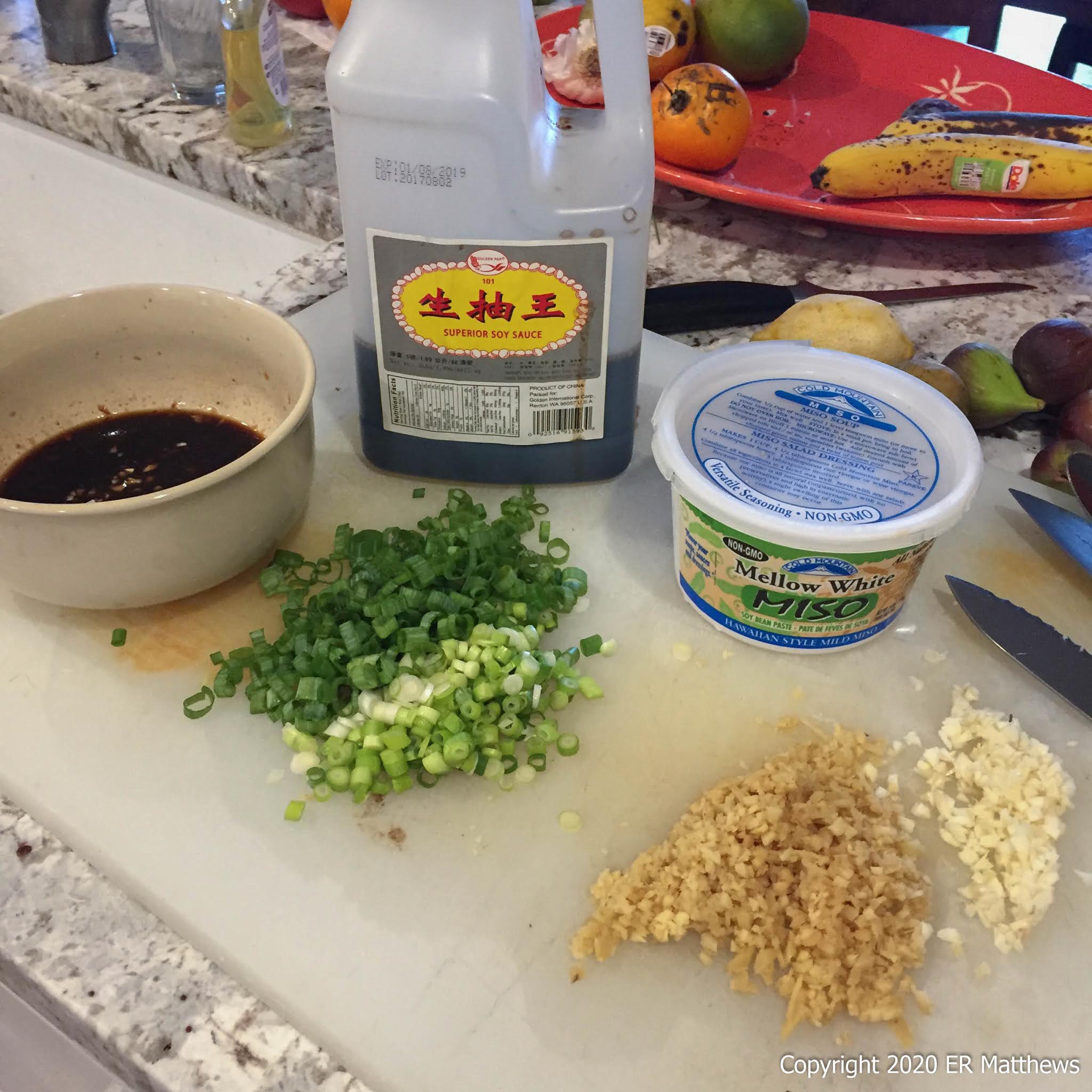
Mise en Place
Here are all my seasonings and the finished soy-lime sauce to spoon over both the meatloaf and the roasted broccoli. The seasonings for the meatloaf are soy sauce, shiromiso (white miso), garlic, ginger, and green onions.

I have been loyal to one brand of soy sauce since I was a kid: superior soy sauce from Pearl River Bridge, a lighter 100% soy Chinese-style soy versus the heavier and darker 50% soy, 50% wheat Japanese-style (tamari) embodied in Kikkoman or San-J, a fine sauce made in Virginia. 

Soy-Lime Sauce


For the sauce, I mixed in a small bowl:

one quarter cup soy
one quarter cup lime juice (juice of one large lime)
one clove garlic, minced
one teaspoon minced spicy chile (my stand-in for a fresh Thai bird chile)
one teaspoon agave syrup

I use agave as a sweetener in sauces because as a liquid, it mixes in to the sauce better than a granulated sugar. Adjust this sauce to your taste. If you find it too acidic, you can add more sweetener to balance the acid and/or some water to dilute it a touch. After you've made a couple of similar sauces, you'll get the hang of it for your palate.

Ginger-Miso-Green Onion Meatloaf 


Meat Loaf Ready for the Oven
Mixing up a meatloaf is child's play. First, you mix the liquid and seasoning ingredients in a bowl. Then you add the meat and binder and mix well, but gently, until all the ingredients come together. Then you drop the meatloaf on a sheet tray and shape it. After a quick bake and a brief cool-off period, dinner's done.

1 tablespoon soy sauce
2 tablespoons white miso
1/4 cup chicken stock 
4 green onions, sliced
1/3 cup minced fresh ginger
3 cloves garlic, minced
1 pound ground turkey
1 cup rolled oats

Mix the soy, miso, and chicken stock well until the miso is dissolved. Then add the green onions, ginger, and garlic and mix well. Finally, add the turkey and rolled oats and mix gently, but well.

Mound the forcemeat on a sheet tray in an even rectangle. The thicker the rectangle, the longer it will take to cook. This one took about 25 minutes, maybe 30.

Bake in a moderate oven at 350F until a meat thermometer registers 160F in the center of the loaf. Remove from the oven and let stand for 5-10 minutes. As the meatloaf cools, it will continue to cook in the center and will finish at 165F or higher.

As a chef, I don't always follow USDA Food Code guidelines about temperatures (they often want you to char your meat in the name of safety), but with poultry, I don't fool around. They say ground poultry must be cooked to 165F to kill any pathogens and I am with them in this regard. If you don't have a thermometer, go buy one and learn how to use and calibrate it before you embark on this recipe.

I use rolled oats in preference to other binders (such as panko or other breadcrumbs) because oats are relatively healthy for you.

You'll notice that there's no salt in this recipe. The soy and miso have plenty of salt to compensate.

This dinner was delicious, like eating a plate full of pot stickers without the pastry. I know that the pastry around those dumplings is awesome, but not when you're trying to lose your accumulated COVID gut!

Wednesday, October 12, 2016

Roasted Rockfish with Mapo Dofu

Ann asked me to make Rockfish with Mapo Dofu sauce on Monday and so I obliged her, stopping by the store on the way home and getting some tofu and a rockfish.

Roasted Rockfish with Mapo Dofu
My kitchen Spanish was not good enough to keep my fish unmolested when I turned it over to the fish guy to scale with the instructions, "limpio y entero, con cabeza, por favor" and so it came home without fins or tail. Oh well, it would have been worse had I ordered it in English.

The Guest of Honor
I decided to do a vegetarian mapo dofu substituting shiitake mushrooms for ground pork, sautéing them in a bit of sesame oil with lots of garlic and ginger. Then I added pickled mustard stems, spicy bean paste, a sprinkle of freshly ground Sichuan peppercorns (in the spice mill cup), and a splash of soy sauce. After this cooked for a minute, I added a little water and the tofu, thickened the sauce lightly with a touch of corn starch slurry, and adjusted the seasoning, adding a bit more spicy bean sauce because I thought it wasn't spicy enough in the la sense, chile spice. It was plenty spicy in the ma sense, numbing and tingling, from the Sichuan peppercorns.

Mapo Dofu Mise en Place

Wednesday, February 24, 2016

Steelhead Trout with Gingered Nappa and Soy Shiitakes

Steelhead Trout, Nappa Cabbage, Shiitakes
We're still very much in the winter doldrums at the restaurant and I am able to leave the cooking to the cooks on some weeknights, giving me an opportunity to get home and have dinner with Ann and Carter. Last night was one such night that I took off, worked on the bathroom that we're remodeling, and made dinner for all of us.

Yesterday afternoon Ann and I were discussing dinner via text when she asked me to do something with the Steelhead Trout that I brought home on Monday. So I started sketching out an idea: gingered nappa cabbage, soy-glazed Steelhead, and shiitakes. No sooner had I written this on a piece of paper than she texted me: "teriyaki or hoisin." How crazy that we were on exactly the same page, miles apart?

The nappa I quickly sautéed in a little oil with a splash of sesame oil, a lot of minced ginger, and a bit of minced garlic. Once it wilted, I moved it on to plates, wiped the pan down, and quickly sautéed some sliced shiitakes with a bit more ginger and garlic, then as they were wilting, splashed them with a few drops of soy sauce, let that evaporate, and moved them to a plate at the back of the stove to stay warm.

Another wipe down of the pan, a touch more oil, and in went the Steelhead, skin side down until the skin was crispy and brown and the fish at least half cooked, about three minutes. Then I flipped the fish and let it go for another minute, splashed the pan with soy sauce, let it evaporate, and then I turned off the flame and let the fish rest for 90 seconds. The fish was perfectly cooked: crispy skin, soy char on the other side, moist, flaky, and pink center. Delicious!

The plate up as you see above is simple.

Ann did not like the nappa cabbage. She keeps surprising me with all the leafy vegetables that she will not eat, nothing except for spinach and maybe gai lan, Chinese broccoli. This is going to be a bone of contention when we are eating together full time, post restaurant because I've not met a vegetable that I won't eat and I love and have to have my leafy greens. More for me I guess! I ate her cabbage and enjoyed every forkful of it!

Friday, January 30, 2015

Hot and Sour Chicken Soup

Hot and Sour Chicken Soup
It was about 25 years ago in San Francisco's Chinatown that I discovered that hot and sour soup could really be a thing of beauty. I was splitting my time between Virginia and a residential hotel in Sunnyvale, down the 101 from San Francisco and I was spending most of my free time between Napa/Sonoma and Chinatown, learning both wine and Chinese food. This was back in the day before most of the good Chinese food had fled the city.

I was already a disciple of Henry Chung, at whose Kearny Street hole in the wall I was a frequent visitor before the scary 1989 Loma Prieta earthquake shuttered it for good. The storefront was tiny: five or six tables and a counter, my haunt, where I could watch the ladies making the dishes. What amazing smoked ham and scallion cakes came out of that kitchen! Thanks to the Chung family's help and that of many other generous souls in Chinatown, I was just learning how amazing real Chinese food could be and I was cooking a lot of it back at home in Virginia, learning the ingredients, the techniques, and the metaphors. And already I knew enough to know that I didn't like hot and sour soup, that insipid gloppy crap that every Americanized Chinese restaurant served.

Once I got invited to a fancy fixed menu dinner at one of the big touristy Chinese restaurants in Chinatown, a place that hole-in-the-wall-spelunker-me would never have entered. One of the early courses in our banquet was a cup of hot and sour soup that blew me away with its rich broth, carefully curated spice, and fresh vegetables. A light went on that evening!

Yesterday was a wan, bleak day. Schools closing right after lunch signaled the coming rain, sleet, and ice and scared off all our lunch and dinner customers, so I decided to take the night off and cook dinner at home. The weather had me thinking soup. I proposed chicken soup to Ann and somehow we arrived at hot and sour chicken soup.

A quick stop at the market yielded some chicken legs, straw mushrooms, pressed tofu, lop cheung, slivered bamboo shoots, and a couple kinds of pickled vegetables. There are two kinds of preserved vegetables at the market of which I am especially fond right now, the one that is mainly stem mustard in chile oil labeled "Tasty Vegetable Good with Meal," and a sweet-and-spicy turnip pickle that is not labeled at all in English.

Ordinarily, I would make a rich pork stock for my soup, but given that this was a spur of the moment dinner, I went with chicken and added sliced pork lop cheung for the pork component. I poached the chicken in water with a splash of soy sauce, ginger, whole garlic, a couple of star anise pods, and a half a cinnamon stick, just enough spice for a background hint and nothing more. Once the chicken was tender, I fished it out and strained the seasonings out of the stock.

Into the stock went dried daylily buds, tree ear and straw mushrooms, tofu, both preserved vegetables, slivered bamboo shoots, and the lop cheung. I'm not a big fan of straw mushrooms, but Annie is and so I added them for her. Next, I picked the chicken and added the meat to the soup and let the whole simmer for about 15 minutes to rehydrate the dried vegetables. At this point, I then started to season, working the balance of sweet (rock sugar), salty (soy sauce), sour (Chinkiang black vinegar), and spicy (ground white pepper).

The very moment I was happy with the seasoning, I swirled in the tiniest amount of cornstarch just to amp the body slightly (something I wouldn't have done with a super-rich pork stock) and served the soup with a scattering of green onions over the top.

This was the soup I was meant to make on this dreary day. Not only was it warm and comforting, but it brought back some great food memories from my days in California, of a time when each new dish was a revelation, a discovery. Those days are mainly long behind me now, but the memories are vibrant still.

Tuesday, December 2, 2014

Vegetables with Spiced Tofu

I admit that I wasn't too jazzed when I read in an email from Ann yesterday "Let's do a vegetable stir fry with tofu." But, I was in a hurry to get home and really didn't want to try to think of something different, so I just replied "OK" and grabbed a few things at FoodMaxx on the way home.

Vegetables with Spiced Tofu
I also have to admit that it really did taste very good and that my body was craving vegetables, after a week of heavy Thanksgiving eating.


Peppers, Snow Peas, Shiitakes, Green Onions, Carrots
Not shown here is a small crown of broccoli that I prepped into florets and steamed in the microwave for about four minutes before adding them to the pan to caramelize.


Spiced Tofu, Cilantro, Garlic, "Pickled Radish"
The prep took about 15 minutes of chopping and slicing during the afternoon and then it only took about 10 minutes to bring the dish to the table when Ann decided she was hungry. I seared the ingredients in three different batches to keep my pan smoking hot. This is where I miss a carbon steel wok and a smoking wok burner. ;) The heat and the smoke I don't miss.

The green onions and cilantro went in raw. And then when all was done, I put the so-called "pickled radish" into the pan and deglazed with a touch of water. In went a little bean paste, some hoisin, a little soy sauce and it all cooked for another 90 seconds at which point, I poured the sauce over the veg and tossed well.

As for the "pickled radish," that's the name on the shelf tag at the store. The packages themselves are not marked in any way in English, except for a use-by date. So, I don't really know what these sweet and spicy pickled vegetables are, other than addictively good. They are my new favorite find!

Tuesday, February 4, 2014

Red-Cooked Chicken

"Oh my God, I think this is better than your pork belly bánh mì!" exclaimed Ann. This is high praise indeed: my bánh mì, currently on the lunch menu at the restaurant, was tops on her list of all the dishes that I have ever cooked. And for such an unassuming looking dish to assume the mantle of the-best-dish-ever is saying something. Though no stranger to hyperbole when it comes to food, Ann seemed earnest in the extreme. I can understand her excitement: this dish clearly shows why Chinese cuisine is one of the world's great treasures.

Red-Cooked Chicken: Uninspired Plating, Inspired Flavors
Unwittingly, Ann asked me to cook this eastern Chinese classic last week. As she was flipping through some or another food thing, she showed me a plate of red-cooked pork and said she wanted it. The dish wasn't labeled red-cooked but that's what it was. It's been 30 years since I red-cooked anything at home (though it is the basis of many dishes at the restaurant). I decided to lighten up the calories by going with chicken, but chicken legs instead of insipid breasts.

Red Cooking Basics
I've been red cooking dishes so long that I no longer remember the prescribed formulae, if there ever were such things, for this braise. Because of the long cook time, I put together the dish in the slow cooker the night before, so that I could remove it from the refrigerator and start it cooking before I left for work in the morning, to have it waiting when I returned.

Into the slow cooker went the three huge chicken leg quarters, 6-8 star anise pods, half a cinnamon stick, a chunk of rock sugar, a handful of whole garlic cloves, several slabs of ginger, a couple whole green onions, the peel of a tangerine, and the stems from a bunch of cilantro. To this I added about half a cup, maybe three-fourths, of soy sauce, several tablespoons of Chinkiang black vinegar, and water to just reach the top of the chicken.

To finish the dish, I put some rice on to cook, removed the chicken to a plate, and strained and defatted the braising liquid which I then reduced to the point where if I reduced it any further, it would be too salty. At the very end when the sauce and rice were done, I blanched some Chinese broccoli and we sat down to dig in.

This dish clearly belongs in the pantheon of great dishes invented by humankind. It is that good. And that simple: try it yourself. If you've never had it before as Ann had not, it will be a revelation of the best kind.

Tuesday, January 14, 2014

Hot and Sour Catfish

Hot and Sour Catfish
For dinner, Ann wanted me to reprise the fried catfish dish with mapo dofu topping that I did this time last year. But I was in a soup mood, so I split the difference. This didn't stop Ann from giving me grief about not cooking exactly what she wanted, for doing some riff, but that's what Eds do: they take inspiration from whatever source and then map that inspiration onto something deliciously edible (and I don't think that judging from her happy noises that she really has any grounds to complain about the results). ;)

Earlier in the afternoon, I simmered for a couple of hours a couple pounds of chicken necks in chicken stock with garlic, ginger, and cilantro stems. Meanwhile, I soaked a handful of dried daylily buds and tree ear mushrooms in hot water.

Just before dinner, I strained the chicken stock and added the rehydrated lily flowers and mushrooms, broth and all, to the stock. To this, I added soy sauce and vinegar in equal parts to the soup until I got just the right amount of salt and sour. I added three parts rice vinegar to one part black vinegar. Into the soup went finely diced tofu, chopped Shanghai bok choy, and spicy preserved mustard stems. I didn't add any more spice to the soup, but if I had, the classic hot and sour soup spice is ground white pepper (which I did add to Ann's soup because she wanted more spice). I did not add cornstarch to the soup: I am not a fan of the gloppy consistency. If that's your speed, go for it.

While finishing up the soup stock, I roasted a whole sheet tray of catfish in the oven (to have something to eat for dinner late night when I get home later this week) and then placed a small filet in the bottom of a soup bowl. Over this went a couple ladles of soup and on top, fresh cilantro and green onions. And presto! Hot and sour catfish.

Tuesday, September 24, 2013

Zhajiangmian

Zhajiangmian with Snow Peas
Zhajiangmian ("fried sauce noodles") is one of my all-time favorite comfort dishes: there is something about noodles with a rich earthy pork and bean paste sauce that makes me tremendously happy. I first encountered it twenty or so years ago in a little hole in the wall Chinese restaurant where I ordered (it and lots of other delicious and unusual dishes) blindly from the Chinese-language only menu by pointing. I raised some eyebrows playing palette roulette this way, but I got to try a lot of great dishes and I finally trained the staff so that they would suggest dishes that I should try. It took a long time for them to figure out that they weren't going to scare me by serving pig's ears or dried jellyfish. Of all the dishes that I tried though, fried sauce noodles was one of my favorites and one of those that I have learned to make. And beyond making it, I now feel comfortable in making my own versions.

It is one of those dishes that varies each time I make it depending on what I have on hand in the refrigerator and pantry. The theme is thick wheat noodles and a sauce of bean paste and ground pork. The variations are endless.

Yesterday's variation involved two kinds of bean paste, regular Korean soy bean paste (doenjang) and spicy Korean fava bean and chile paste (dobanjang), along with soy sauce, Chinkiang black vinegar, and dark sesame oil. Garnishes always vary, but I almost always insist on pickled mustard stems (zha cai), five spice-pressed tofu, and a green vegetable, in this case, some beautiful fall snow peas. The sauce was flavored with copious amounts of both ginger and garlic and I tossed raw green onions and cilantro leaves into the noodles while tossing them with the sauce. The noodles themselves: udon.

I no longer worry about the cultural mash-up that is my zhajiangmian, for this is a dish that has been adopted all over Japan, Korea, and China and is made with whatever suitable local ingredients are available. The best noodles I can get happen to be udon and the best bean pastes I can get happen to be Korean. And who cares? The results are spectacular!

Cultural Mash-Up: Japanese, Chinese, and Korean


Wednesday, January 30, 2013

The Art of the Sauce: Pork and Snow Pea Lo Mein

Well, Monday was to be date night but Ann wasn't feeling up to going out and she asked me if I would make lo mein with snow peas, so I grabbed some pork neck bones, snow peas, and lo mein noodles at the market on the way home.

I have never liked the usual casual approach to making Chineses sauces: thickening broth with starch. I don't mind dredging meat in starch, frying it, then adding broth and have it thicken that way, but thickening broth with a starch slurry seems like a cop out to me, a lazy way that says the cook doesn't care enough to make a good sauce. Maybe it's my classical French sauce background coming through that drives me to make my sauces by reduction. Maybe it's the flavor: the results are spectacular.

Pork Neck Bones
Into a screaming hot pot went the meaty neckbones to brown thoroughly on all sides, a process that took about 15 minutes. At various points, I added whole garlic, slabs of ginger, green onion bulbs, a halved shallot with the skin still on, and a bunch of cilantro stems tied in a bouquet, so that each item caramelized along with the pork. In went water to cover and after deglazing the bottom of the pan, I left the pot to simmer while we watched a movie. After the movie was done, I removed the solids, reserving the neck bones, skimmed the fat from the stock, and started reducing it over high heat until I had a cup of liquid.

Meanwhile, I picked the gelatinous neck meat from the bones, Ann pulled the strings from the snow peas, and I slivered garlic and green onions. And I got a jar of young slivered bamboo shoots in spicy chile oil out of the refrigerator.

Pork and Snow Pea Lo Mein
Once the stock reduced to a cup, I added a tablespoon of Chinkiang black rice vinegar, a couple tablespoons of soy sauce, a teaspoon of sambal oelek chile paste, and enough brown sugar to balance the flavors. I brought this down to about 3/4 of a cup and adjusted the seasonings to end up with a deliciously porky, sweet, sour, spicy, and salty sauce.

While the sauce was finishing, I cooked the noodles and stir-fried the other ingredients. It was then just a matter of mixing the noodles, the garnishes, and the sauce and serving. The results were delicious and a fair amount of work for a weeknight, but really worth it in terms of flavor. You just can't duplicate the depth of flavor of a carefully crafted sauce reduction by thickening some broth with starch.

Wednesday, February 1, 2012

I Love Sichuan Food

A few days back, Ann emailed me a photo of a Chinese fish dish along with a recipe and said she wanted me to make it. Just quickly glancing at it, it was obviously just the classic mapo dofu over fish instead of rice. Easy enough and a dish I haven't cooked in more than 20 years when I was teaching myself Chinese fundamentals.

Here you see my mise en place. Ann accuses me of doing this just for photographic reasons, but after years of seeing me operate in the restaurant kitchen, she ought to know better. I always have and I always will get all my ingredients together ready to cook before lighting any flame (and you should too!) From the top left dish: Shaoxing wine, light soy sauce, fermented black beans and broad bean paste, black mushrooms, cornstarch slurry, and tree ear mushrooms. On the righthand plate: tofu (I prefer mine firm; eat what you like) and green onions. And clockwise from the red chile paste on the other plate: preserved vegetable, ginger, garlic, and bamboo shoots in chile oil. You don't see the ground pork or the catfish, which are still in the fridge at this point.

A word about ingredients. Sichuan cooking is famous for use of preserved ingredients that are often spicy. You will almost always find dried, pickled, or salted ingredients in Sichuan food, and these are huge flavors that appeal to my palate. I am in love with the inelegantly named preserved vegetable, a salted mustard green, more about which on the restaurant blog. This was Ann's first encounter with this spicy, salty bit of goodness, which now comes conveniently packaged in single serving foil packets, and she loves it as well.

So, here's an awful photo of a scrumptious dish. I started by dredging the catfish lightly in cornstarch and then searing it on both sides. This gives the fish a nice crust and then it helps thicken the sauce when the fish goes back in. After removing the fish, I built the sauce by cooking the ground pork with garlic and ginger over very high flame, then added the other flavorings except the tofu and green onions. A couple of ladles of chicken stock went in next and then the fish. Once the fish had cooked through, off to a warm plate it went while I added the tofu and half the green onions, then thickened the sauce with a little cornstarch slurry. The sauce went over the fish and the rest of the green onions on top. Yum!

A typical Sichuan sauce would most likely also contain Sichuan peppercorns, but I couldn't find mine. Bummer. I like their little electric numbing touch that the Chinese call la.

Tuesday, January 10, 2012

Broiled Spanish Mackerel

Last night's dinner had a decidedly Japanese character: miso soup, rice with furikake, broiled marinated Spanish mackerel, and steamed edamame. Ann had already made the dashi from kombu (kelp) and hanakatsuo (bonito shavings) when I arrived home with the guests of honor.

I quickly filleted the two mackerels and marinated the fillets in equal parts mirin, shiroshoyu, and sake with a lot of freshly minced ginger. This is one of the most delicious ways I know of preparing mackerel and mackerel is one of the most delicious fishes that I know. It has a very high oil content—the raw flesh almost feels buttery—that lends itself to high heat cooking applications such as grilling or broiling.

While the fish was marinating (for a total of about an hour), we prepped for for Ann's delicious shiromiso soup with tofu, straw mushrooms, and green onions. And then we put on a pot of rice with a couple more pieces of kombu and the katsuobushi left over from making the dashi. In retrospect, we wouldn't add the bonito to the rice again: too fishy. The edamame come in handy plastic bags that can be microwaved, so we just let Chef Mike cook them for about five minutes. I've never done edamame in the microwave before and probably won't do it again. Much better to boil them in salted water or even steam them. Still, I'm not complaining. Some edamame is better than no edamame! While the rice was finishing and the edamame were in the microwave, the fish went on a sheet tray (on oiled aluminum foil) under the broiler for a scant five minutes. You can see the gorgeous bronze hue that the fish takes on from the marinade, almost as if it had been smoked. The result was utterly delicious!


PS. I learned something new about wine (but that's nothing really new: I'm always learning about wine). I was drinking Thistle Chardonnay Dundee Hills 2008, a fairly oaky and buttery Chard that still retains fair acid. Though I would never pair this wine with a fishy fish, I decided to try it for giggles. It was a train wreck. The wine tasted awful and the fish tasted wretchedly fishy. Yuck. Note to self.

Ode to the Tortilla

I love tortillas. It wasn't always that way. I am a child of the early 1960s. Then, on the East Coast, our food was influenced by two th...