Showing posts with label garlic. Show all posts

Sunday, June 28, 2026

We Needed a Celebration

It's been a long time since we had a get-together at our house. Spring was busy: I'm volunteering a couple days a week, I traveled to Philly to watch Ellie graduate, and we had a few health problems along the way. We needed a reason to celebrate at home. Ann set it up, inviting Rob and Dyce and Michelle and Andreas for dinner.

Pregaming with Chenin Blanc
Superstar Wine: Anjou Blanc
Chenin from Thibaut Boudignon
Whipped Feta with Spicy Honey and Pine Nuts
We had been saving a magnum of Anjou Blanc from Thibaud Boudignon for just such an occasion. He is a winemaker who came from obscurity to global reknown (at least among sommeliers) in a blink, now making some of the best wines in the Loire. These are not old school wines, however. They are precise and angular and suit my palate to a tee. Although he is best known for his outstanding Savennières, I prefer his base level Anjou Blanc for its simplicity and laser-focused acidity.

I let the wine guide the appetizer course, selecting a cheese dish that would be a great foil for the incredible acidity of the Boudignon wine. Over the years I have done many versions of baked feta and whipped goat cheese, but never whipped feta.

For garnishes, I made spicy honey (half a cup of honey and a tablespoon of sambal oelek) and toasted a handful of pine nuts. I chose to garnish with honey expressly to echo the honey and beeswax aromas and flavors of the Chenin Blanc.

Whipped Feta


For the whipped feta, I decided to add 20% goat cheese by weight to help loosen the feta which I was afraid would be too grainy whipped alone. I was quite happy with the results as apparently were all the others—none was left at the end of the evening.

400 grams of excellent sheep's milk feta
100 grams of fresh goat cheese
squeeze of lemon juice
drizzle of extra virgin olive oil

Soften both cheeses at room temperature. Place both in a food processor and process until whipped, scraping down the sides of the bowl as needed.

The raw whipped cheese tasted flat so I squeezed in the juice of an end of a lemon that I had left on the cutting board from making lemon slices for the chicken. I drizzled in an equal amount of olive oil; call it a tablespoon of each. The feta is salty enough; the whip did not need more salt.

Setting the Table: First Time in a Long Time
Ann and I went back and forth on the menu for a few days. At first, she wanted a reprise of a chicken tagine that I made some years ago, actually, an entire meal that I had made before. I resisted repeating myself, feeling that it is a cop out of sorts. But then she changed her mind to simple roasted chicken on white beans.

She was dead set on the tomato salad flavored with fennel pollen from the menu that I did not want to replicate. She talks about that salad often, but it's funny how I barely remember the dishes (so many thousands) that I have cooked. Thankfully, this blog is a repository of dishes that I have made, so there is a record even if I no longer recall them.

Roasted Chicken
with White Beans, Artichokes, and Garlic
The orginal roast chicken, as I conceived it, had no white beans. But I added them to subsequent iterations because something magical happens when you roast chicken on top of them. As always, quality matters. Use the best beans you can find. In this case, I used yellow eye beans from Rancho Gordo. These are among my favorite all purpose white beans ever and a stalwart at the restaurant.

Roasted Chicken with White Beans, Artichokes, and Garlic


6 heads of garlic, broken into cloves and peeled
3 lemons, sliced
1 pound of dried white beans, cooked
3 400-gram cans artichoke hearts
1 bunch of Italian parsley, destemmed and roughly chopped
2 large sprigs of rosemary, destemmed
drizzle of extra virgin olive oil
12 chicken thighs
salt
pepper

Mix the garlic, lemon slices, white beans, artichoke hearts, parsley, and rosemary with a drizzle of olive oil. Season as necessary. Place the mixture in the bottom of a roasting pan. Toss the chicken thighs with salt and pepper and arrange on the bed of vegetables. Roast in a hot oven (400F) until the chicken skin is crisp, about two hours. Check the beans occasionally. If they are drying out, moisten them with a little bean broth or chicken stock.

Tomatoes with Fennel Pollen and Shallots
Nobody needs a recipe for this simple tomato salad that is as surprisingly delicious as it is easy to make. It is merely a mixture of halved grape tomatoes, minced shallots, fennel pollen, lemon juice, olive oil, and salt, all to taste. 

Shout Out to El Mentridano
Ann and I, we are fans of light bodied reds with good acidity and some structure, wines that let their aromatics do the talking. While we are not fans of the usually overripe Spanish Garnacha, we both agree that El Mentridano, a high-altitude, lightly expressed Garnacha from Méntrida, near Madrid, is delightful. It offers a nose of cranberries, cherries, black tea, and a slight earthiness, all positives in our book. Color is light and tannins are polished, all backed by an attractive sour cherry acidity that keeps the wine vibrant. It reminds me of Nebbiolo in many ways. We had real problems, likely bottle shock, with this wine about six months ago, but after sitting in the rack for that period, it is back to normal. We must buy more—it is an indispensable summer red that pairs with a vast range of foods.

Herding Cats Again: Impossible to Get Everyone to Cooperate
Ann Made Her Delightful Summer Pudding (Berries and Brioche)
Michelle Made Her Best Batch Yet of Lemon Bars
We needed a night to sit back with friends and catch up. The simple menu is just what we needed, tasty and yet easy to prep in advance, with zero à la minute cooking that let us enjoy the company of our guests.

Sunday, February 16, 2025

Third Bendiversary

February has historically been a feast month for us. It all started a long time ago as a way for Ann and me to celebrate an anti-Valentine's Day of sorts. It has since evolved.

Andreas, Kasia, Dyce, Ann, Michelle, Rob, Mike, Meredith
Sorry Andreas, You Rocked Back out of the Frame
Being in the restaurant business, I was always on the brutal business end of Valentine's Day. It was a time when we prepped for days and days to handle the jam-packed restaurant for a night, or two if we were lucky. And it was not optional: there was no other traffic at the restaurant in February and we depended on the instant cashflow of the big night or nights to tide us through the fallow time of a cashflow negative winter season. Did this conjure images of Stanley Tucci and Tony Shalhoub for you?

Moreover, Ann was stranded at home on Valentine's Day, the prototypical chef-widow, watching TV while all her friends and neighbors were out celebrating. I would come home late and exhausted, in a mood for nothing but a shower, a beer, and a pillow.

We had other friends in a similar situation and we had many friends who were winemakers. Because of our tremendously busy schedules, times for us to get together and celebrate life were few and far between. Fortunately, February is a slow month in both the restaurant and winery worlds. And so Ann put together what she termed an anti-Valentine's dinner. Over the years, it became customary for me to make a big cassoulet, a humble but ever so comforting dish of beans.

I cannot speak for many restaurateurs and chefs, but most that I know do not want fancy food when they celebrate. They have enough fancy restaurant food on a daily basis to be sick of it. What they want is excellent comfort food.

Cassoulet became our go-to not only because it is excellent comfort food, but also as a counterreaction to the prescriptive Valentine's menus that we served. Valentine's Day in the business is a night that people who do not go out often to fine dining restaurants descend upon fine dining restaurants.

These people scrimped and saved their money (and thank you to them for helping us get through the lean months) for this once-a-year night out. These folks wanted a very strict and limited selection of items that they perceive as valuable for their cash outlay. In other words, the menu must contain lobster, steak, and chocolate and must not be too avant-garde. We were permitted no risks in the menu.

This kind of menu was a strict departure from our normal multi-course menu, but it was necessary to ensure that the restaurant were packed to generate the cash that we needed to operate. This kind of menu, however, was no fun for us to cook. As chefs, we found it boring and a mere ticking of the boxes to attract clientele.

And so cassoulet became the antidote to both fine dining and a strictly prescriptive menu. It was exactly the kind of dish that I both wanted to cook and to eat on a cold February night.

Cassoulet After the Seventh Punch-down
What began as an anti-Valentine's celebration has taken on additional meaning over the years. My birthday is near Valentine's. It is a given that chefs are working on their birthdays serving food to other people celebrating their own birthdays. Chefs rarely have a chance to celebrate and so this dinner became a way for me to celebrate my own birthday, especially after retiring from the business. And, we moved to Bend just before Valentine's Day and it has been such a wonderful place to live that we added a celebration of our so-called Bendiversary to our feast night.

It was a foregone conclusion that I would make another cassoulet this year and so I did. It is an easy dish to make, but it requires a lot of time to achieve the layering of flavors that makes a great cassoulet. I put the cassoulet together over three lazy days. To go with it, I made a roasted garlic and chive goat cheese spread for an appetizer and an arugula salad with fennel and apples. Ann made a flourless chocolate cake that we served with 1977 Warre's Port.

Roasted Garlic, Chives, and Goat Cheese
Kasia, who manages the cheese department at our local store, brought two great cheeses, one a blue and one a washed rind. Along with it was some amazing honey that she and Mike brought back from Piemonte. Mike also brought two bottles of wine that he made, a Tempranillo and a Malbec, both from Walla Walla grapes. Rob and Dyce brought Savigny-lès-Beane. I was busy kibbitzing and forget to get photos.

Ann Made a Flourless Chocolate Cake
1977 Warre's Port that I Bought on Release
It is Finally Calming Down after Nearly 50 Years

Monday, February 3, 2025

The Boys are Back in Town

With apologies to Thin Lizzy, the boys are finally back in town, having moved back from Boulder after a short stay there. We were devastated when they decided to move while we were away in Italy in the fall and we are ecstatic that they missed Bend so much that they have decided to return.

Naturally, to celebrate their return, we had them to dinner. For this dinner, Ann wanted me to do pasta with ragù bolognese and she wanted to make garlic bread, especially because Rob loves garlic bread.

The Three Musketeers
Kitchen Elf Extraordinaire!
Spying a bin of small tomatoes on the counter where I leave them to ripen sparked an idea for a simple appetizer, mini-Capreses on skewers. Nothing could be simpler than skewering tomatoes, basil leaves, and bocconcini and drizzling them with a bit of pesto thinned with olive oil.

Caprese Skewers
We waffled on making a traditional lasagne (I should have, damn it!) but I let Ann convince me that I should just used boxed pasta rather than rolling out a sfoglia and cutting it into big sheets for lasagne. We ended up with par-cooked mezzo rigatoni (from Giuseppe Cocco) mixed with ragù and a bit of ricotta, topped with mozzarella and baked until golden brown. It was good, but not great and certainly not in the same league as lasagne.

Baked Mezzo Rigatoni and Ragù Bolognese
Ann wanted to make garlic bread as a surprise for Rob, whose predilection for this delicious carb we noticed in Santa Fe. She concocts a mixture of butter, mayonnaise, granulated garlic, fresh garlic, and a bit of Italian parsley and slathers obscene amounts on a split loaf of excellent bread. After it browns under the broiler, it is absolutely irresistible and makes the house smell amazing. I can gain weight just by looking at photos of it.

Ann's Crazy Good Garlic Bread
After kibbitzing for an hour or so and catching up with the boys and their move back to town, we relocated to the dining room and finished up the evening with a couple bottles of delicious Langhe Nebbiolo.

Wednesday, October 4, 2023

Note to Self: Roasted Chicken with Artichokes, Lemon, and Garlic

Here's an impromptu dish from last evening that Ann is raving about and wants me to make again, which I will never do if I don't document it, because it, like so many thousands of dishes I have cooked in the past, will escape the tenuous confines of my feeble mind for the vast ether.

Roasted Chicken with Artichokes, Lemon, and Garlic
Olive oil in the pan, chicken thighs, peeled garlic cloves, salt and pepper, artichoke hearts, lemon slices, Italian parsley, rosemary, olive oil drizzle over; roast 400 until done. Voilà! That's all the recipe a chef needs.

Tuesday, May 17, 2022

Mother's Day Dinner

Back in the restaurant days, we closed every Sunday without exception, including Mother's Day. Would-be customers would sometimes get irate and/or indignant that we would not be open on the day that they wanted to take mom out. Rarely ever did they consider that people who are in the restaurant business are human beings and that some things, such as being with family, are more important than money.

Cooking Fools: John and I Assembling Gnocchi

To make the most of our Mother's Day day-off from the restaurant, Ann and I would often host a Mother's Day dinner at our house, especially when Ann's parents were alive and able to make the hour-long schlep to our house. We fell out of the habit when her parents became unable to make it and then soon after, we relocated to Oregon away from our families. Then COVID decided to shut everything down for a couple of years.

And now in 2022, Ann decided that she wanted to have a dinner once again for Mother's Day. She even knew the dishes she wanted me to make: a potato-salad modeled on one we had eaten at a local restaurant and goat-cheese gnocchi. While I loved her ideas, I really didn't want to have two dishes that would have me doing last minute cooking, what we call in the business à la minute dishes, keeping me away from socializing with our guests, which is what I thought the idea was.

That issue, coupled with my objecting to having carbs on carbs in subsequent courses, fell on deaf ears and in the spirit of marital harmony, I ceased demurring. One thing I have learned is that when Ann is entrenched on some point, I really, really, really, really must want to try to move her off that position. In this case, it was just easier to shut up and cook! And I mean this lovingly with no ill intent!

A Little Snow for Mother's Day

When I think of Mother's Day, I think of mild temperatures, green grass, and flowers galore. But that isn't the case here in Bend, Oregon where it is really snowing hard as I type this. It won't amount to much down here by the river, but up in the Cascades, you can be sure they're getting dumped on. Still, we have pretty much of a spring menu for today and I guess that we will have to pretend that the weather is beautiful.

Special Guest Cady
Working for his Dinner, John Cooks Maiitake
For our Mother's Day affair, John and Heidi and Tim and Susan joined us. Tim was kind enough to bring a couple bottles of blends from his private stash, one Napa and one Columbia Valley. Tim and Susan also brought along their dog Cady whom we were very happy to entertain. It was great having a dog in the house again after having had to put Grace down just a very few days ago!

Appetizer: Potato Salad with Argentinean Red Shrimp


Potato Salad with Argentinean Red Shrimp

We have dined twice now at a very charming and competent Italian restaurant called Bosa. One of the appetizers on their current menu is Grilled Calamari on Potato Salad. The potato salad contains tomatoes, olives, garlic crema, and Sherry vinaigrette. The flavor combinations are wonderful and hats off to the cook on the grill station; the calamari has been perfectly cooked on both occasions that we have eaten it.

As much as we loved the calamari, the revelation for us was the potato salad under the squid. I made a mental note that I would try to recreate that salad and make it my own. I have always thought that one chef taking an idea from another chef is the ultimate compliment and nowhere akin to thievery. That I found your dish sufficiently wonderful to add it to my repertoire says how much I respect you. I never understood chefs who rant about people "stealing" their dishes.

Not having access, yet, to decent squid, I decided to make do with some lovely Argentinean Red Shrimp on top of the potato salad of roasted baby creamer potatoes, grape tomatoes, cracked olives, and a few capers. It sounds to me as if Bosa used two dressings, a garlic crema and a Sherry vinaigrette, but my version is an all-in-one dressing made of garlic confit, Sherry vinegar, salt, sour cream, and water.

Entrée: Goat Cheese Gnocchi with Chicken Confit, Asparagus, Peas, and Maiitake


Goat Cheese Gnocchi with Chicken Confit, Asparagus, Peas, and Maiitake
Crispy Chicken Skin Garnish

When Ann and I started discussing the idea of goat cheese gnocchi, we knew we needed a salty ingredient to play off the relatively neutral gnocchi. At the restaurant, I would have used house-cured duck confit or house-cured country ham (prosciutto), both of which we kept on hand at all times. Here at home, however, I don't have access to or have need for these items, so I decided to make a quick chicken confit to serve as the salty ingredient.

Then I went "foraging" at the various markets around town, trying to find some spring ingredients. In addition to sugar snaps, pea shoots, and purple asparagus, I wanted some mushrooms, specifically morels. I did find some ratty looking morels, but they were absurdly priced at $80 per pound, so I brought home some maiitake instead. I also decided, since I was going to make chicken confit, to confit some garlic at the same time and include it.

This is a lot of ingredients for one of my dishes, but it is what I had on hand and needed to use. Were I to do the dish again, I would simplify to gnocchi, asparagus, chicken confit, morels, and a splash of cream to bring them all together.

Gnocchi Mise en Place: (clockwise from top left)
Sugar Snaps, Pea Shoots, Purple Asparagus
Toasted Hazelnuts, Maiitake, Chicken Confit, Garlic Confit
made the gnocchi and prepped the garnishes in the morning, leaving the final cooking and assembly for the dinner itself. I really don't like to do à la minute dishes for parties because it takes me away from guests. In this case, the meal was super sauté heavy, so I asked for a volunteer to reduce the time we were at the stove. John gladly accepted the challenge and he set to work cooking all the garnishes while I browned batch after batch of gnocchi in brown butter. Once we were done and had gently mixed all the ingredients in a large bowl, I plated the gnocchi and topped each plate with a crispy chicken skin.

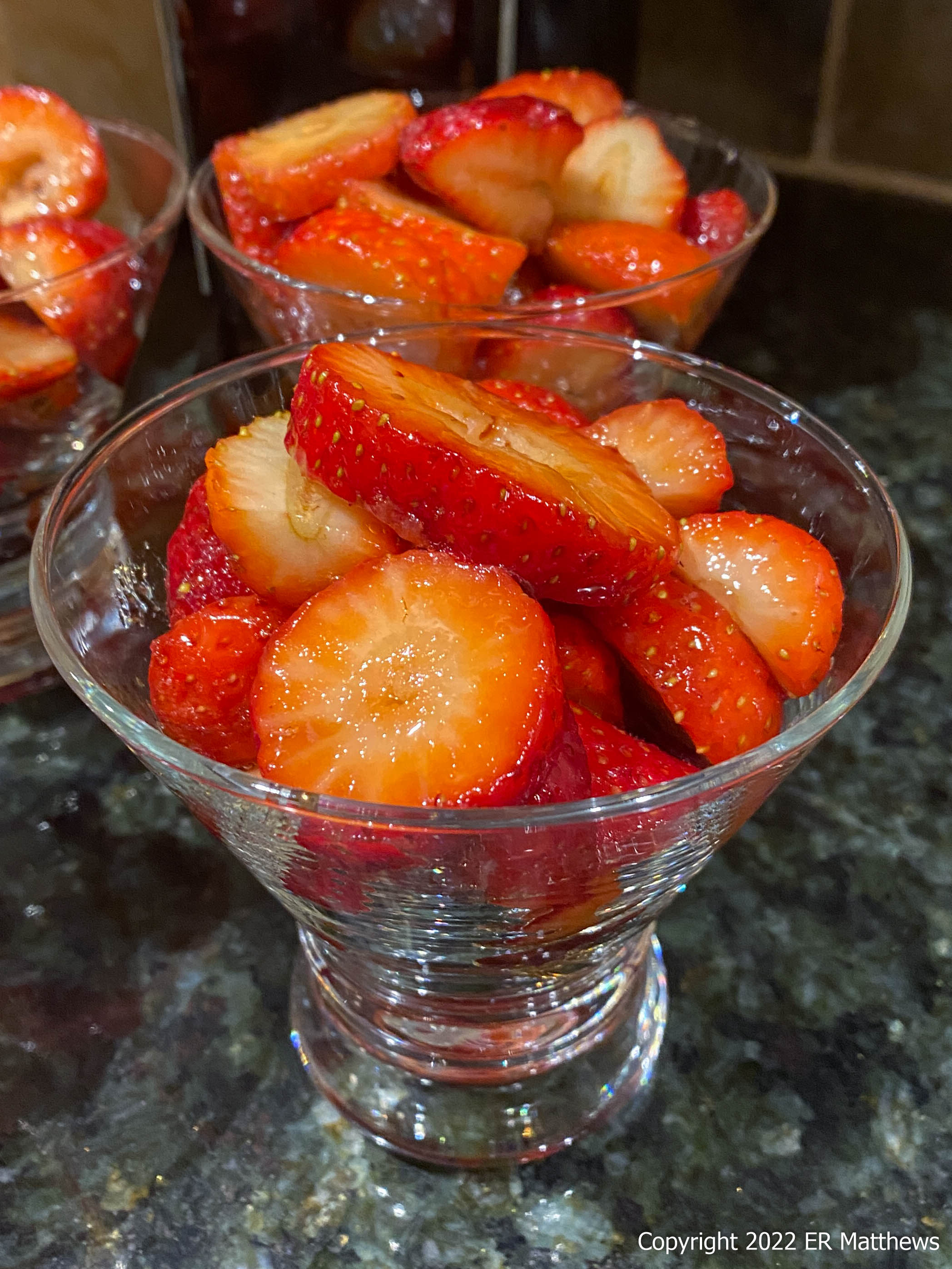
Dessert: Strawberries with Balsamic Vinegar


May 4th was the first day of the Bend Downtown Farmers Market and we were excited to visit it last week. It is still very early days for the market here on account of our weather, but at least some vendors are making the trek across the Cascades to bring us some fresh product from the Willamette Valley, such as these strawberries from the Woodburn area. They were neither super ripe nor super tasty as far as strawberries go, but they were better than nothing. Ann wanted them tossed with a little sugar and a splash of balsamic vinegar and so that's what we had.

Strawberries with Balsamic Vinegar
After several years of not cooking a nice meal for Mother's Day, it sure was nice to get back in the saddle again and to have good friends with whom to share the occasion.

Wednesday, May 11, 2022

Kitchen Basics: Garlic Confit

To get tender whole cloves of mild garlic to add to dishes, you can roast them, blanch them, deep fry them, and my favorite way: confit them. The French verb confire means to preserve. Originally, confiture meant fruit preserved by poaching slowly in sugar syrup. Over time and by extension, it has come to refer to meat and other non-fruit items preserved by gentle poaching in fat. The resulting confit is stored away from oxygen under fat and if it is cured with salt before being cooked, it will last a very long time without spoiling. Now of course, we all have refrigerators and we no longer confit meat to preserve it, but because we are in love with its flavor and texture.

Peeling Garlic
Garlic (rear pan) Under Olive Oil, Ready for the Oven
Garlic (rear pan) Confitted for Two Hours

I hate to even call this a recipe for garlic confit, because there really is no recipe. After peeling the garlic (the annoying, but necessary part), place it in an ovenproof container and cover it in fat. At the restaurant, we would have used duck fat from the very many ducks that we processed weekly. At home, however, I used olive oil, extra virgin at that. There is no need to use extra virgin olive oil for confit, but I wanted to be able to use the resulting garlic-flavored oil to season future dishes.

The idea is to poach slowly, so I set my oven at 250 degrees, very slow. Cook until the garlic is soft, but still holds together, about two hours.

Thursday, February 11, 2021

Pacific Rockfish with White Bean, Arugula, and Piquillo Salad

Pacific Rockfish is the fish that we eat most commonly, being widely available and relatively inexpensive. I use the term Pacific to distinguish it from what folks on the East Coast call Rockfish, the common named for the king of all American eating fish, the Striped Bass. Pacific Rockfish is not a species of rockfish but a placeholder for any fish of the genus Sebastes from our local waters; the State of Oregon lists 43 distinct species of Sebastes on its web site, from Aurora to Yellowtail. All the commercially fished ones are lumped under the label Rockfish at the market. As far as I can tell, there is precious little difference among them in terms of flavor and cooking.

We're kind of in a rut with our rockfish, mainly eating it in tacos, probably because we eat it so often, but also because as a small fish, it doesn't really lend itself to a lot of applications. Partly in response to the rut and partly in response to a couple of rare days of sunny January weather, I decided to do something different with it last week, given that I was able to purchase some decent 6-ounce filets (large as they typically go).

It's no surprise to anyone who has ever cooked with me that one of my go-to spices is Pimentón de la Vera, real Spanish smoked paprika. It has a haunting smokiness that when used sparingly complements a lot of dishes (but, inexperienced cooks beware, when overused becomes bitter, acrid, and overwhelming). I thought to roast the rockfish filets with a coating of pimentón garlic oil to add a hint of both flavors to the delicate fish without overwhelming it.

And because the weather was sunny for a change, I made a salad of cannellini, arugula, and sliced piquillo peppers to serve the fish on. The salad was dressed with a bit of salt and lemon juice.

Pacific Rockfish with White Bean, Arugula, and Piquillo Salad
Pimentón Garlic Oil
To make the pimentón- and garlic-flavored oil, heat a couple tablespoons of extra virgin olive oil over a medium flame with three minced cloves of garlic and cook until the garlic just starts to color. Turn off the flame and stir in a tiny amount of pimentón. I used what fit on the tip of my knife blade, perhaps a quarter of a teaspoon. Cooking pimentón in hot oil is to risk burning it, so add it dead last off the heat. And because it is so assertive, less is more.

Thursday, February 4, 2021

Pan-Fried Noodles with Vegetables

In recent weeks, we've taken to celebrating our collective weight loss (about 55 pounds now) on weigh-in days, every Monday, by having a bit of a splurge dinner. The long and short of it is that we allow ourselves a few simple carbs: all stick and no carrot is no fun. This week, it was noodles. We love noodles in any way: in soup as in ramen, wet with sauce such as in lo mein, dry fried as in chow mein, and of course, Italian-style as in spaghetti aglio e olio.

This week, I decided to serve a mound of stir-fried vegetables on a cake of pan-fried noodles, a quasi Hong Kong-style dish. Call it chow mein, pan-fried noodles, or yakisoba as you will. I call it a delicious way to eat a couple hundred calories of simple carbs while still eating a pile of vegetables.

Pan-Fried Noodles with Vegetables
Frying Noodles
It all started by making a stir fry of nappa cabbage, bean sprouts, shiitake mushrooms, snow peas, green onions, garlic, and lots of ginger, with a splash of soy sauce for salt. And while that was cooking, I steamed some wheat noodles briefly in the microwave to limber them up and put them in a large skillet to brown into a cake, flipping halfway through.

And that's it. The vegetable prep takes a while, but the cooking is done quickly. Given that I prepped the vegetables sporadically during the afternoon, dinner was on the table in under fifteen minutes, a win all the way around.

Wednesday, December 16, 2020

Shakshuka

It's cold, gray, and dreary here in Oregon during the shortest days of the year and only about 2 and a half months into our 8-month rainy season, there's no relief in sight. This drab weather has put me in the mood for warm, comforting, bright, and sunny food so I have planned to make shakshuka for dinner.

Shakshuka, a dish of eggs poached or baked directly in a tomato-based sauce, is common to North Africa and the Mediterranean. It's probably most commonly known as an Israeli breakfast dish, but the dish feels African to me, and I believe that it came to Israel when Jews from North Africa emigrated to Israel.

But who really knows. It is quite likely that eggs baked in tomatoes developed simultaneously in a lot of places, eggs and tomatoes both being inexpensive and common foods. Certainly the dish is also common on the northern side of the Med (think uova in purgatorio from Italy and oeufs à la provençale in France) and who among us in America has not feasted on huevos rancheros at our local Mexican restaurant?

No matter the dish's provenance, it is what I wanted to chase the dreary skies away and bring me back to summer for a few minutes.

Shakshuka: Baked Eggs
With shakshuka in mind, last week at the grocery store, I bought bright and cheerful yellow, orange, and red peppers, the best reminders of summer that I could find.

Garlic, Onions, Poblanos, and Colored Bell Peppers
Although the vegetables for shakshuka are traditionally chopped, I prefer to slice mine to give the resulting dish more texture.

Peppers and Onions Starting to Cook
In a deep sautoir, I heated enough olive oil to cover the bottom of the pan and then added all the sliced onions and peppers. Stirring frequently, I cooked the vegetables until they started to go limp. At this point, I added minced garlic, a little bit of cumin (not more than a teaspoon and a half for this large pan), and my secret spice, the barest hint of cinnamon. A touch of crushed red pepper flakes complete my spicing.

In a departure from many versions of shakshuka, mine is not a spicy dish in either of the senses: neither piquant from pepper nor containing a lot of spices. I've not found cinnamon to be a typical spice in other people's shakshuka, but for me, the barest pinch of ground cinnamon adds that mysterious hint of je ne sais quoi. It is at once subtly exotic, but wholly unrecognizable as cinnamon.

After Adding Tomatoes and Juice
To this large pan, after the vegetables became limp, I added a couple of large (28-ounce) cans of diced tomatoes in juice and I let it cook down for a good 45 minutes, wanting all the flavors to meld into a deliciously chunky sauce.

Eggs Ready to Cook
Once the sauce is thick and ready to eat, I season it and moderate the flame so that it just simmers. I make small wells in the sauce with a spoon and crack an egg into each hole. At this point, I will either place the pan into a moderate oven and bake uncovered or I will leave the pan on the stove top and cover it with a sheet tray. In both cases, I will serve the eggs with a copious amount of sauce once the egg whites have set.

Saturday, December 5, 2020

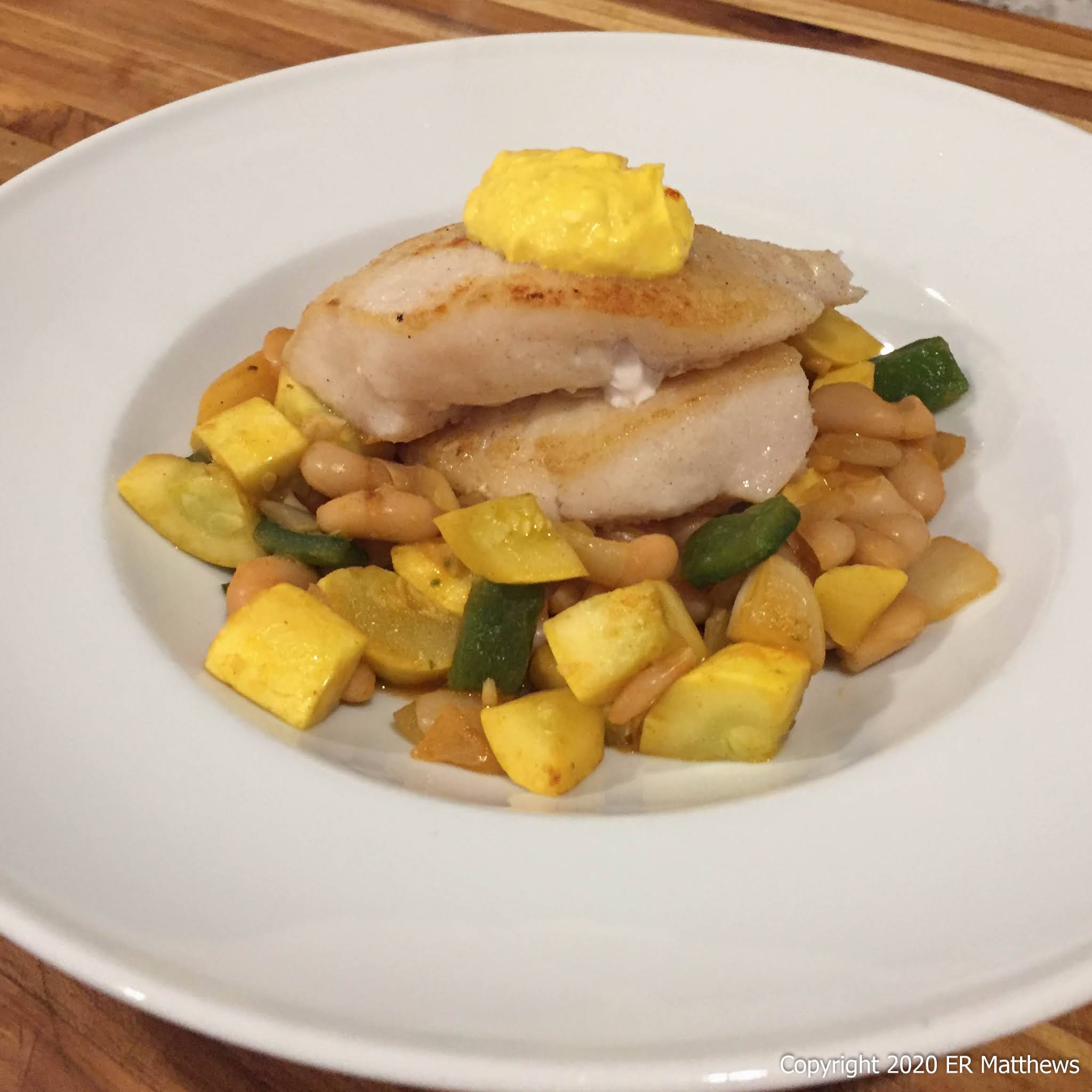
Pacific Cod with White Bean Sauté and Saffron Aioli

Every now and again, we need to have something just a touch bad in our diet and saffron aïoli fills that bill well. It's something that we used to serve with fish often at the restaurant, especially the baccalà cakes that we would make from cod that we salted ourselves. If you've ever seen the crap that passes for commercial baccalà in the US, you'd make your own too.

Pacific Cod with White Bean Sauté and Saffron Aïoli
We had bought a really nice looking piece of Pacific cod at the store and were looking for a quick dinner. I rummaged the refrigerator and found a poblano pepper and yellow summer squash, so I chopped those with an onion and some garlic and made a quick white bean sauté as base for the fish. The saffron aïoli is a garnish that blends well with both the fish and the white beans.

Garlic, Saffron, and Salt
When making aïoli, I always insist on using the mortar and pestle to achieve a very fine paste. It is impossible to use any other method to get the garlic so finely pounded, especially when making a tiny quantity of aïoli. In this case, I pounded half a clove of minced garlic, a few saffron threads, and a pinch of salt. The sharp edges of the salt crystals act as grist to help grind the garlic and saffron to a paste.

Be aware that garlic becomes extremely pungent when pounded to a paste. In other words, a little goes a long, long way. Take this friendly word of advice from a garlic fiend.

I have had this green granite mortar and pestle a very long time, since the early 1990s, before kids. I recall it being about $45 back then, imported directly from Thailand. A similar mortar will set you back about $90-100 now, but will last forever. Mine saw daily use in the restaurant for 15 years and except for one little flake off the edge, is as good as new. 

Granite is beastly heavy, but that is what you want in a mortar. You want it to sit still on the counter, not move around, and transmit the full force of the pestle strikes into the food being pounded. Notice that I sit mine on top of a towel to keep it stationary on the counters. In the restaurant, we would put it on a cutting board directly over one of the legs of a table or, more likely, sandwich unit so that the mortar would be well supported. If all the energy is going into a flexing table top, the mortar is going to be of little use.

Garlic-Saffron Paste
While traditional aïoli is made from egg yolks and olive oil, I long ago switched to using mayonnaise, for liability reasons. I did not want to make and serve a product based on raw eggs that was not going to be consumed immediately.

I added a tablespoon of mayo directly to the mortar, mixed everything well, and let the aïoli stand for an hour before serving. Saffron, in particular, takes time to color the mayonnaise. The saffron aïoli will look quite blond when you first make it, but will go the screaming brilliant saffron yellow that you see in the top photo given time.

I only made a tablespoon of aïoli because Ann and I are both fiends for it. We could eat it with a spoon! To avoid all temptation, I made just barely enough for dinner.

Ode to the Tortilla

I love tortillas. It wasn't always that way. I am a child of the early 1960s. Then, on the East Coast, our food was influenced by two th...