Showing posts with label gochujang. Show all posts

Saturday, May 6, 2023

Doenjang Noodles

Ann has been feeling her kitchen oats a bit recently, coming up with dishes that she wants to make. And I could not be happier. She's a wonderful cook and I love the break from having to come up with dinner all the time. Well, that's a bit of a lie just now. My foot is just healed and out of the cast and I am starting to walk gingerly and I'm itching to get back into the kitchen. Despite my jones to be back in the kitchen, I'm still happy to sit at the counter and watch Ann work.

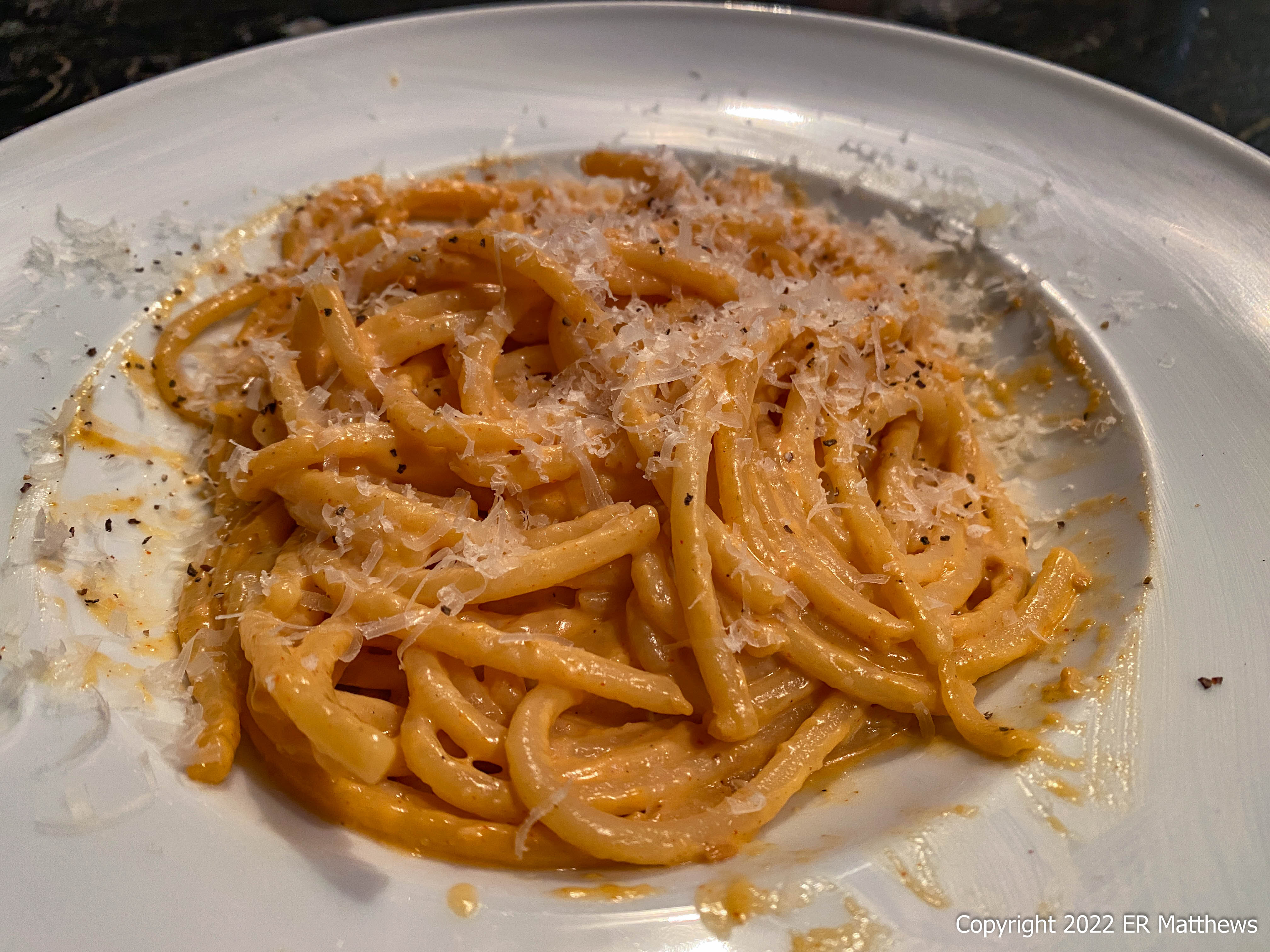
Doenjang-Gochujang Perciatelli
Last night being my first tentative foray into walking unassisted by crutches in almost three months, we decided to celebrate with a bottle of Champagne. As we were sitting on the sofa chatting over Champagne, Ann decided that she would make a dish for me that she has been planning for some weeks. The dish in question hails from the NY Times and is called quite unimaginatively Doenjang Noodles.

Doenjang Noodles is pretty much the recipe, too. The par-cooked noodles are finished in a sauce of a quarter cup of doenjang whisked into a pint of milk, end of story. The dish is garnished with a few grinds of black pepper and a grate or two of pecorino romano.

Measuring the Doenjang and Milk
While I believe that the idea of the NYT recipe was to be an umami-laden ersatz alfredo, we like a bit more flavor in our pasta. After tasting the pasta, Ann ended up doubling the inoffensive amount of doenjang in the original recipe along with adding a big glob of spicy gochujang. 

I Love This Woman!
What a really easy and tasty pasta for a quick meal!

Sunday, January 29, 2023

Gochujang-Roasted Carrots and Brussels Sprouts

I love gochujang, that somewhat spicy, funky, thick and sticky, fermented Korean paste of red chiles, glutinous rice, soy, and barley. Although many people would find gochujang highly spicy, in my world, it's pretty mild as spicy things go.

Gochujang-Roasted Carrots and Brussels Sprouts,
Ann: "Damn it! You're Trying to Get Me to Eat Vegetables!"
Back during the height of COVID sequestration, I started toying with the idea of gochujang and carrots, using those carrots as a base for a fish dish. Initially, I tossed the carrots in a gochujang-based sauce before roasting them, but in more recent iterations, I have taken to roasting the carrots first, then tossing them in the sauce after cooking, à la Buffalo wings. I prefer this method because I can roast the carrots just to doneness without having to worry about the sauce burning in the high heat of the oven.

Last night, in expanding on the theme I decided to do a strictly vegetarian dish of roasted carrots and brussels sprouts in gochujang sauce over rice. From the get-go, Ann was asking, "What protein are you going to serve that on?" She's not quite of the "if it's not meat, it's not a meal" ilk, but vegetarian is harder for her than for me. I could happily live on vegetables without any meat at all, but that would really test Ann's limits.

Gochujang Sauce
My new iteration of gochujang sauce shows some evolution from the original as well. Last night, I mixed a lot of gochujang with a little rice vinegar, some agave nectar to balance, a little soy for salt, a touch of sesame oil for complexity, and finely minced garlic. A couple of tablespoons of warm water helped make the sauce fluid enough. This would make a really tasty Buffalo wing sauce, come to think of it.

Monday, September 28, 2020

Coho Salmon with Gochujang-Roasted Carrots

I was lying wide awake in bed one early morning not too long ago when a dinner idea popped into my head pretty much out of nowhere. I had a lot of carrots in the refrigerator that I needed to use. The idea was to roast those carrots with the funky fermented Korean chile paste called gochujang.

I have been missing the bold, direct, and earthy flavors of Korean food a lot recently. Ordinarily, we could sate our cravings at any of the myriad Korean restaurants west of Portland in Beaverton. But with this pandemic, we're not going out to eat. Any Korean-inflected food that we eat, I am going to have to make myself.

Always prepared for such an eventuality, I keep a tub of gochujang in the refrigerator. It is a wonderful flavor builder. With the exception of the inherent sweetness from the glutinous rice powder that it contains, gochujang has an earthy funkiness that reminds me a bit of the sambals (fiery Thai bird chiles fermented in fish sauce) that we used to ferment at the restaurant for our own consumption. While the staff and select customers enjoyed these sauces, they were way too spicy to unleash on the general public. 

In the same vein, we used to make dozens of kinds of kimchee at the restaurant in addition to dozens of kinds of western pickles and sauerkraut. After fermenting on the counter in the pastry station, various batches of kimchee would go onto a specially reserved shelf in our walk-in refrigerator, to keep the health department at bay. Most pickles don't need to be refrigerated, but our health inspectors have been trained that any unrefrigerated food is bad. Anyway, the dozens and dozens of pickle containers on our pickle shelf was a site to see.

These pickles, our sambals, and gochujang all serve similar purposes in the kitchen. They are instant spicy umami bombs that naturally complement other flavors, especially sweet flavors such as carrots.

I was actually intrigued enough by the carrot idea at 3 am that I roused myself to write a note on my phone so that I would not forget it. Good thing too: the next morning I had no recollection of the idea until I saw the note I left for myself.

Seared Coho Salmon with Gochujang-Roasted Carrots
But roasted carrots do not a meal make. Taking inventory of the refrigerator the next morning, I found a half a pound of wild Coho salmon and some baby spinach. That was enough to make a complete dish: seared Coho on gochujang-roasted carrots, topped with the classic Korean spinach banchan called sigeumchi namul.

Toasting Sesame Seeds
I wanted to toast sesame seeds for both the spinach and the carrots. Lightly toasting them really brings out the flavor. You can see the color just starting to change in the photo above and the toasted color in the photo below. Toss sesame seeds in a dry pan over a high flame until they get to the color you want, them remove them from a pan to a cool container. If you leave the seeds in a hot pan, they will continue to cook beyond what you want.

Making the Sigeumchi Namul
"Recipes" for sigeumchi namul are as varied as there are cooks. I've made fancier versions and I've made plainer. So as not to detract from the salmon, I wanted to keep this version pretty straightforward.

I started by blanching half a pound of baby spinach leaves for just a few seconds. Once a batch of spinach came out of the hot water, I put it in ice water to fix the bright green color and stop the cooking while I finished all the batches of spinach.

After the spinach was fully chilled, I squeezed it dry. Then I dressed it right in the bowl with toasted sesame seeds, minced garlic, and a splash each of rice vinegar, sesame oil, and soy sauce. After mixing, I set the bowl in the refrigerator to await dinner.

Making the Gochujang Sauce
Before roasting the carrots, I wanted to coat them in gochujang, so I mixed up a couple big spoonfuls of gochujang, with a splash of sesame oil and a splash of soy sauce. It still wasn't quite liquid enough and I didn't want to add more oil, so I added a tablespoon or two of warm water to make the sauce flow.

Before roasting the carrots in the oven, I tossed them in this sauce, reserving the remainder of the sauce for later. Because of their tapered shape, carrots are difficult to roast: the slim root end cooks a lot faster than the chunkier leaf end. Stealing a technique from Chinese cooking, I roll cut a bunch of carrots into roughly equally sized pieces to even out the cooking.

Gochujang-Roasted Carrots

After about 20 minutes in a hot oven (425F), the carrots were tender, yet still firm, with nice caramelization along the edges. While still hot from the oven, I put them back into the leftover gochujang sauce and tossed them along with some toasted sesame seeds. Once I plated the carrots, I still had some gochujang sauce left in the bowl to drizzle over the fish for a plate garnish.

As good as the crispy-skin coho was, the carrots were the star of the show. The funky spicy sauce really contrasted with the sweet carrots and earthy sesame seeds in a delicious marriage of flavors. Gochujang-roasted carrots is definitely an idea I need to keep in mind for both Ann and I want more, fish or no fish.
Monday, December 8, 2014

A Day with Tom and Ann

Sunday afternoon was a beautiful if chilly day, a great day for the easy drive over to Tom and Ann's in Capon Bridge. Carter protested going over and over to the point where we had to threaten him with losing every privilege he has to get him to shut up. He sulked all the way over, but that silence was golden!

After we were effusively and hyperenthusiastially greeted by Levi, we spied that Tom had already opened four bottles of wine: a 2011 Sokol Blosser Pinot, a 2012 Owen Roe "The Kilmore" Pinot, a 2011 Hartford Court Old Vine Zin, and the star of the day, a 2010 Insignia. Insignia isn't generally my style of wine, but this one was delicious.

Wine Star of the Day
Neither of the Pinots really floated my boat, but the Owen Roe really bloomed when tasted with these bison meatballs with a gochujang-apricot glaze. Not only were the meatballs delicious in their own right, but the spice in the glaze and the ginger in the meatballs really made the Pinot sing. I have got to remember this for my own pairing dinners.

Bison Meatballs with Gochujang-Apricot Glaze: Culinary Star of the Day

Cornbread with Bacon

Cold Day, Hot Stew!
For dinner, Tom made a big pot of venison stew which he served with cornbread. That's a pretty good choice for a cold December day!

Venison Stew on Cornbread
After lunch, we adults watched "The Best Exotic Marigold Hotel" with a whole cast of our favorite actors, while the boys snoozed away the afternoon on the couch.

Levi and His Buddy Carter
Once again, thanks to Tom and Ann for their hospitality and kudos to Tom for another wonderful meal.

Tuesday, February 5, 2013

Haddock, Sichuan Style

When I spoke to Ann early yesterday morning, she wanted something for dinner last night but just couldn't put her finger on it. So she went back to this blog and looked at what we were doing at this time last year. When she came across the Sichuan-style catfish from February of last year, she knew what she was in the mood for.

At the market, I couldn't find a catfish, but I did find some reasonable looking haddock filets. Haddock is mild and white and pretty forgettable: it would be a fine foil for the super tasty Sichuan sauce I was about to put on it. I wouldn't dare put this complex and spicy sauce on a really good piece of fish.

Mise en Place
Each time I make this dish, I do it differently, based on how I am feeling and what I have available. Isn't that how most people cook? Once you learn the theme of a recipe, each time you make a dish after that it is all about subtle variation. Where I would typically use dried black and tree-ear mushrooms, this time I had fresh shiitake on hand. And I happened to want five spice-flavored and pressed tofu instead of plain tofu. The recipe theme is the same, but the slight variations make the particular instance of the dish.

The ingredients clockwise from the little red bowl of ground Sichuan peppercorns: five spice-flavored pressed tofu, bamboo shoots in chile oil, dobanjang (more about which in a minute), garlic, cilantro, green onions, shiitake, zha cai mustard stems, doenjang bean paste, and ginger.

The market I shop at is run by Koreans and so their selection of Korean foods is really good; their Chinese less so. But fortunately, there are a lot of ingredients in common. Take the dobanjang for example, the bright red fermented fava bean and chile paste in the small jar to the extreme left of the photo. It is also known in China as doubanjiang and is the heart and soul of Sichuan sauces. The same sauce made with soybeans instead of favas is known as gochujang and it is very different to tell the two apart. I mention this because the tiny jar of dobanjang you see above cost an exhorbitant $8. You can make your own gochujang facsimile by mixing chile paste with doenjang, the bean paste that you see on the right of the photo, for next to nothing. Although the flavor isn't quite the same, with all the chile spice going on, it is very difficult to tell them apart in a finished dish.

Haddock, Sichuan Style

To pull this dish off, I first rubbed one side of the fish in a touch of sesame oil and then sprinkled the filets with finely minced garlic, finely minced cilantro stems, freshly ground Sichuan peppercorns, and a little corn starch. After they were browned on the corn starch side, I flipped them and removed them to the casserole dish. Then I built the sauce by cooking the mushrooms, tofu, ginger, garlic, bamboo shoots, and mustard stems over high heat. To this I added a bit of dobanjang and a lot of doenjang bean paste along with enough water to just make a sauce. After this cooked for a minute, I poured it over the fish and put the whole thing in the oven for about 4 minutes, until the fish just cooked through. Just before serving it got a topping of green onions and cilantro leaves.

Just delicious served with plain rice!

Ode to the Tortilla

I love tortillas. It wasn't always that way. I am a child of the early 1960s. Then, on the East Coast, our food was influenced by two th...