Showing posts with label aioli. Show all posts

Thursday, January 1, 2026

New Year's Eve: Latke Board

New Year's Eve 2025 is right at the top of my list of most memorable year-end celebrations. And for all the wrong reasons. Somehow, I picked up a nasty case of food poisoning, and by the time that midnight rolled around, I had all the classic symptoms.

The cautious drive home down the slippery butte in the icy and misting rain-fog-snow mess was excruciating as I fought back wave after wave of gut wrenching nausea. I finally got to sleep around 0300 and when I awoke the next morning, I had strained the ribs on my right side. Fun times.

I should have known something was up earlier; I did not even feel like taking photos which is uncharacteristic.

Small Potato Latkes for NYE Caviar
We made plans with Rob and Dyce to have caviar and Champagne at their house to ring in the new year. All of us really like caviar and I happen to like latkes with my caviar, although the more I think about it, really great potato chips are fantastic and so much easier. In any case, a couple years ago, I came up with an idea for New Year's along the lines of a charcuterie board: a latke board. I had never heard of or seen anyone doing any such thing, but when I typed the phrase into my handy dandy search engine, up popped thousands of photos of people who beat me to the punch.

This reminds me that there is little truly original thought in cooking; dishes are built from a long lineage of precursors. Long ago in my restaurant days, a line cook from another restaurant angrily confronted me outside my restaurant, accusing me of stealing a dish from the menu at his restaurant. As busy as I was, I did not have the time or the energy to look at another restaurant's menu, let alone steal a dish.

I believe that it might have been some kind of beet and goat cheese salad. Because people have been putting beets and goat cheese as long as there have been beets and goat cheese, I am certain that it was not original to either the young cook's restaurant or mine. It was on thousands of menus long before our two.

In any case, my latke board idea reminds me that two people can come up with the same idea independently. My idea was to make several different kinds of latkes, a few pickles, and a few spreads, all of which would work with caviar.

Shallot Pickles and Cucumber Pickles Curing
My Latke Board
Potato, Celery Root, and Sweet Potato Latkes
Cucumber, Shallot, and Cornichon Pickles
Smoked Trout Mousse, Saffron Aïoli, Horseradish-Dill Sour Cream
Smoked Salmon and Caper Mousse
If you can name a root vegetable, I have made latkes from it, and likely fries and chips, or for you Brits, chips and crisps. Of the three vegetables that I picked for this latke board, potatoes will always be the best, but celery root latkes are equally phenomenal. The little sugar in sweet potato latkes is interesting, but makes the latkes want to stick to the pan and want to burn before they are done. Reducing the heat is necessary for making sweet potato latkes.

Latkes with smoked trout mousse was a regular feature of the lunch menu at the restaurant for many years, probably a decade. Ultimately, I believe it was a series of fad diets that did them in. For many years, the ladies who lunch would not order anything fried, no matter how tasty. In any case, apparently I had a reputation for making latkes, as the following cute "diploma" will attest. My oldest daughter, then but a tiny girl, awarded me a "specialty in making potato pancakes." How cute is this!?!

Chef's Diploma with
Specialty in Making Potato Pancakes
For caviar for the restaurant, I always bought from Browne Trading Company in Maine. I still buy from them, but the retail prices are a shock after paying wholesale for decades. Rob bought caviar from a company that is new to me, OM. Their ossetra and Browne's Siberian Supreme malossol were the best of the bunch.

We All Bought Caviar
Potato Chips, Best Vehicle for Caviar

Being the designated driver, I could only but sip a little of the delicious Champagne on offer at Rob and Dyce's. I managed to photograph the two that we bought so that I could remember them. The Gonet-Médeville is a lovely blanc de noirs. The André Clouet "Chalky" looks pretty gimmicky in its white wrap, but it is a fine 100% Chardonnay blanc de blancs. I like it, but I like many others better.

Here's hoping that 2026 proves better than New Year's Eve's inauspicious start.

Wednesday, May 21, 2025

A Southwest Dinner

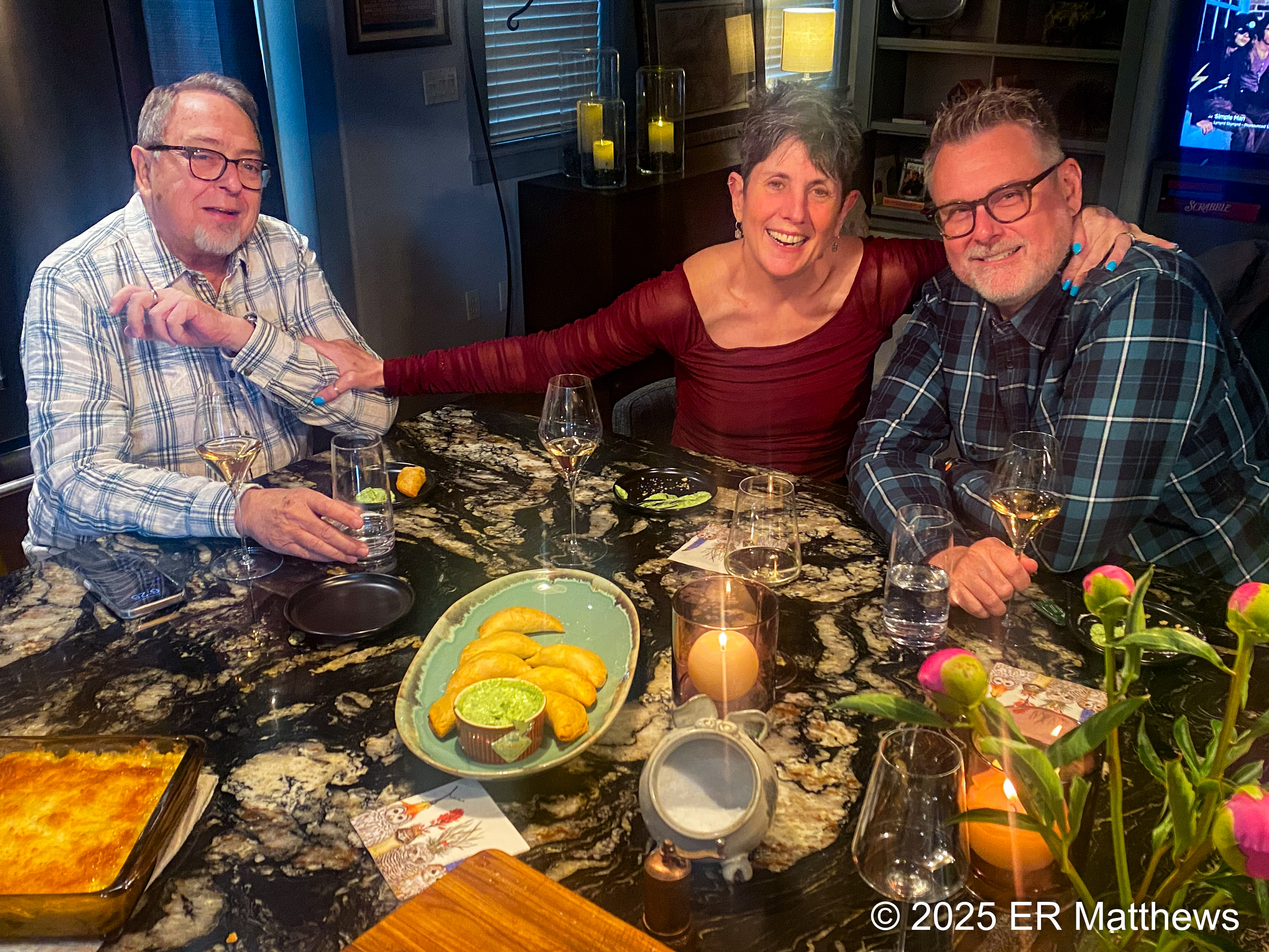
We're getting close to the summer travel season when we are going to be on the road somewhat often. Before we leave for Virginia for my daughter Ellie's wedding, we wanted to have Rob and Dyce over for a casual dinner.

Rob and Dyce Brought the Most Gorgeous Peonies
I really am trying to avoid dinners with lots of last minute cooking so that I can relax and focus on guests. That shifts meals towards braises and dishes without touchy timing. Ann had kindly suggested all manner of dishes, but nothing grabbed me.

Unclear on what to make and rooting through the freezer, I found a bag of cleaned and cubed pork shoulder from a foray to Costco. Their shoulders come in two packs and that's a ton of meat. I typically break down both shoulders into cubes for braises like carnitas and freeze what I don't need right away.

Knowing that Rob and Dyce are fond of New Mexican food had me thinking along those lines and so I decided to make chile verde. After pondering for a few days, I decided to make a posole casserole to accompany the pork, and to offer empanadas for an appetizer. After a week of beautiful weather, it cooled off again and the choice of heartier food seemed lucky and apropos.

Then I remembered the heirloom masa harina that Ann gave me for my birthday and I decided to make tortillas to accompany the meal. And so the menu was set with the only last minute task to cook the tortillas. Somehow in the course of moving, my tortilla press did not make it to this house and so I improvised using a cast iron pan and a cut open Ziploc bag.

Empanadas de Picadillo Dulce, Cilantro Aïoli
Empanadas I make with an egg-enriched pie crust that never fails to bake up flaky and golden brown especially when brushed with an egg wash. Habitually, I fill empanadas most often with picadillo dulce, a sweet and sour pork that I first learned about by reading old Spanish-language recipes in the Biblioteca Nacional de México.

The filling is clearly of Moorish origin, containing almonds, olives, and sometimes raisins, though I have made it my own through the years. This version was ground pork shoulder, almonds, olives, onion, poblano chile, garlic, Mexican oregano, and three types of dried red chile (the majority ancho). I made it sweet and sour with brown sugar and Sherry vinegar. I have outlined the process in a previous post.

Masa Balls for Tortillas
Ghetto Tortilla Press: My 1930's Griswold Skillet
Tortillas on the Table
Chile Verde, Posole-Chipotle Casserole, Tortillas
Chile verde is not a recipe but an idea. At essence, it is cubes of pork braised in a salsa verde. There are as many ways to make it as there are cooks and they are all wonderful. I am certain that I make it differently each time and this time, I used the slow cooker to free our single oven to use in baking the posole.

For chile verde, there are two essential steps. First, make a salsa verde and second, brown the meat and braise it in the salsa.

For salsa verde, I roasted at high temperature (say 400F) a sheet tray of poblano peppers, Anaheim peppers, onions, garlic, and tomatillos. I rotated the chiles as each side became blistered. Once done, I pulled the tray out and covered it in film so that the veg could steam until cool and loosen the pepper skins.

Next up, I skinned and cleaned the peppers, dicing and reserving three or four Anaheims for the posole casserole. The peppers, garlic, tomatillos, onion, and a bunch of fresh cilantro went into the food processor. I blended it until roughly smooth and put it in the slow cooker.

For the pork, in recent years, I have adopted a process by which I only brown one surface of the cubes. This provides great flavor while not drying out the pork. After browning all the pork and putting it in the food processor, I deglazed the pan with a splash of water and poured all the porky goodness into the slow cooker with the pork and salsa. Eight hours later, the pork was tender and the sauce reduced to just the right thickness.

The posole casserole, something I started making in my 20s as a broke graduate student, I assembled in the afternoon and put into at 350F oven about 90 minutes before we were ready to eat. Timing is not critical, a delightfully brown crust is.

I admit that I did not make my own posole, though I could. I bought two 28-ounce cans of commercial hominy, the same Teasdale brand that I used in the restaurant. One can each of yellow and white hominy went into a mixing bowl with the reserved chopped green chiles, half a bunch of sliced green onions, and the kernels of one ear of fresh sweet corn for contrast and variation on the corn theme. Purple hominy (maíz morado) would have been cool, but my store had none.

I bound the casserole with a chipotle béchamel: olive oil and a spoon of flour cooked for a minute, then a pinch of salt and one finely chopped chipotle in adobo. After mixing the hominy and sauce, I adjusted the salt and put it into an oiled baking dish and topped it with a little grated white cheese. The result is as delicious as it is simple.

Making tortillas with modern masa harina is a trivial process of mixing the corn flour with enough water to make a workable dough. Then you roll it into balls and smash the balls between sheets of plastic (or a cut open Ziploc freezer bag in my case) in a tortilla press (or beneath a cast iron skillet in my case). We restaurant chefs are used to adapting and overcoming: no tortilla press, no problem. I can even patty them by hand, old school.

After peeling the masa circle off the plastic, it goes into a hot, dry frying pan on low to medium heat. Cooking both sides takes less than a minute and if I had a flat-top, I could have cooked them all at once rather than one at a time. Naturally, I could have fired four pans on the stove and cooked four at a time, but no matter. We were all busy yakking while I was pressing and cooking tortillas.

It should be axiomatic that a tortilla is only as good as the masa from which it is made. And if you use shitty Maseca or Masa Brosa, you are going to get a shitty tortilla. My masa is from Masienda and is processed from heirloom corn varieties grown on small farms in Mexico. It is expensive relative to the big brands (but even so, tortillas cost cents), but it helps sustain small farmers and preserve heirloom corn varieties.

Friday, May 16, 2025

Mother's Day 2025

"Ann is a nosy sort." he said lovingly. She really cannot help herself; her penchant for prying is deeply encoded in her DNA. She will not take polite hints to mind her own business, either. Thus, it is nearly impossible to surprise her.

Quixotic fool that I am, I set out to do just that for Mother's Day, a day which, for reasons that need not be discussed here, has been an emotional day in the past. I figured she could use some friends to help her celebrate and so I invited Rob and Dyce to come over on Sunday afternoon.

Mother's Day Brunch
Hoping for beautiful weather as we had been having for a week, I came up with a menu of light eats to be enjoyed on the patio with crisp white wine. Naturally, the weather did not cooperate and we ended up eating inside at the island. Quoting Stevie Winwood, "You just roll with it, baby!"

I am kicking myself now for not having taken any pictures of Rob and Dyce. I was too caught up in talking and pouring Champagne around. They brought the most beautiful flowers for Ann. And did a wonderful job of acting all week as if nothing were happening on the weekend.

Rob and Dyce Brought This Exquisite Arrangement
The Surprised Guest of Honor
Ann, true to form, did her best to ruin the surprise. The three of us guys put the plan together a week in advance. Shortly thereafter, Ann asked me to take her to the local wine bar and out for brunch somewhere. I confessed my plan for a special brunch at home. Her immediate response was, "Can we invite Rob and Dyce?" At this point, I had to lie, saying that I preferred to have a more intimate tête-à-tête chez nous.

Sunday afternoon, while Ann was watching TV upstairs, I excused myself to go downstairs to prep brunch. Just as I had plated everything, the doorbell rang and Ann was surprised. She was even a good sport about not being dressed or having her game face on!

Camarones in Escabeche with Cilantro Aïoli
Crab Guacamole
Dungeness Crab Mixed with Cilantro-Lime Vinaigrette
Jalapeño Quesadillas with Chipotle Crema

Wednesday, January 22, 2025

Polenta with Mushroom Ragoût

It's been a quiet few weeks at home since we got back from Santa Fe in early December, weeks in which we have uncharacteristically not done any entertaining. At long last, we had Andreas and Michelle, newly engaged, over for dinner. Ann asked me to make polenta with mushroom ragoût and then suggested a Caesar salad served on a romaine leaf to go with the polenta. I decided to roast some olives for a simple appetizer.

Roasted Olives


Roasted olives may be the easiest thing in the world to make. Fundamentally, you toss olives with herbs, spices, garlic, and olive oil and roast them for a few minutes in the oven.

Olives, Ready to Roast
I mixed several kinds of olives from various sources with minced garlic, fresh rosemary leaves, tangerine peels, red pepper flakes, dried oregano, fennel pollen, and a splash of olive oil. They sat on the counter for a couple of hours before I put them in a moderate oven and roasted them for 15-20 minutes or so.

"Caesar Salad"


Caesar salad has been done over and over and over and I wanted to do something different, while still adhering to Ann's vision of a salad served on a romaine leaf. In my reimagining, I would use a lemon-anchovy aïoli both as the base of a dressing and as a garnish. And I would add the bulk of the cheese to the salad in the form of a pecorino romano crisp. Finally, Ann wanted croutons, but Michelle cannot eat gluten. I wrestled with fried polenta cubes before deciding to go with chestnuts spiced with oregano, garlic, salt, and a touch of pimentόn. 


Starting the Aïoli: Anchovies, Garlic, and Peppercorns in Mortar
After pounding two cloves of garlic, three anchovy fillets, and four black peppercorns to a smooth paste, I mixed this base with a cup of commercial mayonnaise and the zest of one lemon. I put it into the refrigerator to bloom and marry the flavors for several hours. I used commercial mayonnaise because I only wanted a final yield of one cup of aïoli. I find it much easier to make mayonnaise in quart quantities, and I just did not want that much product in the refrigerator.

Next I grated a big bowl of pecorino romano, most of which I formed into long pecorino crisps on a silicone mat on a sheet tray. The rest, I reserved to mix into the salad.

For the chestnuts, I spiced them like I would croutons, by melting a little butter in a pan and cooking the freeze-dried chestnuts for a minute, then tossing them with a mix of salt, granulated garlic, dried oregano, and a pinch of pimentón.

I have these freeze-dried chestnuts thanks to my friends Yael and Dan back in Virginia. They grow truffles in an orchard that they planted in front of their house. Hazelnuts and chestnuts are the happy side-effect of growing truffles. I have been working with the chestnuts to find good uses for them and this is a very natural and delicious use. These spiced nuts are an addictive snack, not to mention a great way to add crunch to a salad.

To make the salad dressing, to a half a cup of aïoli, I whisked in the juice of a lemon and an equal amount of olive oil. Then I thinned the dressing to my desired consistency with cool water, an amount probably equal to the lemon juice and olive oil. I re-seasoned with a tiny pinch more of coarse ground black pepper. The remaining oli went on the plate to anchor the pecorino crisp in place so that the salads could go to the table with mishap. 

"Caesar Salad" with Pecorino Crisp, Anchovies, and Spiced Chestnuts
I greatly prefer this salad to any other Caesar-type salad that I have ever had. It seemed to be a great hit with everyone.

Polenta with  Mushroom Ragoût


The star of the dinner was polenta topped with a sexy ragoût of mushrooms and an even sexier poached egg. The poached egg was my addition to Ann's idea. The yolk just adds extra creaminess to the dish. I also flavored the polenta with a big sprig of rosemary as it was cooking for about an hour (my corn was fairly coarsely ground).

Rosemary Polenta, Mushroom Ragoût, Grated Pecorino, Poached Egg, Green Onions
I cooked the polenta at least 90 minutes in advance and held it warm, ready to finish at service, using a trick from the restaurant. Once the polenta had cooked, I laid a piece of film wrap directly on the surface of polenta and forced all the air out from under the film. In this way, the polenta stays warmer and does not form a skin on the surface. Then at service, I swirled in a bit of butter and cream and stirred it rapidly while bringing it right back up to temperature.

And now some food porn pictures from the mushroom ragoût, made by sweating a couple of leeks in butter with a bunch of fresh thyme, then adding the fresh mushrooms and cooking, then adding the reconstituted porcini and its rehydrating liquid, all to be cooked down to a nice ragoût.

Rehydrating Porcini
The Water From This is Liquid Gold, an Umami Bomb
Paper Sack of Chanterelles, Oysters, and Shiitakes
Prepped Mushrooms Ready to Cook
It felt good to get back in the kitchen and cook something other than our standard low-fat, complex carb-laden nightly fare. It feels good every now and again to splurge a bit at the table. And I think I came up with a winner of a salad technique.

Everyone had a good time and we put a hurt on a few bottles of Langhe Nebbiolo.

Friday, September 1, 2023

Seafood Supper

Without a doubt, seafood is one of our favorite food groups and last night I made a couple of seafood dishes that I'd like to remember, hence this post. Sadly, I have cooked so many dishes in my life and professional career that I have forgotten more than I remember. Seafood features much less frequently in our diet than we would like, because despite being only 3-1/2 hours from the coast, good seafood is really hard to come by out here in the high desert. Believe it or not, our best source of seafood is often Costco. That's kind of hard to admit for a chef who used to buy directly from the boats, but it's true if a little sad.

John and Heidi came over for dinner last night and we all gathered around the kitchen island to eat. We had really hoped to at least have appetizers if not dinner out in the courtyard around the firepit. But wouldn't you know that it rained, albeit lightly, for the first time since spring? And after some really warm and smoky summer days of late, there was a marked chill in the air and way more humidity than we are accustomed to. Is fall here already on the last day of August? For goodness sake, it just finished snowing on the 19th of June!

Goat Cheese Crostini with Pink Shrimp and Fennel Pollen
Summer here in Oregon is pink shrimp season. Though these tiny shrimp are harvested in the ocean close to shore, they are often called Bay Shrimp. They are netted, then cooked and peeled and are available pretty reliably through the summer. I have been trying to find ways to work with them, an opportunity that I have not had before this summer. Last time, I made them into delicious shrimp cakes. This time, I made them into a quick salad to sit atop crostini.

The crostini are topped with a schmear of softened goat cheese and pink shrimp seasoned with a really great olive oil, lemon zest, salt, and fennel pollen. After I put these delicious appetizers together, I drizzled them with more olive oil, salt, and fennel pollen, then topped each with a fennel frond.

Roasted Steelhead Trout on Fines Herbes Israeli Couscous
I really love the marriage of fish with fines herbes, so I put the two of them together in this dish. Fines herbes is an herb mix used in classic French cooking with seafood, poultry, and other very light proteins. The canonical mix is parsley, chives, tarragon, and chervil, but I use whatever I happen to have on hand. This time the herbs would be Italian parsley, tarragon, and dill. Why is chervil so hard to find? I used it quite a bit at the restaurant, but I had to grow my own.

I boiled the couscous to almost done, then drained and mixed it with a steelhead cream sauce to finish cooking. Just as the pasta was finishing, I added sugar snaps (mange-touts) cut into one centimeter lengths, a big mound of finely chopped herbs, and a quick grating of pecorino romano. The steelhead cream sauce I made by cooking two minced shallots in butter, then adding a quarter cup of brined capers and roughly a quarter pound of diced steelhead trim leftover from portioning the fish. After the fish cooked a bit, I added a pint of cream and let it reduce by half. I made the sauce ahead and rewarmed it before adding to the couscous.

After roasting the fish, each portion went onto a bed of the couscous (which intentionally mimics the look and feel of risotto) and I topped each with a dollop of saffron aïoli and a dill sprig.

Friday, August 25, 2023

Morocco via Marseilles

It's not a big secret that I love the food of North Africa; at the restaurant, my tasting menus often included dishes from or in homage to Tunisia, Algeria, and Morocco. I find the use of spices fascinating and second only in the world to Indian cooking, another love of mine. North African cuisine also relies heavily on my favorite style of cooking, the braise, in the form of its ubiquitous tagines. Tagines are stews, essentially, cooked in the flat earthenware dish with the conical lid which gave its name to the dish.

Ann and Michelle
And I am a big student and lover of French provincial cooking, the more rustic dishes of the countryside versus the haute cuisine of Paris and the Michelin-starred restaurants. Provence, as a region, really excites my palate with its broadly Mediterranean cuisine, a far cry from the more pan-European cuisine of Paris and the north. I have fond memories of eating exciting and for me at the time, novel, dishes in Aix, Nice, Cassis, and Marseille.

What do these two regions on opposite sides of the bright sunny blue Mediterranean have to do with each other? A lot, as it turns out. People and their food have been coming and going across the water from continent to continent for millennia. And as people and cultures have mixed, each side of the sea has influenced the other in innumerable ways. The second language of the North African nations is French and the second cuisine of the south of France is North African, interpreted through the French lens. Highly spiced tajines, for example, are widespread along the Mediterranean coast of France.

I am always truly fascinated how distinct cuisines meet across political boundaries to inform each other. Think of Tex-Mex or the Polish influence in Pittsburgh and the Rust Belt. The mixing of African and French cooking to form une cuisine afro-française delights me.

We had new friends Andreas and Michelle over for dinner last evening and in the process of brainstorming the menu, Ann was pushing in the Moroccan direction. This naturally had me thinking of a tajine. And then I remembered a subtly spiced chicken tajine that I had once in Provence spiced merely with cumin, garlic, and olives. I would make a version of this tajine but naturally, I would make it my own, adding both saffron and preserved lemons to the dish in my food memory for a subtle, yet complex dish.

What to serve with a tajine? Well, naturally, one would make a very plain couscous to soak up all the delicious braising juices. But a dietary restriction precluded any gluten in the dinner. Ann suggested (she's very good at helping me to focus in my menu-making) panisse, the delightful chickpea French fry replacements from Marseille, the major French port on the Med. Why not panisse? It and other chickpea flour dishes (such as socca from Nice) are so common to Provence though they are likely to originate from another close neighbor, Italy.

That left one more dish for the menu, a side salad. Chopped tomato salads are common across the entire Mediterranean from North Africa to the Levant and back through Turkey, Greece, Croatia, Slovenia, Italy, and France. Everyone has a simple salad of chopped tomatoes simply dressed. I thought to make a Moroccan version spiced with cumin until a sachet of fennel pollen arrived in the mail the afternoon of our dinner. Fennel pollen would make a tremendous substitute for cumin. And with that, the menu was largely set: panisses, tomato salad, and chicken and olive tajine.

Any time we have people over for dinner for the first time, I like to set a menu of dishes that I can execute in advance so that I can spend my time socializing rather than cooking. We save guest participation dinners for those who like to cook for future gatherings. However, Ann conveyed to me that Andreas was really into cooking or at least seeing some cooking, to pick the mind of a chef, and so Ann and I did minimal prep beforehand and left much of the actual cooking for after Andreas and Michelle arrived.

Cooking Chickpea Flour for Panisses
Bartender Annie Pre-Mixing a Batch of  Cocktails
About a week before the dinner, I started the process of preserving a lemon, cutting it into lengthwise quarters, coating it in salt mixed with a touch of cinnamon and thyme, and covering the whole with some kalamata olive brine (rather than lemon juice). I used to keep big batches of preserved lemons in the refrigerator, but they take up too much space, so now I just make them to order. They will cure fairly well in a week on the counter, but two weeks is better.

As an aside, we used to make preserved lemons (and dozens of other pickles) in huge containers at the restaurant and pray that the health inspector would not come in during the two-week period that we left them on the counter before refrigerating them. Health inspectors are notoriously bad at overlooking food items that are traditionally not refrigerated: butter, eggs, cured hams, cheeses, and all manner of pickles including sauerkraut and preserved lemons.

Also, I made a batch of harissa, the super spicy chile and spice paste that is ever so common in North Africa, especially Tunisia. I did not know when I made the batch what I would use it for other than as a condiment to accompany the tajine. I have made my own harissa for so long now that I can barely remember the process of reading through recipes for it and trying a bunch of commercial versions to come up with my own version.

One thing I don't like in a lot of commercial versions is a dependence on tomatoes or tomato paste in the sauce. If it's supposed to be a chile sauce, why use tomato as a filler? And so my version came over time to be a mixture of crushed red ripe jalapeños (easily available in the US), smoked paprika, spicy Hungarian paprika, garlic, lemon juice, olive oil, a pinch of cinnamon, and spices. For my spices, I add texture to the sauce by leaving half of the spices whole. My spices include roughly equal parts of fennel, caraway, and cumin. The whole spices soften after about a week while all the flavors marry in the refrigerator. In my not so humble opinion, my harissa beats any that I have ever tasted.

Later in the week when talking with Ann about the menu, she clarified for me that her idea was to serve the panisse as a first course rather than as a couscous replacement with the main course. I loved that and immediately thought that we needed a dipping sauce for the crunchy sticks of cooked chickpea flour. Out of seemingly nowhere, the idea of harissa aïoli jumped into my mind and so the sauce issue and how I would use the harissa were settled.

Early yesterday morning, I ground a bunch of cumin and chopped a lot of garlic which I mixed with olive oil to make a paste. I then rubbed this paste into a batch of chicken thighs and put them in the refrigerator to marinate all day until needed at dinner time. Next, I pounded out a couple of cloves of garlic into a paste in my big green granite mortar and made a batch of plain aïoli that I flavored with a bunch of harissa to give a spicy sauce the color of Russian dressing.

After that, I made a batch of batter for the panisses by whisking water, salt, and olive oil into chickpea flour, bringing it a boil while stirring, then cooking over low heat while stirring constantly for ten minutes. Finally, I would spread the super thick batter into a greased dish to cool to room temperature on the counter. My basic recipe is roughly 250g of chickpea flour to a liter of water with a teaspoon of Kosher salt and a drizzle of olive oil. This is the perfect amount to put into a 9"x9" brownie pan.

In the afternoon, Ann mixed up a bunch of her Oaxacan Old Fashioneds (reposado tequila, mezcal, bitters, and agave nectar). She also rimmed four coupes with smoked salt, meaning that all she had to do when Andreas and Michelle arrived was to chill the drinks and strain into the cups. 

Panisse with Harissa Aïoli
When our guests arrived, I fired two frying pans on the cooktop, one for browning the chicken and one for frying the panisse. While the first batch of chicken was browning, I flipped the panisse cake onto my cutting board and cut it into fingers which Andreas and I fried in olive oil to crispy goodness.

While everyone was enjoying dipping these crunchy fingers into the spicy aïoli, I drained the excess oil from the chicken pan and added diced onion, preserved lemon, and saffron. The onions cooked until translucent at which point I added both green and black olives, both pitted, and moistened the mixture with a bit of chicken stock. Once the sauce was boiling rapidly, I poured it over the chicken which went into a 400F oven, covered, until the chicken was tender, about an hour.

Star of the Show: Tomato Salad
Between sips of wine and while the chicken was cooking, I made a quick tomato salad. It is so hard to get decent tomatoes in this part of Oregon, so I rely on grape tomatoes year round. They aren't awesome, but they aren't bad either. After splitting the tomatoes in half, I minced a quarter of a red onion and a big handful of Italian parsley from the farmers market. These I mixed into the salad with the juice of a lemon, some olive oil, salt, black pepper, and a big sprinkle of fennel pollen.

Fennel pollen is something that I used to use frequently at the restaurant, mainly by sprinkling it over a finished dish. There is something special about a big piece of roasted Striped Bass garnished with a slug of great olive oil, a grating of lemon zest, a sprinkle of coarse salt, and a sprinkle of fennel pollen.

Fennel pollen is exactly what it sounds, the dried pollen from fennel plants created by harvesting fennel blooms, letting them dry, and then shaking them to release the pollen. Fennel pollen is wickedly expensive but its unique and inimitable flavor makes it so worth the price. And a very little goes a long way as it is extremely flavorful. At first taste, the flavor is clearly of fennel, like fennel seed. But unlike fennel seed, the flavor is stronger, deeper, richer and finishes with a delightful fruitiness. Get you some today and play with it. You are guaranteed to fall in love with it as much as Ann and I have.

I had not set out to create a salad that would upstage every other thing that we ate or drank, but that was the happy result of substituting fennel pollen for cumin. Everyone was blown away by this simple salad. I will never forget it. The combination of fennel pollen and tomatoes yields a result that is far, far greater than the sum of the two parts. Happy, happy belly!

Chicken and Olive Tagine
Once the chicken was tender, I pulled it out of the oven and placed it on the stovetop where I boiled it rapidly to evaporate and concentrate the braising liquid. The result as you see in the photo above was as delicious as it was simple. To recap, the chicken was marinated in cumin and garlic, browned, and mixed with onions cooked in olive oil with saffron and preserved lemon to which I added green and black olives and chicken stock.

Ann, Andreas, Michelle

Friday, July 22, 2022

Israeli Couscous in the Style of Risotto

A lot of chefs, myself included, stretch their culinary vocabulary by learning classic techniques and then extending those techniques to non-traditional ingredients. For me, having learned to make risotto in my teens (more than 40 years ago now!), I have always loved the risotto technique and have extended it to many other ingredients. I once taught a series of cooking classes examining the classic technique for risotto and extending it to barley, farro, quinoa, and orzo.

Israeli Couscous in the Style of Risotto
Poached Eggs and Salsa Verde for Garnish
Recently, Ann ordered some Israeli couscous (because it's a favorite pasta and is not readily available in our markets) and that has seen me making couscous just like I would risotto, mainly for the simplicity of a one-pan meal, truth be told. Post-restaurant, I have to wash the dishes myself!

First Liquid Addition
Cooking Off the Final Liquid Addition
The classic technique is three-fold: sauté the onion and rice in fat, add the liquid in small additions until the rice is done (a bit of wine followed by stock), and finally mantecare, adding butter and Parmesan to finish the dish.

I extended this technique to my clean-out-the-refrigerator couscous. First, I sautéed my soffrito of onion, garlic, red pepper flakes, dried basil, sweet peppers, and asparagus slivers to evaporate some of the moisture in the vegetables. Then I added and toasted the couscous. Next, in went the liquid, water in this case because I already had a lot of flavor in the soffrito. To gild the lily, I could have used an aromatic saffron stock.

Once the pasta was just cooked after a few small additions of water, I then finished it à la true risotto with both fat and cheese. For fat, I made a quick pimentón aїoli and for cheese, I used grated cotija from Mexico.

To add protein to the dish, I poached eggs and put them on top, along with some salsa verde and cilantro for garnish. What is better than stirring egg yolk into a dish?

Sunday, July 4, 2021

A Special Fourth

This Fourth of July 2021, among all the 4ths Ann and I have celebrated, was one of the most special. Thanks to COVID, we have been unable to see our friends Donald and Terry since the end of 2019. Thankfully, now that travel restrictions have eased and (at least here in the Pacific Northwest) vaccination rates are high, we are starting to get back to somewhat of normal. Donald and Terry finally made a trip down to the Willamette Valley from their home in Seattle for the first time since 2019. Their lives have been on hold as much as ours have.


Cheers with Soter Brut Rosé
Ann and I had decided, before we knew that Donald and Terry were coming to Oregon, to keep our Fourth of July food simple by grilling hamburgers. At first Ann wanted me to make my freaking awesome potato salad, but through a somewhat convoluted process, we ended up with smashed potatoes with cheddar, bacon, and green onions on the menu. Ann started off wanting to make a flag cake with fresh berries, but the final menu included her terrific summer pudding made of berries and challah.

To further simplify our meal, we decided to buy hamburger buns and challah from local merchants rather than do the baking ourselves. Accordingly, we walked downtown on Thursday and stocked up for our Sunday feast: berries, flowers, burger buns, red onions, red lettuce, green onions, challah, garlic, and ground beef.

Our Haul

Donald Made a Tin of Awesome Parmesan Stars
Delightful 2017 Jacob Martin Pinot
2010 Ghost Hill Pinot in Magnum
After catching up, we settled into a long afternoon of wine, Wine Opoly, and Cards Against Humanity. A wine glass may or may not have been broken. We had an incredible 2017 Walter Scott X Novo Chardonnay with our games. I have not tasted a finer Chardonnay in a very, very long time. Thank you to Don and Terry for this special treat.


Grace Missed Her Friend
Burgers are pretty simple fare and so they rely on the quality of the beef and the toppings. Although I am spoiled for life by the beef from Bill and Holly at Martin's Angus Beef in Virginia, our local Eola Crest beef is excellent. I grilled the burgers to rare and topped them with bleu d'Auvergne which we got at a local cheese shop and which has the perfect creamy texture to melt well on burgers. Initially I wanted to go with an Oregon cheese, but I'm sorry, I won't pay $39 a pound for any cheese. That's what the cheese shop was asking for a local blue.

After baking the bacon between sheet trays in the oven, I roasted the red onion slabs in the bacon grease for a super decadent treat. For a spread for the buns, I used some of the local fresh garlic (did you know that we grow a lot of garlic here in the Willamette Valley?) to make a chipotle aїoli.

Burger Fixings

Smashed Potatoes with Cheddar, Bacon, and Green Onions
For dessert, Ann cooked a bunch of local mixed berries (strawberries, blueberries, and raspberries) in sugar and then layered them and slices of challah in a soufflé dish. Refrigerated overnight, the pudding solidified and unmolded easily. We served that with whipped cream and a mixed berry sorbet that I made from all the leftover berries in the house, plus a bunch of cherries that I liberated from a nearby tree.
Ann's Pudding: Mixed Berries and Challah

Donald texted the following day to call the day "epic." I don't think there is a better way to describe our first visit with friends since the beginning of COVID in 2019.

Ode to the Tortilla

I love tortillas. It wasn't always that way. I am a child of the early 1960s. Then, on the East Coast, our food was influenced by two th...