Showing posts with label tortillas. Show all posts

Tuesday, August 4, 2026

Ode to the Tortilla

I love tortillas.

It wasn't always that way.

I am a child of the early 1960s. Then, on the East Coast, our food was influenced by two things: the post-war 1950s (jiggly Jell-O molds anyone?) and what we call Southern food, the everyday cooking of the South. Black or white, we all ate greens, fried chicken, grits, cornbread, black-eyed peas, and pecan pie. Tortillas did not exist in my world.

Looking back, I am trying to remember how my diet evolved from foods of the South to a diet that frequently features tortillas. In the 1970s, as a teenager, I was aware of corn tortillas mainly because the school cafeteria offered so-called tacos, stale hard U-shaped tortillas filled with ground beef of dubious origin. They were bland and boring, something that I had little desire to eat, but being a ravenous teenager, ate anyway. Then, I had no idea that tortillas were soft.

College added to my culinary vocabulary, but still no tortillas. The college cafeteria did not offer tortillas, as best I can remember, but it did introduce me to bagels and blintzes, foods equally unknown in the Southern food canon. In the latter years of college, when I was cooking for myself, I do not recall tortillas for sale at the A&P. But at a secondhand bookstore, I did run across a used copy of Diana Kennedy's 1972 opus "The Cuisines of Mexico." I devoured it even though I had access to none of the ingredients necessary to replicate her recipes.

Enter grad school. After majoring in French in college, I decided to pursue a degree in computer science. I applied all over the country and ultimately selected Texas A&M because they offered the best financial package. Putting myself through college, I had racked up sizeable debt. By going to A&M, I could just barely squeak by without borrowing any more money, if I lived frugally.

Arriving in College Station, one of the first orders of business was to hit the grocery store, albeit on a razor-thin budget. I walked into an alien landscape: mounds of tomatillos, nopales, dried chiles, cilantro, tortillas, and corn husks for tamales—everything labeled in Spanish. All were items I had just read about in Kennedy's cookbook, but had never experienced. We did not have the internet in those days. I learned by asking questions—constant questions—of anyone who looked like they might teach me something.

I fed myself from the grocery store, gradually learning how to use all those ingredients and consuming big quantities of that essential cheap-eat, the taco, made with the corn tortillas that were for sale at every store.

In exploring the town, I came to notice a steady stream of hispanic workers heading for a particular building, one bearing the sign La Taqueria. Inside, I found a dozen freshly made hand-patted tortillas for a dollar and an abuelita who always ensured that my docena was at least 14 or 15 tortillas. She and I had an unspoken understanding—a dozen tortillas each morning. I was the only white guy in her store every morning and she took care of me as she would one of her own.

Soft, warm tortillas tasting of corn were light years away from the prepackaged store tortillas and even farther from the boxed U-shaped crap my high school tried to get me to eat. Suddenly, I became a full-fledged member of team corn tortilla, eating some fresh and warm for breakfast and the remainder for dinner.

After college, my first wife and I would eat out rarely, for lack of time and resources, and when we did, there was a so-called Mexican restaurant nearby with attractive prices, never mind that it was totally run by non-Mexicans. Here I learned about flour tortillas and found them lackluster. After warm and fresh corn tortillas, everything else seemed wanting.

I find it ironic that a food I had never even seen as a child has become one of the staples of our kitchen. Now in retirement, when I am looking to put a tasty meal on the table without a lot of fuss, tortillas are always on hand. And when I am feeling up to some work, I even make fresh tortillas from the various masas that I have in the pantry.

Here are a few recent meals that remind me just how indispensable corn tortillas have become in our kitchen, despite having been completely unknown to me as a child.

Loaded Quesadilla
Loaded quesadillas are a happy by-product of leftover grilled chicken and baked creamed corn. I topped a quartered corn tortilla and jack cheese quesadilla with creamed corn, sliced grilled chicken, and guacamole. This is much more of a splurge meal calorie-wise than I usually make.

Chef's Tip: The best guacamole is the simplest, made from ripe avocados, lime juice, and salt, mashed gently so that it retains some texture.

Spiced Shrimp Tacos
I coated the shrimp in a spice mix (ancho chile, Chimayo chile, cumin, granulated garlic, Mexican oregano, salt) that I make on the fly, then cook them quickly on the stove top.

Chef's Tip: I love slaw on my tacos for its brightness and crunch. I make it an hour or more before eating, starting by mixing the dressing (apple cider vinegar, salt, and ground chile) in a bowl. Then with a knife, I thinly shred young cabbage and thinly slice a carrot to add to the dressing. I generally chop a little cilantro and mix it in as well. I let it stand on the counter for a while after tossing well, then adjust the seasonings.

Guacamole and Scrambled Egg Tostadas with Salsa Fresca
Here is a dinner that, tostadas aside, takes mere minutes to put on the table. The salsa fresca is chopped grape tomatoes, minced shallots, cilantro, lime juice, and salt. I never intended it to be spicy, but add any kind of spice you like.

Chef's Tip: As much as I would love to deep fry the tostadas, my waist would suffer, so I place them between two sheet trays, to keep them flat, in a moderate oven. I flip and rotate the tortillas after 15 minutes, then once again in 15 more minutes, then every 5 to 7 minutes thereafter until the tostadas are crisp. I make 8 per half sheet tray.

Frijoles Refritos con Totopos; Fresh Corn Salsa
I cook a big pot of beans every week or so. The first night, we eat a bowl of beans with warm tortillas. The second night, I convert the leftovers to refried beans. Sometimes it is fun to cut tortillas into sixths and bake them until they become crispy chips. Chips and dip seems a splurge, but this version is surprisingly healthy. To make refried beans, I finely dice a half onion and cook it briefly in a bit of canola with a finely minced chipotle. Then I add the beans and their cooking liquid, apply my masher to them, and cook until thick. Once thick, I season them with salt. I cook the beans originally with only a little salt; if they had full salt, the refried beans would become too salty after all the liquid evaporates.

Chef's Tip: Raw corn makes a great salsa with mixed with a little tomato, cilantro, chipotle adobo, lime, and salt. If the corn is really mature bordering on too ripe, I will often char it hard in a cast iron pan for a different, if similar, salsa.

Tacos de Tinga de Pollo
Chicken Tinga is so good, so easy, and so much more than the sum of its parts, whether purpose-made or from leftover chicken. I have little use for bland chicken breast, so when I roast a chicken, the breast will be leftover. I shred it and warm it with tomatoes, onions, chipotle, and Mexican oregano until it is dry enough for a taco filling.

Chef's Tip: The best tinga de pollo is purpose made. I brown chicken thighs in a big skillet on both sides before removing the chicken. Then I cook a sliced onion in the pan until limp. I add diced tomatoes and their juice, a minced chipotle, and some Mexican oregano to the pan. I nestle the chicken back into the sauce, cover it, and bake until tender. Then I pull the chicken, let it cool, and shred the meat. The meat goes back into the sauce and reduces until thick, yielding a far superior product. Bonus points for letting the cooked chicken sit in its sauce overnight in the fridge. Like many dishes, it improves overnight.

Shrimp Vegetable Tacos
These are nothing much more than diced onions and poblanos cooked down with minced cilantro stems and a lot of garlic. When the vegetables are soft, I add small shrimp and cook until they are just done. I then mix in raw sweet corn and a handful of fresh cilantro.

Chef's Tip: To make an easy garnishing sauce, thin sour cream with lime juice and season with salt and chipotle adobo to your liking.

Wednesday, May 21, 2025

A Southwest Dinner

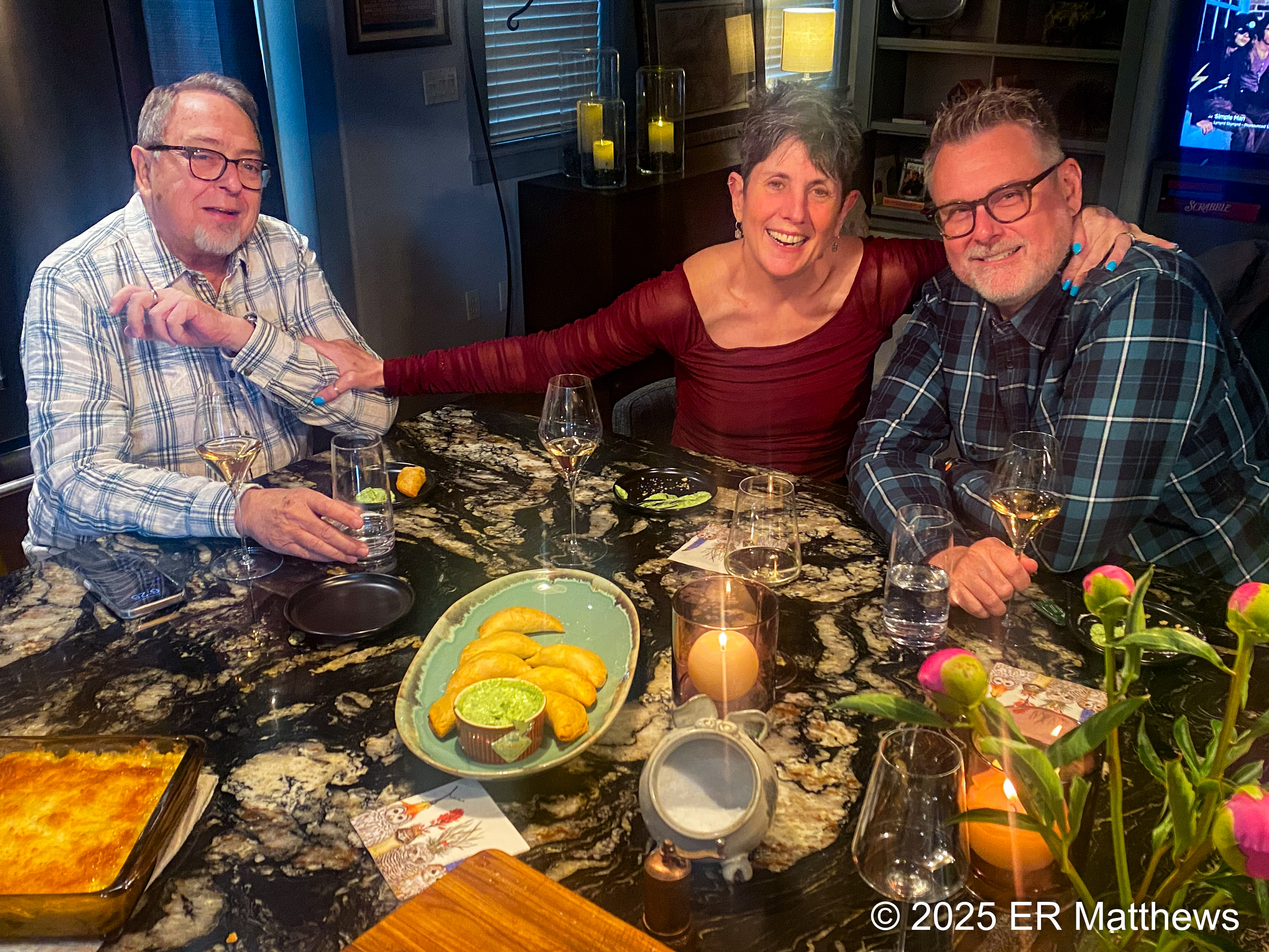
We're getting close to the summer travel season when we are going to be on the road somewhat often. Before we leave for Virginia for my daughter Ellie's wedding, we wanted to have Rob and Dyce over for a casual dinner.

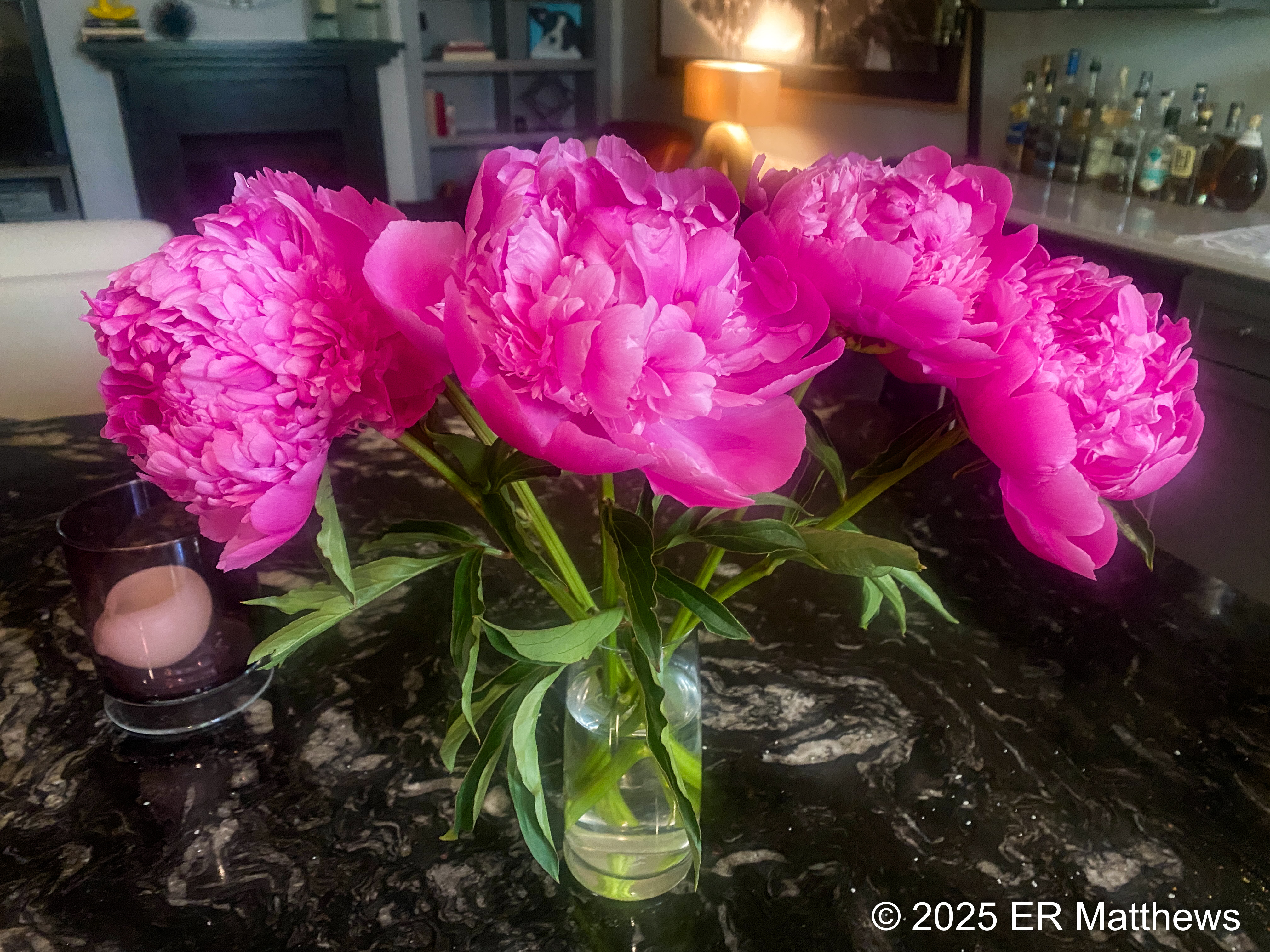
Rob and Dyce Brought the Most Gorgeous Peonies
I really am trying to avoid dinners with lots of last minute cooking so that I can relax and focus on guests. That shifts meals towards braises and dishes without touchy timing. Ann had kindly suggested all manner of dishes, but nothing grabbed me.

Unclear on what to make and rooting through the freezer, I found a bag of cleaned and cubed pork shoulder from a foray to Costco. Their shoulders come in two packs and that's a ton of meat. I typically break down both shoulders into cubes for braises like carnitas and freeze what I don't need right away.

Knowing that Rob and Dyce are fond of New Mexican food had me thinking along those lines and so I decided to make chile verde. After pondering for a few days, I decided to make a posole casserole to accompany the pork, and to offer empanadas for an appetizer. After a week of beautiful weather, it cooled off again and the choice of heartier food seemed lucky and apropos.

Then I remembered the heirloom masa harina that Ann gave me for my birthday and I decided to make tortillas to accompany the meal. And so the menu was set with the only last minute task to cook the tortillas. Somehow in the course of moving, my tortilla press did not make it to this house and so I improvised using a cast iron pan and a cut open Ziploc bag.

Empanadas de Picadillo Dulce, Cilantro Aïoli
Empanadas I make with an egg-enriched pie crust that never fails to bake up flaky and golden brown especially when brushed with an egg wash. Habitually, I fill empanadas most often with picadillo dulce, a sweet and sour pork that I first learned about by reading old Spanish-language recipes in the Biblioteca Nacional de México.

The filling is clearly of Moorish origin, containing almonds, olives, and sometimes raisins, though I have made it my own through the years. This version was ground pork shoulder, almonds, olives, onion, poblano chile, garlic, Mexican oregano, and three types of dried red chile (the majority ancho). I made it sweet and sour with brown sugar and Sherry vinegar. I have outlined the process in a previous post.

Masa Balls for Tortillas
Ghetto Tortilla Press: My 1930's Griswold Skillet
Tortillas on the Table
Chile Verde, Posole-Chipotle Casserole, Tortillas
Chile verde is not a recipe but an idea. At essence, it is cubes of pork braised in a salsa verde. There are as many ways to make it as there are cooks and they are all wonderful. I am certain that I make it differently each time and this time, I used the slow cooker to free our single oven to use in baking the posole.

For chile verde, there are two essential steps. First, make a salsa verde and second, brown the meat and braise it in the salsa.

For salsa verde, I roasted at high temperature (say 400F) a sheet tray of poblano peppers, Anaheim peppers, onions, garlic, and tomatillos. I rotated the chiles as each side became blistered. Once done, I pulled the tray out and covered it in film so that the veg could steam until cool and loosen the pepper skins.

Next up, I skinned and cleaned the peppers, dicing and reserving three or four Anaheims for the posole casserole. The peppers, garlic, tomatillos, onion, and a bunch of fresh cilantro went into the food processor. I blended it until roughly smooth and put it in the slow cooker.

For the pork, in recent years, I have adopted a process by which I only brown one surface of the cubes. This provides great flavor while not drying out the pork. After browning all the pork and putting it in the food processor, I deglazed the pan with a splash of water and poured all the porky goodness into the slow cooker with the pork and salsa. Eight hours later, the pork was tender and the sauce reduced to just the right thickness.

The posole casserole, something I started making in my 20s as a broke graduate student, I assembled in the afternoon and put into at 350F oven about 90 minutes before we were ready to eat. Timing is not critical, a delightfully brown crust is.

I admit that I did not make my own posole, though I could. I bought two 28-ounce cans of commercial hominy, the same Teasdale brand that I used in the restaurant. One can each of yellow and white hominy went into a mixing bowl with the reserved chopped green chiles, half a bunch of sliced green onions, and the kernels of one ear of fresh sweet corn for contrast and variation on the corn theme. Purple hominy (maíz morado) would have been cool, but my store had none.

I bound the casserole with a chipotle béchamel: olive oil and a spoon of flour cooked for a minute, then a pinch of salt and one finely chopped chipotle in adobo. After mixing the hominy and sauce, I adjusted the salt and put it into an oiled baking dish and topped it with a little grated white cheese. The result is as delicious as it is simple.

Making tortillas with modern masa harina is a trivial process of mixing the corn flour with enough water to make a workable dough. Then you roll it into balls and smash the balls between sheets of plastic (or a cut open Ziploc freezer bag in my case) in a tortilla press (or beneath a cast iron skillet in my case). We restaurant chefs are used to adapting and overcoming: no tortilla press, no problem. I can even patty them by hand, old school.

After peeling the masa circle off the plastic, it goes into a hot, dry frying pan on low to medium heat. Cooking both sides takes less than a minute and if I had a flat-top, I could have cooked them all at once rather than one at a time. Naturally, I could have fired four pans on the stove and cooked four at a time, but no matter. We were all busy yakking while I was pressing and cooking tortillas.

It should be axiomatic that a tortilla is only as good as the masa from which it is made. And if you use shitty Maseca or Masa Brosa, you are going to get a shitty tortilla. My masa is from Masienda and is processed from heirloom corn varieties grown on small farms in Mexico. It is expensive relative to the big brands (but even so, tortillas cost cents), but it helps sustain small farmers and preserve heirloom corn varieties.

Monday, July 29, 2024

José Restaurant, Dallas

We considered several options to get to San Angelo TX to visit with Carter for his 25th birthday. The most efficient proved to be to fly to Dallas, rent a car, and drive the four hours to San Angelo. With a return flight to Oregon at 10am on Monday morning, we decided that we would return to Dallas on Sunday evening and camp out at a hotel near the airport, especially given the inefficiency of the rental car system at DFW.

This schedule left us with the opportunity to have a nice dinner in Dallas on Sunday night, a night when many restaurants are not open. Of all the places we could have gone, we chose José near Love Field in north Dallas, an easy drive from our hotel near DFW. José is known for its elevated Guadalajaran-inflected food and drink, a celebrated female chef in AQ Pittman, its use of house-made masa from corn brought in from Mexico, and a segment on "Taco Chronicles," the Netflix show that you do not dare watch if you are remotely hungry or trying to lose weight.

The Very Handsome Floor-to-Ceiling Back Bar at José
As a chef, when I go to a restaurant, I just want the kitchen team at that restaurant to show me what they do well. The restaurant knows far better than I do what they do well. So, why should I order off the menu if I have the option to let my hosts decide? It's a rare restaurant that will roll with a request to just order for Ann and me (there are some technical POS issues, but that's more a cop out than anything), so when I e-mailed asking if they would just order for us, I was pleasantly surprised to get an affirmative response from GM Victor Rojas within a short while.

Just as we were seated, a runner dropped off a basket of totopos and a couple of salsas, one red and one green. The green salsa was one of the standouts of the night. It was almost identical to the usual salsa verde I make at home, except that it was smoother and less rustic. I really enjoyed it. It's the small things for me that make an experience.

Within a couple of minutes of our being seated, Victor appeared at our table bearing amuses and introduced himself. He would take great care of us personally for most of the evening and we greatly enjoyed chatting with him.

Blue Corn Sopecito with Blue Crab Salad
While we were munching on the tiny sopes and contemplating the cocktail menu, I had a chance to look around the spacious dining room of the building that was once a dry cleaner. The industrial steel clear span framing gives a large open interior and high ceilings that leave room for an immense custom floor-to-ceiling back bar that is the focal point of the room.

Back to the table, the star of the sopecitos was not the crab, but the blue corn masa from which they were made. One of the primary reasons we selected this restaurant is because they nixtamalize their own corn and grind their own masa. Nixtamalization is the process of soaking dried corn kernels in a basic solution that dissolves the hard outer shell, the pericarp, of the kernel.

It is a process that my great grandmothers would have used to make the hominy (posole) so prevalent to the Scots-Irish Appalachians. When I was a boy, I would often see ash hoppers at country auctions. People would fill these hoppers with ashes from the fireplace and the rainwater would filter through the hopper and drain into a bucket below. The solution in the bucket would be lye, potassium hydroxide. Today, rather than using lye, we use refined hydrated lime (calcium hydroxide) called cal to nixtamalize corn.

Victor helped us choose cocktails. I had a riff on a Manhattan called the The José Way Manhattan, a dark complex mixture of mezcal, amaro, Banane du Brésil, vanilla, and Angostura bitters. Ann had a smoked tequila Old Fashioned of reposado, agave, and a couple of bitters. We really enjoyed our cocktails; they are similar to what we are making currently at our home bar where Ann's Oaxacan Old Fashioned will hang with anybody's.

Ann and Her Smoked Tequila Old Fashioned
The José Way Manhattan
Victor also brought us small glasses of the house mezcal and said that he had gone to Mexico to help make it. After smelling its unusual fruity nose similar to an eau de vie or schnapps, I asked how it was made. It is a pechuga of 100% espadín piñas. The pechuga used in the redistillation came from things that he sourced at the market: apples, guavas, and chile chilhaucle. I have had pechugas flavored with all sorts of things, but this was the most unique mezcal that I have ever tasted, a smooth and highly refined spirit that I enjoyed.

Arugula with Peaches, Fresnos, Grilled Okra, and Goat Cheese
Next up was an arugula salad course, the standout of the meal for me. The salad was plated on a spread of goat cheese from fairly local (Waco) Pachi Pachi Farms. The best parts were the fresh salad ingredients: sliced peaches, sliced mildly spicy Fresnos, and the revelatory ingredient, sliced grilled okra. I also loved the crunch of the toasted quinoa sprinkled on the salad.

As a southerner, I have grown, harvested, and cooked okra all my life. Even though I have cooked it myriad ways, I never thought to grill it gently. The smokiness from the grill enhances the small tender okra without activating any of its slime. In the highest form of chef flattery, I may rip this off, if I can ever find some tender baby okra out here in Oregon where it is essentially non-existent. 

Champagne Telmont
Our cocktails were done after the salad, so wanting a wine that would be able to stand up to anything that might come next, we went the sparkling route, ordering a bottle of Champagne Telmont. A label that we have not had before, it was a fine all-purpose wine with lots of red fruit dominating the nose, the palate balanced by a healthy addition of Chardonnay.

Dobladas de Pollo Enmoladas
Our first course with the Champagne was a plate of dobladas covered in mole. I detected chicken thigh meat, poblanos, and a white melting cheese inside the fresh tortillas and the top had a good sprinkle of queso fresco. To be honest, I wasn't expecting mole in a self-styled Jaliscan/Guadalajaran restaurant, but I have never met a mole I did not like.

Victor referred to the mole as "aged mole," meaning that each new batch contains some of the previous batch, old school, the way it has always been and should be done. He regaled us with the story of the line cook who thought to put the final batch of mole before COVID into the freezer to be used as a starter on the far side of the pandemic. Good looking out!

The mole on these dobladas was a fairly dark, fruity, complex sauce that in my world I would call a mole poblano. As much as I loved this mole, I cannot help but wonder how this combination of chicken, poblanos, and cheese would respond to a mole verde or pipián.

The star of this dish was neither the mole nor the filling. To quote Ann, “that tortilla though!” She would have been content with a stack of those tortillas and a ramekin of that excellent salsa verde. As would I.

Carne Asada, "Patatas Bravas," Salsa Roja
The Carne was an Excuse to Snack Fresh Tortillas!
We would get more awesome tortillas with our next dish, a cast iron dish of carne asada, onions, and peppers, served with whole roasted potatoes tossed in spice ("patatas bravas"), and a beautiful salsa roja. The eye opener from this dish was the salsa roja, an intense concentrated tomato sauce. The sauce was enhanced with smoky chile morita. The texture of the sauce and the smokiness reminded me in the best way of a beautiful roasted eggplant sauce.

Again, while the meat was awesome (sous vide tenderloin, I think), the tortillas and the salsa roja stole the thunder. Ann and I asked for more tortillas with which we polished off all that delicious sauce.

Coconut Flan with Candied Amaranth and Pepita Topping
Neither Ann nor I are dessert eaters because sweet flavors are not really our thing. Flan is so often cloying and pedestrian, but not so in this case. The pastry chef had a deft hand with the sugar and the addition of coconut milk made this flan much more interesting than usual. 

After dinner, Victor brought us little glasses of dark, barely sweet Fernet-Vallet as a digestif, a nice parting gesture. We thanked him profusely for his hospitality, the willingness to order for us, the excellent staff training, and of course, a delicious meal for which I would like to thank all the BoH team, especially the prep cooks and dishwashers who never get any credit, but without whom, nothing would happen.

The stand-out components of our meal were none of the star players. The glory goes to the supporting actors: the masa, the grilled okra, the salsa verde, and the salsa roja.

I compliment Victor, a consummate hospitality professional, and the service team on their attentiveness. I always love going to a restaurant where the entire service team takes responsibility for all guests, not the usual "not my table, not my problem" attitude. The FoH staff at José are well trained. Not a lot of guests would notice this, but then, I'm not an average guest, having owned, cooked at, and run a fine dining restaurant for a very long time.

Monday, April 22, 2024

One Chicken, Three Meals

I've been wondering a lot recently about how to help people who don't have a lot of money make meals economically. What I see at the grocery store really causes me pause: almost all carts of groceries contain extremely expensive pre-prepared and probably not very nutritious foods, while very few carts actually contain items designed to be cooked into healthy meals.

I haven't really made any headway in figuring out how to help such people, but I thought I'd share how I put three dinners for two on the table for about $20. It all started with a single chicken, a 6-pound behemoth for which I paid $8.

Meal 1: Roasted Chicken and Roasted Asparagus


Roasted Chicken
This is as simple as dinner can get. I rubbed the entire chicken with olive oil and sprinkled it with salt and fresh thyme leaves. I put it on a sheet tray into the oven and cooked it until the thighs came up to 165 degrees in the thickest part, about 90 minutes in the oven at 375F.

When the chicken was done, I left it to stand on the stove while I put another sheet tray of asparagus drizzled with a little oil and salt into the oven. We ate the thighs, legs, and asparagus about 20 minutes later.

Additional cost for this meal $2.50: big bundle of asparagus: $2.50; fresh thyme, salt, olive oil: pennies

After dinner, I collected all the roasting juices from the chicken pan by adding a bit of hot water to it and then pouring it into a container. These juices were for soup later on. I sliced 3 nice slices off each breast and saved them for crunch wraps the next night. I also saved the bones from the legs and thighs as well as the chicken carcass for soup.

Meal 2: Chicken Tinga and Chipotle Refried Bean Crunch Wraps


Chicken Tinga and Chipotle Refried Bean Crunch Wraps
Using the leftover slices of chicken breast, I made crunch wraps with a layer each of chipotle refried beans, chicken breast in tinga sauce, and cheese.

To make the refried beans, I sweated an onion, finely diced, in oil until translucent. I put half the onion in the blender for the tinga sauce. To the remaining onion in the pan, I added two 14-ounce cans of drained and rinsed pinto beans. Then I added the tiniest pinch of Mexican oregano and one chipotle pepper, super finely minced. I added a touch of water to get things cooking and as everything cooked, I mashed the beans with the back of my wooden spoon. When the beans became tight, I turned of the heat.

To make the tinga sauce, I added to the onions in the blender a drained 14-ounce can of tomatoes, a chipotle, a pinch of Mexican oregano, and a pinch of salt. After blending this briefly using a couple of pulses of the blender, I added the sauce to a small pan on the stove where I heated it gently and reduced it to remove any excess water.

When I was ready to assemble the crunch wraps, I put the chicken breast slices in the warm sauce to reheat. Then I built the crunch wraps with a layer of beans, then the chicken slices, then a scant half cup of grated cheddar cheese. I mixed the leftover tinga sauce into the unused beans and had that for lunch the next day. See this post for the crunch wrap technique.

Additional cost for this meal $4.25: 2 cans pintos; $1.25, 1 can tomatoes: $1; tortillas: $0.50; onion $0.50; cheese: $1; 2 chipotles, Mexican oregano: pennies

These crunch wraps are actually massive and could stretch for two meals. After eating my entire one for dinner, I did not eat breakfast the next day, being still sated from dinner.

Meal 3: Chicken and Stars Soup


Chicken and Stars Soup
One of the primary reasons that I roast chickens is to have the carcass leftover for soup. I put into a soup pot the carcass, the leftover roasting juices, a couple sprigs of thyme, a quart of chicken stock, the ends of five carrots, the outer leaves of a leek (saved for soup from a meal earlier in the week), and the frilly leaves from a bunch of celery. After topping the carcass and vegetables with water, I put a low flame under it and went for a 90-minute walk.

When I came back, I turned the pot off and removed all the solids from the stock. After the chicken cooled, I picked all the meat from the bones (the remaining breast meat, the wings, and the oysters in the back) and saved it, pitching the bones and veggie scraps.

I cut one onion, four large carrots, and four stalks of celery into large pieces and put them in the stock and let them cook for an hour. When we were ready to eat, I brought the soup to a rolling boil and added a small 200g bag of pasta stars (estrellas, stelline) and the chicken meat and cooked the pasta for ten minutes.

Additional cost for this meal $5.25: chicken stock: $1.50; pasta: $0.75; onions, carrots, celery: $3

If I were on a budget, I would not have added the chicken stock, but soup is always better if you make a double stock from stock and bones rather than a single stock from water and bones. After two bowls of soup apiece, we had two additional bowls leftover for lunch.

Bottom Line

For these three meals for two, I spent right at $20. As a bonus, we had three lunches from the leftovers, all from a single chicken. I'm always thinking when I am shopping for groceries items that I can cook for one dinner and have leftovers to repurpose for another dinner.

Thursday, March 14, 2024

Old Chef, New Trick

The last time I ate at Taco Bell would have been when my daughters were tiny young things. My eldest, Lillie, loved their bean burritos and would ask for them from time to time. And very occasionally, I would relent. You're beat; it's late and you're scrambling to get groceries after work; the kids are screaming; you know the drill!

Time flies and now that little girl is an internal medicine resident at a hospital in North Carolina. Seemingly without my noticing, it has been a very long time, a full generation or more, since I ate at Taco Bell (or for that matter, any fast food joint). As a consequence, I have no familiarity with their products, bean burritos aside, if even they sell such a mundane (although pure profit) item any longer.

Apparently in recent years, Taco Bell makes a thing called a crunch wrap, which according to hearsay is their biggest selling item, but one of which I have been woefully ignorant. Call me culturally illiterate.

Chipotle Black Bean Crunch Wrap
Ann and I first encountered crunch wraps at a local vegan food truck, a large flour tortilla folded to completely enclose a vegan filling and then the whole shebang browned on a flat-top. When I tasted Ann's crunch wrap, even though I wasn't enamored of the filling (not a huge fan of vegan cheese; sorry Tony!), I thought that the idea in itself might deserve to be permanently enshrined in the stoner-food hall of fame. 

Recently, Ann asked me to make crunch wraps for dinner so I made sure to get some really big flour tortillas at the store. Then, it was just a matter of making a decent filling (onion, poblano, cilantro stems, garlic, black beans, minced chipotle, cumin, New Mexico ground chile, salt, and Mexican oregano) and rounding up some other filling ingredients (cilantro leaves, sliced green onions, pickled jalapeños, grape tomatoes, and cheese).

The next step was to reverse engineer the fold to encase the fillings, which proved to be trivial. I understand that Taco Bell puts the crunch in the crunch wrap using a tostada that also helps stabilize the whole assembly.  For my part, I merely cut down a piece of flour tortilla to lay on top of the filling to give the large flour tortilla a good surface against which to seal. The whole thing folded naturally into a hexagon as if it were intended that way. I got it on the first try.

I didn't feel like it needed a tostada, but then, I'm not marketing to stoners and I don't need my crunch wraps to be stable for portability.

While my experience was trivial, I'm sure that the food engineers at Taco Bell spent countless hours determining how to fold the tortillas in a cost- and time-efficient manner such that their employees could knock them out profitably and consistently across all their stores. [My limited consulting with a large food manufacturer has shown me first-hand what a huge and involved process this is.] And no doubt, there is probably a patent or two lurking about the PTO to protect their product from commercial imitators.

Taco Bell: thanks for the idea! New trick for the old chef!


These stoner-food gems were so good, I confess to have made them two nights running, albeit with slightly different fillings each time.

Wednesday, March 6, 2024

Crunchy Fish Tacos

I've recently revived an old technique for fish tacos and Annie loves the results. Here's how I turned a couple of Pacific Cod fillets into fish tacos.

Pacific Cod Fish Tacos
In recent years, I have been coating fish fillets for tacos with a spice rub and roasting them in the oven. This is certainly a healthy way to eat fish, but many people will miss the crunchy crust of fried fish in their tacos. That got me asking myself how I can get a crispy crust on fish for tacos using a minimum of oil.

Thinking back many decades to when I was just learning how to cook Chinese food (as if there is but a single Chinese cuisine, ha!), I remember using cornstarch not only to thicken sauces and soups, but as a way to coat meat for wok frying. And so I decided to use a bit of cornstarch on fish fillets and to fry them in as little oil as possible.

I cut the cod fillets into pieces that will fit into my pan and then sprinkle both sides with seasonings (sometimes my fish rub, link above). For this particular batch of fish, rather than use a rub, I merely sprinkled both sides with salt, ground New Mexican chile, and a touch of granulated garlic. Then I put a thin coat of cornstarch on both sides.

Pan-Searing Pacific Cod Using Almost No Oil
We eat a lot of tacos at our house because they are quick, tasty, and who doesn't love finger food? One way that I make them quick to prepare is by keeping a lot of garnishes on hand in the refrigerator on a regular basis. These include pickled jalapeños, salsa verde, romaine bottoms, and a squeeze bottle of thinned chipotle sour cream. By planning ahead, tacos take less than ten minutes to bring to the table, just what I want on a busy day or on a day when I don't have the energy or desire to cook an involved meal.

Fish Taco Toppings: (L-R) Pickled Jalapenos, Tomatoes,
Salsa Verde, Cilantro, Chipotle Sour Cream, and Romaine
I've published the recipe for salsa verde before, but it's just a bunch of cilantro, a large can of drained tomatillos, a serrano chile, two cloves of garlic, and a pinch of salt, all blended. We use romaine lettuce on our lunch sandwiches and I always keep the bottoms of the bunches in a bag in the fridge. When it's time for tacos, I slice the bottoms thinly for a crunchy garnish. Chipotle sour cream is merely sour cream, water, salt, and chipotle adobo.

Thursday, September 14, 2023

Black Bean Tostadas with Poached Eggs

Huevos Rancheros, rancher-style eggs, makes a wonderful breakfast and, in my book, an even better dinner. It's a dish that Americans love and have adopted and modified (or corrupted, depending on your punto de vista) and taken (or stolen) as their own. The original dish was probably lightly fried tortillas topped with eggs and pico de gallo (salsa fresca), but has evolved beyond that, especially in the States where it almost always includes beans and cheese. Following is another loose variation on the theme, black bean tostadas with poached eggs, from a dinner last week.

Black Bean Tostadas with Poached Eggs
While I love to fry tortillas in oil for the rancheros, it's better on my waistline if I bake them between two baking sheets so they become tostadas. About 25 minutes in a moderate oven with a couple of turns will do it. Baking them between two sheet trays keeps them relatively flat.

Tortillas Baked Between Two Sheet Trays
Left over in the fridge, I had a little salsa colorada (dried red chiles, chile soaking liquid, garlic, Mexican oregano, and salt, all blended and fried in oil, then thickened with a little masa harina). So I put a bit of that on top of the tostadas before spooning on frijoles refritos (see below). The salsa helps start softening the tostadas so they become more like the lightly fried traditional tortillas.

Salsa Colorada
While the tostadas were in the oven, I made some quick refried black beans, cheating by starting with two cans of precooked black beans. I start by cooking very finely minced onion with minced garlic and minced cilantro stems in oil (lard, traditionally) until the onions are translucent. Then in go the beans and some liquid (bean cooking liquid, stock, water, whatever). You wouldn't hate me if I said that a finely minced chipotle may have fallen by accident into the pan as well?

Next, as the beans start to come up to a gentle boil, I introduce them to my bean masher, Sra. Machadora, my antique maple bean masher. After working them over for a few minutes until they are smooth, but not too smooth, I reduce the liquid to the consistency I want and then season them. Don't salt them before reducing the liquid or you risk oversalting them. 

Introducing the Beans to the Machadora (Bean Masher)
To complete the dish, we need some salsa fresca aka pico de gallo. I wasn't looking for anything fancy here, just a rough condiment of tomato, onion, serrano, cilantro, lime juice, and salt. It could not be any simpler, or better for that matter. 

Salsa Fresca/Pico de Gallo
The plate-up is trivial. Schmear the tostadas with salsa colorada, spoon over the frijoles, and add a poached egg. Most versions use fried eggs, but I love poached eggs. They are way sexier than fried eggs, plus I can cook six at a time versus only three fried eggs. I prefer to serve everyone at the same time. On top of the eggs, a spoonful of salsa colorada and another of pico de gallo with a sprinkle of grated cotija cheese finish the dish. ¡Buen provecho!

Sunday, April 3, 2022

Spring Grilling: Carne Asada

Here in beautiful Bend, Oregon, spring is starting slowly with the appearance of the first buds on trees and the advent of milder, though still cool, temperatures. The nicer weather has inspired me to get my grill cleaned up and reassembled after the move from McMinnville in February. My goal: to grill the  package of skirt steaks, labelled also in Spanish, arracheras, that I came across at the grocery store.

Tacos de Carne Asada

Skirt steak is not all that common at grocery stores here in the PNW, which is a shame, because it is the perfect cut for carne asada, thin and flavorful. No lie, it is one of my most favorite grilling cuts.

Carne asada, literally grilled meat, with beef being implied, isn't typically a meal in itself, though it can be. The grilled skirt steak is generally chopped and used in other dishes, such as tacos. In norteño culture, carne asada can also mean the event at which the meat is grilled, a barbeque in American terms.

To celebrate the coming of spring and the first barbeque in our new home, I decided to make carne asada tacos with a quick salsa roja, cilantro, raw onion, and a sprinkle of cotija cheese, pictured above.

Arracheras on the Grill
For carne asada, skirt steaks are generally marinated before grilling and a lot of people use a wet marinade. I prefer something simpler, rubbing the steaks with oil, a generous amount of salt, a bit of freshly ground cumin, minced garlic, and finely chopped cilantro stems. I left the steaks in the fridge for 3-4 days to absorb the rub, though this is certainly not necessary. I've never been a big fan of wet marinades on steaks, because I feel that the liquid inhibits the really great grill sear and char that you see in the photo below.

Grilled Skirt Steaks: Carne Asada
I also go against conventional wisdom in grilling my carne asada to medium going on medium well. Convention says that skirt steak is tough and so you want to cook it rather less than more. Having grilled thousands of skirt steaks, I have to disagree. I have found that a tough, stringy steak like a skirt steak is very hard to chew when rare to medium rare. And so I opt for medium to a bit beyond, say medium well.

Recipe: Salsa Roja (Guajillo-Chipotle)


I make all manner of salsas and keep them in the fridge to have on hand whenever I want some. In general, I don't use tomato in my red sauce, but this time, I decided to stretch my supply of dried chiles with a can of tomatoes.

Toasting Stemmed and Seeded Guajillos
Chiles After Toasting and Soaking
Finished Salsa Roja

Following is the recipe I used for this batch of mildly spicy red salsa. You can alter it as you see fit.

4 guajillo chiles, stemmed, toasted, and soaked
4 chipotles en adobo
6 cloves garlic
2 tablespoons red wine vinegar (or lime juice)
1-28 ounce can tomatoes in juice
salt to taste

Remove the stems and seeds from the dried chiles. If you are not certain how spicy the chiles are, you might want to wear gloves while doing this.

Toast the chiles in a dry pan until they start to smell good, but stop before they char. Move them around while toasting so that they do not burn.

Off heat, cover the chiles with water and let them soften. This will take an hour or so.

Drain the chiles and place them along with all the other ingredients in the blender. Blend until smooth. If the salsa is too thick, thin with water. Season to taste with salt.

Bonus Dish: "Steak and Eggs"

When grilling carne asada, it always makes sense to me to make more than I need because the leftovers are really useful for a quick meal. In this case, I made steak and eggs with the largest skirt steak. First, I cooked the leftover onions from the tacos from the night before, then added the diced skirt steak and the leftover cilantro. I just warmed the meat through, trying not to cook it any further.

Reheated Carne Asada with Onion and Cilantro
"Steak and Eggs"

The "steak and eggs" is a bowl of scrambled eggs topped with the reheated carne asada, fresh tomato, salsa verde, pimentón sauce, more cilantro, and a sprinkle of cotija cheese. Recipes for salsa verde and pimentón sauce are here.

Friday, February 12, 2021

Super Bowl: Chicken and Green Chile Tostadas

I have been a lifelong Washington Redskins fan and remember trips to RFK Stadium and later to FedEx Field vividly, especially when playing the big NFC East rivals, the Cowboys, the Giants, and especially the Eagles with their riotous fans. Then came the restaurant with its 80- to 90-hour workweeks and football all but disappeared from my radar. Post restaurant, we became cord cutters with no access to cable TV. And so, for the last 20-plus years, football has not played a significant role in our lives, especially because Ann has no desire to watch.

But year in and year out, we seem to find a way to watch the Super Bowl, if for no other reason than to keep at least some grip on cultural literacy. This year, we happened to have access to CBS for the broadcast and that got us thinking that we should do something a little special, a little bad food-wise to eat during the game.

We kicked around a bunch of ideas when Ann struck on chicken enchiladas. I suggested that perhaps instead we do tostadas because I could bake the tortillas without any oil for tostadas versus frying the tortillas in oil to seal them against the enchilada sauce.

Chicken and Green Chile Tostadas
When I think about chicken in Mexican cuisine, my mind immediately leaps to the juxtaposition of mild white chicken with mild green chiles. It is a food combination that really works for my palate and I just love the way that each ingredient plays off of and dances with the other. So when I was at the store buying the chicken for the tostadas, I also bought a small sack of mild Anaheim chiles to roast. Yes, you can buy them roasted and canned, but the flavor is not there and they are wicked expensive compared to roasting your own.

Torching the Chiles
Char Each Chile and Place it in a Plastic Bag to Steam
Peeled and Diced Green Chiles
I took the chiles outside and fired up my propane torch to char the skin on each. As I finished with each chile, I placed it into a plastic bag so that it could steam. After sitting for a half an hour or so, the chiles were ready to peel. The easiest way to peel them is to rub the skins off under running water.

Charring the chiles with a torch does not cook them in the way that charring them over a gas burner or under the broiler in the oven does. As you can see in the photo above, they are nearly raw and bright green. To cook them further, I steamed them in the microwave, covered in film, for about four minutes on high.

Enchilada Sauce
I decided to keep with Ann's enchilada theme by making enchilada sauce to drizzle on the tostadas. This sauce is nothing more than a little roux with a lot of mild New Mexican ground chile and a bit of garlic powder, ground cumin, and rubbed Mexican oregano, all thinned with a ladle of chicken stock from the chicken that I poached for this meal.

Chicken, Green Chiles, and Chipotle Adobo
I picked the chicken that I had poached the day before and put and ounce and a half of shredded chicken per tostada in a bowl, then mixed in enough of the diced Anaheim chiles to make me happy, about two parts chicken to one part chile, or maybe three to one. Really, who cares?

I seasoned the chicken with salt and gave Ann a taste. She requested some heat to the mix, so I added about three tablespoons of chipotle adobo to the mix, turning it slightly reddish. The tostada mix ended up with just the slightest kick in the back of the throat.

Baked Tortillas
I baked eight tortillas, one sheet tray full, and left them on the counter to cool and finish drying out. (Click here for tostada procedure.) Then when we got hungry, around the end of the first quarter or so, I put some chicken-chile mix on each tostada, drizzled on some enchilada sauce, and topped each with a sprinkle of cotija and a few cilantro leaves. They were really good, giving us the sensation of eating something bad, while really being quite waistline friendly.

The tostadas were the highlight of our day, being much better than the game in which the Chiefs rolled over and played dead, the lousy half-time show, and the lame commercials. This sparsely attended COVID Super Bowl will probably be memorable for being unmemorable, except that Tom Brady, no matter what you think of him, continues to demonstrate why he is the best quarterback that I have ever seen. Unreal that he can continue to perform at his age, just unreal to defy time the way he has.

Ode to the Tortilla

I love tortillas. It wasn't always that way. I am a child of the early 1960s. Then, on the East Coast, our food was influenced by two th...