Showing posts with label honey. Show all posts

Sunday, June 28, 2026

We Needed a Celebration

It's been a long time since we had a get-together at our house. Spring was busy: I'm volunteering a couple days a week, I traveled to Philly to watch Ellie graduate, and we had a few health problems along the way. We needed a reason to celebrate at home. Ann set it up, inviting Rob and Dyce and Michelle and Andreas for dinner.

Pregaming with Chenin Blanc
Superstar Wine: Anjou Blanc
Chenin from Thibaut Boudignon
Whipped Feta with Spicy Honey and Pine Nuts
We had been saving a magnum of Anjou Blanc from Thibaud Boudignon for just such an occasion. He is a winemaker who came from obscurity to global reknown (at least among sommeliers) in a blink, now making some of the best wines in the Loire. These are not old school wines, however. They are precise and angular and suit my palate to a tee. Although he is best known for his outstanding Savennières, I prefer his base level Anjou Blanc for its simplicity and laser-focused acidity.

I let the wine guide the appetizer course, selecting a cheese dish that would be a great foil for the incredible acidity of the Boudignon wine. Over the years I have done many versions of baked feta and whipped goat cheese, but never whipped feta.

For garnishes, I made spicy honey (half a cup of honey and a tablespoon of sambal oelek) and toasted a handful of pine nuts. I chose to garnish with honey expressly to echo the honey and beeswax aromas and flavors of the Chenin Blanc.

Whipped Feta


For the whipped feta, I decided to add 20% goat cheese by weight to help loosen the feta which I was afraid would be too grainy whipped alone. I was quite happy with the results as apparently were all the others—none was left at the end of the evening.

400 grams of excellent sheep's milk feta
100 grams of fresh goat cheese
squeeze of lemon juice
drizzle of extra virgin olive oil

Soften both cheeses at room temperature. Place both in a food processor and process until whipped, scraping down the sides of the bowl as needed.

The raw whipped cheese tasted flat so I squeezed in the juice of an end of a lemon that I had left on the cutting board from making lemon slices for the chicken. I drizzled in an equal amount of olive oil; call it a tablespoon of each. The feta is salty enough; the whip did not need more salt.

Setting the Table: First Time in a Long Time
Ann and I went back and forth on the menu for a few days. At first, she wanted a reprise of a chicken tagine that I made some years ago, actually, an entire meal that I had made before. I resisted repeating myself, feeling that it is a cop out of sorts. But then she changed her mind to simple roasted chicken on white beans.

She was dead set on the tomato salad flavored with fennel pollen from the menu that I did not want to replicate. She talks about that salad often, but it's funny how I barely remember the dishes (so many thousands) that I have cooked. Thankfully, this blog is a repository of dishes that I have made, so there is a record even if I no longer recall them.

Roasted Chicken
with White Beans, Artichokes, and Garlic
The orginal roast chicken, as I conceived it, had no white beans. But I added them to subsequent iterations because something magical happens when you roast chicken on top of them. As always, quality matters. Use the best beans you can find. In this case, I used yellow eye beans from Rancho Gordo. These are among my favorite all purpose white beans ever and a stalwart at the restaurant.

Roasted Chicken with White Beans, Artichokes, and Garlic


6 heads of garlic, broken into cloves and peeled
3 lemons, sliced
1 pound of dried white beans, cooked
3 400-gram cans artichoke hearts
1 bunch of Italian parsley, destemmed and roughly chopped
2 large sprigs of rosemary, destemmed
drizzle of extra virgin olive oil
12 chicken thighs
salt
pepper

Mix the garlic, lemon slices, white beans, artichoke hearts, parsley, and rosemary with a drizzle of olive oil. Season as necessary. Place the mixture in the bottom of a roasting pan. Toss the chicken thighs with salt and pepper and arrange on the bed of vegetables. Roast in a hot oven (400F) until the chicken skin is crisp, about two hours. Check the beans occasionally. If they are drying out, moisten them with a little bean broth or chicken stock.

Tomatoes with Fennel Pollen and Shallots
Nobody needs a recipe for this simple tomato salad that is as surprisingly delicious as it is easy to make. It is merely a mixture of halved grape tomatoes, minced shallots, fennel pollen, lemon juice, olive oil, and salt, all to taste. 

Shout Out to El Mentridano
Ann and I, we are fans of light bodied reds with good acidity and some structure, wines that let their aromatics do the talking. While we are not fans of the usually overripe Spanish Garnacha, we both agree that El Mentridano, a high-altitude, lightly expressed Garnacha from Méntrida, near Madrid, is delightful. It offers a nose of cranberries, cherries, black tea, and a slight earthiness, all positives in our book. Color is light and tannins are polished, all backed by an attractive sour cherry acidity that keeps the wine vibrant. It reminds me of Nebbiolo in many ways. We had real problems, likely bottle shock, with this wine about six months ago, but after sitting in the rack for that period, it is back to normal. We must buy more—it is an indispensable summer red that pairs with a vast range of foods.

Herding Cats Again: Impossible to Get Everyone to Cooperate
Ann Made Her Delightful Summer Pudding (Berries and Brioche)
Michelle Made Her Best Batch Yet of Lemon Bars
We needed a night to sit back with friends and catch up. The simple menu is just what we needed, tasty and yet easy to prep in advance, with zero à la minute cooking that let us enjoy the company of our guests.

Friday, March 1, 2024

February Celebration: The Luckiest Beans on Earth

Let's Celebrate!

Mid-February has become a time to celebrate at our house. Valentine's Day, my birthday, and our anniversary of having moved to Bend, this year our second so-called Bendiversary, all fall within a week of each other. Accordingly, we aim to have a small party each February to mark these events. What better to do in this bitter cold season than have a party?

Another February Cassoulet in the Books
For this year's celebration, Ann asked me to make a cassoulet. If you have never had cassoulet, it is a bean and meat stew with four components: beans, meat, stock, and a mixture of diced aromatic vegetables called mirepoix. If you look back to all my cassoulet posts, I tend to make them in February at the worst of the cold season for good reason. Cassoulet is arguably the greatest cold weather comfort food in the world. Thank you France for this wonderful celebratory concoction!

Prepping for Cassoulet

For the cassoulet that I would serve on Saturday night, I started the prep work early Friday morning, right after shoveling the overnight accumulation of snow, a pretty typical chore on a February morning. The day-before prep for cassoulet is pretty limited: soaking the beans overnight and making some delicious pork stock in which to cook the beans.

The first step in making stock is to roast your bones. For pork stock, I use pork neck bones that are both inexpensive and contain delicious meat. I am guessing that if they are readily available here in Central Oregon, you can find them just about anywhere. The trick with roasting bones is time. Put them on a lightly oiled sheet tray in the oven and roast them until they are golden brown on all sides, turning them as necessary. It's not a process that you can or should rush. Cassoulet is only as good as the stock that you cook the beans in.

Having turned the roasting pork neck bones on the sheet tray and put them back in the oven to continue browning and getting sexier and sexier, I was standing at my cutting board, my nose reveling in the porky goodness of the aroma emanating from the direction of the oven. I remarked to Ann, ensconced on the sofa by the fire and nose down in her phone, "How do think these beans are going to feel, being slowly cooked in all that porky goodness?" And she replied, "They're going to be the luckiest beans on earth!"

While the bones were roasting, I did some pre-prep on the vegetables for the mirepoix: onions, carrots, leeks, and celery. While I would dice the mirepoix vegetables on Saturday morning, I wanted the vegetable scraps today for flavoring the stock. To that end, I peeled the onion, trimmed the ends of the carrots, peeled off the tough outer leek leaves, and trimmed the leafy ends of the celery. Be sure to wash the leek leaves well; they can accumulate a lot of dirt, or worse, sand.

After the pork neck bones browned, I put them in a stock pot with all the peels, ends, and scraps of the mirepoix vegetables. Filled with water, the stock pot simmered gently for several hours before I separated the solids from the stock. The stock went into the refrigerator to congeal so that I could remove the fat from the top. After the solids cooled, I picked all the neck meat from the bones to put into the cassoulet on Saturday.

Last thing before going to bed Friday night, I put two pounds of beans in a bowl and covered them with a lot of salted water to soak overnight. I had been wrestling with the choice of beans for a few weeks. Two weeks prior, I put an order in to Rancho Gordo for a big box of beans including my two potential candidates for the cassoulet: Tarbais and Steuben Yellow Eye beans.

I have made many cassoulets in my life, about half with the traditional bean from from the Tarbes area in the far southwest of France up against the Pyrenees, the Tarbais bean; and about half with a traditional American bean called the Steuben Yellow Eye, purported to be the original bean in Boston baked beans. Heretofore, I have always slightly preferred the yellow-eyed beans.

Both beans are loved because while holding their shape, they become ultra creamy inside, exactly what you want for cassoulet, which is nothing if not a super peasant dish of pork and beans. After waffling for days on the choice, I decided to go with the original beans, the Tarbais. I was not disappointed; the resulting cassoulet could not have been better. And I still have Steubens to craft into some other delicacy!

Cassoulet Assembly


Would Anyone Manage to Get Here for Dinner?
Overnight Friday into Saturday morning saw a considerable amount of additional new snow and the forecast had it snowing all day. Both of the couples we invited live up big hills that the snow could make impassable, so during the day on Saturday we weren't sure if our party would come off or if we would be eating cassoulet by ourselves. Regardless of the weather, cassoulet is pretty much of an all-day affair and I needed to get started on it. After shoveling snow again, naturally.

The first item of business was to get the beans par-cooking. I drained them and placed them in a stock pot with fresh water and a bouquet garni of fresh rosemary, fresh thyme, and fresh sage. These herbs would impart a slight flavor to the beans while making the kitchen smell amazing for the 90 minutes in which the beans par-cooked.

In my past restaurant days, we had all kinds of meat garnishes for the cassoulet, especially after we butchered one of the hogs that we had a local farmer raise for us. In addition to pig's feet for the stock, we had a lot of trimmings from which I would make traditional garlic sausages. And we would cure, roast, and confit the hog bellies which aged under their bath of congealed duck fat in the walk-in next to vast containers of confited Moulard duck legs. In short, our walk-in contained every kind of meat garnish a cassoulet cook could want.

But now post-restaurant at home in a fairly small city a half a day's drive from anywhere, meats are limited to what I can get at the grocery store, especially because the farmers markets are inoperative at the height of winter; you know, snow and all. Having little alternative, I just decided to go with what I could scrounge at the store. I ended up buying a large tray of chicken thighs and a small tray of breakfast sausage links to use along with all the neck meat that I picked from the stock bones.

While the beans were par-cooking, I browned the chicken and sausages in fat I had saved in the refrigerator from my last couple of batches of chicken confit. And while the meats were browning, I diced all the vegetables I pre-prepped yesterday into mirepoix. This finely diced mix of carrots, onions, leeks, and celery, I cooked in the same pan in which I browned the meats, scraping hard to get all the brown meat bits into the vegetables.

While the mirepoix was cooking, I minced and added an entire head of garlic to give a nice garlicky background note to the cassoulet. The reason for so much garlic is because I would typically have made the dish with a garlic sausage instead of the mild breakfast sausage that I used for this cassoulet.

Once the beans were par-cooked, tender but still a bit crunchy, I drained and mixed them with the mirepoix and then seasoned them to taste with salt. No longer working in the restaurant, I do not have a pan big enough to accommodate this amount of beans and meat, so I decided to use two pans. I put a quarter of the beans in each of the two pans and topped them with 4-5 bay leaves each. Then I split the pork neck meat, chicken thighs, and sausages between the two pans and covered them with the remaining beans.

At this point, I should mention the one cheffy thing about this cassoulet. From time to time, I make chicken confit, that is, chicken cured overnight in a salt and herb mix, then rinsed and slowly poached while submerged under olive oil. Then this chicken gets refrigerated submerged under the fat, which congeals and protects it from spoilage.

After the chicken is all consumed, I melt the remaining fat and pour it into a container to keep in the refrigerator where the fat congeals on top of any juices from the chicken. I reuse the fat for the next batch of confit, but the intensely flavored juices go into a soup or stew. For this cassoulet, I browned the meats and cooked the mirepoix in some of this confit fat and I added the congealed juices (a half cup) to the cassoulet along with the pork neck stock.

After removing the layer of fat from the stock that I made on Friday, I warmed it briefly to liquefy it. Into each casserole, I poured enough stock to cover the beans by a good centimeter and put them in a slow (300F) oven to start the process of becoming insanely good. I checked the beans periodically to make sure they had enough liquid. Each time a crust would form on top of the beans, I would mash it back down into the stock, topping off the stock if necessary.

This process of crusting and breaking the crust and re-crusting over hours is essential to cassoulet. I want to say that the beans cooked slowly for about seven hours and I probably broke the crust four to five times during my forays from the fireside into the kitchen.

While this is a good description of the process of making a cassoulet, a more exact recipe follows just below.

Cassoulet in the Oven
Essential to Let it Crust and Re-crust over Several Hours
Cassoulet Cooling after Seven Hours in Oven

February Cassoulet Recipe


This is a cassoulet, beans aside, that you can make from stock items at the grocery store. In fact, despite the lack of duck confit and other great ingredients, the is the single best cassoulet I have ever made. In other words, don't let lack of ingredients deter you from making a cassoulet. As for the beans, great beans are easily available via mail-order from Rancho Gordo (note that they call them Cassoulet Beans, rather than the Tarbais beans that they are).

This recipe is based on two pounds or a kilo of beans, enough to feed 8-10 hungry people. You'll want to attack a cassoulet over two days, the first given to making the stock and soaking the beans, and the second to cooking the cassoulet itself.

Pork Stock


This stock is made from inexpensive pork neck bones plus the trimmings from all the vegetables that you will use in the cassoulet. If you have a choice, try to select the meatier bones; the meat will go into the cassoulet. This recipe makes a good gallon/4 quarts/4 liters of stock, enough for two pounds or a kilogram of beans.

oil to coat a sheet tray
5 pounds pork neck bones
5 quarts/liters water
tough outer leaves from one large leek, washed well
ends and trimmings from 3 medium carrots
peel of one medium onion
hearts and leafy ends of one bunch celery

Coat a sheet tray with oil and spread the bones out in a single layer on the tray, then place in a moderate to hot oven. Roast until the upper surface is golden brown then rotate the bones to brown another surface. Continue in this fashion until the bones are brown on all sides.

Remove the bones from the sheet tray to a stock pot. Pour enough water onto the hot sheet tray to cover it. With a scraper or spatula, deglaze all the brown bits from the bottom of the sheet tray and pour into the stock pot. Repeat as necessary to get all the brown bits into the stock pot.

Add the remaining water and vegetables to the stock pot and bring to a simmer for a minimum of two hours. I cooked mine for four hours. At the restaurant, we kept stock pots going all the time.

Strain the solids from the stock. When the stock cools, refrigerate it overnight so that any fat in the stock congeals and can be removed easily from the top of the stock. When the solids cool, pick all the meat from the bones and save for the cassoulet.

Cassoulet


This makes a large quantity of beans, enough to feed 8-10 people. Make sure that you have a deep pan or casserole large enough to hold the beans and all the meats. Or use two, as I did. No longer do I work in a restaurant where we had a braiser (called by its French name rondeau) large enough to hold 5kg of beans! When browning the meats, take your time and do it correctly. This is a key step in building flavor.

2 pounds/1 kilogram of Tarbais or other white beans, soaked overnight in salted water
bouquet garni of 1 large sprig each of fresh sage, fresh thyme, and fresh rosemary
1/2 cup oil/lard/duck fat for browning meats
10 chicken thighs, bone-in and skin-on, 5-6 pounds
1 12-ounce tray breakfast sausages
reserved pork neck meat from stock recipe above
1 large leek, in small dice
3 medium carrots, in small dice
2 large stalks celery, in small dice
1 medium yellow onion, in small dice
1 head of garlic, minced
10 bay leaves
salt to taste
1 gallon/4 liters pork stock from recipe above

Drain the beans and cook them in fresh water with the bouquet garni (the fresh herbs, tied together with a string) until tender, but not cooked all the way through. This will take about 90 minutes give or take.

While the beans are cooking, brown the chicken and the sausage thoroughly on all sides. Remove the meats to a platter while you cook the vegetables.

When the meats are browned, in the same pan, add the vegetables and garlic and cook gently until the vegetables are soft and the onions are translucent. Scrape the bottom well to incorporate all the brown bits from the meats into the vegetables.

When the beans are cooked, drain them and mix them with the cooked mirepoix. Season to taste with salt.

Place half the beans in the bottom of your casserole (or a quarter of the beans, if you are using two pans like me).

Give the beans a sprinkle of salt (there's no salt in the chicken, pork neck meat, or stock) and spread the bay leaves on top of the beans.

Next spread the meats over the beans and then top everything with the remaining beans and a final sprinkle of salt.

Pour the defatted, melted stock over the beans to cover by a centimeter or so.

Place the cassoulet uncovered in a slow oven (say 300F) and let it cook slowly. Mine was in the oven for seven hours, so you should get it cooking in the morning to eat at dinner time.

Keep an eye on the cassoulet from time to time. Cassoulet needs to crust, have the crust mixed back into the broth, and re-crust several times. Keep an eye on the stock level and add more as needed. I believe that I broke my crust four times during seven hours and added a bit more stock twice.

The Rest of Our Celebratory Dinner


Cassoulet in the oven, my thoughts turned to an appetizer, something easy and delicious for a cold winter day. We just recently got an order of pantry items in from Amazon (here in Central Oregon, access to less common grocery items is extremely limited), including a tin of fennel pollen, a couple liters of Sherry vinegar, and a couple jars of Calabrian chile paste. Yes, Virginia, these are stock items in a retired chef's pantry and spice drawer.

With these items in mind, I started building the menu. For the Calabrian chiles, Ann had been talking about spicy honey for days and I spent some time musing on what would taste really good with that sweet and spicy sauce. In fairly short order, I came up with using the sauce on some fennel-spiced meatballs that our guests could graze on before dinner. Who doesn't like a good meatball?

I wanted to keep the meatballs fairly plain to let the Calabrian chile honey be the star of the show, but I did want to incorporate the fennel pollen that had just arrived at the house. The seasoning of the meatballs, made from ground pork, is simple: salt, dried basil, fennel pollen, garlic, and red wine. I mixed this all up in the afternoon and fried a quick test piece to check the seasoning. After adjusting the seasoning to our liking, into the refrigerator went the meatball mix to sit and infuse the seasoning throughout the meat.

After washing up from the meatballs, I made a quick salad dressing for the pound of baby arugula that I had brought home for the store, which is where the Sherry vinegar comes in. I started with one part of sherry vinegar and two parts oil (a splash of French hazelnut oil and the rest extra virgin olive oil) and tweaked it to taste with salt and agave nectar. When I was happy with the taste and acid balance of the dressing, I added a finely minced shallot to the dressing and left it on the counter to be mixed with arugula and thin slivers of pecorino at dinner time.

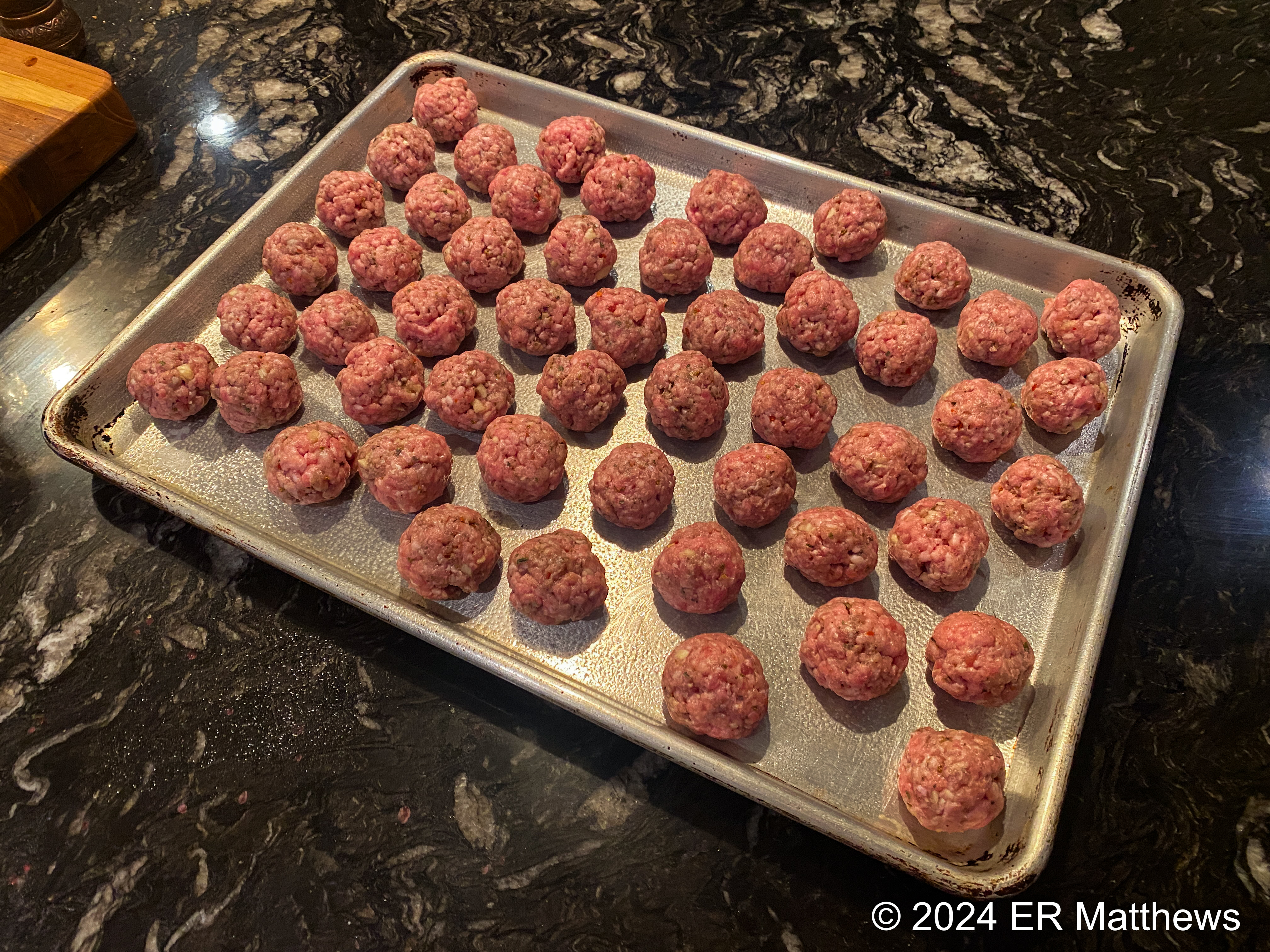
About a half an hour before our guests were to arrive (still no weather cancellations at this point!), Ann and I rolled the 2-1/2 pounds of meatball mix into small 1" (2.5cm) balls. For ease of cooking, I decided to bake them rather than fry or braise them. The meatballs went in the bottom of the oven under the still cooking cassoulet, which I topped with a bit more stock.

Fennel Pollen Meatballs Ready to Bake
When the meatballs came out of the oven 20 minutes later, I sprinkled them with flaky salt and more fennel pollen, then transferred them to a bowl for serving while Ann made final tweaks to the table, glassware, and so forth. I decided to serve the Calabrian chile honey on the side in case one or more of our guests was not a fan.

Fennel Pollen Meatballs, Calabrian Chile Honey
Just about the time appointed time for our guests to arrive (and knowing full well that the trip to our house would be slow on account of the still pouring snow), Ann cracked a bottle of wine for us to start pre-gaming it . While she was doing this, I went outside to remove the 2.5 inches of snow that had fallen in the the last hour from the sidewalk and to try to clear some space at the curb so that car doors could open without getting stuck in snow mounds.

Cassoulet Wine Pairings 


You've heard the saying, "What grows together, goes together"? It's a philosophy that I have always ascribed to in wine pairings. In other words, a good rule of thumb in wine pairing would be to go with the wine from the area from which the dish originates (when possible).

Living in Oregon, our wine coolers are stuffed with our local wine (Pinot Noir) and are sadly bereft of wines from Southwestern France where cassoulet originates. Unfortunately, these relatively obscure French wines are hard enough to source in major metropolitan areas and pretty much impossible to find out here in the boonies. But still, while Ann was out at her exercise class in the morning, I asked her if she would go by the store near her studio and pick up some French wine for dinner.

Cassoulet is a hearty dish that can pair with a wide variety of reds, anywhere from a light Gamay to a heavy Cabernet. My preference is to match the weight of the dish and the wine, opting for heavier rather than lighter wines. For heavier wines, I really like Cahors (Malbec) or Madiran (Tannat), both sturdy reds, with cassoulet.

Knowing the likelihood of finding such a wine was about nil, plan B was to have Ann grab some southern Rhônes, which are what we call GSMs, being made from any combination of the grapes Grenache, Syrah, and Mourvèdre. She came home with three wines, a Châteauneuf du Pape, a Lirac, and a Gigondas. All were delicious. Alternatively, we could have opened some of our GSMs from Walla Walla and the Rocks District from just north of us along the Columbia River.

Three Southern Rhône Reds for Dinner

Celebrating February


I am afraid that I was so intent on our guests that I forgot to take pictures. Rob and Dyce, sorry! What few I did manage are below.

Pre-Gaming it in Front of the Fire
Ann's Simple Tablescape
with Valentine's Gift Boxes for Guests
Andreas and Michelle
Cassoulet and Arugula Salad
Another cassoulet, my best ever, is in the books. I'm so thankful to have great friends with whom to share it.

Tuesday, January 24, 2023

Sweet Potatoes

Man, the restaurant life really sapped my enthusiasm for cooking! My love for the kitchen, even to this day, has not recovered and I retired from the business five and a half years ago. I used to think nothing of spending joyful hours in the kitchen, but now there are days when I can barely be bothered to go back in the kitchen for two minutes to throw together a ham sandwich.

Kitchen Mojo: Sweet Potato Cakes, Pork Tenderloin, Cole Slaw, Chipotle Honey
Just after retirement from the restaurant, I had no love for the kitchen. But these days some five-plus years hence, my love of cooking comes and goes. In the last ten days or so, my kitchen mojo is finally on the wax, at least temporarily. That's a good thing in that I have accumulated of a bit of winter fat and I need to eat better. Also, my body is longing for fresh vegetables, something that it quite usual for me in this cold vegetable-challenged season. That longing in part spurs me to action in the kitchen.

Though many vegetables are now available 365 days a year, thanks to a worldwide supply chain, old habits die hard with me. I try to use ingredients only in season, though I have relented a bit from this imperative in recent years. Back in the restaurant days, as a seasonal restaurant supplied by local farmers, we were limited in winter to storage vegetables from the previous growing season, our farmers bringing us only the tiniest amount of fresh produce from their expensive-to-heat greenhouses.

Winter therefore meant sweet potatoes, bushels and bushels of sweet potatoes. Out of necessity, we had to find creative ways to use them so as not to bore ourselves or customers. Fortunately, the sweet potato is as equally useful as a regular potato and therefore lends itself to a myriad of preparations: boiled, mashed, baked, chips, fries, grated for latkes, and even hashed.

Exercising all my creativity, at one point during my restaurant career, I hit upon a sweet potato hash that quickly became a customer favorite when accompanying our Berkshire x Ossabaw pork, wild boar, Moulard duck, or any of the venison that would come and go on the menu throughout the course of the winter: red deer, white tail, caribou, or elk.

The hash at the restaurant would have started in a vast sauté pan with cubes of our slab bacon, or house-cured pancetta if we were between slabs of bacon, cooked just enough to release a bit of fat. Into the sauté pan would go diced onion and cubes of raw sweet potato. Like any hash, it would stay on the flame until the bacon was rendered, the onions browned, and the sweet potato cooked all the way through.

I have never been one to like sweet food (I'm that guy who does not eat dessert) and I have always frowned on sweet sweet potato preparations. Properly cured sweet potatoes have enough natural sweetness on their own that they really don't need any added sugar, except perhaps if they are being served as a dessert course. But I do make a slight exception for my sweet potato hash.

Just as the hash is cooked is where the sweetness comes in, though not via added sugar (at least not raw sugar). At this point, we'd add dried sweetened cranberries (or cherries) and then flambé the whole shebang with a good slug of Bourbon. Ann is not a fan of the sweet woody and vanilla notes that the Bourbon imparts nor has she ever been a fan of fruit in savory dishes. But this hash ticks my boxes: creative, savory, smoky, and oh so tasty.  For more on the hash technique see here and here.

I have finally got enough distance from the restaurant and its sea of winter sweet potatoes to want to prepare sweet potatoes again at home. So, to accompany a roast pork tenderloin, I made this hash again, omitting the bacon to keep the dish a bit healthier. In spite of Ann not being a big fan, every once in a while, I make a dish because I like it. My usual MO is to only cook the things that I know that Ann loves. Mea culpa.

I actually cooked two tenderloins and put the second one in the fridge along with a small amount of leftover hash, the perfect starting point for a leftover-based dish the next evening. But how to change it up so that it would be different enough from the night before? I didn't have enough hash left to serve one person, let alone two, so I thought about ways to stretch it. And it occurred to me that if I roasted a sweet potato, mashed it, and incorporated the leftover hash into the mash, I could make sweet potato cakes.

I find myself using rolled oats instead of bread crumbs or panko to bind things these days: meatloaf, meatballs, potato cakes, and so forth. The results are fantastic and to my mind, at least, the complex carbs in rolled oats are a healthier option than the more simple bread carbs. Although I put a little panko on the surface of the sweet potato cakes to yield a nice crust, I bound the cakes with oats.

Sweet Potato Cakes, Bound with Rolled Oats
Once I had made the sweet potato cakes and put them in the refrigerator to set up, the full dish came together in my mind: sweet potato cakes, thinly sliced pork tenderloin, a bit of my vinegar-based cole slaw that is always in the fridge, and a drizzle of spicy chipotle-honey (chipotle purée, honey, water to thin, and salt to taste).

At least temporarily, my kitchen mojo is back and functioning at a decent level and I'm still making good use of winter storage vegetables: sweet potatoes, onions, cabbage, and carrots. And Ann is going to forgive my use of sweet dried fruit and Bourbon in the sweet potato cakes.

Sunday, March 20, 2022

Hummus with Sweet and Spicy Carrots


Hummus with Sweet and Spicy Carrots
I've got this thing for roasted carrots with dobanjang and honey going on lately. I love the texture and flavors.

Last trip to the store, I bought some chickpeas and some carrots, knowing that Ann wanted to dip carrots into a batch of hummus for a light dinner. But the weather is still cold here in Central Oregon and I wasn't really feeling such summery fare. I thought instead to roast the carrots and serve them still warm out of the oven on a bed of hummus.

Right now, it is just too much effort to come up with a recipe for the two major ingredients here, hummus and the dobanjang honey sauce in which the carrots are tossed. Both of these I make at the drop of hat in the quantities that I want, spiced like I want. It robs my cooking of all spontaneity to measure and to assign a precise ingredient list to such whimsy. In short, codifying a dish robs all my joy. Sorry. Not sorry.

The hummus is chickpeas, lemon juice, pimiento-stuffed manzanilla olives with some brine, garlic, pimentón, salt, a splash each of sriracha and sesame oil, with enough water to smooth it out to a rough paste. I'm not the biggest fan of super smooth hummus. It's great and all that, but I really do prefer more texture.

The sweet and spicy sauce could be made from anything spicy and anything sweet, but this version is about equal parts dobanjang and honey with a touch each of soy sauce and rice vinegar, to add salt and to tame the sweet a bit.

Maybe someday I will get around to codifying these two recipes, especially if I ever decide to write about creative vegan fare.

Fourth of July 2026

And so, here we are, at the 250th anniversary of the signing of the Declaration of Independence. When I was a teenager, I found the 200th to...