Showing posts with label curry powder. Show all posts

Thursday, December 7, 2023

Playing with Halibut

Contrary opinion here: halibut has no place on my table. It is in the same class of insipid and boring white proteins as chicken breast. No thank you. Ann feels the same way. You are allowed to feel differently and you can go pay $30-40 per pound for it if you like, but Ann and I, we're going to pay $4-6 per pound for local Pacific rockfish.

Aside: lots and lots of similar and related species are lumped under the moniker rockfish and none of them are to be confused with the amazing Striped Bass on the East Coast which also goes by rockfish, at least in the Chesapeake Bay area from where I come.

Dry-Brined Halibut with Roasted Broccoli and Curry Butter
Ann and I do make an exception to the no-thank-you halibut rule: both the cheeks and the collars are delightful and worth every penny that we pay for them. But they cook up and taste way different than the insipidly dull and low-fat fillet meat.

So why am I even posting about halibut? Because I have a freezer full of it. And why do I have a freezer full? Because, when we were in Alaska, I wanted to go halibut fishing for the experience of it; I love fishing especially out on the ocean. And I have a rule about hunting and fishing: if I am going to take an animal, I am going to use every piece of that animal that gave its life so that I could eat. So, I am going to cook and eat every piece of halibut (the cheeks are long, long gone) in the freezer.

Another aside: halibut fishing is pretty damned boring and I don't need to ever do it again. You anchor and put a bait just off the bottom and the halibut takes your line. Then you use brute force to haul the fish, feeling like a barn door on the line, to the boat. There's no fight and not a lot of skill in taking a halibut; it's just brute force work.

As a chef, I do not have much experience in cooking halibut because I have never really cared for it, but more importantly because my restaurant was located on the mid-Atlantic Coast where we have no halibut fishery. I wasn't going to waste the jet fuel in flying these fish in from Atlantic Canada, Scandinavia, or the West Coast, not when I could make a nightly call to the nearby docks, talk about the day's landings, and have my order arrive the very next morning.

So, ever since Ann and I landed our limit of halibut in Alaska, I have been playing with it trying to make it as palatable as possible. I have learned some things that other chefs more well versed in halibut probably already know. First, dry-brining does help the fish have better flavor and retain a bit more moisture. Second, halibut is extremely temperature sensitive and I am having the best results when I pull it at about 120 degrees Fahrenheit, then rest it just like a steak. Third, it's a fish that really demands a fatty sauce.

With those things in mind, I dry-brined the latest batch by giving them a good coating of a 2/3 salt, 1/3 sugar mixture and letting them sit for 45 minutes before roasting them to 120F and then letting them stand for 6 minutes, just like a steak. And then, I topped them with a simple sauce of melted butter into which I had mixed and gently cooked a spoonful of Madras-style curry powder.

Final aside: I use curry powder in my Indian food as often as Indian cooks do and that is never. I keep a little bit of it on hand for American dishes such as curried chicken salad. For Indian food, I use a mix of individual spices keyed to the particular dish that I am making. But for a simple butter to adorn a plate of roasted halibut and roasted broccoli, it worked just great.

This was the most successful halibut fillet that I have ever eaten. Still, I cannot wait for it to be gone from my freezer.

Sunday, March 14, 2021

Curried Chicken Breast Salad


Curried Chicken Breast Salad
Chicken breast is not really my thing, but Ann really likes it a lot. Because of this, recently, rather than buying just thighs, I've taken to buying a whole chicken each week to ten days and using it for at least three meals. I'll start by using the breasts for a dish, then poach the carcass. I'll then pick the meat from the carcass and use it for one dish (such as chicken tinga or chicken and black bean tacos) while the stock contributes to a soup of some sort. 

Ann really likes chicken breast on salad, so I made this one for her, a super quick and easy meal if ever there were one. I start by taking the breasts off the chicken and while they cook over medium heat in a skillet, I assemble the salad.

For this particular salad, I coated the slightly flattened chicken breasts in Madras curry powder. For Indian dishes, I always put together specific masalas from individual spices just for the dish. But for American dishes, I like the convenience of a decent pre-mixed curry powder. After the spice-rubbed breasts sat for a few minutes, I filmed a large skillet with the barest amount of oil and cooked them slowly over moderate heat until just done. These big breasts (off a 5-pound bird) took every bit of ten minutes to cook, with a turn about seven minutes in. The moderate heat keeps my smoke detector from going off and keeps the breasts moist.

I made a quick dressing of a spoonful of unflavored yogurt, a squeeze of agave nectar, a dribble of rice vinegar, a pinch of salt, and a half a teaspoon of curry powder. After mixing it well, I thinned it with water to the consistency I wanted and rechecked the seasonings.

This salad is a mix of whatever greens I had on hand (spinach, arugula, and romaine, I think), diced Granny Smith apple, Marcona almonds, and golden raisins (only in my salad; Ann doesn't do raisins). Good, easy, relatively low fat, low carb, and plenty of fiber. Hard to beat a dish like this for a quick weeknight dinner.

I feel quite fortunate that our local grocery sells bulk Marcona almonds at about $15 per pound. I can get a quarter cup for about a dollar or so and not have to commit serious coin to buy this extravagance. If you've never had Marconas, the Cadillacs of almonds, you should give them a try. But don't blame me if you don't ever want to eat any other kind of almond again.

Monday, November 23, 2020

Steelhead Trout with Curried Zucchini Noodles

Ann loves zucchini noodles. I'm pretty ambivalent about them, but she really seems to love them to the point where she asked me to buy a turner for our home kitchen. Long before the "zoodle" craze, we were turning squash and lots of other vegetables into noodles at the restaurant. We often turned raw beets to toss with arugula and goat cheese in a wonderful and unexpected salad.

With our primary farmers market closed for the season now, our selection of vegetables is really hit or miss, but if there is nothing better looking at the grocery store, the summer squashes always seem to be decent looking.

Quick Dinner: Steelhead Trout on Curried Zucchini Noodles
The other night I was looking for a dinner that I could pull off in 15 minutes and armed with two zucchini and 3/4 of a pound of steelhead trout, I decided to make Ann's favorite form of zucchini as an accompaniment to the fish.

Annie Helps Turn the Noodles
So many people blanch zucchini noodles in water, but in most cases, I think that this is a fail. It only seems to dilute the noodles. If they are going in a sauté, I prefer to put them in raw. It takes almost no time on the heat to cook them through.

For this dish, I started half a sliced onion going in a large skillet and once they it translucent, I added the the zucchini and a large spoonful of very fresh Madras curry powder. In less than two minutes, they were on the plate as a base for the fish.

I don't really use pre-prepared spice mixes in my cooking, but I have a weakness for yellow Madras curry powder. I know that it is not in any way Indian or even authentic, but it has a flavor that brings back memories of my mother's (fairly not good) chicken curry and of one of my favorite quick noshes, Singapore noodles.

Pinot Noir for Pregame
As we were turning the noodles, we opened a stellar local Pinot Noir. McKinlay is unknown even to most people locally, yet they consistently produce some of the most amazing Pinot in Oregon.

Friday, May 3, 2013

Honeymoon: Whiskey Soda Lounge and Pok Pok, SE Portland OR

Friday May 3, SE Portland OR

After our scenic tour of SE looking for an open bar earlier where we could get a bottle of wine, we pretty much had the lay of the land and finding our B&B, The Clinton Street Guesthouse, was a breeze. It's one of many nicely updated and well cared for Craftsman-style cottages along Clinton Street, this one built in 1913. After we let ourselves in with the key code, we made our way to our second floor room and found that the room has a private balcony overlooking the back yard, which is complete with a large fig tree and a chicken coop with several Barred Rock chickens, which we heard from inside the room long before we ever saw them. We wouldn't meet our hosts, Jason and Ann, until the following morning.

Given our very close proximity to the universally acclaimed Thai restaurant Pok Pok, which like Lardo also started as a food cart, I wanted to go, not because everyone has to go here—I don't give a crap about that, but because Andy Ricker is doing food there that is unknown in this country and barely known in most of Thailand. This is an opportunity that a chef doesn't willingly give up and so we planned to walk there around dinner time.

Pok Pok is situated about a 10-minute walk in the absolutely perfect spring weather from where we were staying. During the walk to the restaurant along Clinton Street, we marveled at all the gardens in full bloom and at the swarms of bicyclists traveling along Clinton Street, designated a Bike Boulevard where bicycles have priority to motor vehicles. The poppies and the lilacs are all bursting forth in full bloom now along with dozens of other plants that being from the East Coast, I don't recognize.

When we arrived at Pok Pok at 6:45, we checked in and were told that we were looking at a 60-90 minute wait, which on a pretty night was not a horrible thing, but certainly not something that we are accustomed to. I generally wouldn't wait this long at a restaurant, but this was the one restaurant that I came to Portland to visit. We walked across the street to their bar, the Whiskey Soda Lounge, and commandeered a picnic table on the sidewalk of 32nd at Division and watched a veritable parade of people, mostly youngsters. Portland proper appears to be a young person's town. In fact, one young waitress told us, "This is where 30-year olds go to retire."

Punny Khing and I
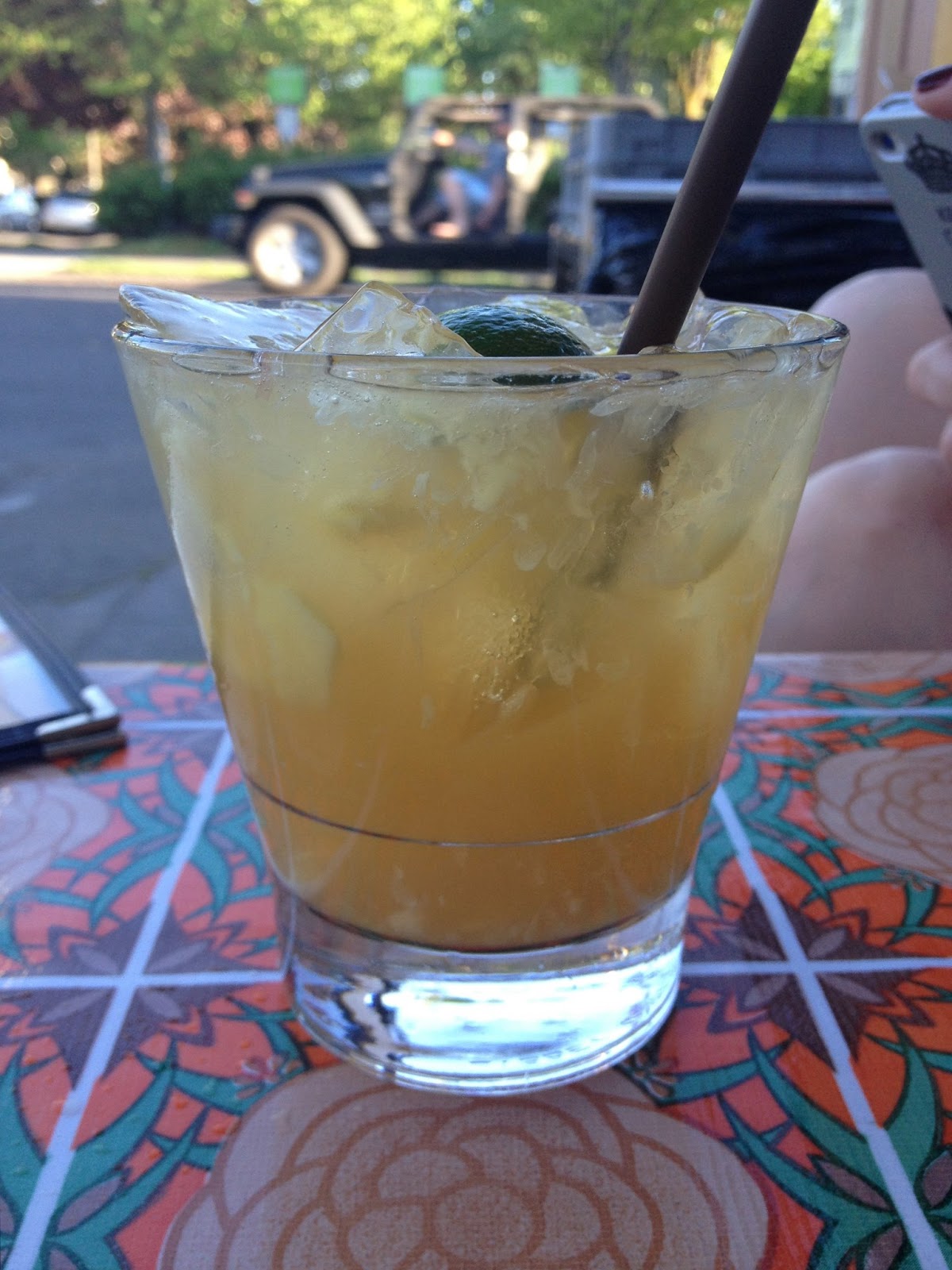
Parked outside on the street beside a drinking establishment on a phenomenal spring day is rough duty, I know. But we suffered through it by ordering drinks, my favorite Asian lager, a Singha for me and one of the house specialty drinks, a Khing and I for Ann, and settling in to watch the people go by. Ann's cocktail was mekong (a sugar cane whisky much like rum), lime, ginger, and ginger syrup, the pun being that ginger in Thai is khing. I doubt a lot of people get that little pun, but I have cooked a ton of Thai food in my life, albeit southern Thai food and not the northern and Chiang Mai-style food served at Pok Pok.

My Favorite for Spicy Food
And what is the point of being at a drinking establishment at happy hour without having some drinking food? A dish on the menu caught my eye: Som Tam Thawt. I know enough to know that this is the traditional green papaya salad, but the last word—thawt—got my chef wheels spinning. That's one transliteration of the Thai word for deep-fried. Deep-fried green papaya salad?!?!! Gotta have it! And what a beautiful sight it was too. The papaya and long beans were battered very lightly and fried gently and the traditional dressing was served on the side. Too awesome!

Som Tam Thawt (Deep Fried Som Tam): How Freaking Awesome!
Sitting on the sidewalk, we have passed the hour mark and are now at an hour and fifteen-minute wait for Pok Pok. Ann, who has been suffering silently for weeks, can no longer suffer in silence and it is perfectly clear that she is feeling poorly and needs to go back to the B&B. I know this and I resign myself to asking for the check and passing up on the one restaurant that I came to Portland for. I would do this for her. Just at that moment, a server came up to us and asked us to cash out, that our table at Pok Pok was ready to go. Knowing how much I wanted to go, Ann put a brave face on it and we walked across the street and entered the bedlam that is Pok Pok on a Friday night. She would do that for me.

Because Ann wasn't feeling well, we ordered in a hurry and ate in a hurry. We ordered an appetizer and two main dishes to be delivered at the same time. Like everyone else in the place, we ordered a plate of Ike's Vietnamese Fish Sauce Wings, huge fried wings tossed in a gooey fish sauce caramel. I won't do that again. I liked the wings, but they weren't stellar. They were huge to be sure, but I have made lots better fish sauce caramels in my life. Chicken wing box now ticked off, I would explore the rest of the menu if I ever had the chance again. If you are visiting Portland and want the wings, go to Whiskey Soda Bar and grab a couple drinks and some wings. You won't have to wait on line.

Ike's Vietnamese Fish Sauce Wings
The two main dishes we ordered were Da Chom's Laap Meuang, a Chiang Mai-style spicy minced pork dish, and Kaeng Hung Leh, a Chiang Mai-style pork belly and pork shoulder curry of Burmese origin. The Burmese curry powder tastes predominantly of coriander and I noted lots of long thin strips of ginger in the curry as well; it had a slight sourness that I attribute to tamarind though I could be wrong about that. The laap/larb was exquisitely superior to any other I have ever eaten in my life. I would have liked less oil in the dish, but the flavor was incredible. I have had lots of larbs and lots of curries from all over Asia, but nothing like these two dishes. And that's why I came to Pok Pok. Mission accomplished.

Da Chom's Laap Meuang
Kaeng Hung Leh
One thing about the Pok Pok business model confused me. Rice costs extra and the servers are constantly hawking rice, it seems as a ticket builder. The three kinds of rice are all around $2 a portion. I'm not looking to cheap out and I want rice with my meal, so ordering rice wasn't a big deal, but it was an issue for several tables that I saw. Why not build the rice into the price of the meal and save the servers the song and dance and having to deal with pissed off wannabe cheap customers?

If I lived in Portland, Pok Pok is where I would hang out on my days off. I would finagle my way into the kitchen and would happily pound chiles in the pok pok all day long just to see how the dishes are made and to start picking some brains about northern Thai cooking.

[Note: Andy Ricker closed his entire Pok Pok empire as of the fall of 2020. I'm sad.]

Tuesday, April 3, 2012

Singapore Noodles

Yesterday was such a beautiful spring day and I had finished all my Monday paperwork and errands and was home by the civilized hour of 4pm. By 5, it had cooled off enough to move outside and enjoy some Garnacha on the patio. What you see below is a classic Ann-pour. Our glasses are marked with a pour line so that the servers pour a consistent amount for each glass. The bottom of the W logo represents a 5-1/2 ounce pour or a fifth of a bottle. When Ann pours for herself, note how far up on the W logo it comes! Also note last year's parsley bolting to the right of the water bottle in our little garden.
I very rarely get in the mood for any kind of food. I'm a classical omnivore; if it's for dinner, I'm all about it. But yesterday I had Singapore noodles on the brain. By the way, Singapore refers to a style of noodle flavored with Madras curry powder, not a noodle dish that you might find in Singapore. While it's not a dish from Singapore, it's also not an American one either, being more of a pan-Asian fusion dish that is common in Hong Kong. Moreover, it is one of my favorite of favorite noodle dishes.

Below you see the mise for this dish, absent the bean sprouts, thin egg noodles, Madras curry powder, and fish sauce. From the chorizo clockwise you see ginger, garlic, preserved vegetable, green onions, edamame, and cilantro.

Before you go getting all technical on me, I'm going to state that I have had Singapore noodles hundreds of times and I know that they are traditionally made with very thin rice noodles. I also know that the best I ever ate in a crazy good hole in the wall Chinese place was made with wheat noodles like I used here. And chorizo? Yes, chorizo because it was what was in the fridge. Traditionally the dish is made with char siu, Chinese roasted pork. Well, damn it, I didn't feel like making my own char siu, which is the only way to get it around these parts. And, consider the role of the char siu in the dish. It is there for its bright reddish color and for a little punch of flavor. And that's exactly the role of the chorizo in the dish. A thrifty Chinese cook would approve.

The edamame are definitely not traditional either, but you'll find every kind of vegetable garnish known to man in some version somewhere. I was just looking for bright green color and there were edamame in the freezer. Typically, I make the dish with slivered yellow onions, because Madras curry and onions is a match made in heaven, but I had these gorgeous green onions that needed to be used.

In other words, it's my dish and I'll fry if I want to, fry if I want to! All I am saying is relax: noodles, like soup, are a great vehicle for whatever ingredients are at hand.

Below you see the finished dish, a result of sautéeing all the ingredients while the noodles were cooking, adding the drained noodles to the toppings, and finishing to taste with copious amounts of curry powder and fish sauce.

Mendocino, Part 4 of 4

Friday October 2 As I came to, the raspy gargles of a pair of ravens sitting in the eucalyptus just outside our open balcony door greeted me...