Showing posts with label poblanos. Show all posts

Wednesday, October 15, 2025

Quick Dinner for Ann's Girlfriends

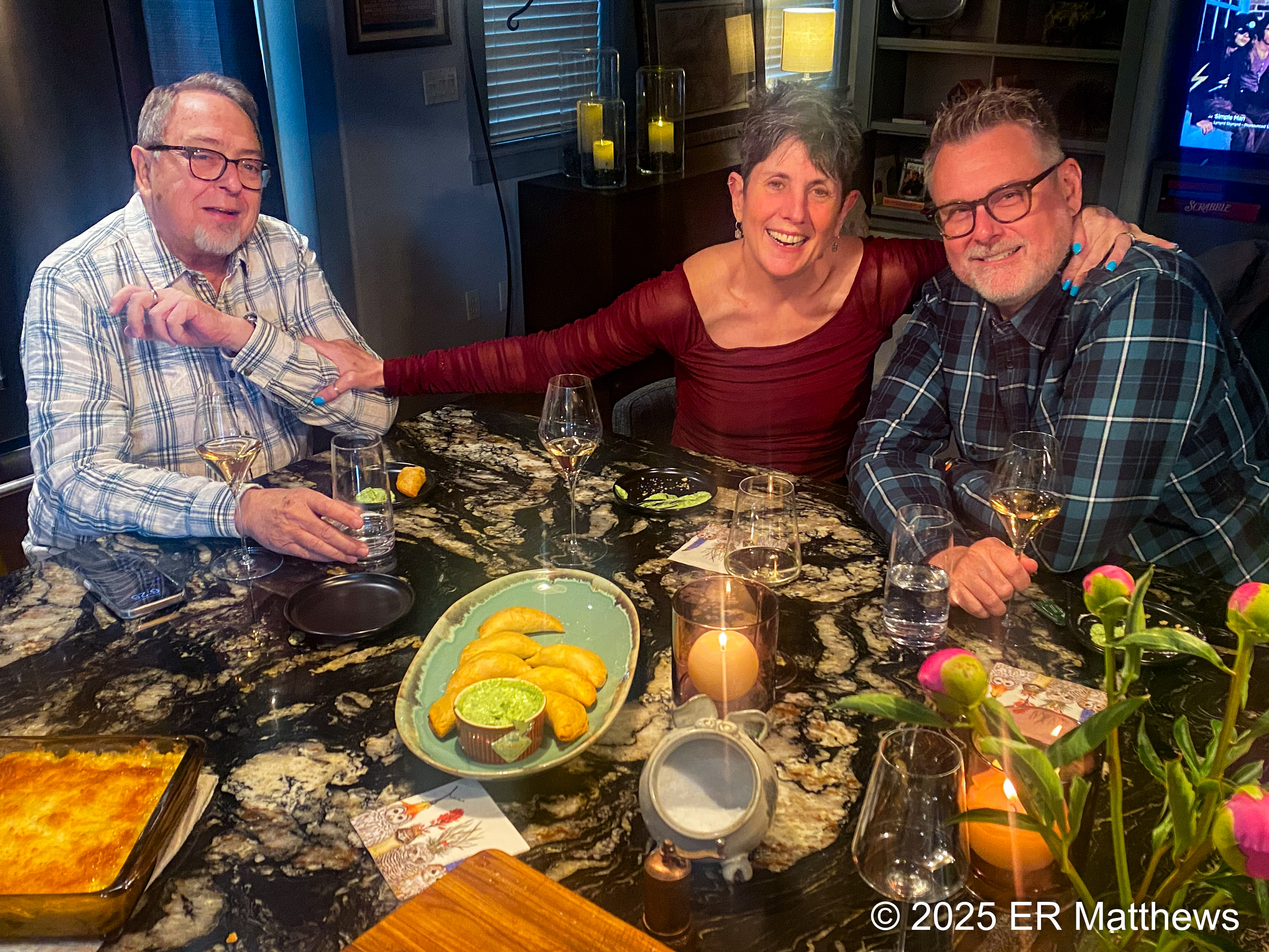
Ann invited Erika and Michelle over for dinner just so that they could catch up with each other. I cooked a quick gluten-free vegetarian dinner and we sat around the counter and yakked for a few hours.

Erika Makes Gorgeous Flower Arrangements
My First Time Seeing the Yellow Kangaroo Paw Flowers

I Shoot a Bunch of Candids When People Are Not Expecting It
Sometimes, I Get a Gem

Chips with Pineapple Salsa
Posole Casserole with Poblanos and Fresh Corn
Michelle Made Mexican Chocolate Mousse

Wednesday, May 21, 2025

A Southwest Dinner

We're getting close to the summer travel season when we are going to be on the road somewhat often. Before we leave for Virginia for my daughter Ellie's wedding, we wanted to have Rob and Dyce over for a casual dinner.

Rob and Dyce Brought the Most Gorgeous Peonies
I really am trying to avoid dinners with lots of last minute cooking so that I can relax and focus on guests. That shifts meals towards braises and dishes without touchy timing. Ann had kindly suggested all manner of dishes, but nothing grabbed me.

Unclear on what to make and rooting through the freezer, I found a bag of cleaned and cubed pork shoulder from a foray to Costco. Their shoulders come in two packs and that's a ton of meat. I typically break down both shoulders into cubes for braises like carnitas and freeze what I don't need right away.

Knowing that Rob and Dyce are fond of New Mexican food had me thinking along those lines and so I decided to make chile verde. After pondering for a few days, I decided to make a posole casserole to accompany the pork, and to offer empanadas for an appetizer. After a week of beautiful weather, it cooled off again and the choice of heartier food seemed lucky and apropos.

Then I remembered the heirloom masa harina that Ann gave me for my birthday and I decided to make tortillas to accompany the meal. And so the menu was set with the only last minute task to cook the tortillas. Somehow in the course of moving, my tortilla press did not make it to this house and so I improvised using a cast iron pan and a cut open Ziploc bag.

Empanadas de Picadillo Dulce, Cilantro Aïoli
Empanadas I make with an egg-enriched pie crust that never fails to bake up flaky and golden brown especially when brushed with an egg wash. Habitually, I fill empanadas most often with picadillo dulce, a sweet and sour pork that I first learned about by reading old Spanish-language recipes in the Biblioteca Nacional de México.

The filling is clearly of Moorish origin, containing almonds, olives, and sometimes raisins, though I have made it my own through the years. This version was ground pork shoulder, almonds, olives, onion, poblano chile, garlic, Mexican oregano, and three types of dried red chile (the majority ancho). I made it sweet and sour with brown sugar and Sherry vinegar. I have outlined the process in a previous post.

Masa Balls for Tortillas
Ghetto Tortilla Press: My 1930's Griswold Skillet
Tortillas on the Table
Chile Verde, Posole-Chipotle Casserole, Tortillas
Chile verde is not a recipe but an idea. At essence, it is cubes of pork braised in a salsa verde. There are as many ways to make it as there are cooks and they are all wonderful. I am certain that I make it differently each time and this time, I used the slow cooker to free our single oven to use in baking the posole.

For chile verde, there are two essential steps. First, make a salsa verde and second, brown the meat and braise it in the salsa.

For salsa verde, I roasted at high temperature (say 400F) a sheet tray of poblano peppers, Anaheim peppers, onions, garlic, and tomatillos. I rotated the chiles as each side became blistered. Once done, I pulled the tray out and covered it in film so that the veg could steam until cool and loosen the pepper skins.

Next up, I skinned and cleaned the peppers, dicing and reserving three or four Anaheims for the posole casserole. The peppers, garlic, tomatillos, onion, and a bunch of fresh cilantro went into the food processor. I blended it until roughly smooth and put it in the slow cooker.

For the pork, in recent years, I have adopted a process by which I only brown one surface of the cubes. This provides great flavor while not drying out the pork. After browning all the pork and putting it in the food processor, I deglazed the pan with a splash of water and poured all the porky goodness into the slow cooker with the pork and salsa. Eight hours later, the pork was tender and the sauce reduced to just the right thickness.

The posole casserole, something I started making in my 20s as a broke graduate student, I assembled in the afternoon and put into at 350F oven about 90 minutes before we were ready to eat. Timing is not critical, a delightfully brown crust is.

I admit that I did not make my own posole, though I could. I bought two 28-ounce cans of commercial hominy, the same Teasdale brand that I used in the restaurant. One can each of yellow and white hominy went into a mixing bowl with the reserved chopped green chiles, half a bunch of sliced green onions, and the kernels of one ear of fresh sweet corn for contrast and variation on the corn theme. Purple hominy (maíz morado) would have been cool, but my store had none.

I bound the casserole with a chipotle béchamel: olive oil and a spoon of flour cooked for a minute, then a pinch of salt and one finely chopped chipotle in adobo. After mixing the hominy and sauce, I adjusted the salt and put it into an oiled baking dish and topped it with a little grated white cheese. The result is as delicious as it is simple.

Making tortillas with modern masa harina is a trivial process of mixing the corn flour with enough water to make a workable dough. Then you roll it into balls and smash the balls between sheets of plastic (or a cut open Ziploc freezer bag in my case) in a tortilla press (or beneath a cast iron skillet in my case). We restaurant chefs are used to adapting and overcoming: no tortilla press, no problem. I can even patty them by hand, old school.

After peeling the masa circle off the plastic, it goes into a hot, dry frying pan on low to medium heat. Cooking both sides takes less than a minute and if I had a flat-top, I could have cooked them all at once rather than one at a time. Naturally, I could have fired four pans on the stove and cooked four at a time, but no matter. We were all busy yakking while I was pressing and cooking tortillas.

It should be axiomatic that a tortilla is only as good as the masa from which it is made. And if you use shitty Maseca or Masa Brosa, you are going to get a shitty tortilla. My masa is from Masienda and is processed from heirloom corn varieties grown on small farms in Mexico. It is expensive relative to the big brands (but even so, tortillas cost cents), but it helps sustain small farmers and preserve heirloom corn varieties.

Monday, April 1, 2024

Snowcap Beans and Chicken Adovada

In my further exploration of interesting beans, today's post features Snowcap Beans from Rancho Gordo cooked in the style of carne adovada from New Mexico. Rather than making it with beef, which we rarely eat, I made it with bone-in, skin-on chicken thighs.

Snowcap Beans and Chicken Adovada
A word on nomenclature: for you Spanish speakers, the pork dish marinated and cooked en adobo is called carne adobada, "marinated" in Spanish. Because the adobo/marinade/sauce is largely red chile, it can also be called enchilada ("covered in chile"). In New Mexico north of the border, however, the spelling has differed slightly (more along the lines of how some people pronounce adobada) to carne adovada. I use the New Mexican spelling to indicate that I'm making an American dish versus a Mexican one which typically features more spices such as cinnamon and allspice.

Snowcap Beans
Snowcap beans are new to me; I bought them because I have no idea what they are like and I like their great looks. The name snowcap is descriptive: they are large cannellini-sized kidney-shaped tan beans with chestnut stripes reminiscent of Borlotti or Bird Egg beans, the whole draped with a seemingly hand-painted blob of white. In short, they're beautiful beans.

After Overnight Soak in Salted Water; Ready for Par-Cooking
The first steps with these beans, like all dried beans that I cook, is to soak them overnight in lightly salted water and then to par-cook them until they are tender. As a rule of thumb, smaller beans will take an hour of simmering to partially cook, while the largest beans can take up to two hours. 

Browning the Chicken
Once the beans are nearing ready, I start by browning the chicken and then removing it to my slow cooker. After draining off any excess schmaltz (chicken fat), I start cooking my mirepoix of onions, poblanos, cilantro stems, and garlic in the same pan in which I cooked the chicken. 

When these vegetables were cooked, I added them to the slow cooker with the chicken and the now-cooked beans and their liquid. I added a half a cup of so of ground Chimayo chile to the pot along with a couple tablespoons of Sherry vinegar (vinegar being a key component of adovada), some Mexican oregano, and some salt. 

Slow Cooker Loaded and Ready to Cook
I put the slow cooker on low for several hours while Ann and I went out to the local pub for beers with friends. When we returned, lubricated and ready to eat, the aromas coming off the slow cooker were amazing. The verdict on the Snowcap beans is that they are large, plenty creamy, and delicious enough to want to reorder time and again.

Tuesday, March 26, 2024

Mexican Cassoulet

In response to yet another snowy stretch in March, Ann and I were looking for something warm and comforting. One of us suggested a White Chicken Chili, an easy-to-make slow cooker dish that we eat somewhat frequently in the winter. It's a simple stew of dried white beans, chicken thighs, onions, poblanos, chopped cilantro, garlic, and Mexican oregano with water to cover. I throw into the slow cooker in the morning and it cooks itself all day. The prep work is trivial: dicing the onions and chiles and peeling and mincing garlic, a matter of five to ten minutes. The results are wonderful for such a minor investment in prep.

A Bowl of "Mexican Cassoulet"
This time, rather than using the usual if unspectacular Great Northern Beans, I remembered that we have a big box of beans from Rancho Gordo in the pantry, so I went fishing in that box and pulled out a pound of Rebosero Beans. I don't know these beans from Mexico at all but they seemed like they would make a nice pot of beans with chicken and green chiles.

Somehow between putting the beans on to soak overnight and the next morning when I started to cook the beans, I decided to cook the chili in the style of cassoulet just like I had done recently with the Tarbais beans that I got from Rancho Gordo.

Rather than dump everything in the slow cooker, I proceeded just like cassoulet. Step one was to par-cook the beans with two cloves of garlic and two bay leaves. Step two was to brown the bone-in, skin-on chicken thighs. Step three was to cook the mirepoix (poblanos, onions, and minced cilantro stems) with a bit of Mexican oregano and garlic. Step four is to mix the beans with the mirepoix and put half of them in a casserole. On top of this, I layered in some very spicy green chile that Rob and Dyce brought back from their last trip to Santa Fe.

Next, in went the chicken and then the rest of the beans on top. The final step was to pour all the bean cooking liquid over the top and then put the uncovered casserole into a very slow oven for about six or seven hours. Unlike a traditional cassoulet, I did not punch the crust down and let it re-crust, for the simple reason that we were not home.

Rebosero Beans Soaking Overnight
Par-Cooking the Beans
The Finished "Mexican Cassoulet"
The results were quite astoundingly good. And I'm in love with these rebosero beans. They are certainly my new favorite bean for refried beans, far surpassing Mayocobas, my previous favorite.

Wednesday, January 17, 2024

Storm Day

We've been staring down the barrel of a winter storm warning for a few days, a warning on the books ever since the prior storm dumped on us on earlier in the week. This weekend was predicted to be extremely cold with a lot of snow. And oddly enough, the forecasters got it largely correct. Saturday the 13th, the snow really started ripping just before dawn and continued for the next 24 hours, a big, big powder day with plenty of wind and arctic temperatures.

Storm Progression, Saturday 10:30
Storm Progression, Saturday 16:00
Storm Progression, Sunday 07:45
All in all, it was just a day to hole up inside and let the storm rage while we sat under blankets by the fire, made some great food, and watched a little playoff football. My short perusal of social media led me to believe that pretty much the entire town was holed up at home as well. I don't believe that even the Mt. Bachelor ski resort was open in the face of this storm. I saw some pretty gnarly footage of the chairlifts iced up and swinging wildly in the wind.

As nice as sitting bundled up by the fire sounds, the day was punctuated by my shoveling the walk and the driveway three times, dawn, noon, and dusk, and really getting cold. Worse, all this shoveling really exacerbated my hurt back to the point where I can barely walk now, days later as I type this. I'm now in about day 10 of a big flare-up. No fun this feeling of being sliced unanesthetized with a flaming knife.

The temperatures Saturday ranged from a high of 1F at dawn to a low of -7F just after sunset and I could only be outside for a few minutes before the pads of my fingers went from stinging cold to numb and insensate, despite my gloves.

I was wearing my US Army combat gloves, the heaviest ones I own that still allow my fingers some mobility and still, ten minutes of shoveling was all I could take before coming in to warm up. For weather like this, I really needed my thin merino base-layer gloves with some big overmitts, but how to shovel with this set-up?

After the first shoveling expedition of the morning and a couple cups of delightful coffee, the first inside order of business was to get something delicious cooking for dinner. Fortunately, I had the foresight the night before to put a couple of pounds of Great Northern beans on to soak. In the winter, I always try to keep the pantry stocked with dried beans, just for times like this storm day.

White Chicken Chili About to Start in the Slow Cooker
Ann had mentioned wanting white chicken chili the day before (hence my soaking the beans) and I happened to have a big tray of chicken thighs that I was going to roast. I repurposed four of those chicken thighs for the chili, leaving the other six for roasting later in the week.

My idea of white chicken chili is white beans, onions, green chiles, cilantro, and garlic, all put in the slow cooker early in the morning and ready to eat by dinner when the chicken falls off the bone into the creamy beans.

In this case, instead of the yellow onions that I normally use, I had a large leek and half a bunch of green onions that had no other purpose, so into the pot they went. And I remembered that Dyce had given us a pint of New Mexico green chile, so that went in as well, with only half as many poblanos as I would normally use. Those New Mexican chiles had a bit of a sting to them!

A few hours later after smelling the beans and chicken starting to cook, Ann and I got pretty darned hungry, so around noon, it was Mission: Lunch. For New Year's Eve, we had planned a really impressive latke board to take to Dyce and Rob's to celebrate the New Year. I had prepped almost everything necessary for the board before the night got called off on account of illness, so we had lots of components already made in the refrigerator heading into this storm weekend.

These items really needed to be consumed before they went bad, so we set about eating them (but still holding onto the caviar in hopes that we can still share it with the guys in the next week.) Ann proposed for brunch that I do something using the smoked salmon that I had brought in from Scotland for New Years and using the loaf of bread that we had slated for another dinner that got axed for illness.

Smoked Salmon Smørrebrød  
Given that I had already prepared two great schmears for our latke board, a smoked salmon mousse and an egg mousse, I set out to make smoked salmon smørrebrød. Smørrebrød are wonderful and beautiful Danish open-faced sandwiches that started as butter on bread, but have evolved into a thing, now fully part and parcel of Danish culture.


The smørrebrød that I made for our lunch consist of smoked salmon mousse, smoked salmon, egg mousse, cornichons, and dill. The smoked salmon mousse is cream cheese, dill, minced capers, and locally hot-smoked salmon. The egg mousse is soft-cooked egg yolks, mayonnaise, dill, minced cornichons, minced capers, salt, and a touch of pimentón for a smoky je ne sais quoi.

Chardonnay by the Fire
While I was busy assembling the smørrebrød, Ann opened a bottle of wine, a Walter Scott Chardonnay. I wasn't really paying attention or even thinking too much (the pain from my back taking center stage) or I might have warned her off Chard to go with our smørrebrød. Even though Willamette Valley Chardonnay is relatively lightly oaked, oak still clashes mightily with fishy fish and smoked salmon is fishy fish. Oak makes the fish even fishier to the point where it's not fun.

While Ann offered to open something different (a sparkling wine would have been excellent), the solution was simple. Eat first, drink after.

At dusk after shoveling the walk and driveway (this really was snowblower snow) while watching the snowmobiles zip up and down the street, I came in to find that Ann had made us a cocktail to sip while we watched the AFC playoff game. Using the new high-end cocktail set that I gave her for Christmas, Ann mixed cocktails of mezcal, tequila, Ancho Reyes, agave, and lime and served them in a coupe rimmed with smoked salt. This was her best effort yet in that the acid balance was perfect.

Ann's Mezcal Cocktail
We don't watch a lot of football because we cut the cord a long time ago and are not willing to pay for the right to watch games. Also, we can take football or leave it. This is the first time that I can remember that a game has been live-streamed on an outlet that we get. From the get-go, the Chiefs crushed the Dolphins to move on to the divisional round of eight.

Watching Football on a Nasty Day
The announcers, in the pre-game yammering, were making a big deal about the weather in Kansas City delivering one of the coldest game time temperatures in NFL history at -4F. For giggles, I checked our temperature here in Bend (on a day when our high was 1F): seven below. I know what the players were feeling; I had been shoveling in that weather all day.

Cold, Cold Evening
As the game was nearing half-time, I served up white chicken chili from the slow cooker. It's hard to imagine a better dish than this on a very cold night. In fact, it was so cold that we opted to stay downstairs and watch the game by the fire, rather than go upstairs and watch it on the big TV. We keep it intentionally warmer downstairs where we spend the day and cooler upstairs where we sleep.

White Chicken Chili
When we went to bed after the game and after some more TV, it was still snowing, but it was definitely not dumping as hard as it had earlier in the day. Overnight, we added another 4-5 inches to our total accumulation, necessitating another early morning shoveling in the frigid air. Fortunately, 24 hours after the storm hit, it was no longer snowing, a flurry or two here and there excepted.

After coming in and warming my stiff fingers by the the fire, Ann and I enjoyed coffee by the fire and stayed near that fire all morning. If my back were not currently ripped to shreds, we would have been out snowshoeing through all the gorgeous new powder. It sucks to be sofa-bound after a big storm has just dumped oodles of fresh powder!

Late morning, Ann asked me to make some eggs with the smoked salmon leftover from yesterday's smørrebrød. As I headed in to the kitchen to get started, I saw the partial loaf of bread also leftover and quickly a plan came to mind. I still had lots of both chives and dill leftover from our aborted attempt to make a latke board for New Years and I decided that the chives should go in the eggs and the dill into a savory French toast.

Eggs with Chives, Smoked Salmon, Savory Dill French Toast
French Toast Almost Done
Dill French Toast Topped with Smoked Salmon and Chive Scrambled Eggs
After all the powder had blown off the tree limbs, we had a freezing fog event that deposited stunning ice crystals on all the plants. Our front yard was a veritable winter wonderland and I leave you with these parting shots.

Now that we have all this spectacular snowshoeing-depth snow, if I could just get my back straightened out to the point where I could walk....

Monday, June 19, 2023

Father's Day 2023

Ann set up a dinner with Rob and Dyce on Father's Day in which she planned to make risotto-stuffed poblano peppers. I love it when she cooks. Rob and Dyce volunteered to bring some cheese and wine to kick off the evening. I ended up making a Margarita sorbet for dessert. All in all, a great evening.

Ann's Risotto Stuffed Poblano with Lime Crema
Rob and Dyce went way overboard with the cheese, including artfully arranging the three cheeses on a board with grapes, figs, dried apricots, Marcona almonds, a jar of chutney, and three types of crackers. The three cheeses were a Comte, a locally smoked Cheddar, and the star of the show, a super runny Quinta from Point Reyes Farmstead Cheese Company. This is a bloomed rind cheese similar to Vacherin Mont d'Or and was so ripe that we sliced the top off and scooped out all the yumminess from inside.

Rob and Dyce's Cheese Board
Poblanos, Peeled, Seeded and Ready to Stuff
Early in the day while Ann was out, I torched the poblanos, then peeled and seeded them. The procedure for this is outlined in a post from a few years back. Also, I sliced some fresh corn from the cob for Ann's risotto. Later in the day, Ann took over in the kitchen and made the risotto base, then stuffed the poblanos, and readied them for the oven.

Kitchen Queen Making Risotto
Once the risotto base was done, she stirred in some fresh corn kernels, a bit of chipotle adobo, and a big handful of grated pepperjack cheese to make the filling for the poblanos. The peppers got a sprinkle of cotija cheese on top before going into a hot oven for 40 minutes, followed by five minutes under the broiler to brown a bit.

Poblanos Rellenos Just Out of the Oven
After dinner, I started up the venerable ice cream machine on a Margarita sorbet base that I made earlier in the day, recipe below. I have never made such a sorbet before and took a wild guess at how to make it. The end result was awesome, so I wouldn't change a thing. It is somewhat expensive to make, however, requiring a lot of fresh limes and most of a bottle of tequila. The results though!

It Takes a Lot of Limes to Make Sorbet
My Venerable Musso Ice Cream Machine
Part of the reason for the success of the sorbet was that I made a different one each night at the restaurant and so I have a lot of experience at it. But a bigger part of the success is down to the machine in which I made it, my 20-year old Musso machine from Italy. Weighing in at nearly 70 pounds, this beast is barely portable from the garage where I store it to the kitchen where I use it. It will knock out a half gallon of sorbet in about 20 minutes and will keep doing it all night long, witnessed by its use in the restaurant where it ran for the better part of each night, churning out intermezzo course after intermezzo course for over a decade.

The Margarita sorbet recipe follows. I have divided it into two parts for ease of explanation.

Tequila Simple Syrup

The following recipe yields about 2 liters of syrup, a bit more than you will need to make a 2-liter batch of Margarita sorbet. Save any leftover tequila syrup for your bar where you can use it in tequila and mezcal cocktails. I have specified a liquid volume of sugar because I am lazy: I use a single one-liter measure to measure the sugar, then the liquid ingredients, limiting the amount of dishes that I have to wash.

500 ml reposado tequila
1500 ml water
500 ml granulated sugar

Add the three ingredients to a 3-quart or larger saucepan, stir well, and bring to a slow boil. Once all the sugar is incorporated into the syrup, turn off the heat and let the syrup cool before using. Syrup can be stored at room temperature for a couple of days. For longer storage, I put it in a squeeze bottle in the refrigerator.

Margarita Sorbet

This is a base recipe for 2 liters (basically a half gallon) of sorbet. 

juice of a dozen limes (about 500 ml)
enough tequila simple syrup to make 2 liters (about 1500 ml)
one shot of Curaçao (about 50 ml)

Mix all the ingredients and taste for sugar-acid balance. I like mine on the tarter side. Add more lime juice or tequila syrup as you see fit. Refrigerate until cold before putting it in your ice cream machine. Adding the bit of alcohol in the Curaçao will help to lower the freezing point of the mix and will help ensure a smoother sorbet with smaller ice crystals. It will also extend the freezing time by a bit (in my case, 25 minutes versus 20 minutes). You can transfer the sorbet to a freezer for a half hour or so to fully firm up.

Hatozaki Small Batch Whiskey
We finished the evening with a nightcap of Hatozaki Small Batch whiskey. I'm a devoted Scotch drinker, but recently I have been branching out to taste malts from other part of the world. I find this whiskey, like almost all Japanese whiskey, smooth and mellow. I prefer rougher and tastier Scotch, but it is no real hardship educating myself on the worldwide differences in malts. Happy Father's Day to me!

Ode to the Tortilla

I love tortillas. It wasn't always that way. I am a child of the early 1960s. Then, on the East Coast, our food was influenced by two th...