Years ago during chefdom, I would put on an annual cooking with herbs demonstration at the State Arboretum of Virginia,
Blandy Farm, during the fall garden fair. I loved being out in the the courtyard, some years battling intense wind, thunderstorms, or brutal sun, doing what I do. After the demo, after all the questions were answered, and after all my gear was packed, I would then have the time to wander the booths and talk to the vendors.
Early on in my string of demos, I encountered a vendor named Michael from Afton, VA, just outside my hometown of Charlottesville. Michael's company was called
Edible Landscaping. He really opened my eyes to using edible plants in landscaping, as opposed to my then-mindset that edibles only go in this separate area called a vegetable garden.
After we moved to Oregon in the fall of 2017, we purchased a newly built house right at Thanksgiving, well into our rainy season. Not wanting builder-grade plants, we had our entire tiny soupy mud parcel simply covered in mulch, what the locals call bark dust. There was not a single plant on our property.
In the spring of 2018, I started planning and planting. As a chef, food is critical to me and planting edibles in our landscaping resonates with me. The first critical decision and purchase was where to place the fig bush. To be fair, it wasn't a bush back then, but a mere whip 24 inches tall. Now in 2020, our third gardening season, that fig bush has hundreds of baby figs and our lot is completely planted. A great many of the plants are edible and mixed in with the ornamentals. In fact, we don't have any space big enough for a traditional vegetable garden.
Here is a brief walk-through of some of the edibles in our landscaping. Maybe you'll be inspired to put edibles in your yard and maybe if you're near central Virginia, you'll go visit Michael in Afton.
Fruit
The major focal points in our landscape are fruit trees or shrubs. We're fortunate to live in a Mediterranean climate that allows us to plant figs and olives. On the downside, it is harder to grow apples and peaches here without enough really cold nights to achieve the necessary dormancy periods, but we can really grow some plums.
 |
Prune 'Brooks'
|
Brooks is an Italian-type plum that was discovered as a sport in an orchard in the next town over of Lafayette, OR and was a workhorse of the dried prune industry here in Oregon. As fresh fruit, they are one of the tastiest plums I have ever eaten.
 |
Olive 'Arbequina'
|
Here in the Willamette Valley, our climate is right on the edge for being able to grow olives commercially. We do have a local olive farm with its own
frantoio (olive mill) and the oil they produce is superb. Most people are having the best luck with Arbequina because it is among the most cold hardy of the olives. OSU is actively testing and promoting olives as a crop here.
 |
Fig 'Brown Turkey'
|
Whether you consider a fig a shrub or a tree is a point of debate. While I vigorously prune mine to keep it harvestable without a ladder, I know of one nearby that reaches to 50 feet tall and wide, a vast shade tree. Coming from Virginia, we're used to significant winterkill in our figs, even though we were growing Chicago Hardy. The worst we've experienced here is a Mother's Day frost in 2019 that knocked down the uppermost leaves. So, I really have to prune the heck out of this beast to keep in under control. From a 24-inch whip in March of 2018, we'll probably get a bushel of figs, if all this green fruit ripens. Brown Turkey is larger but less tasty than Chicago Hardy, but a fresh fig is a fresh fig and probably my favorite fruit.
 |
Grape 'Pinot Gris'
|
McMinnville is the capital of Oregon wine country, as Beaune is the capital of Burgundy wine country. It is fitting then that we should grow wine grapes in our yard. Last year, I turned the harvest into Pinot Gris Chipotle jelly. This year, who knows? Because we have precious little gardening space, much of our focus is on vertical gardening. This grape is a case in point. I have it pruned and espaliered against a vertical trellis that separates one "room" in the garden from another, a green screen that hides your direct view of what is beyond it and invites you to walk further to investigate.
 |
Evergreen Huckleberry
|
Besides planting edibles, planting natives also resonates with me. In this Evergreen Huckleberry, I have a twofer. Not only does it grow wild all over the hills here, especially towards the coast, the tiny blueberry-like fruits are delicious.
 |
Earliglow Strawberries
|
Our back yard offers some landscaping challenges, among which is that the north edge of the yard is framed by the side of our garage. To use the blank space that the windowless garage wall offers, I built a bamboo scaffolding bolted onto it, for vertical gardening. More challenging is that a concrete sidewalk runs along the base of this wall, forcing us to plant in galvanized bins sitting on the concrete. The southern exposure of the scaffolding means brutal heat and bins that dry out quickly.
The smallest of our edible fruit landscaping comes in the form of strawberries whose primary purpose is to shade these bins and to help stem as much evaporation as possible. Out here in Oregon, we have our pick of strawberry varieties bred to our climate (Hood, Tillamook, Totem, and Rainier for example) but I have been growing awesome tasting Earliglow berries most of my adult life and didn't see any need to change. Growing in 14-inch high bins, these strawberries are at perfect plucking height for our two dogs, who consume most of the ripe fruit when we are not looking!
So much for edible fruit. In the yard, we also have other fruit trees as specimen plants, grown for their stellar blooms in the early spring. These include two large ornamental plums and a weeping cherry, both with insignificant fruit that you really wouldn't want to eat.
Herbs
As a retired chef, I cannot imagine being without fresh herbs ready to hand. I have long contended that one of the significant differences between home and restaurant cooking is the abundant use of herbs in the latter. Besides the perennial herbs below, we also grow annual herbs in pots: parsley (technically a biennial, but grown as an annual), Genovese basil, dill, and Thai basil. We also grow our perennial spearmint in a pot, so as not to have it overrun the yard.
 |
Lovage
|
If you have a lovage bush, you will never need to buy celery again, except perhaps in the middle of winter when the foliage dies back. Lovage is pleasantly more bitter than celery with a haunting and slightly more herbaceous flavor and an incredible aroma. It's like someone put flavor enhancer on celery. Critical for an awesome Bloody Mary, lovage is big tall plant (ours tops out around 7 feet) whose foliage can add drama and a focal point to any garden.
 |
| Culinary Sages, Salvia officinalis |
The Salvia family is one of my favorites: culinarily, to soften the landscape, and as a hummingbird magnet. We have three different culinary salvias in three different shades as you can see. The gold one doesn't have the best flavor, that award probably going to the purple one, which is planted out on the front sidewalk where our neighbors can help themselves whenever they need sage.
Americans really underappreciate this herb, using it mainly at Thanksgiving for poultry seasoning. For my full-blooded Italian wife, however, sage is indispensable. The very first meal that Ann ever cooked for me was pasta in sage butter and I could not have been happier with any meal ever. When you are a chef and everyone is afraid to cook for you, a woman who will not only cook for you, but who will make an awesome plate of pasta, is a keeper. Needless to say, I use sage often and unsparingly in dishes.
Sage is one of those herbs that is probably better dried than fresh, so in the fall, I cut big bunches of it and hang it to dry. Woe unto the health inspector who would dare to come into our kitchen at the restaurant and bitch about the bundles of sage dangling from the ceiling. Several tried, among them ones who would also complain about buckets of eggs on the counter. I guess at their houses, their chickens had refrigerated butts.
In the landscape, the tubular flowers of the sages are irresistible to hummingbirds and hummingbirds are one of the great joys of our yard. We probably have ten different species of Salvia in the yard, comprising 25-30 different cultivars. The huge Salvia guaranitica 'Black and Blue' in the back yard next to the fig bush is a hands-down favorite of our little female Anna's Hummingbirds, who viciously protect their sage from all comers.
 |
Silver Thyme, a Favorite for Flavor
|
 |
English Thyme
|
Thyme is one of the herbs that I cannot cook without. We have several thyme plants all over the yard, typically in the front of beds where the plants can function as low ground covers. Around and in our walkways, we also have a lot of creeping thyme, which blooms beautifully in July, but doesn't have any flavor to speak of.
 |
Greek Oregano
|
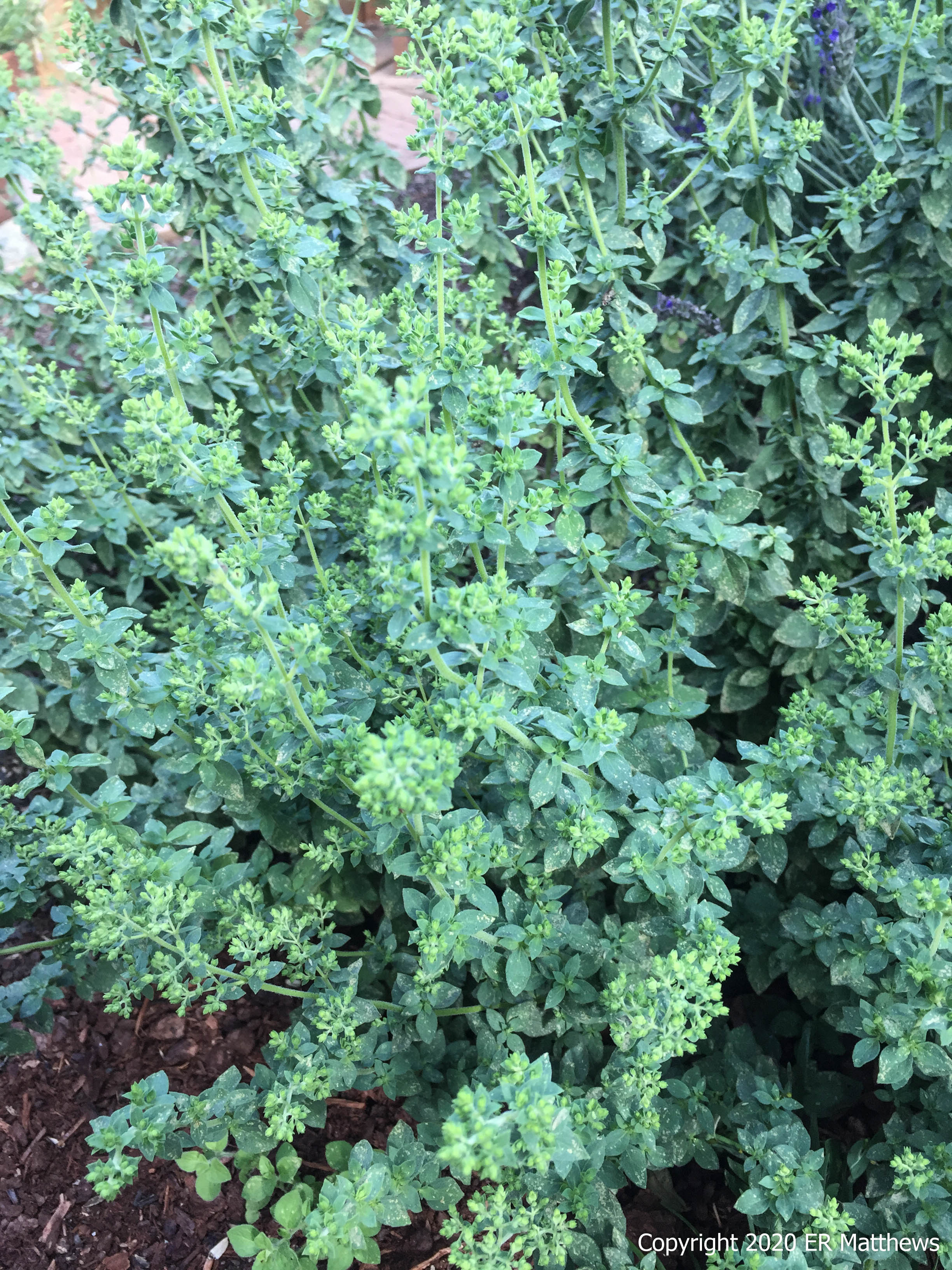
We have no shortage of oregano in the garden, including a decorative variety called Kent Beauty. This is another herb that works better dried than fresh, though I use plenty fresh in the summer.
 |
Chives
|
Chives grow insanely well out here in Oregon and we have large clumps of them all over the yard where their upright blue-green foliage and pretty purple blossoms are charming. They grow so well that I have divided and given away vast amounts to neighbors and to the compost pile. The vigorous growth is a good thing because we consume massive amounts of chives in our eggs and in other dishes. Be brutal with yours. Once they bloom, cut them back a couple inches above the ground and they will come right back. I cut these back about the first of June and they are already back up and blooming again at the Fourth of July.
 |
Rosemary
|
Rosemary grows into shrubs out here in the Willamette Valley. This is a big one that is a focal point in the back yard and which threatens to get out of control if I don't prune it. If you expand the photo, you can see the fig bush in the background and another large herb in between. We also have a conifer-shaped 'Arp' rosemary growing in a pot on our front porch. I mainly use that one for cooking, because I need to keep it pruned to shape.
Edible Flowers
We also grow some edible flowers that look great in salads and such, but which we grow mainly for their good looks.
 |
English Lavender
|
We grow lavender out here in the Willamette Valley like it's our job. Besides many large lavender farms, each yard will have at least one lavender bush. Ours is no exception, with perhaps a dozen or more varieties, none better than the old fashioned English lavender in the photo. Our friend Perrin gave us this venerable bush when she and Chris relocated from Beaverton to an apartment in downtown Portland. While I have used the flowers for garnish and to flavor dishes, mainly desserts, mostly we harvest the flowers and give bundles or sachets of it to our neighbors for gifts.
 |
Nasturtium
|
With beautiful edible flowers, edible leaves, and edible seeds, what's not to like about a vine such as nasturtium especially when you're working hard at vertical gardening? We mostly use ours to drape over the edges of flower boxes and hanging baskets, to lend a downward motion to our mostly upward growing vines. And because young nasturtiums transplant so well, if you let one go to seed in the fall, in the spring you can have all the baby plants you want for all over your yard.
 |
Calendula
|
Out here in Oregon, calendulas are perennial. They are prolific seeders, so if you live in a colder climate, you can let them go to seed to ensure a crop next year. The flowers come in all shades between yellow and orange, including the unusual one above with multicolored petals. The petals make great garnishes to dishes and can add a pop of color to salads. Ours get very leggy, so I have to be ruthless about pruning them.
Annual Vegetables
We tend not to grow annuals in our gardens, but many vegetables are annuals. Limited to vertical gardening, we grow beans and peas up our trellises and scaffolds.
 |
Sugar Snaps on the Garage Living Wall
|
 |
Scarlet Runner Beans in a Wine Barrel
|
That's a long-winded tour of some of the edibles in our yard. Perhaps it will be the inspiration to add edibles to your ornamental gardens.