Showing posts with label spinach. Show all posts

Tuesday, April 23, 2024

Lamb Chops and Gigantes Plaki

Spring is starting to arrive in fits and starts here in Bend although one day will be warm and sunny and the next brisk and cool. There's likely to be more snow to come but the grass is starting to green. And this is more than enough to get my grilling juices going after a winter of seeing the grill out by the patio under a mantle of snow.

Ann invited Michelle and Andreas over for dinner this past weekend, and Michelle's mom Jean was in town, so of course she was welcome too. I no longer remember the thought process behind the menu for the night, but I am pretty sure it was built around a bag of huge Royal Corona beans from Rancho Gordo.

Grilled Lamb Chops, Spinach with Onions and Dill on Gigantes
I decided to make these huge beans into the classic Greek gigantes plaki, baked beans in tomato sauce. I'm pretty sure that grilled lamb chops followed from this thought. After a sunny day that was great for cleaning up the grill after a winter of disuse, the sky turned partly cloudy and spit a little rain just before our guests were ready to arrive. Nonetheless, we turned on the fire pit and sat outside anyway.

Royal Corona Beans Soaking Overnight
Uncooked Huge Beans
After soaking the Corona beans overnight, I par-cooked them with a couple bay leaves, a few dried rosemary needles, and four smashed cloves of garlic. I started the beans at 2pm, knowing our guests would arrive at 6 and figuring it would probably be 7:30 before we sat down to dinner. At 5:45, I was a bit concerned about the beans. Although they had been softening constantly through the afternoon, three hours on the stovetop was insufficient to render them creamy. After another 90 minutes in the oven though, they were just fine. Whew!

Tomato Sauce for Beans
I made a simple tomato sauce for the beans by sautéing an onion, a large carrot, and two stalks of celery in olive oil with garlic, crushed red pepper flakes, a bit of fresh thyme, and a fair amount of dried oregano. I also added ground cinnamon, just what would fit on the tip of a knife blade. To me, this dish doesn't taste right without it.

Ann, however, has a different opinion. She has a pretty firm rule that anything sweet or any spice that we Americans consider a pie spice does not belong in a savory dish. So, the sauce wasn't her favorite.

Once the vegetables had started softening, I stirred in a tablespoon of really amazingly concentrated Sicilian tomato paste called estratto. Then, I deglazed the pan with the juice of a lemon and added a can of crushed tomatoes and let the sauce bubble away for 20 minutes or so, just to bring the flavors together.

At 5:45, I scooped the still-cooking beans into the sauce and mixed them well. After transferring them to an oiled half hotel pan, I drizzled a little of the bean cooking liquid over the beans and covered the pan. They baked covered at 350F until dinner time, about 90 additional minutes.
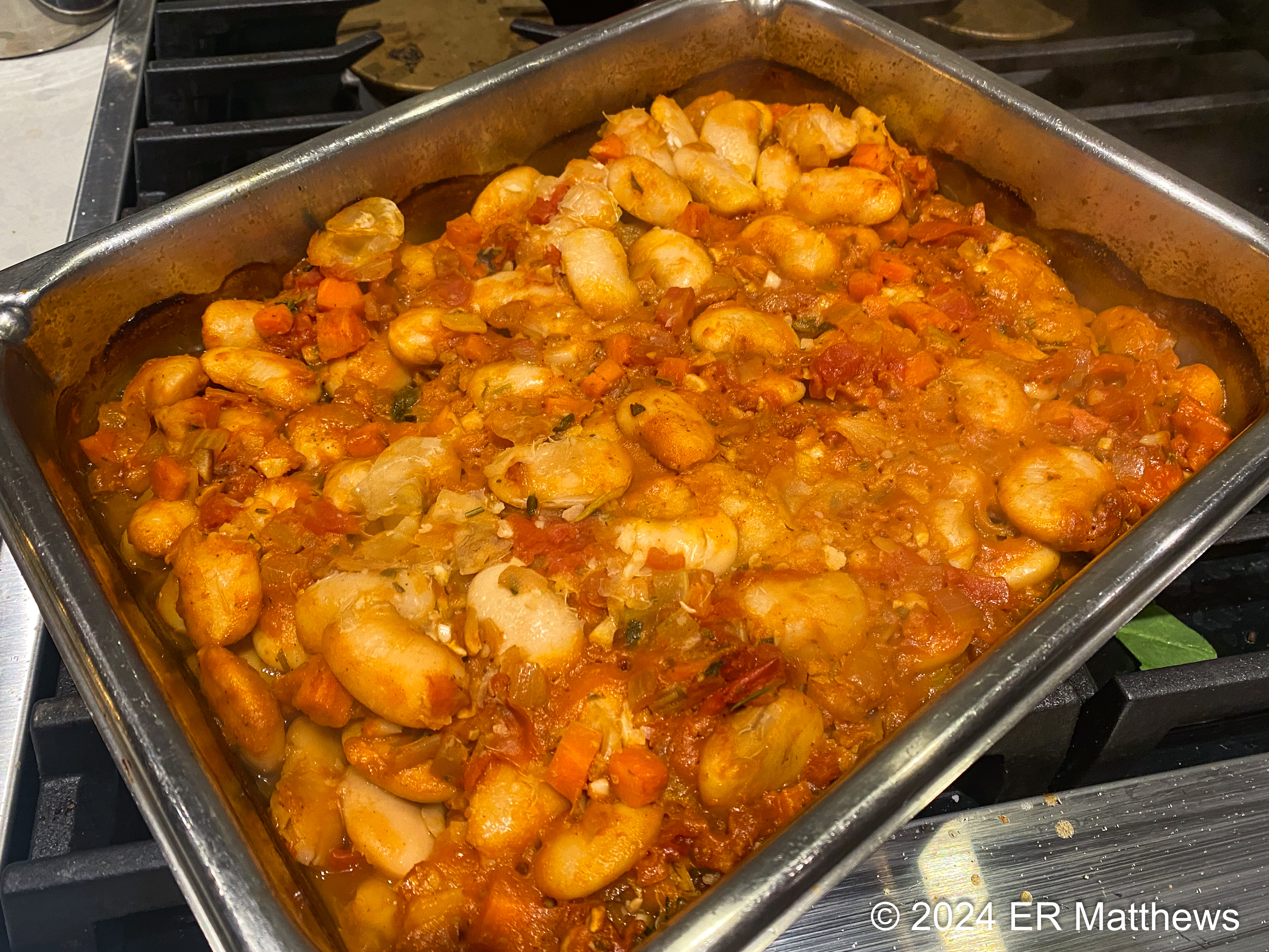
Gigantes Plaki
Our guests arrived shortly after I put the beans in the oven and Ann had poured me a glass of wine, a Semillon-Sauvignon Blanc blend from Walla Walla. We headed outside on the patio by the fire pit with a plate of risotto cakes to have for an appetizer. I like finger food for an appetizer and because Michelle is gluten intolerant, bread such as crostini is out. So, I tend to make rice cakes when she comes over.

Plain Risotto Base: Arborio, Onion, White Wine, Chicken Stock
Lemon, Dill, Feta, and Pine Nut Risotto Cakes; Tzatziki
I made a plain risotto with chicken stock, though I often use water. When the rice had cooled, I added a lot of lemon zest and fresh dill, a good sprinkle of crumbled Greek sheep's milk feta, a handful of toasted pine nuts, and two raw eggs. After mixing the rice well, I shaped it into cakes and seared the cakes.

First thing in the morning, I made tzatziki to accompany the cakes. Each time I make tzatziki, I make it slightly differently depending on what I have on hand and how I'm feeling, but I did publish a basic recipe here.

A Touch Chilly Outside Around the Fire
First thing in the morning, I put a bunch of lamb chops in the fridge to marinade. The marinade was quite simple: olive oil, a splash or two of red wine, a lot of chopped garlic, dried rosemary, and dried oregano. I turned the chops in the marinade every couple of hours.

Lamb Chops Ready to Grill
Lamb Chops, Ready to Plate
After I grilled the lamb chops, we headed inside where I cooked a couple pounds of small spinach. I chopped an onion and cooked it to tender in olive oil, then tossed in the spinach which wilted in short order. I added a big handful of fresh dill and seasoned with salt.

I decided to plate at the stove rather than serve everything family style. I put a bed of gigantes on each plate and then scattered some feta, fresh oregano, and salt over the top. After garnishing the gigantes with a healthy drizzle of olive oil, I put some spinach on top and then added the lamb chops.

All in all, it was a very simple meal and scratched my grilling itch. I'm so glad that we were able to share it with Michelle, Andreas, and Jean.

Wednesday, January 31, 2024

Late January Dinner

In the past several months, we've pretty much stopped going out to eat at restaurants around Bend. The lousy food we have had in the past couple of years has made us really tired of spending a lot of money with almost no return. For myriad reasons, quality and consistency of restaurant food is lacking and so for our special meals lately, Ann and I have been cooking at home and inviting friends over to dinner.

This past weekend, I really had no overarching theme for the menu; I simply wanted to use (and use up) items that we had on hand already. In addition to a bunch of stuff to use up in the refrigerator, we have a pretty robust pantry that includes a great many items that we can use to cook whatever it is that we want.

Ann was in charge of cocktails and dessert. For cocktails, she made us one of her favorites, dirty martinis with blue cheese-stuffed olives. I am sorry to say that white liquor isn't my jam and although the cocktails were well made, I just couldn't drink mine and opened a bottle of Crémant d'Alsace to go with my appetizer. As much as I would like to be a martini guy, I am resigned to never being one.

Lovely Dirty Martini
Blue-Cheese Stuffed Olives

For appetizers, I had more Scottish cold-smoked salmon and sea trout caviar leftover from our aborted New Year's Eve celebration that I wanted to clear out of the refrigerator. So I envisioned an appetizer of smoked salmon, smoked salmon mouse, and sea trout caviar that is similar in many ways to the smoked salmon smørrebrød that I made a couple of weeks back when we got pounded by snow. Because this appetizer needed to be gluten-free, I cut cucumbers on the bias to mimic crostini. 

Smoked Salmon, Smoked Salmon Mousse, and Sea Trout Caviar

For the main part of our meal, it was pretty much a no-brainer that we were going to have pork tenderloin. A recent foray to Costco saw a package of four tenderloins come home, two of which were salted away in the freezer, leaving two more in the fridge that needed to be cooked. I decide to stuff a tenderloin with goat cheese and spinach and wrap it in prosciutto, a technique that I developed for the restaurant and which is documented in a separate post for anyone curious about how to do it.

The beauty of this dish is three-fold: it looks a lot more complicated to pull off than it is, it looks beautiful, and you can prep it well in advance, leaving only the final roasting to be done and freeing up your time to visit with your guests.

Searing the Prosciutto-Wrapped Stuffed Pork Tender
(cut in half so it would fit into the pan)
Seared Pork Tenderloin Rolls, Prepped in Advance, Ready to Roast
To accompany the pork, I turned to our pantry where I found the tail end of three separate bags of Arborio rice that I wanted to use or consolidate. Moreover, we just ran out of dried porcini and ordered a new bag which is more than will fit into the canister. I wanted to use the overflow that would not fit in the canister and so it seemed pretty natural to make an earthy risotto to go with the pork.

One of the neat things about risotto is that you can par-cook the base about ten minutes and let it cool. This then means that it will only take 8-10 minutes to have the risotto ready. In other words, all I had to do when guests were over was spend ten minutes at the range finishing the risotto while the pork roast cooled and rested. I spent the rest of my time socializing and enjoying the evening.

I get really tired of chefs making out like risotto needs some kind of crazy voodoo to pull off correctly and that it takes far too long to prepare to put it on the menu. In fact, I have good friends who run a restaurant whose menu claims that a simple plate of risotto will take the kitchen 45 minutes to make, and oh by the way, that will be $45 for the plate. Ridiculous. I love you guys, but that's ridiculous.

Spinach and Goat Cheese Stuffed Pork Tenderloin on Porcini Risotto
Ann asked also that I reprise the salad that I made last weekend and I obliged her. She just really loved the combination of ingredients: greens, spiced pecans, pomegranate seeds, and pickled shallots all combined with a pomegranate-pickled shallot vinaigrette. You can find all the salad magic covered in prior posts: spicing pecans, pickling shallots, and making the vinaigrette

Greens with Pickled Shallot and Pomegranate Vinaigrette
In keeping with the theme of using up, I remembered that for the holidays, Ann had prepped a batch of her delicious shortbread made with orange zest, rosemary, olive oil, sea salt, and very little sugar. Unfortunately, she became sick before she could do all the baking that she wanted to do. I suggested that we take the remaining log of dough from the freezer, cut it into discs, bake them, and then dip the shortbread cookies in melted chocolate for an easy finish to dinner. I sliced; Ann baked; I melted the chocolate and dipped the cookies; and Ann applied sea salt to the chocolate. Tag team and done!

Chocolate-Dipped Orange-Rosemary-Olive Oil Shortbreads
As a final thought, I love having leftovers in the refrigerator that can be repurposed into another meal. The following evening, I formed some of the leftover risotto into cakes that I crusted in a pan while gently rewarming the two remaining slices of stuffed pork tenderloin. While I poached four eggs, I whipped up a little of my pimentón sauce with which to finish our dinners of leftovers.

Leftovers: Stuffed Pork Tenderloin and Risotto Cake
Topped with Poached Eggs and Pimentón Sauce 

Sunday, May 1, 2022

Pork Tenderloin Medallions on Sweet Potato Hash

Yesterday was a blah, chilly, mainly cloudy, slightly rainy day and a very good day to be inside. These are the kinds of days when I need to get in the kitchen and cook to relieve the sense of having been a slug for the day. In short, it was a good day to make something a little more involved for dinner.

Pork Tenderloin Medallions on Sweet Potato Hash
My restaurant was highly seasonal with menus changing each day depending on the ingredients our farmers, fisherman, and foragers had found for us. Because of this, our winter and early spring menus were of necessity creative to make good use of the storage vegetables on which we depended.

One of those storage vegetables that we always had in vast quantities was sweet potatoes. Out of necessity, we came up with a sweet potato hash to accompany a wide variety of proteins, and I decided to reprise a version of that hash at home last night. This hash is diced sweet potatoes, onions, and dried cherries, flavored with a touch of garlic and then flambéed with Bourbon.

Start with Raw Sweet Potatoes and Onions
To start the hash, cook the raw sweet potatoes and onions until the sides are a bit browned and the sweet potatoes are just tender. At the restaurant, we might have started with cubes of slab bacon before adding the veggies or we might have added cubed pork belly after the veggies were cooked. For a vegan dish, we would have proceeded just as I did last evening. We might have even added Cajun-spiced pecans to the hash once it was done. This idea is just that, an idea from which to launch your imagination.

Flaming the Hash with Bourbon
Once the vegetables were cooked, I added a bit of minced garlic and a handful of dried cherries. Once the garlic started smelling really good, I added a shot of Bourbon and tilted the pan towards the flame to light it. The hash is quite savory from the onions and garlic, yet it gets a touch of sweetness from the sweet potatoes and cherries and a hint of oaky vanilla from the Bourbon. This sweet profile really resonates with pork and duck, and even gamier meats such as elk, caribou/reindeer, or venison.

Pork Tenderloin Medallions
Pork tenderloin is inexpensive and so super simple to cook that it should be a go-to protein in your refrigerator. It takes seconds to remove the little piece of silverskin from the head end and mere seconds more to cut it into say one-inch segments. Turn the segments on end and flatten them gently with your palm and after a good dose of salt, they're ready for the pan in which they will cook very quickly, perhaps two minutes on one side and another minute on the flip side.

To finish the plating, I wilted some spinach and placed it between the hash and the pork on the plate. A drizzle of honey and a sprinkle of smoked salt finished the dish. At the restaurant, we might have topped the pork with a few fern fiddleheads, a pat of toasted pecan compound butter, or even a drizzle of chipotle honey, the spice working well with the sweetness of the dish.

This is one of those super simple dishes that you can use to impress people. They never need to know how easy it is to make. And it makes a great springboard for your imagination to morph it into many other kinds of dishes.

Monday, April 26, 2021

Meatball Soup

Looking through the refrigerator on a cold March day, I spied a pound of ground turkey, two quarts of homemade chicken stock, and a bit each of baby spinach and arugula that was nearly shot. The cold weather definitely put me in a soup mood and for some reason, I thought to make the meatball soup that is commonly called Italian Wedding Soup here in the US.

Meatball Soup
This family of soups is not known by that name in Italy, however. It is often called zuppa di scarola (escarole soup, when made with escarole) or zuppa di verdure e polpettine (soup of greens and little meatballs). The English name comes from minestra maritata (married soup) from the marriage of the flavor of the greens and the meatballs, a happy union to be celebrated for sure! It's a great soup, but alas, has nothing to do with weddings.

I flavored my chicken stock with diced onions, leeks, celery, and carrots, poaching until just tender. Then I added the meatballs to the simmering stock for about 15 minutes. After poaching the meatballs in the soup, I added a little Mexican orzo-shaped pastina called semillas (seeds), the spinach, and arugula and let it simmer until the pasta was just done, another 8 or so minutes. All in all, this is a very quick and easy soup.

The Meatball Mix
The meatball mix could not be simpler, yet it is super flavorful, flavorful enough that Ann has asked me to make it over and over again as patties and as meatloaf. Many people would add grated cheese to their meatballs, but I was looking for a lower fat meatball, so I did not. To a pound of ground turkey, I added a bunch of finely chopped Italian parsley, four cloves of minced garlic, a teaspoon of dried basil, a teaspoon of Kosher salt, a pinch of pepperoncini (dried pepper flakes), and a slug of white wine.

Poaching the Meatballs

Friday, January 22, 2021

Chicken Broth with Egg and Spinach

Ann has been asking me to make a chicken broth-based soup with egg in it for a few weeks now, but it has always been pushed aside for something else. I poached a chicken early this week with the express purpose of making broth for this soup and last night was the night for the soup. To the boiling chicken stock, I added one breast that I diced, two big handfuls of spinach leaves, and five beaten eggs. It was just what the doctor ordered yesterday, after a day of working out in the cold.

Chicken Broth with Egg and Spinach
Almost every culture has its version of chicken broth and egg soup, probably because it is so simple to make, so tasty, so easy to digest, and so comforting, something that mom might make for you when you are not feeling up to par. There are not too many dishes like that in the culinary world! Just off hand, I can think of Cantonese egg drop soup, Greek avgolemono, Italian stracciatella, and Bavarian/Tirolean Eierflockensuppe. Ann, being Italian on all sides of her family, was lucky enough to be fed stracciatella with acini di pepe and parmigiano when she wasn't well!

This soup was the third dish that I made from that very versatile poached chicken. A chicken can so easily feed a lot of people for very little cost, if you know how to stretch them. Consider that with this chicken I made chicken pot pies, chicken tacos, and this soup. This chicken is not done yet: I will roast the remaining bones and skin along with some turkey necks that I have in the freezer to make yet another big pot of turkey-vegetable soup this weekend. I'll have to do a post soon on chicken tacos and how to stretch six ounces of chicken with onions and black beans to feed two people very heartily.

Saturday, January 9, 2021

"Warm" Greek Salad: White Beans with Horiatiki

I'm a big fan of mixing textures of foods in the same dish, witness my vegetable tacos in which I mix cooked vegetables with raw ones to achieve the final product. In the same vein and in response to wanting something warm for dinner in this cold season, but also wanting something fresh, bright, and cheerful, I started thinking about combining two dishes: a humble pan of white beans and horiatiki, the classic chopped Greek salad.

"Warm" Greek Salad: White Beans with Horiatiki
White Beans with Red Onion, Spinach, and Garlic
Horiatiki Without Feta
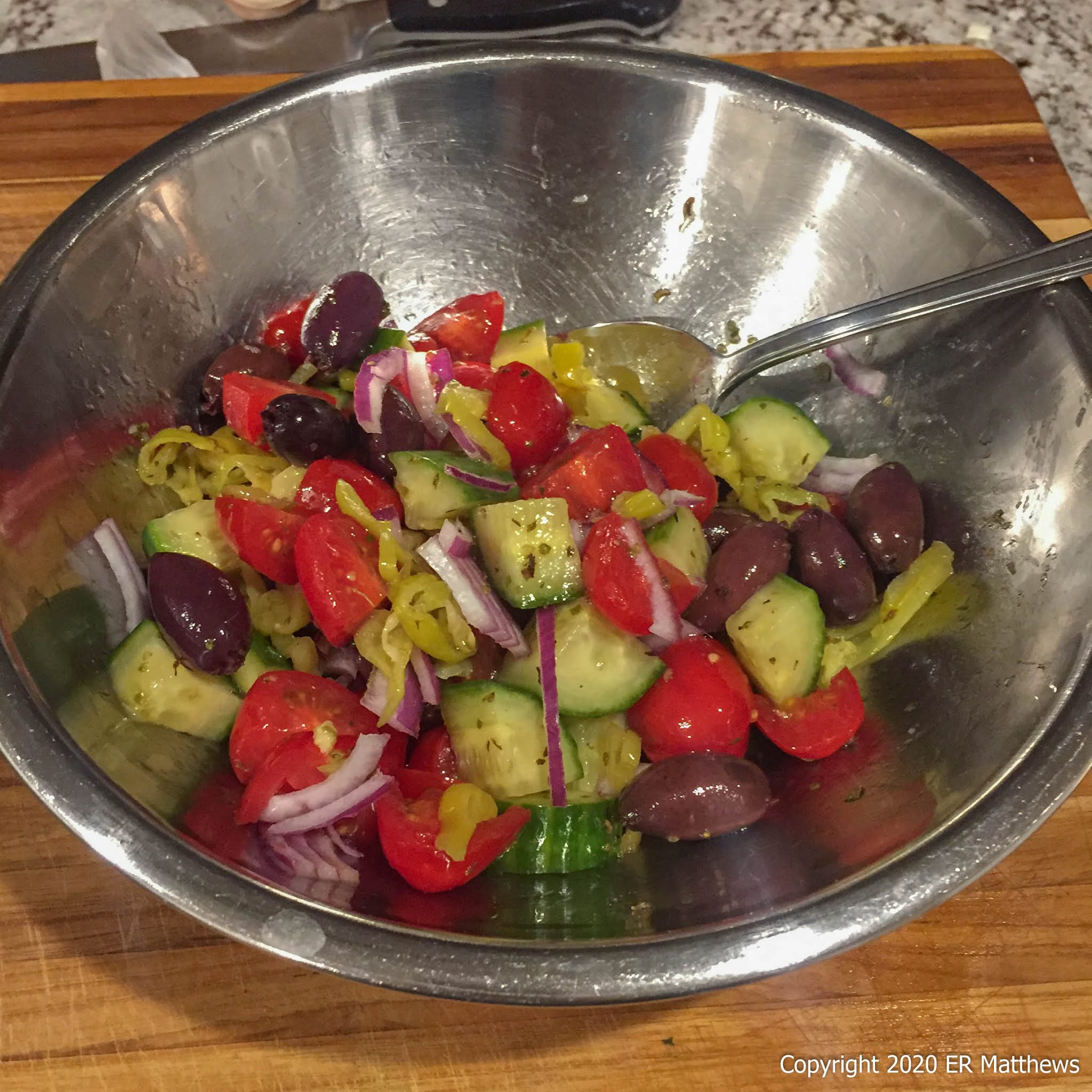
It's quite simple really: cook some onion and garlic in olive oil, add spinach and white beans to warm through and wilt the spinach. Assemble a chopped salad of tomatoes, cucumbers, olives, red onions, and peppers and dress them with olive oil, lemon juice, oregano, and salt. Lay the beans in a bowl and top with the horiatiki.

Feta would be great in this salad or crumbled into the beans or over the top of the plate but we are watching our fat intake and my gut has issues processing a lot of cheese. It's a shame because a great sheep's milk feta is one of the world's great cheeses.

Ann asked me to make this dish again. It really is tasty and it's a great vegetarian dish that can be on the table in under ten minutes start to finish.

Sunday, December 20, 2020

Halibut Cheeks with Masoor Dal Tadka

Even though I am retired and have long stretches of time at the house, I still find many nights that I am looking for something quick to get on the table. My days these days seem to be filled with renovation and remodeling tasks. By the time dinner time rolls around, I don't want to make a huge investment in time in the kitchen, yet I do want a healthy and tasty dinner. By quick, I mean something on the order of 15-20 minutes of active work in the kitchen.

To help with this, I am trying to keep a few quick fish portions in the freezer. That is, when I buy fish at the seafood merchant, I try to buy 3 or 4 meals of fish and freeze that which I don't want to cook right away. Which brings us to the halibut cheeks that I IQFed a few weeks ago. IQF is a food service term for Individually Quick Frozen.

What it means in my home setting is that I spread halibut cheeks out on a sheet tray (coated with pan spray) so that none of them touch and freeze them. Once the cheeks freeze hard, I pluck them off the sheet tray and put them in a freezer bag. In this way, I can pull out as few or as many as I want for a meal. And because they are so thin, I can either defrost them under running water in 20 minutes or so, or I can leave them in the refrigerator overnight. In either case, they are ready to cook quickly.

Halibut Cheeks with Masoor Dal Tadka
Our local grocery has a vast bulk section and as I was wandering through last trip to the store, I spied a bin of red split lentils which I know by their Hindi name as masoor dal. I brought some home for the pantry because they too are a quick cooking food, great for when you don't have a lot of time to cook. A lot of folks use a pressure cooker to have the dal ready very quickly, but even without a pressure cooker, they are done in less than an hour.

One of my very favorite dal preparations is called a tadka or "tempering" in which spices are warmed in hot oil and then mixed into the cooked dal. So I made a quick masoor dal tadka for our halibut cheeks by cooking onion, garlic, ginger, and cumin in a bit of oil until the cumin seeds started to pop. For spices, most people use garam masala, the pseudo-generic Indian spice mix, but I tend to individual spices ground at the moment in my spice grinder: coriander, cumin, fennel, cayenne, and mehti (fenugreek seeds). I stir in the spices and then add the masoor dal. I add water as necessary and cook the lentils until they are tender and falling apart a bit, but still have some texture.

For the tadka, I heat a little ghee or oil and add whole cumin and mustard seeds. When they start popping, I drop in a touch of cayenne powder and turn off the heat. Then I pour this mix over the lentils and they are ready to serve.

All this was done in advance of cooking the fish and while the fish was finishing on its second side, I sautéed a bit of baby spinach for a garnish. One hour start to finish is a pretty quick dinner in my book, especially when most of the time was spent having a glass of Pinot Noir with Ann while the lentils simmered away gently.

Monday, September 28, 2020

Coho Salmon with Gochujang-Roasted Carrots

I was lying wide awake in bed one early morning not too long ago when a dinner idea popped into my head pretty much out of nowhere. I had a lot of carrots in the refrigerator that I needed to use. The idea was to roast those carrots with the funky fermented Korean chile paste called gochujang.

I have been missing the bold, direct, and earthy flavors of Korean food a lot recently. Ordinarily, we could sate our cravings at any of the myriad Korean restaurants west of Portland in Beaverton. But with this pandemic, we're not going out to eat. Any Korean-inflected food that we eat, I am going to have to make myself.

Always prepared for such an eventuality, I keep a tub of gochujang in the refrigerator. It is a wonderful flavor builder. With the exception of the inherent sweetness from the glutinous rice powder that it contains, gochujang has an earthy funkiness that reminds me a bit of the sambals (fiery Thai bird chiles fermented in fish sauce) that we used to ferment at the restaurant for our own consumption. While the staff and select customers enjoyed these sauces, they were way too spicy to unleash on the general public. 

In the same vein, we used to make dozens of kinds of kimchee at the restaurant in addition to dozens of kinds of western pickles and sauerkraut. After fermenting on the counter in the pastry station, various batches of kimchee would go onto a specially reserved shelf in our walk-in refrigerator, to keep the health department at bay. Most pickles don't need to be refrigerated, but our health inspectors have been trained that any unrefrigerated food is bad. Anyway, the dozens and dozens of pickle containers on our pickle shelf was a site to see.

These pickles, our sambals, and gochujang all serve similar purposes in the kitchen. They are instant spicy umami bombs that naturally complement other flavors, especially sweet flavors such as carrots.

I was actually intrigued enough by the carrot idea at 3 am that I roused myself to write a note on my phone so that I would not forget it. Good thing too: the next morning I had no recollection of the idea until I saw the note I left for myself.

Seared Coho Salmon with Gochujang-Roasted Carrots
But roasted carrots do not a meal make. Taking inventory of the refrigerator the next morning, I found a half a pound of wild Coho salmon and some baby spinach. That was enough to make a complete dish: seared Coho on gochujang-roasted carrots, topped with the classic Korean spinach banchan called sigeumchi namul.

Toasting Sesame Seeds
I wanted to toast sesame seeds for both the spinach and the carrots. Lightly toasting them really brings out the flavor. You can see the color just starting to change in the photo above and the toasted color in the photo below. Toss sesame seeds in a dry pan over a high flame until they get to the color you want, them remove them from a pan to a cool container. If you leave the seeds in a hot pan, they will continue to cook beyond what you want.

Making the Sigeumchi Namul
"Recipes" for sigeumchi namul are as varied as there are cooks. I've made fancier versions and I've made plainer. So as not to detract from the salmon, I wanted to keep this version pretty straightforward.

I started by blanching half a pound of baby spinach leaves for just a few seconds. Once a batch of spinach came out of the hot water, I put it in ice water to fix the bright green color and stop the cooking while I finished all the batches of spinach.

After the spinach was fully chilled, I squeezed it dry. Then I dressed it right in the bowl with toasted sesame seeds, minced garlic, and a splash each of rice vinegar, sesame oil, and soy sauce. After mixing, I set the bowl in the refrigerator to await dinner.

Making the Gochujang Sauce
Before roasting the carrots, I wanted to coat them in gochujang, so I mixed up a couple big spoonfuls of gochujang, with a splash of sesame oil and a splash of soy sauce. It still wasn't quite liquid enough and I didn't want to add more oil, so I added a tablespoon or two of warm water to make the sauce flow.

Before roasting the carrots in the oven, I tossed them in this sauce, reserving the remainder of the sauce for later. Because of their tapered shape, carrots are difficult to roast: the slim root end cooks a lot faster than the chunkier leaf end. Stealing a technique from Chinese cooking, I roll cut a bunch of carrots into roughly equally sized pieces to even out the cooking.

Gochujang-Roasted Carrots

After about 20 minutes in a hot oven (425F), the carrots were tender, yet still firm, with nice caramelization along the edges. While still hot from the oven, I put them back into the leftover gochujang sauce and tossed them along with some toasted sesame seeds. Once I plated the carrots, I still had some gochujang sauce left in the bowl to drizzle over the fish for a plate garnish.

As good as the crispy-skin coho was, the carrots were the star of the show. The funky spicy sauce really contrasted with the sweet carrots and earthy sesame seeds in a delicious marriage of flavors. Gochujang-roasted carrots is definitely an idea I need to keep in mind for both Ann and I want more, fish or no fish.

Thursday, September 17, 2020

Labor Day Filet Mignon with Red Wine Sauce

After scoring a whole beef tenderloin at a great price, I broke it down into some steaks, some bits for steak tartare, and a small pile of trim from which to make steak sauce. In general I'm a purist: on those very rare occasions when I eat steak, I want to taste the meat without a sauce obscuring the flavor. However, because filet lacks fat, it's pretty flavorless on its own and a bit of sauce can help perk it up. 

Below you see a six-ounce filet perched on a couple of slabs of ripe tomato, a pile of spinach sautéed with shallots, and a drizzle of red wine sauce intermingling with the tomato juices. I'm not a big fan of steak, but this was a decent dinner.

Filet, Red Wine Sauce, Fresh Tomatoes, Sautéed Spinach
As a base for the steak sauce, I had a pile of silverskin, fat, and some otherwise unsalvageable bits of meat leftover from cutting the steaks. These went into a pan with a bit of oil to brown thoroughly and to create a great fond (browned stuff) on the bottom of the pan. Also into the pan went a whole clove of garlic and a shallot that I sliced skin and all.

When making brown stocks and sauces, I always put the onion and shallot peels in the pan because they yield a nice brown color. Onion skins have traditionally been a source of a beautiful natural brown dye for wool and other clothing fibers. You should take advantage of the skins to help introduce a great brown color into your stock.

Browning Beef Scrap
Once the beef and shallots were deeply brown all over, about 10 minutes of cook time, I added a small sprig of rosemary, a single lovage leaf, a bay leaf, and a healthy pinch of coarse black pepper as seasonings.

After this, I deglazed the pan with two glasses of red wine, making sure to scrape up all the brown bits of the fond off the bottom of the pan and into the sauce. Then I added about a cup and a half of homemade chicken stock. The collagen in the chicken stock will help the sauce have great mouthfeel. I would have used beef stock, but all I had made recently was chicken stock. In the grand scheme, the red wine flavor will dominate whatever stock you use.

Reduced, Defatted Sauce
I let the sauce bubble away gently for 15 minutes and then strained the solids out of it. After this, I let it come down to about a half a cup in total. As the sauce came down, I skimmed the fat off of it. Traditionally, if I were making a beurre rouge, I would bring it down tighter and finish it with a lot of cold butter. Otherwise to make a red wine sauce with classic technique, I would knead cold butter with flour to make a beurre manié that I would whisk in to thicken the sauce.

But, we're in the process of losing a bunch of this COVID quarantine weight by minding our fat intake. So, I used a much lower fat way to bind the sauce. I mixed a little cornstarch with a bit of cold water to make a slurry. Then I dribbled this in bit by bit until the sauce thickened to my liking.

Last Time Outside for a Week
OK, so don't look too harshly on the indistinct grill marks on these filets. Even though I need to scrape the grill down good, I don't have a wire brush and I'm not running right out to Lowe's for just that. I'm not risking my health for something as inconsequential in the grand scheme as a grill brush. Even more important now to our health than COVID is the quality of our air. Have a look at the photos below.

The Wildfire Smoke Starting
Day Two, Dark Skies
Day Three, The Last Time We Saw a Little Sun
Day Three, Late Afternoon Red Skies
Day Four to Eleven, Choking Smoke
We should have seen the warning signs in the forecast from the NWS that included a red flag warning for violently gusty, hot, and super arid winds. I did see the warnings, but I never in my wildest dreams extrapolated them to spending the last eleven days closeted in the house with towels blocking off some doors.

We're used to fire season in the West. It's a natural artifact of our summer season in which we do not get rain for months on end. Each fall, before the rains begin and when the forests have desiccated all summer, we have forest fires. But what we don't have are 2020-style fires one-upping COVID for the Trauma of the Year award.

Back to the steaks which I saved for celebrating Labor Day. Given the constant northerly and easterly winds (our usual winds are SSW to NW in orientation) with wicked blasts sending loose things flying, I was not sure that I would be able to grill out as my Labor Day tradition dictates. I was afraid that a blast of hot, dry air would tip the grill over. Fortunately, when I went out to light the grill for its preheat, the wind was directly out of the north and the grill was in the lee of our next door neighbor's house.

I should have known that something was up when I found myself licking my lips and wishing I had lip balm, just like being in the dessert in New Mexico and Arizona. Although we have naturally low summertime humidity here in the Willamette Valley, it is a comfortable humidity that does not require us to maintain a steady stock of lip balm.

The first time that I licked my lips outdoors when lighting the grill, it tasted like a freaking ash tray, acrid and bitter. The reek of smoke was all around. After putting the steaks on the grill, I retreated to the house and only emerged to give them turns.

After turning off the gas, and bringing the steaks in for dinner, little did I know that that would be the last time I would go outside for over a week. I finally did relent and go to the grocery store on day 10, not having been shopping in 17 or 18 days and the cupboard really bare.

I also had no way of predicting that things would get worse and that of this writing, millions of acres are on fire or have already burned here in Oregon and we have the worst air quality in the world. This is unprecedented as far as I know, though one old-timer told us that the air has not been this bad since Mt. St. Helens erupted 40 years ago.

2020, we're screaming "uncle!" Do you hear?
 

Tuesday, July 14, 2020

Souvlaki

I really miss the Greek Festival every August back in Winchester. The really crummy and cheap Greek wine under the big tents out front of the church, the kids running around like crazy, the smells of roasting lamb and grilling souvlakia, all accompanied by the strains of the emphatic bouzouki band. It was so miserably hot and humid every year, but a heck of a lot of fun! Thinking about it got me to wanting to make some souvlaki ("little skewers") from a pork tenderloin that I had in the refrigerator.

Souvlaki, Spinach, Rice, Tzatziki
The marinade for souvlaki starts with lots of garlic and oregano. Good thing our oregano is going nuts in the back yard right now.

Oregano and Garlic, Sine Qua Non of Souvlaki
I put the finely minced oregano and garlic in a gallon bag along with the zest and juice of a lemon, and a few glugs of extra virgin olive oil.

Ready for the Refrigerator
I cut a large pork tenderloin into roughly one-inch dice, yielding enough cubes for four nice skewers of souvlaki. Into the bag to marinate, the pork went in the refrigerator for two hours before firing the grill.

Skewers of Pork Ready for the Grill
I like to grill my souvlaki hot and quick, so I fired all three burners of the grill for 20 minutes before putting the pork on. The skewers were done at about two to two and a half minutes per side: that's a hot grill.

Souvlaki on the Grill

I wish you could have smelled the fragrant smoke coming off the grill as some of the olive oil in the marinade dripped onto the flame baffles. That's about as good a smell as there is! I know the neighborhood had to be jealous!

I'd normally want to shove these small pork kebabs in a pita with a bit of sliced cucumber and a slathering of tzatziki. I did want to do that this time as well, but we're watching the amount of bread that we shove in our faces.

At least for a few minutes, we were transported back to the Greek Festival in Virginia. Too bad the closest festival is in downtown Portland, an hour and a parking nightmare away. Opa!

Ode to the Tortilla

I love tortillas. It wasn't always that way. I am a child of the early 1960s. Then, on the East Coast, our food was influenced by two th...