Showing posts with label mozzarella. Show all posts

Monday, February 3, 2025

The Boys are Back in Town

With apologies to Thin Lizzy, the boys are finally back in town, having moved back from Boulder after a short stay there. We were devastated when they decided to move while we were away in Italy in the fall and we are ecstatic that they missed Bend so much that they have decided to return.

Naturally, to celebrate their return, we had them to dinner. For this dinner, Ann wanted me to do pasta with ragù bolognese and she wanted to make garlic bread, especially because Rob loves garlic bread.

The Three Musketeers
Kitchen Elf Extraordinaire!
Spying a bin of small tomatoes on the counter where I leave them to ripen sparked an idea for a simple appetizer, mini-Capreses on skewers. Nothing could be simpler than skewering tomatoes, basil leaves, and bocconcini and drizzling them with a bit of pesto thinned with olive oil.

Caprese Skewers
We waffled on making a traditional lasagne (I should have, damn it!) but I let Ann convince me that I should just used boxed pasta rather than rolling out a sfoglia and cutting it into big sheets for lasagne. We ended up with par-cooked mezzo rigatoni (from Giuseppe Cocco) mixed with ragù and a bit of ricotta, topped with mozzarella and baked until golden brown. It was good, but not great and certainly not in the same league as lasagne.

Baked Mezzo Rigatoni and Ragù Bolognese
Ann wanted to make garlic bread as a surprise for Rob, whose predilection for this delicious carb we noticed in Santa Fe. She concocts a mixture of butter, mayonnaise, granulated garlic, fresh garlic, and a bit of Italian parsley and slathers obscene amounts on a split loaf of excellent bread. After it browns under the broiler, it is absolutely irresistible and makes the house smell amazing. I can gain weight just by looking at photos of it.

Ann's Crazy Good Garlic Bread
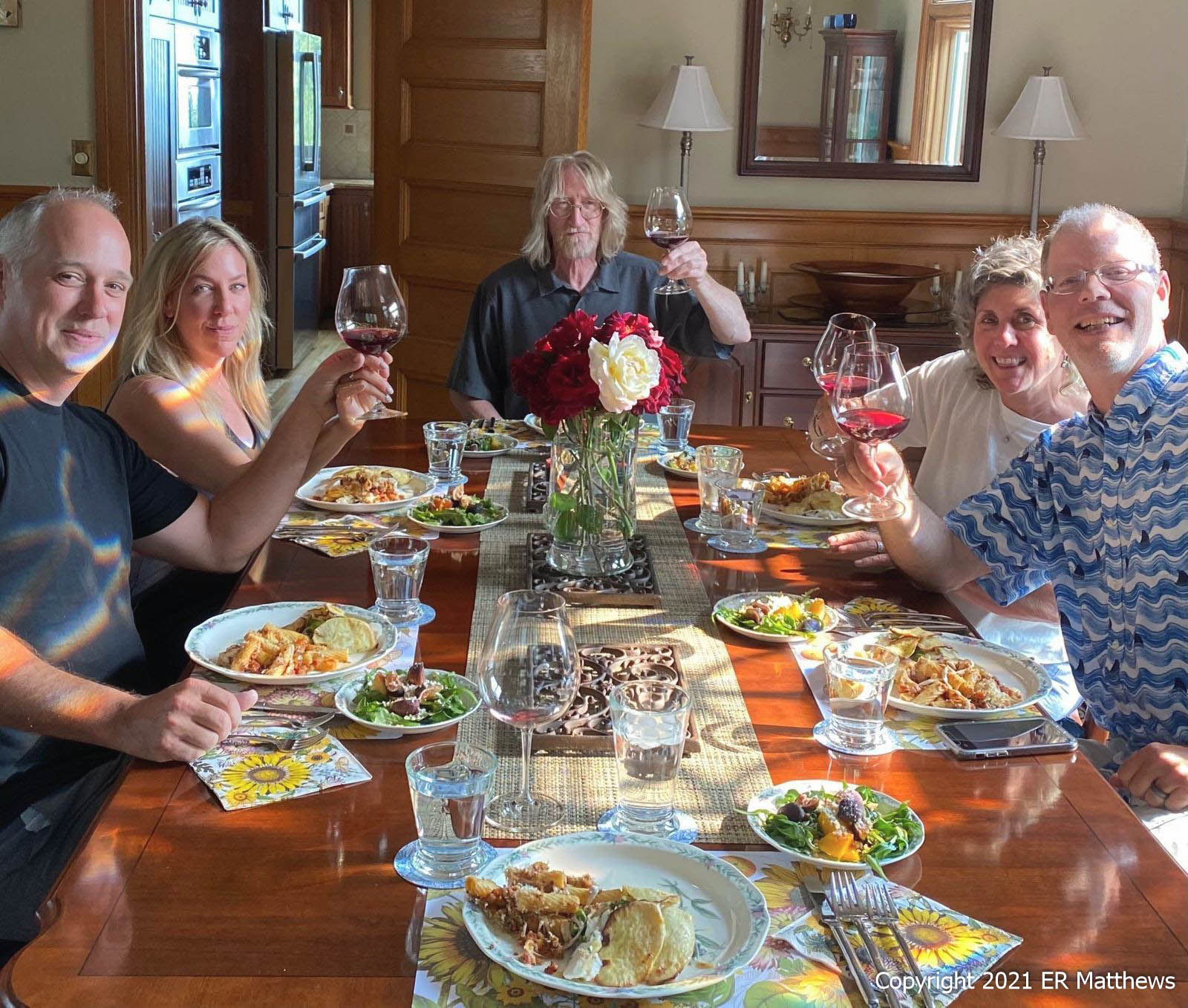
After kibbitzing for an hour or so and catching up with the boys and their move back to town, we relocated to the dining room and finished up the evening with a couple bottles of delicious Langhe Nebbiolo.

Thursday, June 6, 2024

Playing with Pizza

Pizzas around here in Central Oregon are expensive and, with a couple of notable exceptions, not worth trying. This is a shame because we love a great pizza. Ever since we got invited to a party where they had a gas-fired outdoor pizza oven and we fired our own pies, a little voice has been nagging in the back our minds.

Amatriciana-Style Pizza with Arugula and Olive Oil
That little voice has been saying, "If pizzas are such junk, make your own." And why not? I'm a (retired) chef, I can handle dough and a peel, and I have always been able to hack together an acceptable pie at any time. But why not put in the time and testing to really put out a great pie?

This is the year that we have decided to get serious about pizza: Ann ordered a new natural gas-fired Ooni pizza oven a couple weeks back and it has finally arrived. After two trips to the hardware store for fittings, I got it plumbed into the gas line that also supplies the fire pit out on our patio. 

Saturday, I fired it up and let all the oils burn out of it in preparation for its maiden voyage. That morning, I also made a batch of dough for an 8-hour ferment for our first run. I think I prefer a longer ferment, but I was also itching to try the oven out that day, rather than wait for an overnight ferment to complete.

The test batch was a safe 60% hydration/3% salt version made with Caputo 00 flour with the aim to make four 250g balls. The results were better than just about any pie here in Bend, but not where we are aiming. We're not looking for acceptable; we're looking for professional quality. It's going to take a lot of experimentation to determine what works the best with the flour we have available here, this oven, and our elevation. Honestly, I do not know how high elevation messes with pizza.

1000g of Dough
Four 245g Dough Balls, Ready to Proof
Proofed and Ready to Go
First Pie: Pesto, Mozzarella, Pecorino, Fresh Basil
Rosé on the Patio Waiting for Oven to Heat
First Pie!
First Pie: I Didn't Rotate it Quickly Enough
Lessons learned on day one. The crust was a bit doughy and I believe that this is a combination of too hot an oven coupled with insufficient hydration. In my mind, I have been toying with a hydration approaching 70% but I thought I'd start with a foolproof 60% which is easy to work until I hone my dough handling skills. Obviously, I need to rotate the pie a little quicker which is merely a function of being able to determine the crust color in the dark interior of the oven. And finally, 250g is the perfect size pie for us.

So for day two of testing, I decided to make another batch of dough at 65% hydration. I rejiggered my recipe accordingly and made the new batch, also a kilogram and also using Caputo 00. The idea was to do an A-B test with one pie from the new 65% batch and an 8-hour fermentation against a leftover dough ball at 60% which had re-proofed in the refrigerator for another 24 hours. Not exactly modifying a single variable, but illustrative nonetheless. Ann would be tasting blind, but I would know which pie was which.

For these pies, we decided to do an Amatriciana-style pie using Sicilian estratto di pomodoro (world's sexiest tomato paste) thinned with water and a little grease from rendering guanciale as the sauce. Then I would put some of the rendered guanciale and mozzarella on top of that.

Rendering Guanciale
Left: 60% Overnight Ferment, Right: 65% Same Day Ferment
After tasting both pies, we both had definite opinions and as it turns out, we agreed. For this test, I dialed the oven back to about 7/8 of its maximum heat to give the crust just a few seconds longer to cook. We both liked the texture of the 65% hydration dough better, so now we will move on to something higher, perhaps 67%. I am still not happy with the black charring on top of that pie though; it may be I need to cook it slightly less. Or this may have happened when I elevated the pie on the peel to quickly finish an area that looked undercooked. Time and experience will sort this out.

Pesto and Sun-Dried Tomato Pies on Day Three
Left 60% Ferment, 48-Hour Proof; Right: 65% Ferment, 24-Hour Proof
On day three, I did not make any new dough and tested one of the original 60% dough balls from two days prior against one of the 65% balls from the day before. Again, we preferred the crust of the 65% pie; however, after all this time in the refrigerator, it seems the flavor of the original 60% dough was starting to gain some character.

This is going to be a many-week process of refining the recipe. Next up, I'm going to switch flour and go back to the flour that I always used at the restaurant, King Arthur Sir Galahad. While in the minority, one of my favorite pizza joints uses this flour to great effect and if I can achieve the same thing, King Arthur is way cheaper and way more available in this part of the world.

Saturday, July 8, 2023

Lament for a Sandwich

In rereading the words I wrote below, I'm not sure that the title word "lament" is exactly correct. It may be that the more precise word might be "rant" though that word implies some amount of anger. I don't feel anger, but rather sadness, so perhaps I am lamenting after all.

A good sandwich, that most simple and pleasing of foods, is in my experience apparently a difficult thing to find, maybe not unicorn rare, but only slightly more commonly found. A sandwich is such a simple creation that it should be possible to find a good one almost anywhere. Not so, at least in our part of the world. Ann and I, we've given up on finding a reliably decent sandwich in Bend, Oregon.

As far as we have tasted, there are no outstanding delis or sandwich shops here in town. At least, the ones we have tried have left us wanting for the quality of sandwich that we expect. Clearly, we are in the minority in town, because time and again, acquaintances and web reviewers alike recommend to us the same places and while some are better than others, not a one of them is demonstrably a paragon of sandwich-making.

Maybe the simplicity of a sandwich is its downfall. After all, in a dish with very few ingredients, each must shine: there is no room to hide subpar ingredients or technique. A great sandwich really comes down to just two things, two very simple things: attention to detail in sourcing excellent ingredients and attention to detail in preparing them in a caring manner.

Entire Loaf Italian Cold Cut Sandwich, Feeds 4-6 People
What's really amazing and saddening to us is that creating a great sandwich is really easy to do. That is, we do it at home. Out of necessity, sadly. And if we can do it at home, certainly sandwich shops can do it as well, if not better than we can.

The really sad aspect of this dearth of great sandwiches is that delis and restaurants have all the advantages over us home cooks when it comes to making great sandwiches. They have access to great quality breads or even can make their own. They don't have to rely on pre-packaged deli meats, instead being able to slice their meats as needed or for the day. Some places even cure some of their own meats: I used to make my own pastrami at my restaurant, from first class meat and spiced the way I like it. Clear advantage to the deli over the home cook.

What I, as a retired chef, don't understand is why restaurants will not put the effort in to make a great sandwich. Is it because in a tourist town they have all the business they can handle? Is it because they don't care? Or is it because they are ignorant about what makes a great sandwich? Is it because a sandwich is too pedestrian to put effort into? Maybe the feeling is if customers don't care enough, a mediocre product is just fine?

Or is it because they don't think they can put out a top-quality product and still make a profit? As a restaurateur, I can certainly understand the last question, but being retired from the business, I no longer have a handle on the food, rent, insurance, licensing, and labor costs that drive the profit equation. But my restaurant consultant gut tells me that this is not the case: a great sandwich can be a profitable offering and a top-quality sandwich will drive volume sales.

To illustrate the care necessary to make a great sandwich, let's walk through making an outstanding Italian cold cut sandwich. It's not inexpensive to make, but it is what I expect, not the very lame examples that I have had at several places all over town.

A Single Serving
Select Great Bread. For a sandwich, select a loaf with a nice crisp crust and a soft, airy crumb. The crust cannot be so thick or so crunchy that it is hard to eat, however, or the bread so dense that the bread to filling ratio is off. I would love to be able to find such bread in single sandwich portions, but no longer being in the trade, I cannot. But I can still find great large loaves, thus, I make one large sandwich from an entire loaf and slice individual portions from it. Shout out to the Village Baker whose Italian-style striata loaf is one of the very best in town.

Source Top Quality Cold Cuts. I really like a good mix of flavors and textures and I find that four different types of cold cuts is just about perfect. I like the mix that I used for this sandwich: silky prosciutto di Parma, unctuous mortadella, smoky bresaola, and for the soppressata, I really like a spicy Calabrese. Great meats are not cheap, but you don't need a lot to make a great sandwich.

Select a Great Cheese. While I like provolone, a nice aged and dry one, I really adore thinly sliced fresh mozzarella on an Italian cold cut sandwich. An 8-ounce ball of good fresh cow's milk mozzarella  sliced very thinly is plenty for this whole-loaf sandwich. I would save the expensive and decadent bufala for something other than a sandwich.

Other Garnishes. For me, I like one of either fresh tomato slices or roasted red peppers. Both would make the sandwich too sloppy for my liking. We usually end up with roasted red peppers because tomatoes are rarely in season in Oregon and let's face it, Oregon does not grow as good tomatoes as hotter climates with long growing seasons. Furthermore, shipping ripe tomatoes from such locales is a losing proposition; great tomatoes do not travel. In my book, it is better to omit tomatoes than to use sub-par tomatoes, something that is lost on most restaurants. Also mandatory for me are a great leaf lettuce, thinly sliced red onions, and if available, fresh basil leaves.

Prep the Red Onions. Onion is critical for an Italian cold cut sandwich. Not only does it offer a slightly crunchy texture, its real purpose is to supply a bit of acidity to balance the fat of the cold cuts and cheese. Slice a red onion into very thin rings. If you don't have the knife skills for this, use a benriner slicer. Rub the onions gently in your hands with a bit of Kosher salt and place them in a non-reactive bowl. Cover with water and let stand five minutes. Drain off the water and cover them again for another five minutes. Squeeze out the water and the onions are ready for use. This process tones down some of the very aggressive onion qualities and makes them sweeter and much more palatable on a sandwich.

Prep a Tangy Dressing. A good vinegary dressing is essential to help counterbalance the fat of the meats and cheese. It's not possible to make a good Italian cold cut sandwich of the quality that I demand without making a decent dressing, which is neither hard, nor time consuming. I start with a couple tablespoons of red wine vinegar in a bowl, to which I add a mashed filet of anchovy, a pinch of salt, a teaspoon of dried oregano, a half a teaspoon of dried basil, and a tiny dab of a good mustard. After whisking this together with a fork, I start adding about 6 tablespoons of great extra virgin olive oil dribble by dribble, bringing the dressing together with the fork.

Toast the Bread. After slicing the loaf in half, put it on a sheet tray and drizzle it lightly with a little extra virgin olive oil. Then it goes under the broiler (here is where I really miss having a commercial salamander) until it lightly browns around the edges with maybe a hint of browning in the center. You want the bread warm with crispy edges, but you don't really want to toast it hard as the next step is to put dressing on the bread and you want that dressing to soak in a bit, difficult to do if the bread is highly toasted.

Dress the Bread. Spoon the dressing over both halves of the bread and spread it lightly but evenly with the back of the spoon. You want fairly even coverage without soaking any part of the bread.

Build the Sandwich. Lay all the ingredients on the base of the loaf and then put the lid on. I built the sandwich thus: roasted red peppers, destemmed leaf lettuce, prosciutto, mortadella, calabrese, bresaola, fresh tender basil leaves, red onions, and then fresh mozzarella. Another area where many restaurants miss the mark: I think it is important to season the roasted red peppers (or tomatoes) and the mozzarella with a little salt and pepper while building the sandwich.

I know this is a lot of words about making a simple sandwich, but this is a good description of what is necessary to build a great sandwich. And none of it is difficult which leads me right back to the initial question. Why cannot we find a great sandwich in Bend?

Sunday, August 15, 2021

Pranzo di Ferragosto

A few weeks ago when Greg and Bridget visited from Portland and we went wine tasting at nearby Maysara Winery in the McMinnville AVA, they had discussed the possibility of Ann and I celebrating Ferragosto with them the weekend after we returned from Alaska. This was the first time that I, or my full-blooded Italian wife, had ever heard of Ferragosto, the Italian Feast of Assumption celebrated on the 15th of August.

Having been in the software business with an Italian distributor, I did recognize that much of the country (a lot of Europe too) takes August (or a large chunk of it) off, but I was ignorant that there was a mid-month celebration. Deconstructing the term, I recognized ferr (as in the French jours fériés, holidays, feast days, celebrations) and agosto (the month of August after Augustus Caesar). 

The plan was that on the 15th of August, we would get together at Greg and Bridgets's house in Portland, watch the film Pranzo di Ferragosto, one of Bridget's favorite flicks, pop our pranzo into the oven, then dine on the two principal dishes from the film. Greg would make the fish dish and asked me to make the pasta. He sent me recipes for both dishes.

I'm not a recipe guy and in making Pasta al Forno, baked pasta, a dish I have made countless times, while I kind of adhered to the spirit of the recipe, I felt free to do my own thing. And I noticed that Greg did his own take on the perch and potato dish, doing halibut with a covering of white sweet potatoes instead. My meat sauce is made from a bit of home-made sausage, a bit of pancetta, and I augmented the mirepoix with reconstituted dried porcini. I added the porcini broth to the sauce as it cooked down.

Ingredients for my Ragù
Cooking Down the Meat Sauce
One Layer of Pasta, One of Mozzarella
Final Layer of Pasta, Then Pecorino Romano
When we arrived, we met their friends Will and Corinne, down for the weekend from Seattle where Greg and Bridget had lived prior to relocating to Portland. After introductions, we went downstairs to the wine cellar where they had laid out a beautiful array of cheese, charcuterie, and crudités which we enjoyed with sparkling wine.


After appetizers and sparkling wine, we watched Pranzo di Ferragosto, a charming film, if a little short. While the movie was nominally about a guy who gets hoodwinked into babysitting four elderly women, his mother included, while everyone else deserted Rome for the holiday, I found it to be primarily a love story about the main character's home of Rome. Certainly Rome is a major character in a movie full of characters, played largely by non-actors.

Back upstairs after the film, we put the pasta and the fish in the oven to cook and yakked for a good while. Once the two pre-prepared dishes had baked, we relocated to the dining room and started our own feast, followed by Corinne's arugula and fig salad, and then finishing with a delicate fig cake from a local Russian bakery. It's really a lot of fun to sit around a dinner table and chat over a lengthy meal, something that we don't do nearly enough of.

Saturday, September 5, 2020

Comfort Food

Wednesday August 26, 2020 was a shitty day, shitty even by the standards of 2020, the year that has redefined the term annus horribilis for most of us, perhaps Queen Elizabeth excepted. On Wednesday afternoon, at 91 years of age after years of health struggles, Ann's mother Mary Chiappetta died of natural causes in the ICU at Arlington Hospital Center in Virginia after a three-week stint on a respirator. Although we expected it, our inability because of COVID to travel from Oregon to be there with her made a bad experience so much more horrible for us, especially for Ann.

We feel grief at her loss, torment at not having been able to say goodbye at the end, and guilt born of not being there for her. Compounding these emotions is the question of how we can possibly in good conscience have a real funeral service to honor her life under these pandemic conditions. The adjective shitty that I used above does not even come close to capturing the depth and rawness of these emotions.

For comfort in horrible times, we turn as so many do to comfort food. Tears streaming down her face and between racking sobs, Ann implored me to cook her something comforting. After some discussion we arrived at pasta, a baked pasta with tiny meatballs. Ultimately, I think Ann was beyond caring what I made, but what is more comforting for a good Italian girl than pasta?

As I was going out the front door to the store to pick up groceries for the next ten days, including supplies for the pasta, Ann yelled after me, "Get beer!" "No shit!" I remember muttering to myself. And so in the fog of a stunned mood, I vaguely recall going to the store pretty much on autopilot to get ingredients: tomatoes, Italian parsley, ziti, ground pork, mozzarella, and ricotta.

Baked Ziti and Meatballs
I won't lie and deny that I bought some really good beer, a couple of craft hazy IPAs, and I also won't deny that cooking interrupted the beer drinking at times. It was just that kind of day. Through the fog of grief and beer, I managed somehow to take some passable photos. I also won't deny that writing this is my way of trying to process and come to grips with the hurt. Here's a quick primer on how to make a baked pasta with meatballs.

Meatball Spices
I've been through making meatballs several times on this blog, so just a refresher here. I always start by mixing the herbs and spices with the liquid ingredients so that they get evenly distributed in the the meat. For a pound of ground meat, I would use one egg, about a tablespoon each of basil and oregano, 3-4 garlic cloves, a teaspoon of Kosher salt, and a large pinch each of black pepper and red pepper flakes. To this, if I am doing restaurant-style meatballs, I'll add a half a cup of heavy cream, but at home, I use chicken stock instead.

Meatball Mix
After mixing the spices well into the liquid ingredients, in goes the meat, in this case ground pork, because pork makes awesome inexpensive meatballs. Veal is amazing, but who can afford it or even find it at the store? I don't care for beef meatballs and so I avoid beef and the so-called meatball mix of a third pork, veal, and beef. I made sure to break the meat apart gently before folding it with my hands into the liquid and spice mixture. Then I asked my trusty assistant to sprinkle in a handful of panko. As I mixed it in, I could feel that it wasn't enough to bind the mixture, so Ann added another handful.

I let the mixture stand for a few minutes before rolling it into small meatballs. This rest period gives the panko time to absorb the liquid and firm up the mixture.

Blender Marinara
While the meat mixture was resting, I made a batch of blender marinara, the easiest sauce ever. Into the blender, I dumped two 28-ounce cans of diced tomatoes in juice, two minced cloves of garlic, a tablespoon of dried basil, and a teaspoon of Kosher salt. Ten seconds of blending and presto!

We never kept marinara on hand at the restaurant, even though parents often ordered it for their kids. It was simple enough to whir it up in the blender on the fly and have it to the table nicely warm, but not screaming hot, within four minutes using par-cooked pasta.

I stressed to all my cooks that time was of the essence because no parent can relax with a hungry child at the table. I always sent the pasta out warm, not hot, so that the kids, who invariably shoved their hands right in the plate, would not burn themselves and so they could eat right away without fretting and fidgeting while their dinner cooled. Then mom and dad could relax over a glass of wine while we cooked their food.

If you will indulge me one more aside apropos of marinara, canned tomatoes is something I am really picky about. I will buy store brand or private label of some vegetables (artichokes, beans, chickpeas, etc.), but I will not risk my tomato-based dishes on generic tomatoes. I am brand loyal with tomatoes because I want consistent product in the can, each time that I open one. Sometimes that does not happen with packer tomatoes.

I want consistently ripe tomatoes without green pieces, cores, and skin, and with a consistent ratio of flesh to juice. Back east at home, I used Cento brand and out here, I have settled on S&W, a Del Monte brand. Yes, they cost more, but I won't risk my food for a few cents. It's not the brand name that matters to me; I care only that each time I open the can, I get the same product as every other can that I have opened.

Raw Meatballs Ready for Oven

Cooked Meatballs
Although you can fry meatballs before braising them in sauce, I'm fairly lazy and just put the raw meatballs into the sauce. These small meatballs took about an hour or so in a moderate oven to braise. Larger meatballs take longer. If you are uncertain about whether the meatballs are done, they should be at an internal temperature of 160F, 165F if they contain poultry.

Partially Cooked Pasta, Italian Parsley
Once the meatballs were done, I par-cooked two pounds of ziti to about two-thirds done, then mixed the drained pasta with fresh Italian parsley, the meatballs, about 3 cups of ricotta, and enough marinara (just shy of a quart, so about a quart leftover) to coat everything. After seasoning with salt and a bit more red pepper flakes, I put the mix into a baking dish and topped it with grated mozzarella.

Ziti Before Topping with Mozzarella

Baked Ziti
The oven was still going from baking the meatballs, so it didn't take too long to get a nice crust on the cheese, perhaps 35-40 minutes. After the baked pasta cooled for the better part of an hour, I sliced it into squares as you see in the very first picture above and we devoured it. For the sake of comfort, we ate far more of the pasta than we should have and drank more beer than we should have. But no regrets: what else to do on the shittiest day of 2020, the year that is proving to be the shittiest of our lives?

RIP Mary Chiappetta. You were sharp as a tack, funny, personable, frugal to a fault, direct, opinionated, not one to be on the wrong side of, and as big a fan of me as I was of you. I was privileged to be your son-in-law. In trying to find humor amidst the at times overwhelming sadness, I hope that wherever you are, there are no turkeys and baby goats on your bed. And may 2020 not become any more horrible.

Ode to the Tortilla

I love tortillas. It wasn't always that way. I am a child of the early 1960s. Then, on the East Coast, our food was influenced by two th...