Showing posts with label masa harina. Show all posts

Wednesday, May 21, 2025

A Southwest Dinner

We're getting close to the summer travel season when we are going to be on the road somewhat often. Before we leave for Virginia for my daughter Ellie's wedding, we wanted to have Rob and Dyce over for a casual dinner.
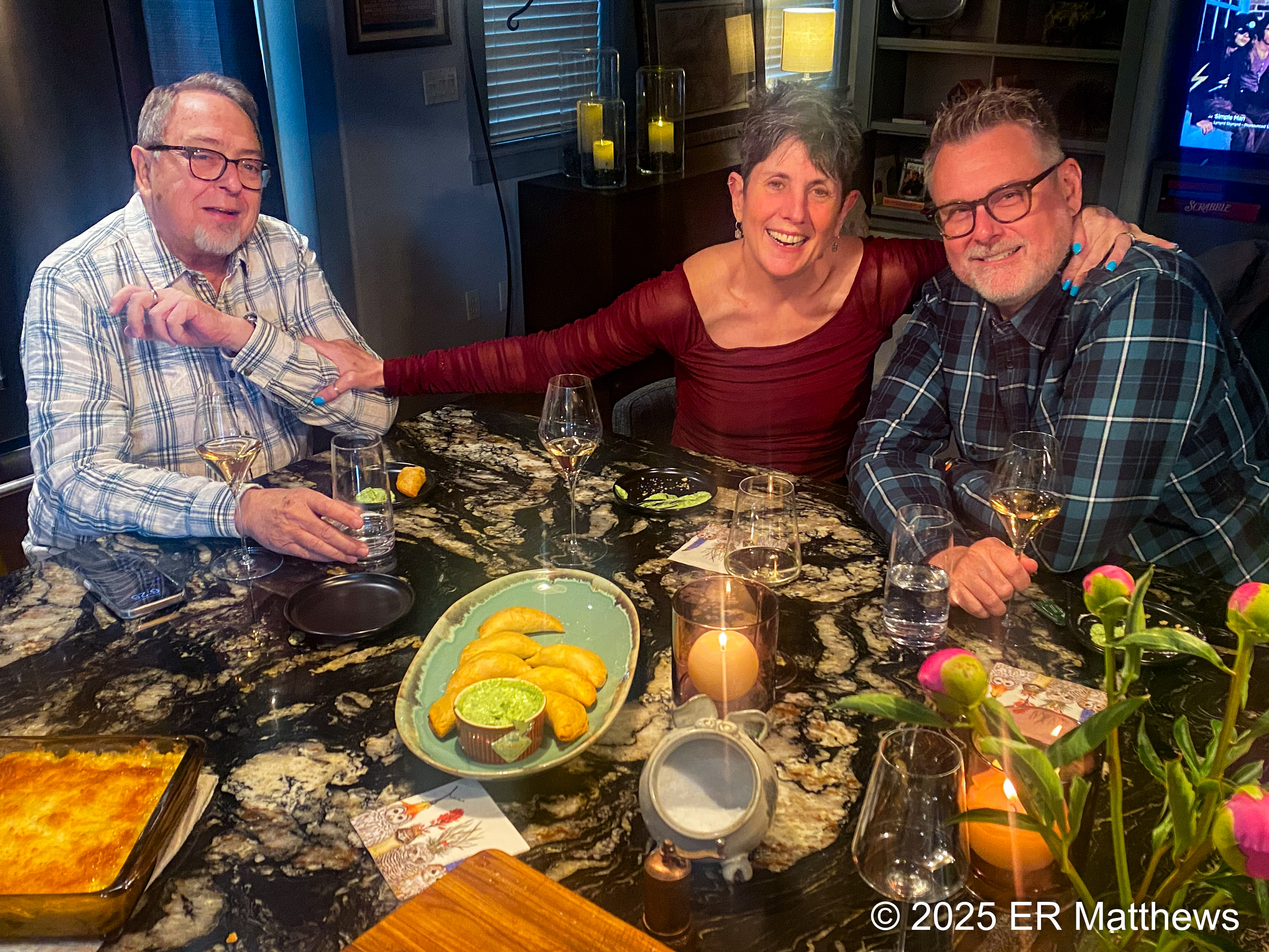

Rob and Dyce Brought the Most Gorgeous Peonies
I really am trying to avoid dinners with lots of last minute cooking so that I can relax and focus on guests. That shifts meals towards braises and dishes without touchy timing. Ann had kindly suggested all manner of dishes, but nothing grabbed me.

Unclear on what to make and rooting through the freezer, I found a bag of cleaned and cubed pork shoulder from a foray to Costco. Their shoulders come in two packs and that's a ton of meat. I typically break down both shoulders into cubes for braises like carnitas and freeze what I don't need right away.

Knowing that Rob and Dyce are fond of New Mexican food had me thinking along those lines and so I decided to make chile verde. After pondering for a few days, I decided to make a posole casserole to accompany the pork, and to offer empanadas for an appetizer. After a week of beautiful weather, it cooled off again and the choice of heartier food seemed lucky and apropos.

Then I remembered the heirloom masa harina that Ann gave me for my birthday and I decided to make tortillas to accompany the meal. And so the menu was set with the only last minute task to cook the tortillas. Somehow in the course of moving, my tortilla press did not make it to this house and so I improvised using a cast iron pan and a cut open Ziploc bag.

Empanadas de Picadillo Dulce, Cilantro Aïoli
Empanadas I make with an egg-enriched pie crust that never fails to bake up flaky and golden brown especially when brushed with an egg wash. Habitually, I fill empanadas most often with picadillo dulce, a sweet and sour pork that I first learned about by reading old Spanish-language recipes in the Biblioteca Nacional de México.

The filling is clearly of Moorish origin, containing almonds, olives, and sometimes raisins, though I have made it my own through the years. This version was ground pork shoulder, almonds, olives, onion, poblano chile, garlic, Mexican oregano, and three types of dried red chile (the majority ancho). I made it sweet and sour with brown sugar and Sherry vinegar. I have outlined the process in a previous post.

Masa Balls for Tortillas
Ghetto Tortilla Press: My 1930's Griswold Skillet
Tortillas on the Table
Chile Verde, Posole-Chipotle Casserole, Tortillas
Chile verde is not a recipe but an idea. At essence, it is cubes of pork braised in a salsa verde. There are as many ways to make it as there are cooks and they are all wonderful. I am certain that I make it differently each time and this time, I used the slow cooker to free our single oven to use in baking the posole.

For chile verde, there are two essential steps. First, make a salsa verde and second, brown the meat and braise it in the salsa.

For salsa verde, I roasted at high temperature (say 400F) a sheet tray of poblano peppers, Anaheim peppers, onions, garlic, and tomatillos. I rotated the chiles as each side became blistered. Once done, I pulled the tray out and covered it in film so that the veg could steam until cool and loosen the pepper skins.

Next up, I skinned and cleaned the peppers, dicing and reserving three or four Anaheims for the posole casserole. The peppers, garlic, tomatillos, onion, and a bunch of fresh cilantro went into the food processor. I blended it until roughly smooth and put it in the slow cooker.

For the pork, in recent years, I have adopted a process by which I only brown one surface of the cubes. This provides great flavor while not drying out the pork. After browning all the pork and putting it in the food processor, I deglazed the pan with a splash of water and poured all the porky goodness into the slow cooker with the pork and salsa. Eight hours later, the pork was tender and the sauce reduced to just the right thickness.

The posole casserole, something I started making in my 20s as a broke graduate student, I assembled in the afternoon and put into at 350F oven about 90 minutes before we were ready to eat. Timing is not critical, a delightfully brown crust is.

I admit that I did not make my own posole, though I could. I bought two 28-ounce cans of commercial hominy, the same Teasdale brand that I used in the restaurant. One can each of yellow and white hominy went into a mixing bowl with the reserved chopped green chiles, half a bunch of sliced green onions, and the kernels of one ear of fresh sweet corn for contrast and variation on the corn theme. Purple hominy (maíz morado) would have been cool, but my store had none.

I bound the casserole with a chipotle béchamel: olive oil and a spoon of flour cooked for a minute, then a pinch of salt and one finely chopped chipotle in adobo. After mixing the hominy and sauce, I adjusted the salt and put it into an oiled baking dish and topped it with a little grated white cheese. The result is as delicious as it is simple.

Making tortillas with modern masa harina is a trivial process of mixing the corn flour with enough water to make a workable dough. Then you roll it into balls and smash the balls between sheets of plastic (or a cut open Ziploc freezer bag in my case) in a tortilla press (or beneath a cast iron skillet in my case). We restaurant chefs are used to adapting and overcoming: no tortilla press, no problem. I can even patty them by hand, old school.

After peeling the masa circle off the plastic, it goes into a hot, dry frying pan on low to medium heat. Cooking both sides takes less than a minute and if I had a flat-top, I could have cooked them all at once rather than one at a time. Naturally, I could have fired four pans on the stove and cooked four at a time, but no matter. We were all busy yakking while I was pressing and cooking tortillas.

It should be axiomatic that a tortilla is only as good as the masa from which it is made. And if you use shitty Maseca or Masa Brosa, you are going to get a shitty tortilla. My masa is from Masienda and is processed from heirloom corn varieties grown on small farms in Mexico. It is expensive relative to the big brands (but even so, tortillas cost cents), but it helps sustain small farmers and preserve heirloom corn varieties.

Tuesday, May 3, 2016

Warm Black Bean Salad

We've been really trying to watch what we eat and to make sure that our carbs are complex and healthy. Beans fit that bill wonderfully. And we love beans, so it is win-win.

Black Beans
Ann has been asking me to make her batches of black bean burgers that she can eat during the week when I am not there. I like to cook the beans one day and then let them refrigerate overnight so that we can form them into patties. While the beans are still warm, I'll add a tiny little bit of masa harina to them to help them stiffen when they cool.

Of course the first night before I add the masa and before the beans are refrigerated they make a wonderful warm salad when topped with chipotle salsa, fresh tomatoes, pickled nopalitos, green onions, sliced romaine, and cilantro. The black beans themselves are cooked with poblano chile, onion, lots of garlic, cilantro stems, cumin, ancho powder, and oregano.

Thursday, April 14, 2016

Black Bean Burgers

Black Bean Burgers and Salsa
I could eat these black bean burgers every day. Monday, I cooked black beans with garlic, cumin, onion, chipotle salsa, poblanos, cilantro stems, oregano, and the merest hint of cinnamon. And we ate black beans topped with salsa. When we had taken our beans out for Monday's dinner, I added a few tablespoons of masa harina to the beans and cooked them for another minute, until they seized up. Then they went in the fridge to get good and cold. I pattied them out last night, covered the faces in panko, fried them, and served them with a batch of impromptu salsa.

This salsa was grape tomatoes, white onion, green onion, poblano, cilantro, sambal oelek, salt, and because I didn't have any limes, sherry vinegar. Sherry vinegar is a nice and different touch. And the masa is a great touch. It adds a nice sweetness to the spicy beans.

Tuesday, November 19, 2013

Red or Green?

Chile is so important to New Mexican cuisine that New Mexico has an official state question: "Red or Green?" I spent a bunch of time in that beautiful state back in my teens and early 20's and I came to love dishes smothered in chile. My answer to the question: Green! I don't dislike red chile in any way, but I love the nuance that I am able to impart to green chile and we often have chile verde and salsa verde on the menu at the restaurant because of that.


Fried Tortillas with Beans, Poached Eggs, and Chile Verde
Yesterday was an early day for me (home by 2pm) and that let me tackle a more complex dinner than I would have with less time. My ladies at the grocery store perked up a little when they saw what I was buying, probably because they recognized all the ingredients in my basket. I usually have all kinds of Asian ingredients that they can't relate to, but yesterday's haul of pork neck bones, pinto beans, corn tortillas, tomatillos, and cilantro prompted the inevitable questions about what I was making for dinner.

And I told them that I was making a version of huevos rancheros with salsa verde instead of salsa ranchera and poached eggs instead of fried. It was Ann who got me thinking along these lines and I am glad she did because last night's dinner was AWESOME!

Broiling Poblanos, Tomatillos, and Garlic
When I first got home, I wanted to get the stock for the chile verde going so that it could simmer and do its thing while Ann and I went out on the patio and enjoyed the unseasonably warm temperatures. The first step was to put poblano chiles, tomatillos, and whole peeled cloves of garlic on a sheet tray under the broiler on high. I turned the poblanos once when they had blistered on the first side and then removed the sheet tray from the oven once the second side had blistered. Into a plastic bag with the poblanos so that they could steam a bit and into the stock with the garlic and tomatillos.

Putting a Hard Sear on Pork Neck Bones, Onion, and Cilantro Stems
I got a shallow stock pot really hot on the stove and put in the pork neck bones to get a good, hard sear. To this I added half a large yellow onion, cut into chunks, with the skin still on, and all the stems from a bunch of cilantro. After turning the neck bones until they were well caramelized on all sides, I added water to cover and brought it to a simmer. In went the roasted garlic and tomatillos, along with an avocado leaf, and all bubbled away for a couple hours.

The Secret to Awesome Frijoles Refritos: Bacon, Onion, and Garlic
Just before dinner, I made some refried beans. Well, I cheated. I decided that on a non-weekend night with limited time and limited patience for dirty dishes that I just wasn't up to cooking beans from scratch, so I bought a big can of already cooked and roughly mashed pinto beans, knowing that I could doctor them and make them awesome. When buying pre-prepared ingredients such as this, something I almost never do, I always check the ingredients to know exactly what I am buying. In this case: pinto beans, lard, and salt. Perfect.

You can see in the photo above that I finely chopped some bacon, the other half of the onion that I used in the stock, and some garlic and slowly sweated it down. To this I added the beans and water and seasoned with salt as necessary.

The Green Pork Stock Before Thickening
To make the chile verde, I removed the neck bones to a plate to cool, and fished out the avocado leaf, the onion skins (which float), and any tough tomatillo skins that I could grab with my tongs. In went the immersion blender and I blended it smooth as you see above. At this point, I picked what meat I could off the neck bones and peeled, seeded, and chopped the four roasted poblanos. Into the pan went the poblanos and pork and I turned up the flame to get a low boil. I then whisked in a scant quarter of a cup of masa harina and let it cook another five minutes to slightly thicken the sauce. The chile verde wanted a good bit of salt at this point, not having been seasoned at all during cooking (and this is always a good idea with highly reduced sauces: season after the reduction, not before!).

Ann joined me in the kitchen and helped fry the tortillas and slice an avocado while I poached us two eggs apiece. And from there, it was just a tiny bit of assembly: frijoles refritos down on the plate, two tortillas over, two poached eggs over that, chile verde over all, and a scattering of green onions and cilantro on top. OMG, so awesome!!


Ode to the Tortilla

I love tortillas. It wasn't always that way. I am a child of the early 1960s. Then, on the East Coast, our food was influenced by two th...