Monday, January 11, 2021

Roast Chicken with Potatoes and Brussels Sprouts

One of Ann's favorite meals is a simple roast chicken and I share her enthusiasm for it. When she asked me last week to roast a chicken for her, I could not refuse. A roast chicken has a lot going for it: it is delicious; it is a simple dish to prepare; and, it provides leftovers for additional meals.

Roast Chicken with Potatoes and Brussels Sprouts
Chicken Trussed and Ready to Roast
To ready the bird for the oven, I patted it dry, stuffed some rosemary sprigs into the cavity, trussed it with string, sprinkled it with salt and pepper, and put it in the roaster, surrounded by Yukon Gold potatoes, brussels sprouts, peeled cloves of garlic, and more rosemary sprigs.

Then it went into a moderate oven (350F) until the legs moved freely in the joint. The internal temperature in the thickest part of the thighs was 165F and I'm sure it finished ten degrees higher than that. This 4-pound bird was in the oven for 90 minutes.

I truss my bird because that's the way I learned to cook poultry, old school classic French technique called ficeler un poulet. I don't know what they teach new cooks, but I fear that I may be of the last generation to truss poultry so that it cooks evenly and looks nice on the table. I fear that new cooks may not even know how to cut up a chicken, let alone roast a whole one. Do I underestimate our culinary schools? I don't know; I never attended. They did not exist in my youth.

Along with hard boiling an egg and making a decent omelette, roasting a chicken is a basic culinary skill. I like to roast a bird or two a year to keep my practice up, though there really is not too much to it other than knowing when to take the bird out of the oven so that the dark meat is cooked and before the white meat dries out.

One of the best things about a roast chicken is that it provides additional meals. We ate roast chicken and vegetables the first night, chicken tinga the second night, and vegetable soup with chicken stock the third. Not a bad yield for a $5 bird.

Saturday, January 9, 2021

New Year's Black-Eyed Peas

It's an old tradition, at least in the South, that we eat black-eyed peas for good luck in the new year. I don't know what in the hell happened in 2020: I assure you that I ate my black-eyed peas. This year, I wanted to do a dish reminiscent of my time in New Orleans, a creole take on a black-eyed pea stew.

Creole Black-Eyed Peas

Ready to Cook
The dish is simply made. I decided to start with two pounds of dried black-eyed peas because I wanted leftovers for lunches. After draining and rinsing the soaked peas, I put them in the slow cooker with a chunk of smoked turkey neck, large can of diced tomatoes and juice, a lot of minced garlic (an entire bulb, minced), and a bunch of "trinity." My trinity comprised two poblanos, a bunch of green onions, a huge yellow onion, and three stalks of celery, all diced. I filled the slow cooker with water and put it on high for seven hours (and it was done in about 6:45).

Later in the day, I mixed up a batch of my Cajun spice mix, which I call Magic Dust. I would have put it in from the get go, but I was out. My spice mix contains thyme, salt, black pepper, white pepper, garlic powder, onion powder, cayenne pepper, basil, oregano, smoked paprika, mustard, and bay leaves. I grind the basil, oregano, mustard, thyme, and bay to order. My ratios have been determined by trial and error over forty years. I don't currently have any onion powder, so I went heavy on the granulated garlic. I added three heaping spoonsful of spice mix to the stew.

Once the beans were tender, I mashed a bunch of them against the side of the slow cooker with the back of a wooden spoon. This helps thicken the stew, otherwise, you end up with a sort of thin black-eyed pea soup, not what I was aiming at.

Although this stew contains a chunk of smoked turkey for flavor, it would make a fantastic vegetarian stew by omitting the meat. My Cajun spice mix has enough smoked paprika in it to give a smoky flavor without the smoked meat.

"Warm" Greek Salad: White Beans with Horiatiki

I'm a big fan of mixing textures of foods in the same dish, witness my vegetable tacos in which I mix cooked vegetables with raw ones to achieve the final product. In the same vein and in response to wanting something warm for dinner in this cold season, but also wanting something fresh, bright, and cheerful, I started thinking about combining two dishes: a humble pan of white beans and horiatiki, the classic chopped Greek salad.

"Warm" Greek Salad: White Beans with Horiatiki
White Beans with Red Onion, Spinach, and Garlic
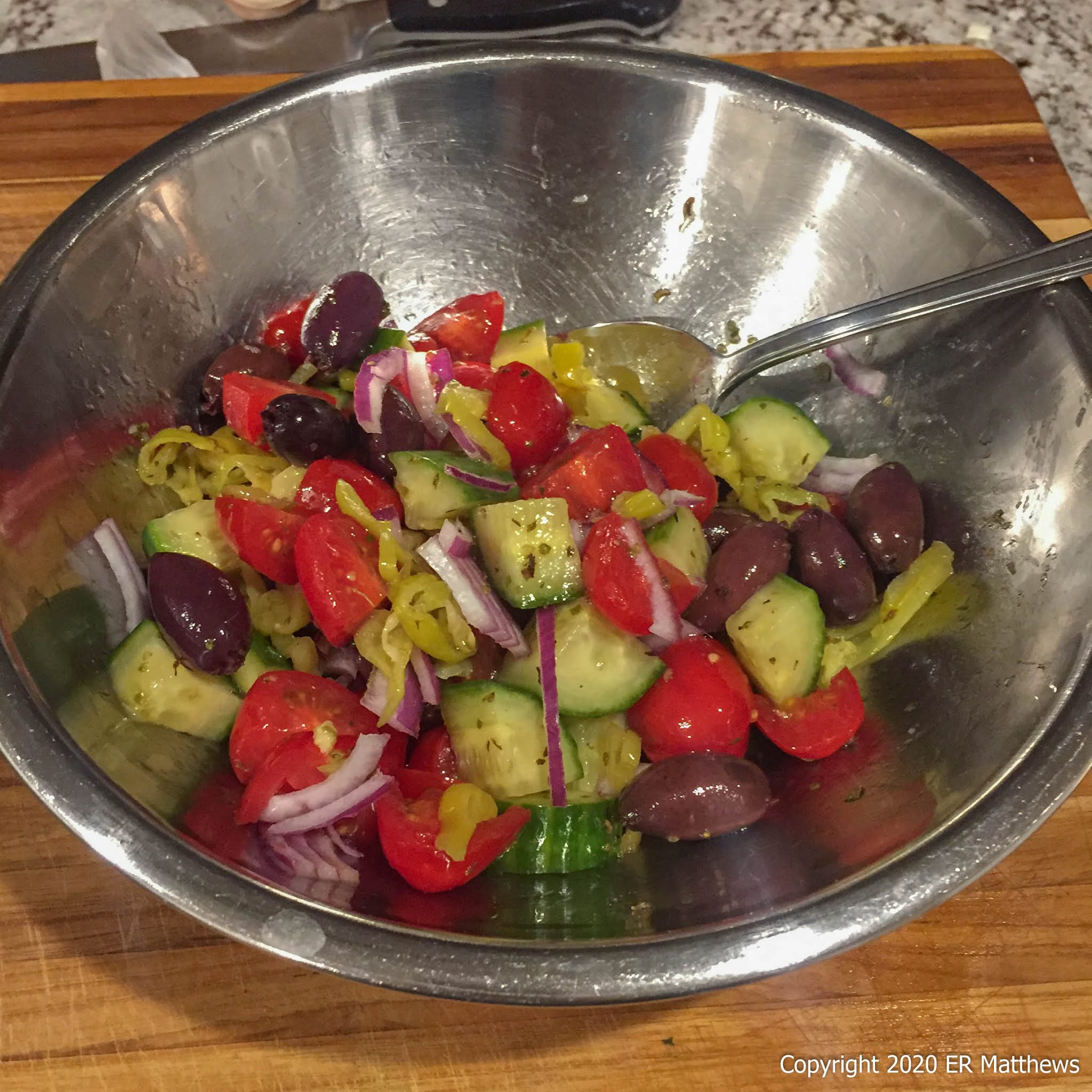
Horiatiki Without Feta
It's quite simple really: cook some onion and garlic in olive oil, add spinach and white beans to warm through and wilt the spinach. Assemble a chopped salad of tomatoes, cucumbers, olives, red onions, and peppers and dress them with olive oil, lemon juice, oregano, and salt. Lay the beans in a bowl and top with the horiatiki.

Feta would be great in this salad or crumbled into the beans or over the top of the plate but we are watching our fat intake and my gut has issues processing a lot of cheese. It's a shame because a great sheep's milk feta is one of the world's great cheeses.

Ann asked me to make this dish again. It really is tasty and it's a great vegetarian dish that can be on the table in under ten minutes start to finish.

Friday, January 8, 2021

Squid, White Beans, and Arugula

There must be foods in everyone's lives, if they ever take the time to reflect on it, that are somehow meaningful in ways that have nothing to do with alleviating hunger, foods that conjure memories. Perhaps it is a dish that grandma used to make, a dessert eaten on a first date, or a secret midnight snack to satisfy a particular craving. In my life, many such dishes make me feel things. Topping the list, perhaps, is white beans with squid and arugula, a dish that I made once again just recently.

Squid, White Beans and Arugula
On the face of it, it is a trivially constructed dish consisting of cannellini beans, baby arugula, raw red onions, and lightly cooked squid dressed with lemon juice, olive oil, salt, and oregano. It is so simple that to taste it is to know how to make it. But it is one of those amazing dishes whose flavors and textures are transcendent, that are more than the sum of the parts. One of my former sous chefs calls it "a perfect dish," high praise indeed.

I cannot in any way take credit for this dish. My history with this dish started in Richmond, VA in the 1980s. Once upon a time, I used to spend pretty much every weekend in Richmond, commuting from my apartment in the DMV in suburban Maryland.

On Richmond's Oregon Hill across from the Virginia War Memorial on the north bank of the James River in a building that looks boarded up sits a restaurant called Mamma 'Zu, a self-styled Italian restaurant that really puts the D in dive. It has no décor to speak of, no fancy furnishings, a surly host, a no-nonsense menu written on a chalkboard, and a wine rack in the back. If you want a bottle of wine, you go to the back and grab a bottle and bring it to your table, or that was the drill 35 years ago.

It is a polarizing restaurant: people love it or they hate it. The restaurant has a well-deserved reputation for taking shit from nobody. They don't accept credit cards, they don't modify their dishes, and you follow their rules or you hit the road. It is a place where the host is intimidating and if you act intimidated, you could be in for a long night. It is also a place where the vibe is chaotically electric and the cooks are jammed into a tiny hell hole of an inferno.

But they turn out some exquisite food. They don't list their excellent pizza anywhere, but if you go there enough, you'll see pizzas coming out along with mounds of pasta. But what I went there for was impeccable seafood. The menu would mainly list the name of the fish and a price, such as "Sardines 24" and "Rockfish 30" and you just ordered them. Woe be unto the newbie who enquired about a preparation or worse, asked for a change in a dish. Me, I never cared. My trust in the kitchen was implicit.

My favorite was an appetizer called Squid, White Beans, and Arugula, the very same dish that you see above, a dish which my then-wife would not touch. I loved it so much that it had to be on the table every time we ate there, which was regularly. Sometimes we would venture to their second location near VCU in The Fan District, a restaurant called Edo's Squid which also had this same dish on the menu. I never liked the swankier location as much, but the food was just as good.

We continued to visit Mamma 'Zu with nearly every trip to Richmond for many years. Fast forward fifteen years or so to a point at which I had opened my own restaurant. One day, into the restaurant walks a young cook looking for employment at a point when I had just lost my sous chef. On the strength of his resume which included stints at both Mamma 'Zu and Edo's Squid, I hired him (and he has gone on to helm many of his own kitchens). In the bustle of getting a new restaurant off the ground, I had put squid and white beans to the back of my mind. He inspired me to put the squid dish on our menu occasionally.

My restaurant was located in Winchester, VA at the very northern point of the state, far, far closer to Pennsylvania than Richmond. The primary industry in Winchester is the hospital which is a large regional trauma center serving a vast geographic area. Many of the employees of the hospital and associated doctor's practices trained at MCV in Richmond and were familiar with the dish from Mamma 'Zu and/or Edo's Squid, which is located just a few blocks west of the hospital.

Many was the transplanted Richmonder who would call me and ask me to make the dish for them on their visit to my restaurant. Such is the nature of the dish that it inspires great loyalty. I have great memories of all the friends and customers who loved this dish as much as I do.

To keep in touch with this dish, I make it from time to time at home. Ann and I both love it. For me, it brings back memories of when I was young, a favorite restaurant, a young sous chef who has gone forth to do great things, of my restaurant and special customers, and of a meal that really resonates with Ann and me. She doesn't have the connection to the dish that I do, but she is the reason that I continue to make it.

Wednesday, January 6, 2021

Savory Bread Pudding: Shiitake, Leek, and Goat Cheese

Way back in the Thanksgiving time frame, Ann expressed a desire to have a savory bread pudding for Christmas Day brunch, by way of celebrating. We haven't been eating many simple carbs at all since August and the bread pudding would be a rare treat. I proposed making one with shiitakes, leeks, and goat cheese and she agreed, further asking if I could make it with challah. So I made a loaf of challah and assembled the bread pudding on Christmas Eve, baking it in early afternoon on Christmas Day.

Savory Bread Pudding: Shiitake, Leek, and Goat Cheese
I really love doing dishes like this for brunch because I can assemble everything the night before, leaving only to pull it out of the refrigerator and put it in the oven the next day.

Starting the Flavorings: Leeks and Shiitakes
Cooking the Leeks and Shiitakes with Thyme
I started by cooking sliced leeks and shiitakes with a bit of thyme. Thyme is one of my favorite herbs and I think it pairs extremely well with shiitakes.

Measuring the Bread
When making any kind of bread pudding, I always use the baking pan to measure the bread. I keep cutting cubes until the pan is full. That way, there's no guessing. Because challah is so soft, I cut it into very large cubes so that it will not fall apart when I add the custard. I prefer to use more substantial bread for bread puddings. When using bread with more body and a tougher crust, I would cut it much smaller.

You can use any bread you like. For example, I have made bread pudding with croissants and my grandmother used to smear store-bought white bread with butter and jam and shingle (overlap) the whole slices of smeared bread the length of her baking dish.

Dry Ingredients Before Mixing with Custard
Bread Pudding Ready to Bake or Refrigerate
The custard for bread pudding can be flavored or unflavored. In the restaurant days, I would infuse the cream for the custard with garlic, herbs, spices, and dried mushrooms, among other flavorings. For this bread pudding, I did not want to take that extra step, mainly because I had just made the challah and spent three days making French onion soup for Christmas Eve Dinner. Also, I wanted to reduce the fat in the custard by using low fat milk rather than the 40% heavy cream that I used to use at the restaurant.

A decent rule of thumb is that each egg will set one cup of liquid, so each quart of liquid requires four eggs. I always use five eggs. It's always a good idea to know how much custard volume you need for the size pan you will be using. A full shallow hotel pan will take a gallon (plus 20 eggs), a half hotel will take a half gallon (plus 10 eggs), and this 9x9 pan will take a quart (plus 5 eggs).

At the restaurant, in addition to making large puddings, we used to bake bread puddings in individual molds, in which case, we'd fill each mold full of bread and then ladle custard into the mold until the mold was full.

This 9x9 pan contains, in addition in addition to the bread and custard, a leek, a half a pound of shiitakes stemmed and sliced, and four ounces of fresh goat cheese.
 
Bread Pudding Coming Out of the Oven
Baking bread puddings is a simple matter of putting them uncovered in a moderate oven (350F) and waiting for them to set up and brown on top to the degree that you want. A bread pudding of this depth will take about 90 minutes, a good bit longer than many people expect. A full hotel pan of bread pudding is going to take about two hours to set in the center and brown. If you're wanting to eat your bread pudding while it is still warm, you'll probably want it to cool for 20 minutes before you cut it so that it has a chance to solidify a bit. All this is by way of saying that you should allow plenty of time to cook and cool your bread pudding before you want to eat it.

Prosecco: A Great Match for Goat Cheese
The slightly acidic flavor of the goat cheese in the bread pudding seems to go incredibly well with Prosecco, so we put a bottle in the refrigerator and had a glass while the pudding was in the oven and another glass with the pudding.

New Year's 2020

2020 in Review

Many have characterized 2020 as a horrible year and one that they are glad to see in the rearview mirror. While it was certainly the most memorable year of my life and one that changed my life totally and irrevocably, I cannot say that 2020 was all for the bad.

Ann's Take on 2020
Given the extraordinary nature of the year, it would be easy to focus on the bad: living through a contentious presidential impeachment, rethinking our lives in the face of a global pandemic, going stir crazy being holed up at home, finding empty supermarket shelves at the onset of the COVID quarantine, losing my job, having a president who encouraged racial and social division, canceling our long-delayed vacation, enduring a presidential election cycle unlike any other, suffering the death of Ann's mother and attending her funeral by watching an empty church on the internet, coping with our dog's cancer diagnosis, barricading ourselves indoors with towels under the doors for just over two weeks because of massive forest fires, and seeing riots in major cities exceeding what we saw in 1968.

While that is a lot on the negative side of the balance sheet, lest you think that 2020 was a total shit show, the positive side is not negligible and potentially tips the scales to the good:

  • The loss of my job was exactly the impetus that I needed to retire. To be honest, I was scared of pulling that trigger myself both for financial reasons (committing to a thin fixed income) and for personal reasons (my sense of self has always been bound to my work). Financially, we've learned to live on our adjusted income and emotionally, I'm used to being retired now, though it took several months to divorce myself from feeling that I needed some external purpose in my life.
  • The pandemic that caused us to wear masks everywhere and to worry about social distancing also forced us to quarantine at home. As a result, Ann and I spent a lot of time together for the very first time in our marriage. It has proved to be wonderful.
  • Our pharmaceutical companies undertook truly heroic efforts to deploy a COVID vaccine, efforts that are just now starting to come to fruition. Just as heroically, our amazing healthcare providers risked and continue to risk their personal safety to care for the ill. As a world, we now have first-hand experience in tackling the next global epidemic. I hope our politicians will have learned from this.
  • Our three kids are well. Carter jumped through significant hoops, some COVID-imposed, to enlist in the Army and now has discovered a path forward for himself. Although it is early days for him, he seems to be thriving. The girls, Ellie and Lillie, despite both working in medicine and having daily contact with patients, are healthy. We are proud of all of them, but are equally glad that we do not have to go to work daily as do they.
  • Being retired and being isolated at home gave me the time and motivation to tackle all those house and yard projects that have been on the someday list.  The yard and the house have never looked better. Ann's vision for the interior is coming along beautifully. She is a talented decorator and her results are impressive.
  • Time at home and closure of restaurants has brought me back into the kitchen. After three years away from the restaurant and cooking simple post-work meals only begrudgingly, I am re-finding my love of cooking and I am finally delighting in cooking all those things that make my wife happy. 
  • Likewise, I have missed writing for many years. It is my therapy. The time to sit and organize my thoughts is a bonus born of this epidemic.
  • Finally, all this cooking and the drinking to combat the quarantine blues caused us both to put on a lot of weight, like a lot of people. But at year end, we find ourselves down a combined fifty or so pounds, our clothes fit (I had to get a new, smaller wedding ring), and we are walking a lot. We're not in super cardio-shape because our local terrain in the valley is flat, but we're way better off than in the first months of quarantine.

On balance then, 2020 was not as horrible as many feel it to be. Moreover, if 2020 has done nothing else, it has made me think about how well off we really are and how thankful we should be for the small things in our lives that we too often take for granted. I am:

  • thankful that we no longer own a restaurant and have to worry about keeping it open and keeping the employees paid so that they can pay their bills. Several of our favorite places have closed permanently and tragically there are more to come. My heart goes out to all.
  • thankful that we no longer have school-aged children that we need to educate safely and responsibly. I cannot imagine juggling home schooling and trying to work for a living.
  • thankful that we had the financial ability to retire rather than face job-hunting in this environment. So many people are so much worse off.
  • thankful that we have a strong marriage that has only gotten stronger during the epidemic. I am quite sure that it has had the opposite effect on many marriages.

All this said, I am really hoping that with the roll-out of the COVID vaccine that 2021 sees a return more towards what we consider normal. I am not so naïve as to think that our 2019 normal will be our normal going forward, but I hope that we make good strides on moving away from 2020 normal. The thing that I first want to do after all this virus mess is said and done is to go sit with Ann at a bar with a cheeseburger and a beer, talking to any and all at the bar. That's not such a big ask, is it?

New Year's Eve

Early in the day, we went to our local park for a five-mile hike, knowing that we were going to eat badly on New Year's Day. 

We did not plan much for New Year's Eve other than opening a bottle of Champagne and having a nice piece of fish for dinner. Earlier in the day when we went to Newberg to pick up the caviar that we ordered for celebratory Egg's Benedict on New Year's Day, we also picked up a stellar portion of wild Steelhead Trout. The side from which our piece came was huge (I'd guess that fish was 10+ pounds) and resplendent with its pink stripe and black dots. I pan seared it and it was delicious.

Marc Hébrart Premier Cru Champagne with our Steelhead Trout
With our fish, we had a very sexy Marc Hébrart Champage, a cuvée called "Mes Favorites." Delicious raspberry notes from Pinot Noir made this one of the best Champagnes that I have ever tasted and I've tasted a lot.

We ended up heading to bed early, though I stayed up until after midnight, the first half an hour of the new year spent comforting Grace who was terrified of the neighbors' fireworks. It would have been a great year to have held a quiet get together with some of our neighbors to toast the new year, but alas, we start 2021 with the same social distancing to which we had become inured in 2020.

New Year's Day

While we made no plans for New Year's Eve, we had been planning a special Pacific Northwest eggs Benedict for brunch the next day, a Benedict fashioned of toasted crumpets, smoked salmon, halibut, poached eggs, hollandaise, and white sturgeon caviar. All three fishes are native to our rivers and seas here in Oregon.

Ann Set the Table While I Cooked
We opened a bottle of grand cru grower Champagne for brunch, this one more lemony from being 50% Chardonnay and 50% Pinot Noir. It did not suck, but it was not in the same class as the premier cru Marc Hébrart from the evening before. It always amuses me when a premier cru (a lesser cru than grand cru) outperforms a grand cru. Of course, the grand cru was only two-thirds the price of the premier cru, so the market is under no illusions as to which is better.

Hollandaise Set Up
Making hollandaise is a classic kitchen task that every chef should master. In French cuisine, hollandaise is one of the five mother sauces upon which almost all other classic sauces are built. A good rule of thumb for home use is that four egg yolks and a tablespoon of fresh lemon juice will incorporate and thicken a quarter of a pound of melted butter, enough for 4-8 healthy portions.

I made a 2-yolk batch, a very difficult task because the volume is so small that it is so easy to overcook and curdle the sauce. A much bigger volume gives you a lot more leeway with the temperature. I had to watch the sauce like a hawk while dribbling butter into the egg yolks over a pan of boiling water. Most of the time, I had the bowl on the cold counter to keep the heat in check. If you're just learning, start with a big batch of hollandaise.

Pacific Northwest Eggs Benedict
Making this eggs benedict at home is a tricky proposition in that the halibut, the poached eggs, and the hollandaise are all last minute (what we chefs call à la minute) items that vie for a single cook's attention. In a restaurant, we would have at least three cooks involved in this dish: one poaching the eggs, one making the hollandaise, and one cooking the fish. And if labor is no object, you really want a fourth person doing the plate-up and calling for each ingredient as necessary.

At home, I toasted and plated the crumpets and smoked salmon while the halibut was cooking. I held the halibut warm between two domed plates while I made the hollandaise. As soon as the hollandaise was done, I dropped the eggs in the water bath. Then I started plating the halibut, pulled the eggs out of the water, rewhisked the hollandaise, and finished the plate-up. That's a lot of cooking with precise timing for a lone cook.

Farmed White Sturgeon Malossol Caviar
Out here on the West Coast, we have a much better selection of domestic caviar than on the East Coast. I wish we had this selection during my restaurant days. Back then, I never served any endangered or overfished fish, always seeking more environmentally friendly wild-caught species. The same thing went for caviar, except that for caviar, I preferred eggs from farm-raised sturgeon rather than endangered wild populations. Our domestic white sturgeon caviar can be really outstanding. At home, I still insist on caviar from sustainable operations that do not harm wild fish populations.

I prefer malossol caviar because it is less salty than regular caviar (you can hide a lot of sins behind salt, too). I remember the word малосоль from my Russian classes in college, a combination of мало ("light" or "a little") and соль ("salt").

Ann's No-Knead Olive Bread
Olive-Pecorino Focaccia
Continuing our "bad" New Year's eating spree, Ann had put up a bowl of her no-knead bread dough flavored with Kalamata olives and pecorino romano cheese the evening before. This is really significant in that we have been eating almost no simple carbs such as bread since August. For dinner on New Year's Day, I shaped the dough into a focaccia and baked it. We were going to have it with cheese and Pinot Noir, but we were wined out after the bottle of Champagne at brunch and really not hungry enough after the big brunch to want cheese along with the bread. If the truth be told, we really just craved the bread!

And so 2021 is now off and running. May it treat us all better than 2020.

New Year's Eve: Miller Woods

Ann and I are walking a lot these days, but there are only so many routes through our side of town and they are getting boring. Although we yearn for the days of weekly far afield and mountainous hikes, neither of us feel comfortable in leaving our old Chuck dog for that long. So we make do walking the neighborhoods near to home. For a change of pace, on New Year's Eve, Ann suggested that we head just three miles west of town into the hills to Miller Woods, a local park with a 4.5-mile loop trail.

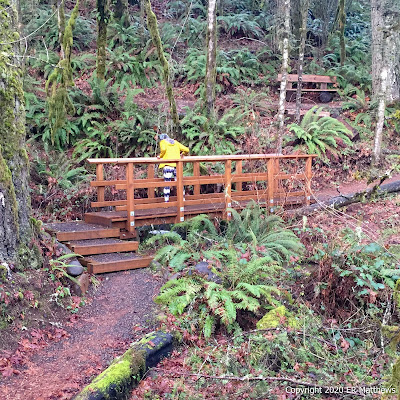
It felt wonderful to get out and walk during a temporary break between rain showers. Although the track was extremely muddy in places, it felt good to walk on uneven ground and go up and down hills, something we do not have on the sidewalks around home.

Oregon White Oak
Moss and Lichens on a Big Leaf Maple
Black Tail Doe
One of the big draws for me at Miller Woods is the wide variety of ecosystems in such a compact area. We had traversed a pasture and then an oak savannah before entering a planted section of Douglas fir. As we worked our way down a hill towards a bridge across a stream, I started seeing very fresh deer tracks in the sloppy mud, so fresh that they had not yet filled in with water. The tracks were heading down the trail the same direction as we were and as I lifted my head from examining the tracks, I could see a doe in the trail about fifteen yards ahead of us.

We followed her slowly for perhaps 150 yards. She would stop and check us out every few yards. Finally, she turned off down the hill into the sword ferns on a fairly distinct game trail. She never did spook. Looking up the hillside following along the game trail, we spied yet another doe browsing in the ferns under the firs. We have plenty of deer near the house too and we see them frequently on our walks, but seeing them out in the woods always seems special to us.

Douglas' Squirrel
As we moved down the trail from the doe, moving through a low section of old growth forest of ancient Doug firs and western red cedar, a male Pileated Woodpecker called from about thirty feet up the side of a fir. We spotted the noisy bird fairly quickly before it glided off towards the creek looking like a miniature pterodactyl. Pileateds prefer old growth for dead snags and older trees in which they can excavate their nest holes, so we don't see them in town much, unlike back in Winchester where they were a common site among the mature sycamores in town and along the Shenandoah River. I believe that this is the first Pileated that I have seen in Oregon.

Just as the woodpecker flew away, a pair of tiny squirrels came racing sixty or seventy feet down a large fir and then proceeded to chase each other through the underbrush and up another tree. I thought they were Red Squirrels, the common tiny squirrel of eastern coniferous forests. When I went to look up the Red Squirrel range map later in the day, I found that they come into Oregon only in the far northeast corner of the state over by Idaho. Our tiny squirrel of coniferous forests is the Douglas Squirrel.
Ann Watching the Stream Fall Over the Rocks
What Ann Was Looking At
A Very Old Douglas Fir
Low Oregon Grape, Mahonia nervosa
Mahonias are common out here in Oregon, so common that the Tall Oregon Grape is the state flower. I haven't seen any of the tall variety at Miller Woods, but there are several patches of M. nervosa, most often abutting old growth stands of trees. By contrast, most of the undergrowth under the planted Douglas firs is the domain of the sword ferns. But no matter what the undergrowth, wherever it was thick we would hear, but rarely see, what I have called Winter Wrens all my life.

It's quite amusing to me after having looked up the Red Squirrel range map to see that it doesn't live here to have looked up the Winter Wren to see that it too does not live here. At some point recently (2010, in fact), the Winter Wren was split into three species, our Pacific Wren, the Winter Wren back east, and the European Wren that I have seen in England and Ireland. By whatever name, they are noisy tiny scurriers of the underbrush that you could easily think were mice.

Dead Fir Draped in Moss
Red-Breasted Nuthatch
There is a lot of bird life at Miller Woods and once in the woods proper we were serenaded not only by the ever-present and ubiquitous Pacific Wrens, but also mixed flocks of winter birds: both kinglets, chickadees, creepers, and nuthatches. We were walking from an old growth area to a more open transition zone when we came across a little blue-gray bundle of fluff right in the middle of the trail.

Naturally, we went immediately to see if the bird were dead or alive and we could see from a couple of feet away that it was breathing, but it let us approach to within inches, as if it were stunned. But within a few seconds, it flew off down the trail ten feet, landed for a moment, and then flew up onto the trunk of a small western hemlock and looked down at us from its upside down perch.

It's really nice to have this delightful park so close to the house. And in winter, it is not very crowded and a good place to get out from being holed up in the house since April.

Ode to the Tortilla

I love tortillas. It wasn't always that way. I am a child of the early 1960s. Then, on the East Coast, our food was influenced by two th...