Friday, July 22, 2022

Israeli Couscous in the Style of Risotto

A lot of chefs, myself included, stretch their culinary vocabulary by learning classic techniques and then extending those techniques to non-traditional ingredients. For me, having learned to make risotto in my teens (more than 40 years ago now!), I have always loved the risotto technique and have extended it to many other ingredients. I once taught a series of cooking classes examining the classic technique for risotto and extending it to barley, farro, quinoa, and orzo.

Israeli Couscous in the Style of Risotto
Poached Eggs and Salsa Verde for Garnish
Recently, Ann ordered some Israeli couscous (because it's a favorite pasta and is not readily available in our markets) and that has seen me making couscous just like I would risotto, mainly for the simplicity of a one-pan meal, truth be told. Post-restaurant, I have to wash the dishes myself!

First Liquid Addition
Cooking Off the Final Liquid Addition
The classic technique is three-fold: sauté the onion and rice in fat, add the liquid in small additions until the rice is done (a bit of wine followed by stock), and finally mantecare, adding butter and Parmesan to finish the dish.

I extended this technique to my clean-out-the-refrigerator couscous. First, I sautéed my soffrito of onion, garlic, red pepper flakes, dried basil, sweet peppers, and asparagus slivers to evaporate some of the moisture in the vegetables. Then I added and toasted the couscous. Next, in went the liquid, water in this case because I already had a lot of flavor in the soffrito. To gild the lily, I could have used an aromatic saffron stock.

Once the pasta was just cooked after a few small additions of water, I then finished it à la true risotto with both fat and cheese. For fat, I made a quick pimentón aїoli and for cheese, I used grated cotija from Mexico.

To add protein to the dish, I poached eggs and put them on top, along with some salsa verde and cilantro for garnish. What is better than stirring egg yolk into a dish?

Summer Eats: Sesame Sōmen with Shrimp and Edamame

When the temperatures soar, who feels like eating large, hot meals? We certainly don't. High summer is the perfect time for a cold pasta salad such as the one I made the other night with sōmen, thin wheat noodles from Japan, poached shrimp, shelled edamame, and a soy-sesame dressing augmented with a healthy dose of crushed red pepper flakes.

Summer Salad: Sesame Sōmen with Shrimp and Edamame
The really great thing about this salad is that you can make it in the morning in just a few minutes, put it in the refrigerator, and it will be ready for you when you get home from doing whatever it is that you do on a wonderful summer day.

Although at the restaurant, I developed a standard recipe for the soy-sesame dressing, at home, I don't bother with a recipe, preferring to eyeball it instead. I use roughly equal parts of soy sauce (or tamari), unseasoned rice vinegar, and toasted sesame oil, which I whisk together roughly with a fork just before dumping in the warm wheat noodles.

I pour a bunch of frozen shelled edamame onto the warm noodles; they will defrost quickly in the salad.

For salads, I use small shrimp which I dump into boiling salted water which I turn off. I let the shrimp stand in the hot water until they are just cooked through, a minute to three depending on size. They go into the bowl of warm noodles along with sliced green onions and a healthy pinch of crushed red pepper flakes.

Toss the salad well and let it cool a few minutes before putting it in the refrigerator. Don't worry about seasoning the salad until you are ready to eat. It will take a few minutes for the noodles to absorb the dressing, which can change the seasoning balance. The flavors are better if you let the salad warm up a few minutes on the counter before serving. Just before serving, taste and season as necessary.

Summer Sipper: Txakoli
What to drink with this salad? The obvious choice for a lot of somms is Riesling. Others might go with a Chenin Blanc or even a fragrant Sake. For my part, living in one of the great Riesling producing parts of the world, I drink a gracious plenty of Riesling in the summer. While I am not over-sated on Riesling by any stretch, I do like to taste wines from elsewhere on occasion. Moreover, I like serving obscurer wines that others might not have tasted. Summer screams to me of Vinho Verde from Portugal, but these days, it is ubiquitous. So for me in my quest for obscurer wines, branching out to its Spanish cousin from Basque country makes a lot of sense.

Txakoli (or Txakolina as the bottle in the photo above is called) is a great lightly effervescent alternative to Vinho Verde. Pronounced CHACK-uh-lee, this wine, like Vinho Verde, comes in white, red, and rosado forms, though most people know only the white form made from Hondarrabi Zuri grapes, if they know the wine at all.

It's a high acid, low alcohol, clean and easy-to-drink wine. Depending on the producer, it may be vinified in a riper, more aromatically fruity style, or as is my preference, in a more lemony and saline style reminiscent of great Albariño that has been picked slightly early.

Here's to cold salads and crisp wines to beat the summer heat!

Thursday, July 21, 2022

Hosmer Lake

In the last week, Ann and I have succumbed more to the Bend lifestyle, purchasing an inflatable paddle board and an inflatable kayak. Ann was more than eager to take them for their maiden voyage and chose Hosmer Lake for their trial run. Hosmer is situated in the Deschutes National Forest 20 some miles west of Bend on Cascade Lakes highway, the road to Mt. Bachelor and beyond that is dotted with lakes every couple of miles.

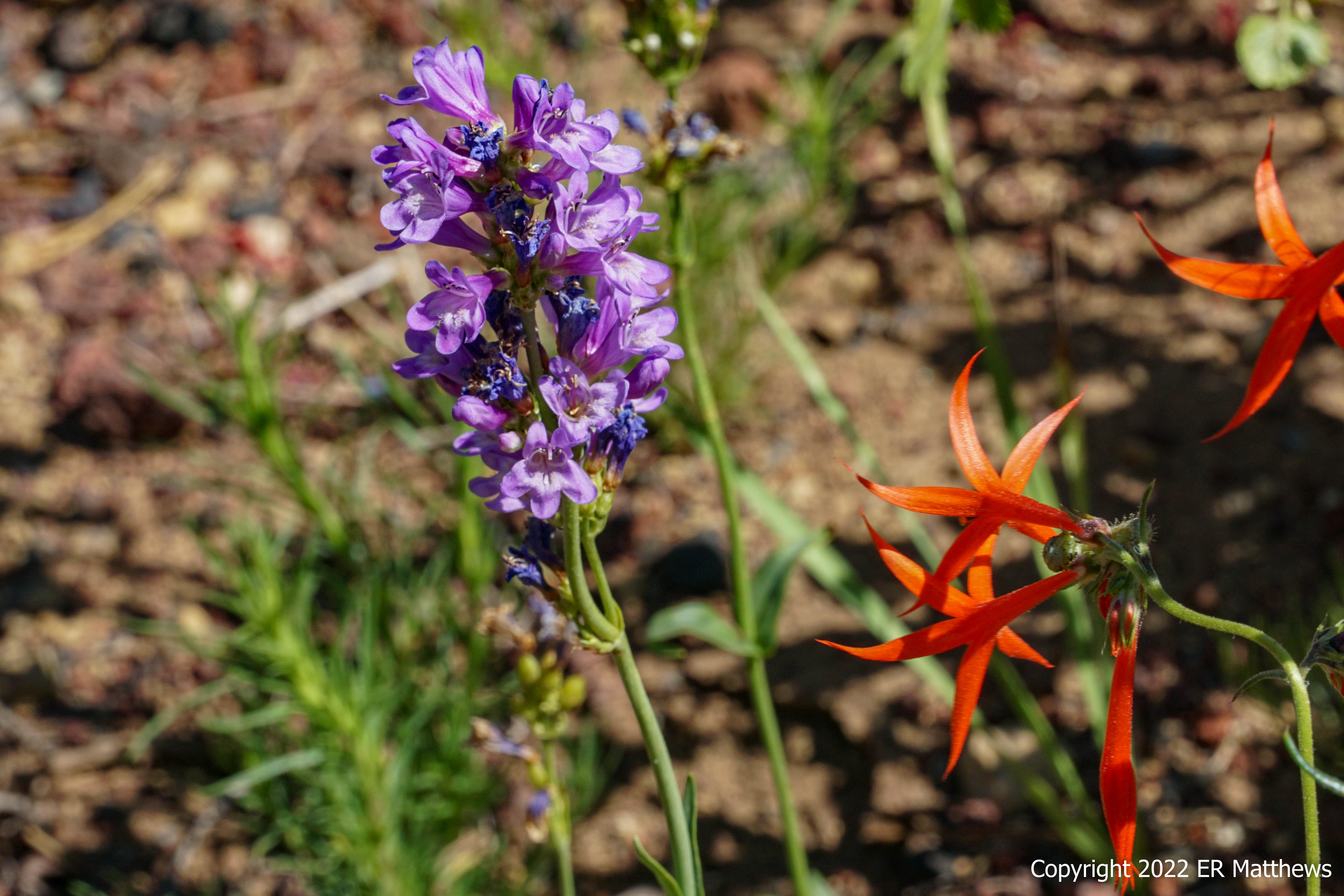
Still brand new to the area, this trip would be our first out Century Blvd/Cascades Lakes Highway beyond Benham Falls to Mt. Bachelor and beyond. As we reached the first of the sno-parks, Virginia Meissner, we started seeing huge swaths of brilliant scarlet flowers on the roadside, intermixed with vast stands of purple, blue, and lavender penstemons. We saw that they were heaviest just east of Wanoga Sno-Park and made a mental note to stop on the way back to look at the wildflower display up close and personal.

Seeing Mt. Bachelor and the Three Sisters is an everyday occurrence for us, one that we marvel at and do not take for granted. The scenery in this part of the world is breathtaking. However, we are used to seeing the mountains from Bend or from out Skyliners Rd about ten miles west of Bend. We have never seen Bachelor up close and it got taller and taller the closer we got, an almost perfectly symmetrical cinder cone dominating the landscape.

Bachelor dominates the landscape around it, sort of. Just as you cross its northern flank going past the ski resort, Broken Top and South Sister come screaming into view. And as tall and dominating as Bachelor is, South Sister takes no crap from it, looming 1300 feet above Bachelor. And even the super otherworldly looking Broken Top is taller than Bachelor. It is hard to put this in perspective all the way back in Bend.

Mt. Bachelor from Hosmer Lake

We arrived at Hosmer Lake in the lunch hour, after much of the morning crew had vacated the lake, making finding parking fairly simple. We set about inflating our craft and got out on the water within 15 minutes from the boat launch at the end of the parking lot. The water in this lake is both clear and shallow. In the noon hour, I could not see any fish in the water, but it was rare when I could not see the bottom: the average depth of the lake is three feet.

Getting Ready to Hit the Lake
Leaving the Boat Launch
Mt. Bachelor from the Boat Launch
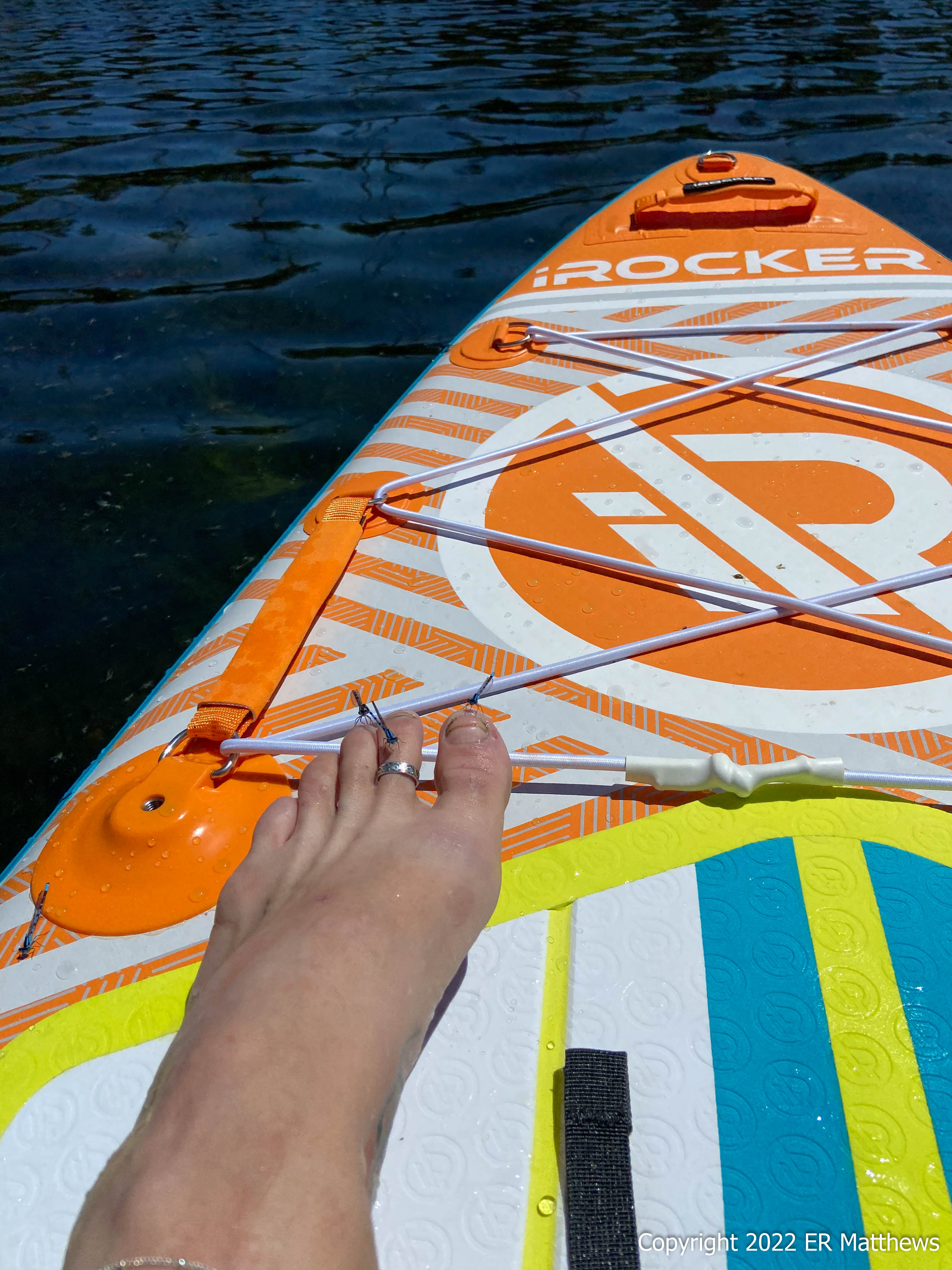
Blue Dragonflies on Ann's Foot
I wished I had brought my camera along, but I still haven't figured out how to keep it dry. That will come with time and experience. I would have loved to have photographed the four tiny baby Mallards that their mom let me slide right up to in the kayak. I stopped paddling some distance out, turned broadside to the ducklings and let the wind push me right to them. While mom was talking gently to them and they to her, she never got animated in the least by my presence and let me get within three feet of them.

There was no shortage of other birdlife to photograph including hundreds of Red-wing Blackbirds (no Yellow-headed ones though) posturing and feeding young. Gliding up to an island, I was able to get within about ten feet of a Flicker nest hole and watch the female come and go with food. Red-headed Ducks were more skittish and I could only get to about ten yards before they would fly further or dive under water. Once I heard a Bald Eagle whistle, but could not locate it or the two American Bitterns serenading the lake area with their booming calls. At one point out on the biggest part of the lake, Violet-green Swallows were grabbing insects right off the surface of the water with trout launching skyward in the midst of whatever was hatching.

Out in this same middle part of the lake, I was watching as Ann made her first successful attempt at standing on her paddleboard, if only for a few strokes before she kneeled back down. I am sure that like most things, it will take a bit of practice to become proficient.

We wound through the S-shaped channel between the two more open parts of the lake as we went from one end to the other. It appears that vegetation is slowly overtaking the lake and converting it to a marsh. All along the edges up to the start of the cattails and rushes were large rafts of both Yellow Pond Lilies and Longleaf Pondweed floating on the surface. In addition to the brilliant gold flowers of the pond lilies, the edges of the water were blooming with white Ladies' Tresses orchids, poisonous hemlock, Cow Parsnip, and many other unknown plants. An especially striking one with dark wine-colored blooms that lined much of the shallow water, I finally identified as Purple Marshlocks, Comarum palustre.

After three hours on the water, we reluctantly came back ashore and packed up for the trip back to Bend. On the far side of Bachelor, we stopped just past Wanoga to look at the beautiful display of wildflowers. As soon as I got out of the truck, I could see that the masses of brilliant scarlet blooms were Scarlet Gilia, a flower that I have seen recently along the Deschutes River Trail in Bend.

Scarlet Gilia, Ipomopsis aggregata

The purple and white blooms interspersed with the Gilia were all penstemons. I noted about five different species in the area, including white-blooming Scabland Penstemons, P. deustus. The majority of the penstemon plants that I saw were either Glaucus (P. eglaucus) or Ash (P. cinicola). With my limited ability to identify penstemons, I feel that they were probably Glaucus.

Chicken Confit and Asparagus Pizza

Food posts are few and far between this summer as we enjoy all that the surrounding majestic outdoors has to offer. Summer dinners are quick, sometimes cold, sometimes eaten out with beers after an outdoor day. Often, we eat a late lunch and this suffices for our dinner. This time of year, I probably cook something creative only once a week, saving up my creative energies for the short, dark days of winter.

A weekend back, we went to the home of some new friends, Ken and Dawn, to enjoy pizza on their back patio. We had a great time and it was my first time using an Ooni pizza oven, which worked really well. I was impressed at the little oven that could. I made a batch of Malbec-pineapple sorbet to take along and at the end of the evening, I left the sorbet with Dawn and she sent me home with a pizza dough.

Chicken Confit and Asparagus Pizza
That pizza dough stayed in our fridge for a few days until we were home for dinner. Scrounging the fridge, I came up with enough to make a pie: the last piece of chicken confit from the batch I made back in May, a few stalks of asparagus, and a block of pecorino romano. Shaping the dough, I rubbed the top with a bit of garlic oil left from making garlic confit. Then I decorated the pie with shreds of chicken, slivers of asparagus, and thin slices of pecorino.

The pie didn't brown well, most likely as a result of it having overproofed during its long stay in the refrigerator, but still, it was delicious and quite a quick treat on a hot summer night.

Dawn, thanks for the dough and the hospitality!

Wednesday, July 20, 2022

Paulina Peak

Paulina Peak is the highest point in the Newberry National Volcanic Monument, the tallest point remaining along the crater rim of the massive Newberry Volcano. The caldera itself is massive and contains two large lakes, Paulina Lake and East Lake. We hiked around Paulina Lake last month.

While we have wanted to scale the peak for months now, it's been tricky finding a good time. At about 8000 feet in height, the peak was under snow well into June. Moreover, the top is above the treeline and is exposed, meaning that we don't want to hike it on a blazingly hot day.

Paulina Peak
We finally found a day with moderate temperatures and set off from our house in Bend to make the 3.25-mile climb from the parking lot along Paulina Lake opposite the Visitors Center. Driving in the entrance road in the early morning, it was another game of rodent Frogger, in which the resident chipmunks and ground squirrels would run, seemingly suicidally, across the road in front of us.

Adding to the game of Dodge 'Em, a doe Mule Deer also walked casually across in front of us. Having spent the vast majority of my life on the East Coast, I am always really surprised by the large size of Mule Deer. The does are just about as big as the White Tail bucks that I am used to.

On our drive in we saw big patches of Monkeyflowers blooming purple and Nuttall's Linanthus in white mounds all along the roadside. It is really a beautiful climb from highway 97 up to Paulina Lake, a gain of about 2000 feet over 13 miles.

The hike started from the Visitors Center in the forest which was predominantly Lodgepole Pine. In the more open areas, we started to see little patches of lupines. We have 21 species that have been reported in this area and I hardly know one from the other, except for the very tiny and distinctive Dwarf Mountain Lupines which in this area, were no more than 2 inches tall.

Still Life with Lupine
Dwarf Mountain Lupine, Lupinus lyallii
As we climbed, other trees started to intersperse with the Lodgepoles, the odd spruce, fir, and hemlock. And before we knew it, we were in a section of old growth Western Hemlock. The hemlock would dominate the forest nearly all the way to the top.

Mount Jefferson over Paulina Lake Lodge Marina
No trip to this area would be complete without a mention of obsidian. This volcanic glass is terribly common and we started seeing it on and beside the trail about halfway up to the peak.

Obligatory Obsidian Photo
After swinging southwest and west through the trees climbing up onto the crater rim, the trail swings back east and opens up a bit. At this point, volcanic features start to appear in earnest. The trail passes a few spires of harder rock still standing proud of the crater rim. The photo below is our first view of East Lake. If you click through to enlarge the photo, you can see the sun glinting off the small knob of obsidian to the right. Beyond it in the distance, you can see the tongue of the Big Obsidian Flow protruding just below East Lake.

Paulina and East Lakes; Sun Glinting off Obsidian Knob
As the trees thinned out, the predominant wildflower in bloom was Davidson's Penstemon which forms large mats of short plants with mouse-eared leaves covered in a profusion of the most beautiful purple blossoms. Penstemons are so terribly common here that many people overlook their beauty. With 28 possible species at Paulina Peak, it is hard to narrow down to the species level. Fortunately, Davidson's Penstemon is pretty distinct in form. The small mats that we started seeing along the trail were a mere tease for what we were to encounter at the top.

Davidson's Penstemon, Penstemon davidsonii
Ann's Photo of Her Trekking Poles
How Meta is This?
Paulina Lake Through Rock Spires
At one point, out of my peripheral vision, I started seeing masses of orange color on the ground. The last time this happened to me, I found myself in the motherlode of chanterelles. I quickly popped off the trail to check out the brilliant orange fungi on the forest floor. It became quickly evident that these were no chanterelles. Ann said that they looked like orange peels and they did to a certain extent. We found ourselves in a house-sized patch of Orange Peel Fungus, which despite being common, I do not recall ever having seen before.

Still Life: Pine Cones, Hair Cap Moss (Polytrichum juniperinum), and
Orange Peel Fungus (Aleuria aurantia)
Soon after as we headed east up the ridgeline of the crater, the full expanse of the Big Obsidian Flow came into view. As you can see in the photo below, it appears almost as if a giant had poured a bucket of mud onto the ground where it spread slowly and dried in place. The obsidian flow is very young, geologically speaking, having occurred about 1300 years ago. Obsidian happens when silica-rich lava cools very quickly to form black volcanic glass. A park ranger told me that his theory was that the lava flow happened in the winter when it was very cold. Makes sense to me.

The Big Obsidian Flow
Just at the point where we were able to observe the Big Obsidian Flow and East Lake in their entirety, we came out of the relatively damp and dense hemlock forest into an open sandy scabland crowned with Whitebark Pines, a species that I was on the lookout for, really never having had a chance to see them up close.

A Young Whitebark Pine, Pinus albicaulis
Whitebark Pine
The endangered pines are clearly related to White Pines; the smooth whitish grey bark and bundles of five needles are a dead giveaway. These pines grow very slowly, attain great age, only grow at high elevation and so are threatened by climate change, and are under siege by fungal and insect pests.

As soon as we left the hemlocks and entered the pines, the air erupted in raucous squawks of Clark's Nutcrackers, which love to feed on the Whitebark seeds. In fact, these gregarious birds are primarily responsible for reseeding the pines via their forgotten caches of seeds. Although it was hard to see for the tree cover, I would guess that we were standing among a group of about a dozen of the big birds.

Clarks' Nutcracker in Whitebark Pine Snag
Another Clark's Nutcracker Giving its Compatriots What-For
The Three Sisters Through the Whitebark Pines
1200 Feet Above Paulina Lake
Just a quarter mile from the summit, the Canyon Rim Trail leaves the Paulina Peak Trail, heading southwest. We misinterpreted the sign to read that we wanted to branch off to the right instead of continuing straight on to the peak. A quarter mile later of heading downhill, we reversed course. I have never yet headed downhill to a peak! This little sidetrack led us through a relatively open sandy area full of mats of Davidson's Penstemons and Whitebark Pine snags. I enjoyed the detour; I believe that Ann had a different opinion, being tired and hot from the steep parts of the climb.

Sandy Ground Crowned with Mats of Davidson's Penstemon
Yet Another Scenery Change, A Beach at 7800 Feet
Whitebark Pine
Ample Lookout Perches for Clark's Nutcrackers
Another Rock Spire Near the Summit
Exiting the Tree Line
Pink Mountain-Heather, Phyllodoce empetriformis
Littleleaf Huckleberry (Grouse Whortleberry),
Vaccinium scoparium, Glowing in the Sun
Finally, Flat Ground 15 Feet Below the Summit
360-Degree View at Paulina Peak Summit
The trail approaches the summit mainly from the west via a rocky area. Emerging from the rocks, you spy a large parking lot and viewing area further to the east. People can drive to the summit depending on the snow conditions and road repair. This year, the road has been open about a week, fairly late in opening. From where the trail reaches the summit plateau, it is a further rock scramble of about 15 feet in elevation to get to the very top. Interspersed in the rocks along the way to the very top are small patches of wildflowers.

Paintbrushes (Castilleja sp.) Appear at the Summit
Nuttall's Linanthus, Linanthus nuttallii
As we moved further east away from the rocks and into the viewing area, I noticed that the patches of flowers were becoming larger and more profoundly beautiful. Vast mats of resplendent penstemons were everywhere, becoming intermixed on the far east side of the parking area with stands of low-statured paintbrushes.


While I was photographing the red and purple hillside, I noticed a Golden-mantled Ground Squirrel pop out from behind a rock a few feet away from me. What I did not realize is that I was standing nearly atop the entrance to its burrow. As I watched, it brought a mouthful of something (probably a bit of pine cone) to the burrow at my feet and disappeared below ground.

Golden-Mantled Ground Squirrel, Mouth Full
The top offers 360 degrees of astounding views. Arguably, the best views are to the north and west of the Cascade peaks to the west of Bend. And as a bonus today, through the atmospheric haze, we could see all the way to Mount Hood, 118 miles north as the crow flies.

Mt. Bachelor and the Three Sisters
Mount Hood, 118 Miles Distant
From the top, though it is possible to follow a loop trail back to the lake where we were parked, we headed back down the way we had come. The day was getting warm and we had already had our fill of sun up above the tree line. My knees hate downhill and I was really glad an hour later to be back at the parking lot.

As we approached the parking lot, I saw a Robin with a mouthful of food make a beeline for a short Lodgepole pine. I quickly spotted the nest and three babies jockeying for food. That a robin will approach the nest directly is unusual. Usually, a robin will follow a circuitous path to obscure the location of the nest from any would-be predators.

Robin Feeding Babies
The hike to Paulina Peak is pretty doable by most people in reasonable shape. The first third is easy, the second third is really steep (with coming down harder than going up), and the final third is moderate. The views at the top are hard to beat for such a short hike.

Bendiversary 2026: Cassoulet Encore

Once again, seemingly more quickly this year, February is upon us in a flash. We have crammed our February celebrations (Valentine's Day...