Tuesday, May 10, 2022

Lava Butte

Living on the south side of Bend, we are really close to Newberry National Volcanic Monument managed as part of the Deschutes National Forest by the National Forest Service, whose rangers at the site are incredibly nice and helpful.

The entire monument is close to 55,000 acres spread over many miles. The primary attractions are Lava Butte, Lava River Cave, Lava Cast Forest, and Newberry Caldera. Newberry Caldera, of which the highest point is Paulina Peak, just got 8" of new powder and the approach road is closed at a gate two miles out. We won't be going there until the snow melts a good bit. We decided to focus on Lava Butte, a 500-foot high cinder cone close to our house and clearly visible for miles around, for our first foray into the National Monument.

Lava Butte from Edge of Lava Flow

The first thing that we noticed on parking at the Lava Lands Welcome Center is that the area is alive with little critters of the mini-bear ilk, so-called because we fear them getting into our food supply when backpacking more than the real bears. There are two kinds of small rodents readily found here: the larger and less shy Golden-mantled Ground Squirrel (Callospermophilus lateralis) and the smaller, shier Yellow-pine Chipmunk (Tamias amoenus) that is prone to scurrying at high speed with its tail straight up in the air. I had a really great photo of the latter that somehow I deleted in reviewing photos on the camera. Oh well, these chipmunks are everywhere out here and we see them regularly on our walks.

Golden-mantled Ground Squirrel

Yellow-pine Chipmunk
Leaving from the visitor center parking lot, it is an easy 3.8-mile round trip road walk to the top of the cinder cone and back. The gradient is a bit steep at times, but the walk is easy. We're not a fan of road walks in general, but bushwhacking the loose cinders on the slopes is not a great idea from either a safety or an ecological perspective. Traffic on the road was minimal on a Monday off-season and split equally between cyclists and motorists.


As you can see in the photos above, the flanks of the cinder cone are largely bare, with a scattering of Ponderosa Pines at the top. Extending out in all directions from the cinder cone are lava flows that are also largely bare, despite having been deposited on the plain some 7000 years ago. Around the edges where the lava starts to meet the desert, the flora starts to appear, mostly Ponderosa Pines, a few Western Junipers, Green-leaf Manzanita, Rabbit Brush, and Antelope Bitterbrush.

Beautiful if Stark Landscape at the Edge of the Lava
Wolf Lichen Glowing on a Ponderosa
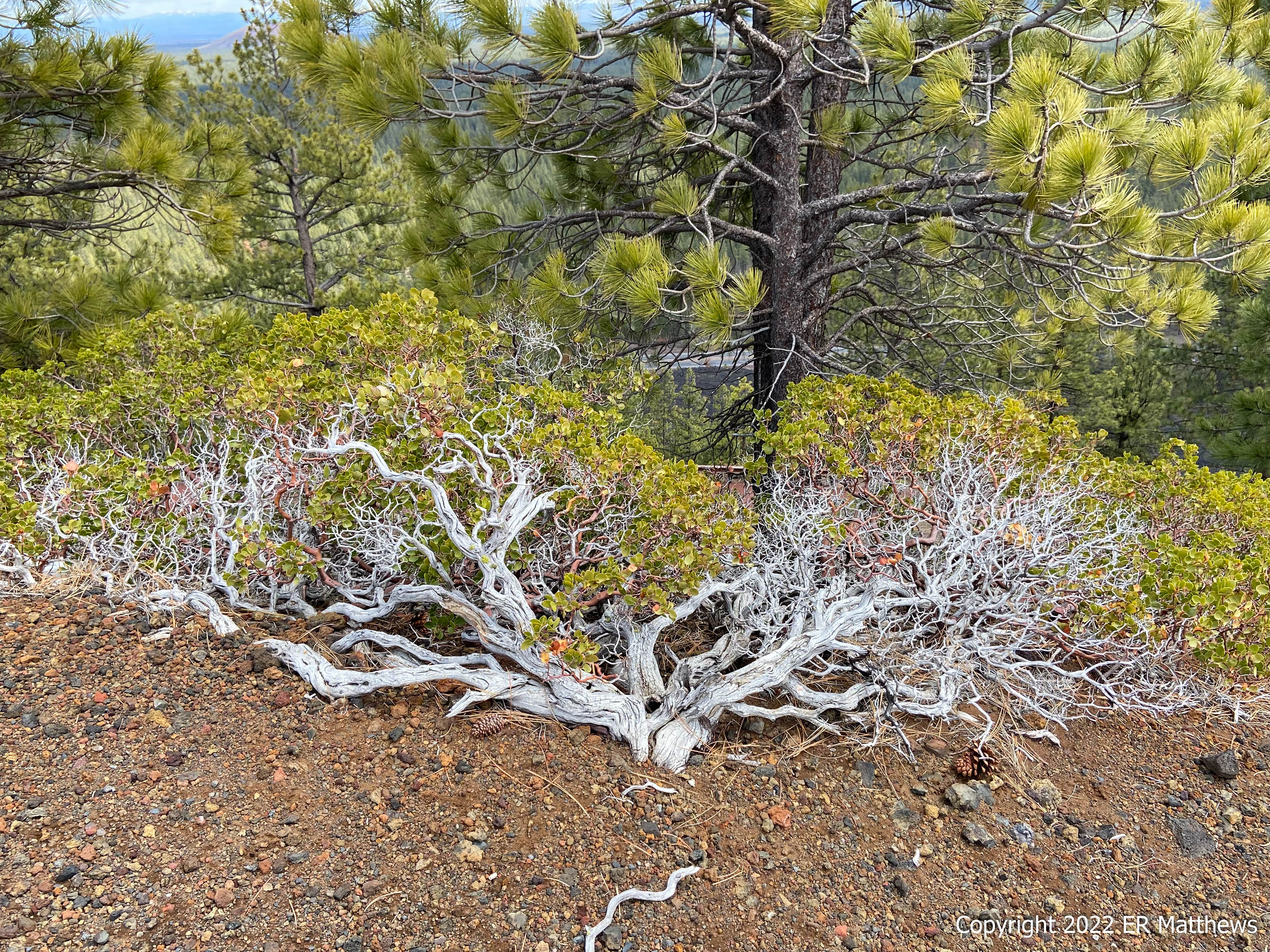
Gorgeous Trunk on an Old Manzanita
The land at the bottom of the cinder cone is about 4500 feet, another 600 feet above our house, while the peak of the caldera tops out at roughly 5000 feet. At this height, spring is still a long way away and there really was nothing in bloom. We did find a single manzanita still blooming on the north side of the cone along with a few Wax Currants. 


The walk up the red cinder road to the top afforded us great views of Central Oregon, though clouds did obscure the Cascades at times. The forecast was for intermittent snow flurries and although we got flurried on a bit on the way up, the day was largely sunny near the butte.

Mt. Bachelor Under Clouds
Unknown Cinder Cone East of Lava Butte
Lava Flow Stretching West to the Deschutes River
Lava Flow and Trail System Behind Visitors Center
Black Butte in the Distance
As we neared the top of the cinder cone, we saw our first close-up glimpse of the active fire tower on the highest part of the caldera rim. Once we were up top, we could finally look down into the crater, which drops about 150 from the rim. We walked the rim trail around the circumference of the caldera marveling at the cataclysmic forces that created this amazing landscape.

Two-Story Fire Tower
Looking into the Crater
On the Caldera Rim Trail
Remember that snow that had been spitting on us all morning? While we were up top, Mt. Bachelor was obscured at times by snow squalls and then as we were leaving, more serious squalls started to come closer, largely obliterating the view of the mountains to the west.

Snow Squall Approaching in the Distance
With snow coming on from the west, we decided to head back down and to explore the trails in the lava field out behind the Visitors Center. On the way back around the rim trail headed for lower ground, I heard an explosive burst of happy birdsong, sounding almost like the House Finches nesting in the Blue Spruce behind our house.

Clearly not House Finches, these birds almost had me thinking that they were Purple Finches, a bird I used to see often as a child before they were chased off by the House Finches. On getting home and reviewing the photos, I could see that they are Cassin's Finches, a bird that I have never seen before, something of a rarity in that I have seen many hundreds of species in the US.

Cassin's Finch (Haemorhous cassinii)
To make the day even more complete, as I was walking through the parking lot shaded by tall Ponderosa Pines, I saw a bird that I have been wanting to see for a very long time but have never lucked onto. As soon as it flew up, I recognized it immediately, reminding me of a slim Mockingbird and looking much like a large grey female Mountain Bluebird with a white eye ring, clearly a Townsend's Solitaire. It put on a show for me, hawking bugs from its perch.

Townsend's Solitaire (Myadestes townsendi)
Back at the Visitors Center and still in the sunshine for the moment, we headed out back to explore the short (1 mile out and back) Trail of the Molten Land. Immediately into the lava field, we might as well have been on another planet, as otherworldly as it felt and looked, harsh, bleak, and truly unforgiving. It is no wonder that NASA brought astronauts here when I was a kid in the mid-1960s to train for lunar missions.

From up above on the caldera rim, the lava fields look flat. In reality, when walking through them, they are anything but flat, having large hills, lava tubes, and formations that resemble alien creatures.

Snow Squall Now Engulfing Lava Butte
A Lava Tube

I am largely at a loss when it comes to geology, yet I still find rock formations amazing. If you're not in a hurry reading this, take a moment to click through and enlarge the following two photos, which show a lava face with a squarish almost fish scale effect. It reminds me of looking at the top of a columnar basalt or columnar phonolyte formation, but those tend to be pentagonal and/or hexagonal in shape. 


We humans do not have a good sense of geologic time as it works on a timeframe so far out of our reckoning. This lava field is about 7000 years old, ancient according to the scale of a human life, and yet geologically it is almost brand new. Bearing witness to this, the black plain is almost barren as far as the eye can see. And yet if you get up close with the lava, you can find small plants and trees starting to colonize the cracks, such as the dwarf Ponderosa Pine in the next photo.

Solitary Ponderosa in a Sea of Lava
We quickly reached the farthest extent of the trail at the Phil Brogan Viewpoint under rapidly darkening skies. Looking to the west and getting a face full of wind-driven snow, we could see the snowstorm rapidly approaching, our signal to make back for the shelter of the Visitors Center and the truck.

Rapidly Approaching Snowstorm
After a brief interlude in the Visitors Center where we looked a the three-dimensional map of the entire Volcanic Monument, extremely helpful in gaining perspective, we exited toward the truck under nearly black skies. As we pulled out of the parking lot, I could see a squall flying up the road towards us. We drove back to Bend through thick snow showers that dropped an inch in just a few minutes.

Thursday, May 5, 2022

Chickpea Salad with Yogurt Dressing

Chickpea Salad with Yogurt Dressing
This post is mostly a note to myself to remember this salad, because Ann really loved it. I made it last evening from odds and ends I had in the kitchen that needed to be used. It's a two-part salad, the base of which is arugula tossed with lemon juice, olive oil, and salt. The chickpea salad on top is chickpeas, olives, green onions, and grape tomatoes tossed in a yogurt-based dressing.

The dressing, very much a spur of the moment thing, is plain Greek yogurt flavored with garlic, cumin, and salt, spiced with chipotle adobo, and thinned with water. If I were making a true Mediterranean-inspired dressing, I would have used some other kind of spice, such as Urfa or Aleppo pepper, or even a bit of harissa, but I have a can of chipotles open in the refrigerator that needs to be used.

Update: I have cooked so much food in my life that I have forgotten much of what I have done. In cruising through old posts, I came across a recipe for this dressing that I published back in 2020. I totally forgot about it.

Tuesday, May 3, 2022

Oregon Badlands Wilderness

In a really sad, but not unexpected turn of events, we had to put our remaining dog Grace down mid-week. We really miss that dog, but on the other hand, caring for her was keeping us rooted at home. It was terribly hard for us to get away for more than about 2-3 hours at a time, basically eliminating our ability to get out and hike.

Thanks to a great break in our winterish weather, we were able to take advantage of the sun to get out and take a half-day hike. I selected the Oregon Badlands Wilderness because it is close to the house and out in the desert, we wouldn't have to worry about snow on the trails.

The Badlands is a 29,000-acre juniper and sagebrush wilderness area just 15 miles east of the house. Managed by BLM, it is similar to other wilderness areas we have visited: limited to no facilities, trail markings at some (but not necessarily all) trail junctions, and total absence of on-trail markers. In short, when visiting a wilderness area, you need to know how to navigate and potentially navigate cross country, which we ended up doing.

Since moving from the west (wet) side of the Cascades to the east (dry) side, I have been fascinated by the terrain, flora, and fauna of Central Oregon. The west side is characterized by Douglas Firs, Big Leaf Maples, and Sword Ferns. Here along the Deschutes, we see mainly Ponderosa Pines, Lodgepole Pines, and Greenleaf Manzanita. But starting not three miles east of the house, the primary vegetation is Western Junipers and Big Sagebrush (along with allies Rabbitbrush and Antelope Bitterbrush).

Because of a commitment of Ann's, we couldn't get out to the Badlands until pretty much high noon, the worst light for photography and the worst time of day to see fauna. On the other hand, the temperatures had warmed up to the low 50s, so it was quite pleasant, even in the blazing sun out in the sagebrush.

Not knowing anything about the Badlands, I looked at a trail map and put together a roughly 8-mile circuit from the Badlands Rock trailhead. As we arrived at the parking lot for the trailhead and exited the truck, we could hear a veritable symphony of Western Meadowlarks (Sturnella neglecta) to our south and the happy, bubbling tune of Mountain Bluebirds (Sialia currucoides) to our north.

Mountain Bluebird (Sialia currucoides)
Our intended (rather than actual, more on this later) route was to take the Badlands Rock trail 3 miles north, then the Castle Trail a mile west to Flatiron Rock, then from there south to the car via the Flatiron Rock and Homestead trails for a total right at 8 miles. When we got to Flatiron Rock, we found ourselves on a small, almost game trail, without any signage or any sign of the much larger Flatiron Rock trail.

Rather than hunt further west for the Flatiron Rock trail, we just kept going through the scrub south and east, winding in and out of interesting rock formations, and ultimately ran back into the Badlands Rock trail. Our modified route was about a half a mile shorter than our intended route.

We weren't alone in our confusion; we met a couple of women coming through the scrub in our direction fairly utterly confused about where they were and hoping to be on the Flatiron Rock trail. I directed them back to the last trail marker we crossed so that they could plan a route back to their car. 

It would be truly hard to get lost in the Oregon Badlands Wilderness simply because the southern edge is bounded by the Central Oregon Highway, US 20. Head south long enough and you're bound to hit the highway. As it was, we enjoyed trekking through the scrub, off the beaten path seeing parts of the area that not many people see.

Leaving the Parking Lot
Sand, Western Junipers, Bitterbrush, and Sagebrush
Before moving to Bend, I'd never seen a Western Juniper (Juniperus occidentalis) before, its range being quite limited and largely confined to eastern Oregon along with tiny bits of northern California and Nevada. Of course, coming from Virginia, we are intimate with the eastern version called Eastern Red Cedar (Juniperus virginiana), a scrub tree that is wont to colonize neglected pastures.

I come to find out that a lot of people despise the tree for a variety of reasons, but I have nothing but admiration for its ability to live for 1-2000 years in horrible volcanic soil with almost no rain. My hat is off to anything that can not only survive these circumstances but actually thrive in them.

I don't really understand the lifecycle of these trees yet, but I do know that we have just been through a big bloom back in March. Apparently, it is a big deal for many people with allergies. Some trees were barren of cones, some were laden, and others had just dropped all their blue cones on the ground. Around town, I see American Robins and Cedar Waxwings feasting on these cones when they cannot find better fare. I assume other birds feed on them as well, but I don't know of other fruit eaters in the desert.

Western Juniper Laden with Cones
Western Juniper Cones on the Ground
The Western Juniper has a spectrum of differing forms and the older ones with their twisted limbs are quite fascinating to look at. When allowed to grow free of interference, fire, disease, and competition, they can take on a rather oak-like form, which Ann and I called the "broccoli tree" for obvious reasons. The older trees such as the one below have scale-like leaves. The young trees such as the second one below not only have a spiky form, but they have spiky needle-like leaves as well.

"Broccoli Tree" Form
Young, Spiky Form
The soil in the badlands is poor, thin, shallow, and largely sandy, varying from fine sand to rougher red volcanic cinder, originating as windblown volcanic ash or eroded lava. The rock, mainly Columbia River Basalt, is the remnant of an ancient shield volcano. The higher areas have either pushed up through faulting or are harder rock that has not eroded as quickly as the surrounding rock.

Lava Flow, Western Junipers, and Big Sagebrush 
Beautiful Old Juniper Trunk
Juniper is really rot resistant, so it is not unusual to finding dead trees standing for decades, providing nesting cavities and perches for a variety of birds. The snags also are home to other things: almost all dead wood in the Badlands is covered in a brilliant neon green lichen, called Wolf Lichen (Letharia vulpine). If you click through the picture below to enlarge it, you will see that the branches of the dead juniper glow green.

Juniper Snag Glowing Neon Green
Wolf Lichen (Letharia vulpine) Detail
Natural Sculpture, a Juniper Snag
Badlands Rock, our primary destination for the afternoon, stands above the desert floor; let's call it 75 feet high. You can see it a bit in perspective in the photo below by comparing Ann's height (in the yellow jacket) to that of the rock formation. As I was taking the second photo, I was being serenaded by a Canyon Wren (Catherpes mexicanus). I would hear the haunting descending melody several times as I was climbing the rock formation, but I never did see the little guy. Ann saw it fly off to my right as I was looking down trying to find a handhold, but I missed it. I've seen Canyon Wrens throughout the southwest, but never here in Oregon.

Badlands Rock from 1/4 Mile
Badlands Rock from 100 Yards
Atop Badlands Rock, Looking Southeast
Western Spire, Home to Canyon Wrens
Climbing Badlands Rock affords a view of the snow-capped Cascades to the west that we really cannot take in in its entirety from downtown Bend. I'm pretty sure that on a pristine day, you could see all the way to Mount Hood but it was too hazy when we were there. From south to north, the mountains in order are Bachelor, Broken Top, South Sister, Middle Sister, North Sister, Washington, Black Butte, Three Fingered Jack, and Jefferson.

Mount Bachelor and Broken Top
South, Middle, and North Sisters
Mount Washington and Black Butte
Black Butte, Three Fingered Jack, and Mount Jefferson
We saw no mammals at all, no doubt because it was the height of the afternoon while we were hiking. In spite of this, we saw and heard more birds than I was expecting. In addition to hearing a Canyon Wren, I heard a lot of Western Meadowlarks, the Oregon state bird. I only saw one because they do a phenomenal job of blending in to the scrub. Dozens of Mountain Bluebirds were hawking bugs from snags. I got a brief glance at a Prairie Falcon (Falco mexicanus) and a better look at a stunningly colored male American Kestrel (Falco sparverius). What at first I thought was the trilling of a male Oregon Junco turned out to be a tiny Chipping Sparrow (Spizella passerina).

Chipping Sparrow (Spizella passerina)
Male American Kestrel (Falco sparverius)
I was hoping that because of a wetter than normal April and some relatively mild weather that more plants might be in bloom. That was sadly not the case. Blooms were few and far between. The most common flower was a white lily-like flower that Ann and I had never seen. We decided to call them Sand Lilies until we could look up their common name. Over beers later, we found that the common name is indeed Sand Lily. It could not be a more fitting name.

Western Tansymustard (Descurainia longipedicellata)
Redstem Storksbill (Erodium cicutarium)
Sand Lily (Leucocrinum montanum)
Wax Currant (Ribes cereum)
Western Wallflower (Erysimum capitatum)

With so many hiking options available to us here in Central Oregon, I am not sure the next time we will get to the Badlands. I do want to visit later when more plants are in bloom and I would love to go see some of the very old junipers on the Ancient Juniper Trail.

Sunday, May 1, 2022

Pork Tenderloin Medallions on Sweet Potato Hash

Yesterday was a blah, chilly, mainly cloudy, slightly rainy day and a very good day to be inside. These are the kinds of days when I need to get in the kitchen and cook to relieve the sense of having been a slug for the day. In short, it was a good day to make something a little more involved for dinner.

Pork Tenderloin Medallions on Sweet Potato Hash
My restaurant was highly seasonal with menus changing each day depending on the ingredients our farmers, fisherman, and foragers had found for us. Because of this, our winter and early spring menus were of necessity creative to make good use of the storage vegetables on which we depended.

One of those storage vegetables that we always had in vast quantities was sweet potatoes. Out of necessity, we came up with a sweet potato hash to accompany a wide variety of proteins, and I decided to reprise a version of that hash at home last night. This hash is diced sweet potatoes, onions, and dried cherries, flavored with a touch of garlic and then flambéed with Bourbon.

Start with Raw Sweet Potatoes and Onions
To start the hash, cook the raw sweet potatoes and onions until the sides are a bit browned and the sweet potatoes are just tender. At the restaurant, we might have started with cubes of slab bacon before adding the veggies or we might have added cubed pork belly after the veggies were cooked. For a vegan dish, we would have proceeded just as I did last evening. We might have even added Cajun-spiced pecans to the hash once it was done. This idea is just that, an idea from which to launch your imagination.

Flaming the Hash with Bourbon
Once the vegetables were cooked, I added a bit of minced garlic and a handful of dried cherries. Once the garlic started smelling really good, I added a shot of Bourbon and tilted the pan towards the flame to light it. The hash is quite savory from the onions and garlic, yet it gets a touch of sweetness from the sweet potatoes and cherries and a hint of oaky vanilla from the Bourbon. This sweet profile really resonates with pork and duck, and even gamier meats such as elk, caribou/reindeer, or venison.

Pork Tenderloin Medallions
Pork tenderloin is inexpensive and so super simple to cook that it should be a go-to protein in your refrigerator. It takes seconds to remove the little piece of silverskin from the head end and mere seconds more to cut it into say one-inch segments. Turn the segments on end and flatten them gently with your palm and after a good dose of salt, they're ready for the pan in which they will cook very quickly, perhaps two minutes on one side and another minute on the flip side.

To finish the plating, I wilted some spinach and placed it between the hash and the pork on the plate. A drizzle of honey and a sprinkle of smoked salt finished the dish. At the restaurant, we might have topped the pork with a few fern fiddleheads, a pat of toasted pecan compound butter, or even a drizzle of chipotle honey, the spice working well with the sweetness of the dish.

This is one of those super simple dishes that you can use to impress people. They never need to know how easy it is to make. And it makes a great springboard for your imagination to morph it into many other kinds of dishes.

Saturday, April 30, 2022

Spring is Starting in Central Oregon

We love to hike and walk and Bend is a great location for that, being close to so many wonderful outdoor venues. It's also a highly walkable city (in the north-south direction; east-west not so much). Bend is bisected roughly on a southwest-northeast axis by the scenic Deschutes River and along the river runs an entire system of trails. Living in southwest Bend right on what is known as the south canyon, we often find ourselves walking into downtown Bend, "earning our beers" as we say. Our round trip will be 10-12 miles.

Traveling Bend at three miles an hour gives us plenty of opportunity to observe nature along the trails. And while we have been making the trek for months now, our trip downtown yesterday is really the first one that has prompted us to think that spring is coming at last. At about 3900 feet, spring comes slowly and even now at the very end of April, we got snow showers last evening.

The biggest and showiest harbinger of spring around here is our Oregon state flower, the gorgeous Oregon-grape. In sunnier locations, they have been putting on a show for a few weeks, but in the more forested areas such as along the banks of the Deschutes, they are finally in the midst of their glory.

Tall Oregon-Grape in Full Bloom
Although the state legislature adopted one species of Oregon-grape, Mahonia aquifolium (known as Berberis aquifolium when the legislature voted in the 19th century), as the state flower, we have three distinct species here in Oregon, only two of which are common here in Bend growing in the shade of the ubiquitous Ponderosa pines. Besides M. aquifolium (meaning holly-leaved), we also have a low-growing species called M. repens or Creeping Oregon-grape. Here along the river, these two grow side-by-side and apparently they do hybridize somewhat readily.

Low Growing Creeping Oregon-Grape
Back in the Willamette Valley from which we just relocated, there is a beautiful west side (of the Cascades, the giant mountain range that separates the wet valley from the arid high desert) species called M. nervosa which grows in sunnier and lighter locations under the canopy of Douglas firs.

Lovely Dwarf Oregon Grape Foliage, Mahonia nervosa
We noticed a lot more wildflowers in bloom during our walk yesterday than we have before, but we are still very early for most spring flowers. The greenleaf manzanitas (Arctostaphylos patula) have been blooming in sunnier locations for a few weeks and while some plants are bloomed out, many are displaying branches full of delicate heather-like bell-shaped pink-to-white flowers. Joining them in the last few days are the wax currants with their white-to-yellow tubular blooms.

We're finally starting to see leaves on the bitterbrush (Purshia tridentata) and rabbitbrush (Ericameria nauseosa) and the evergreen sagebrush is starting to look a little less drab too. The local iris, Western Blue Flag, Iris missouriensis, is finally starting to send up new leaves. Down on the river, the various willow species are starting to sport some catkins while the Woods' roses, alders, and the red osier dogwoods all have hints of leaf buds. We don't have a lot of deciduous trees here because the beavers pretty much wipe them out, but the aspens and vine maples still look pretty barren. The larches, our only deciduous conifers, are starting to get tiny bright green needles.

Speaking of beavers, new damage is everywhere where the water is slower. We haven't seen any of them, but their cousins, the muskrats, are pretty evident and busy, paddling along the slower water. As for other mammals, we saw a few chipmunks, a couple of massive western grey squirrels, a couple of tiny Douglas' squirrels, and a black-tail doe.

Bird life is starting to wax too. We're seeing lots of kinglets and warblers come through on their annual migration up the river. We saw one male yellow warbler that we could identify without binoculars, but we heard and saw dozens of others flitting along the riverbanks. Also flitting along the alders are scores of tiny flycatchers and a few goldfinches.

The resident Pygmy Nuthatches and Mountain Chickadees are much more vocal now than a few weeks ago as are the killdeer and ospreys that patrol the skies above the river. The ospreys, having returned a few weeks back, are now sitting on or building nests. The swallows have returned in the last few days. We saw gangs of barn swallows and northern rough-wing swallows working inches above the water, while the violet-green and tree swallows were setting up nesting territories along the banks.

Both California scrub jays and Steller's jays are quite evident on our walks, the Steller's being much more stealthy than the scrubbers, until they aren't and they break out into their obnoxious braying. We don't really see any crows, but the ravens amuse us with their antics as do the rare turkey vultures that work the thermals above the southern canyon.

We hear many more woodpeckers than we see, especially downies and hairies up in the trees. This time of year, we can't miss the super vocal flickers as they call and drum for mates.

The ducks and geese have really disappeared from the river, most of them now sitting on and protecting nests. The Canada geese are fairly obvious sitting on their nests out on islands, away from the humans walking along the trails, but we only saw a few babies. Mergansers, both common and hooded, are still staking out the faster water where they catch their fish.

We generally will see a couple of great blue herons, but none appeared yesterday. In a surprise, we did see a black-crowned night heron standing in shallow water near the far bank. They're not too common here and are mainly active at night.

Along the slower water and riverside ponds, the blackbirds, both red-wing and Brewer's, are setting up nesting sites. The males of both species are quite vocal and showy, looking to attract a mate and warn off other would-be competitors for their nest sites.

While it flurried a bit last night with more in the forecast over the next few days, it seems that spring is coming to Central Oregon. And three miles an hour is the perfect speed to watch it arrive.

Ode to the Tortilla

I love tortillas. It wasn't always that way. I am a child of the early 1960s. Then, on the East Coast, our food was influenced by two th...