Thursday, June 1, 2023

The High Desert Museum

Last year in our visit to the High Desert Museum just south of Bend, we promised ourselves that we would become members this year and visit more often, if for no other reason than watching the daily raptor flights is fascinating. With the kids due to visit at the end of June, we wanted to go ahead and get our membership squared away, so yesterday we made the less than 10-minute drive to the museum.

We are just rolling into spring after a very cold and snowy winter, so there are not a lot of wildflowers in bloom just now at the museum compared to later in the year. Still, this is as early as I have seen any Forget-me-nots in bloom; along the river, the plants are just coming up and none are thinking about flowering. You can see below one other sign of spring: a lush patch of Stinging Nettles just coming up reminding me that I sure would love a stinging nettle and potato pizza.

Stunning Western Serviceberry, Amelanchier alnifolia
Early Forget-Me-Nots, Myosotis scorpioides
Aspens, Populus tremuloides, Finally Have Leaves
Antelope Bitterbrush, Purshia tridentata, in Full Bloom
Spreading Phlox, Phlox diffusa
Western Wallflower aka Prairie Rocket, Erysimum capitatum
Virginia Strawberry, Fragaria virginiana
Young Nettles Just Wanting to be Cooked, Urtica dioica
The museum grounds are usually overrun by rodents, both the tiny Yellow-pine Chipmunk and the fatter and larger Yellow-mantled Ground Squirrel, but not currently this early in the season. So far this year, I've seen but a single chipmunk, but not one at the museum. We did see a few ground squirrels including two that seemed to be duking it out over some disputed turf. I also saw a tiny Douglas' Squirrel toting an entire mushroom in its mouth; the mushroom was a third the size of the tiny rodent.

Golden-Mantled Ground Squirrel Surveying its Turf
Aggressive Posture after Fighting a Rival
Western Fence Lizard Basking
For Ann and me, the museum's primary attraction is viewing the resident birds which fly each morning at 11:30 in a program called Raptors of the Desert Sky. I might object on technical grounds to Turkey Vultures being called raptors, but they are beautiful, graceful fliers and I love watching them. As long-range soarers, they are not built for the short flights during the exhibition, which must be really tiring for them, unused as they are to flapping their wings.

Swainson's Hawk
The first bird in the program was a Swainson's Hawk, a bird that I have never stopped to identify in the wild. I have no doubt seen plenty of them on the prairies out where we live, sitting on fences, poles, and irrigation rigs, but I've never taken the time to make sure of the ID. The bird in the photo above hit me in the head with its wing as it flew by.

Next up in the program was a pair of Harris' Hawks, also birds I have never seen in the wild because they live in the desert along the US-Mexico border and not around here. I just love their striking plumage and so if they are overrepresented in the photos in this post, it will be because they are phenomenal looking birds.

Female Harris' Hawk
Both Hawks in Same Frame
The following four photos are consecutive frames of a female Harris' Hawk taking flight.


Vultures, both Turkey and Black (which live in the Southeast), get a bad rap as carrion eaters. I think they are beautiful birds nonetheless and am envious of the seeming ease with which they can soar on thermals all day with never a wing beat. 

Female Turkey Vulture

The undisputed star of the show is the avian fighter jet equivalent, the vaunted Peregrine Falcon. If this female is underrepresented in the photos, it's because she flies too damn fast for still photography, at least with my equipment and skill. This one, recovering from a broken wing, flies significantly slower than the one on display last year which flew nearly twice as fast.

Peregrine on the Wing
Peregrine in the Hand
After the aerial portion of the show, the museum staff bring out other birds on the hand for patrons to see up close. On this visit, we saw a small and atypically (in my experience) brown Great Horned Owl rescued from northern California as well as a striking Gyrfalcon, the largest falcon species, one which lives way north of us in the arctic and Canada.

Small Male Great Horned Owl
Striking Gyrfalcon

The other prime attraction on the museum grounds are the silly River Otters which always put on a show doing what otters do best: playing. 

The High Desert Museum is one of the principal things that tourists want to see when they visit Bend and for good reason. We are very eager to show off this resource to the kids when they come in late June.

Monday, May 22, 2023

New Friends and Pulled Pork

While out at our favorite tap house last week, Ann and I met Taylor and Laura and invited them over for dinner. Laura has some really serious food allergies, so I wanted to plan a meal for her that would be a little bit special. While her allergy list is certainly daunting, I have faced much worse as a professional chef.

New Friends
As fate would have it, while out shopping earlier in the week, Ann had found pork shoulders at a terrific price and brought home a pair of them. With Laura's diet restricted to mainly meat and vegetables, I thought that pulled pork would be a great anchor for dinner. I'm not a professional pit master, but I like to think that as a chef, I can make some decent pig even without a smoker.

Butt Rub
The first step in making pulled pork is to make a decent rub for the pork. This rub adds seasoning but also helps create that really delicious bark on the outside of the meat. I have never been one for buying pre-mixed spices, preferring to make my own mixes to get just the flavor profile that I want. Also, because I have always dealt with a customer base with innumerable allergies, I like to know exactly what is in everything I make. Because I do not use a recipe, each batch is slightly different and I am OK with that. My home kitchen is not a commercial enterprise where consistency is imperative.

My all-purpose pork rub, which I call tongue-in-cheek Butt Rub, starts with sweet Hungarian paprika, salt, and crystallized sugar (not the stickier brown sugar found in so many recipes). Additional spice and heat comes from smoked paprika, Chimayo chile, cayenne pepper, black pepper, and ground mustard. Sweet spice, which lets me keep the sugar to a minimum, comes from allspice and nutmeg, ground at the moment of making the rub. Additional flavorings come from granulated garlic and a touch of cumin and Mexican oregano, ground to order.

Shoulders, Rubbed and Perched on a Bed of Onion Slices
Because I don't have a smoker, I make my pork in the oven. I don't get the smoke, which I really miss, but I do get some really sexy onions. Decades ago, I watched a French chef roast a pork tenderloin on a bed of onions and was intrigued, so I followed suit. Habitually now, when I roast pork, I put it on a bed of onion slabs. After the onions have slow-cooked in the pork fat, they may be one of the sexiest foods you can put in your mouth!

Pork shoulder cooking technique is pretty similar in an oven as in a hot smoker, except I have more temperature control in the oven. I started the pork at 8:30am, uncovered, at 300F for an hour to start warming the pork through. After an hour, the internal temperature was around 75F and I turned the oven to 250F for another hour. At this point, the pork was smelling really good and I turned it down to 225F.

My usual technique is to cook the pork uncovered until it comes up to a safe temperature, about 155F. At this point, the bark is very pretty and dark, and I wrap the butts in film first, then foil, and return them to the oven to steam-roast at 225F until the internal temperature comes up to 200F. At 200F, the pork is done and will fall apart if you look at it slightly wrong! I want to say that it came up to 200F by about 4:00pm and I turned off the oven and let it stand, still wrapped, until we were ready to eat around 6:00pm.
Sexy Pork, Ready to Fall Apart
Ready to Serve, No Forks Necessary!
Because Laura has both dairy and gluten allergies, I am sure that her starch diet is pretty limited, perhaps to rice and potatoes, probably in the form of fries. I wanted to make her a dairy-free potato gratin as something special, using a technique that I learned a long, long time ago from a French chef. The dish starts by concentrating chicken stock flavored with shallots and fresh thyme to a syrup glaze. This stock will be the cooking liquid instead of the usual milk or cream.

Reducing Chicken Stock with Shallots and Thyme
I make the gratin by thinly slicing skin-on yellow potatoes. I used a knife instead of a mandoline, but the tool you use to slice the potatoes does not matter. To build the gratin, I rub the gratin with olive oil, then put in a layer of potatoes and brush on a little of the flavored chicken stock reduction. A sprinkle of salt completes the layer and I continue in this fashion until the gratin is full. I bake it in a moderate oven, say 350F, covered under foil for 45 minutes to an hour to cook the potatoes. Then I uncover the dish and bake it on the top shelf until the liquid is evaporated and the top is nicely browned, say another 20 minutes. At the same time this weekend, I put in a sheet tray of asparagus to roast while the potatoes browned. When the potatoes were brown, we sat down to eat.

Gratin of Potatoes
Roasted Asparagus

Biscuits and Bloodies

Breakfast for dinner. Seriously, who doesn't love the occasional dinner of breakfast foods? Ann apparently loves breakfast for dinner so much that she invited Dyce and Rob over for biscuits with gravy and Bloody Marys for Saturday night dinner. I'm happy to cook whatever, so why not biscuits and gravy?

Split Biscuit Topped with Two Poached Eggs and Sausage Gravy
Biscuits are not something I make all the time, but are something I learned to make as a child by watching my mother, aunts, and grandmother make them often. It's a skill that takes practice because the dough is best made by feel; a dough that is rather wetter than drier gives the best results. After rubbing in the butter into the dry ingredients, I add buttermilk until I get a very wet dough that I can gently bring together without kneading. Kneading will develop the gluten and result in a less tender biscuit.

Cold Butter Cubes in with Flour, Salt, and Baking Powder
Lightly Rolled Out, Ready to Cut
Ready to Refrigerate
Out of the Hot 425F Oven
In making biscuits, you get more what we chefs call ovenspring (rise), if the dough is cold. The longer that the biscuit takes to reach temperature in the oven, the longer the steam from the butter and buttermilk and the CO2 from the baking powder will have to push the dough upwards. In short, if you can refrigerate your biscuits before baking them, you'll get higher and lighter biscuits. It's not necessary, of course, and nobody in my family did, but I'm the only pro chef in the family, and more to the point, for entertaining like Ann and I were doing, I'd rather have everything done in advance leaving more time for our guests.

For our breakfast masquerading as dinner, I ended up splitting the biscuits, one per person, topping each half with a poached-to-order egg and draping the whole in a blanket of sausage gravy. What makes for sexier meal than cutting into a just-so poached egg and have the yolk ooze all over the dish?

Bloody Mary
Pickles, Lime, Olives, and Spicy Chicharrones for Garnish 
Local Horseradish Vodka
Friday after returning from the grocery store, I put together some homemade Bloody Mary mix to mix with Kachka Horseradish vodka, a local vodka made for one of our favorite Portland restaurants and available at our local liquor store. I have to say that this batch of Bloody mix was not my best effort (I was playing around in the kitchen) and I promise to do better next time.

Start of the Gravy: Ground Pork, Herbs, and Spices
Gravy After Thickening
Making southern country-style sausage gravy is pretty much a snap, a simple béchamel sauce with sausage. I start with browning ground pork to which I add salt, black pepper, red pepper flakes, lots of garlic and sage, thyme, and a hint of rosemary. When the meat is cooked, I sprinkle over some flour and let it cook for a couple minutes. Finally I add milk, or in this case, half and half, and let it thicken. If it gets too thick, I thin with water. Just before serving, I taste and re-season. I often cannot get enough sage in my gravy.

Never fear about what to do with leftover biscuits. They're extremely useful to have on hand. For the four of us, I made a dozen biscuits, knowing that we'd probably only eat four of them. I made a enough gravy for a dozen biscuits as well. We sent home with Dyce and Rob all but two biscuits, which we set aside for dinner the following night. For that dinner, I split the two remaining biscuits, topped them with solidified cold gravy, and put them under the broiler. Once they were good and brown, I topped them with scrambled eggs and a tomato-pimentón sauce, for a very quick dinner of leftovers.

Leftovers: Broiled Biscuits and Gravy
Topped with Scrambled Eggs and Tomato-Pimentón Sauce

Saturday, May 6, 2023

Doenjang Noodles

Ann has been feeling her kitchen oats a bit recently, coming up with dishes that she wants to make. And I could not be happier. She's a wonderful cook and I love the break from having to come up with dinner all the time. Well, that's a bit of a lie just now. My foot is just healed and out of the cast and I am starting to walk gingerly and I'm itching to get back into the kitchen. Despite my jones to be back in the kitchen, I'm still happy to sit at the counter and watch Ann work.

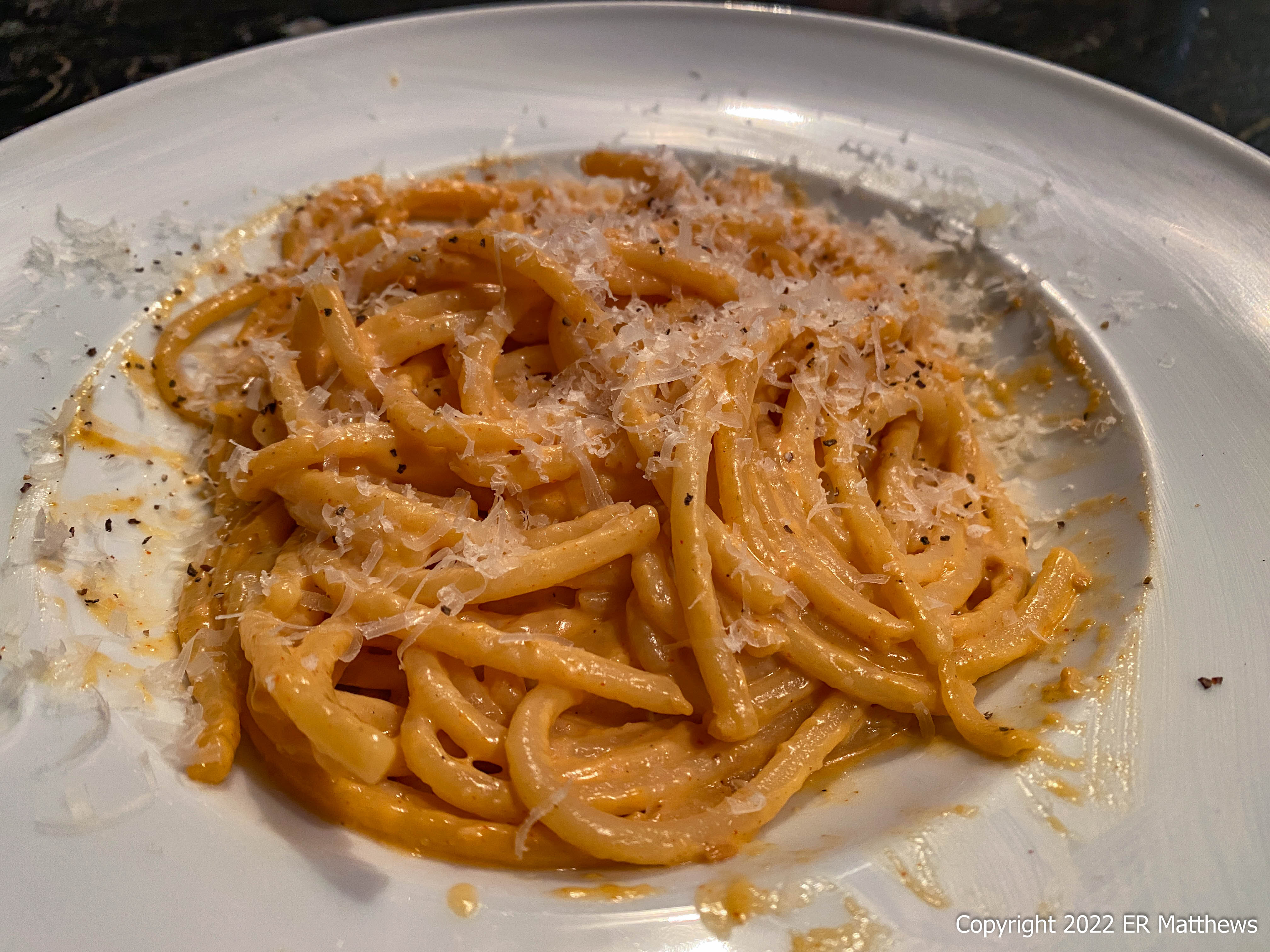
Doenjang-Gochujang Perciatelli
Last night being my first tentative foray into walking unassisted by crutches in almost three months, we decided to celebrate with a bottle of Champagne. As we were sitting on the sofa chatting over Champagne, Ann decided that she would make a dish for me that she has been planning for some weeks. The dish in question hails from the NY Times and is called quite unimaginatively Doenjang Noodles.

Doenjang Noodles is pretty much the recipe, too. The par-cooked noodles are finished in a sauce of a quarter cup of doenjang whisked into a pint of milk, end of story. The dish is garnished with a few grinds of black pepper and a grate or two of pecorino romano.

Measuring the Doenjang and Milk
While I believe that the idea of the NYT recipe was to be an umami-laden ersatz alfredo, we like a bit more flavor in our pasta. After tasting the pasta, Ann ended up doubling the inoffensive amount of doenjang in the original recipe along with adding a big glob of spicy gochujang. 

I Love This Woman!
What a really easy and tasty pasta for a quick meal!

Xi'an Cumin Lamb with Scissor-Cut Noodles

Now that my foot is almost better and I am in a walking boot, I can at long last get back in the kitchen and start cooking again. Ann showed me a photo a few times recently of a dish that is something of a current-day internet phenomenon, cumin lamb noodles modelled after the New York restaurant chain Xi'an Fine Foods.

Xi'an Cumin Lamb with Scissor-Cut Noodles
And so on our last foray to the grocery store, my first since early February (you don't know what a blessing it is to be able to do your own shopping until you cannot), we got some lamb to make the dish. We would have liked to have got some shoulder or loin, but that's really only available at the as-yet-unopened-for-the-season farmers market, so we settled for ground lamb.

Our original thought was to make some of our typical pasta dough (egg pasta of about half all-purpose flour and half semolina) hand-cut into wide flat noodles, but that egg pasta did not sit well with me because it is atypical in China. Meanwhile, I had been reading about various styles of Chinese noodles and decided to make some wonderful looking scissor-cut noodles.

Noodle Dough Resting
The noodle dough is merely a couple cups of all-purpose flour, some Kosher salt, and enough water to bring it together into a shaggy dough. I kneaded the dough just enough to bring it into a ball and let it rest on the counter under film for a couple of hours to hydrate. Then later in the afternoon, I kneaded the dough into a smooth paste to develop the gluten. I let it rest for another hour or so before we started on dinner.

Right after making the dough, I toasted the spices, one part Sichuan peppercorns and three parts cumin. At the same time, I heated a quarter cup of oil with a tablespoon of chile flakes to make some chile oil (which is much better made to order than in bulk because it goes rancid fairly quickly).

Toasting Sichuan Peppercorns and Cumin
Oil and Chile Flakes Becoming Chile Oil
When we were ready to eat dinner, Ann and I attacked it together. She started the lamb while I cut pieces of dough into a pan of boiling water. The lamb is a quick sauté of onions, spicy green chiles, and ground lamb seasoned with the ground spices that I toasted earlier. To finish the sauce, she added some soy sauce, chile oil, sesame oil, black vinegar, and a bit of sugar.

Ann Making the Lamb Sauce
Cooking the Noodles
In cooking the noodles, I treated them just like gnocchi or spätzle, removing them from the pan once they floated. It could not have been simpler. The final dish we garnished with (much) more chile oil, sesame seeds, and cilantro.

Delicious Xi'an Cumin Lamb with Scissor-Cut Noodles
We're definitely making these noodles again, one, because they are so easy to make, and two, because they satisfy our desire for pasta with body (you might guess by that, that we are no fans of capellini). The sauce needs work. We hewed closely to a recipe from the web, but now we feel free to make it our own.

Our next version needs to be spicier and funkier, plus I feel like I want a higher ratio of Sichuan peppercorns in the spice mix. I'm thinking of starting with fermented soy paste and creating a dish more akin to zha jiang mian. Good thing the farmers market opens in a week or so, giving us access to locally raised lamb shoulder.

Friday, May 5, 2023

St. Patrick's Day 2023

St. Patrick's Day arrived three weeks after my foot surgery this year and I was in a cast, in pain, and not in a mood to cook anything. [And here I am 7 weeks later, posting, not having been up to even blogging]. Ann and good friends Rob and Dyce conspired to put together a nice meal to cheer me up. It so did cheer me up and I truly appreciated it, having been confined to the house for a month and fully in the midst of going totally stir crazy, not to mention being pissed off at having to sit on the freaking sofa all damn day every day.

St. Paddy's isn't a big event at our house. Ann's full Napoletan on both sides and my family is from Wales and England. But what the hell: everyone is Irish on St. Paddy's Day!

Co-Conspirators
Sadly, the day of St. Patrick's Day, Rob was ill and elected to stay home. We probably would have cancelled the event had Dyce not been up since early morning putting the corned beef brisket on the smoker. In addition to the corned beef, Dyce also brought some Irish cheese, a bottle of Irish malt, a bottle of Chassagne, a loaf of soda bread, and a small lemon curd cake. He went way overboard as he does always.

Irish Cheddar with Porter
My First Irish Single Malt: Pretty Good
We started the evening with a little Irish Cheddar and a shot of Bushmill's single malt. Though I've been to Ireland a couple of times and consumed my fair share of whiskey, it's always been a mild blended whiskey and not a single malt. As a great fan of Scotch, I had never really taken notice of the Irish cousin and was pleasantly surprised. It's not super complex or peaty or smoky, but it is a good dram. Not having had a drop of alcohol in a month, I nursed mine very slowly.

A Seriously Delicious Chassagne
Dyce's Corned Beef, Smoked then Braised
With the beef that Dyce made, we had an unusual wine pairing: Chassagne-Montrachet. I might have picked a light fruity red (Gamay) or even a Riesling or a sparkling white to go with corned beef, but when somebody brings a bottle of Chassagne to my house, all bets are off! That bottle is getting opened!

Italian Girl Cooks Colcannon!
When Ann and Dyce were planning this dinner, you could have knocked me over with a feather when I heard Ann say, "I'll make colcannon!" Really, I had no idea that my Italian bride even knew what colcannon was, let alone would volunteer to make it. I thought cabbage was firmly on her no-no list. Live and learn! Day of, I hobbled over to the counter and seated at a bar stool with a portable cutting board, I finely sliced two leeks and half a cabbage for her. She then browned both of these in leftover bacon grease and added them to her mash of yellow potatoes. Delicious!

Ann Slicing "Irish Soda Bread"
Dyce scored a loaf of soda bread from a local bakery. I've eaten a lot of soda bread in Ireland, made a lot of it, and even have a handwritten recipe from Alice O'Sullivan, my innkeeper and damned fine baker from my final visit to Killarney. Bottom line, what we bought locally doesn't look like pound cake and it sure as hell does not taste like pound cake. Irish soda bread is not sweet, often has a good portion of whole wheat flour in it, and traditionally is shaped as a round loaf with a cross cut into the top. We were fairly put off by this so-called loaf.

Corned Beef, Colcannon, and Soda Bread
Damn Fine Lemon Curd Cake for Dessert
I cannot reiterate what a lifesaver it was for me for Dyce and Ann to put together this dinner. It so elevated my spirits.

Friday, March 31, 2023

Happy Bendiversary!

[Ed note: so I started this post on February 11, never expecting that I would shatter my left foot on the 15th in a freak accident and here it is already the first of April before I'm feeling up to working at the computer again.]

Time is flying right by! It struck me a couple weeks back that we were quickly coming up on the first anniversary of our moving to Bend on February 10, 2022 from our prior home in McMinnville, closing a year that zoomed by at warp speed. I thought we should celebrate if for no other reason than we don't do enough celebrating in our busy lives. And time is flying right by!

Here's to a Year in Bend!
I asked Ann if she would have a date with me on the 10th to celebrate moving. Her immediate acceptance was never in question! I planned a stay-home date without telling Ann, because we have a brand new kitchen in our house to celebrate. I thought that celebrating by making a nice dinner at home and having a date at our new kitchen counter would be both fitting and appropriate. 

At first, I let Ann believe that we were going to a restaurant, but there was no way that I could pull off a meal in the kitchen and still maintain the ruse of going out. A day or two before, I told her what my plan was and enlisted her help in making the island counter look nice. To that end, I bought a bunch of spider mums and Siberian iris and arranged them. Ann set our places at the counter.

All Set for the Two of Us
Ann Taking the Shot Above
In thinking about what to make for our celebration, I recalled that recently Ann has been pinging me about making coq au vin, a dish that she has never had before (incredible, if I may say so). This got me planning a French-inspired menu for our celebration. French food is something that I am well versed in and certainly classic French technique underpinned nearly everything that we did at the restaurant.

Even if we desired to dine out, there is no French restaurant at all in this part of Central Oregon. And besides, I don't get the urge to get in the kitchen and cook much any more, so I wanted to strike while the proverbial iron was hot and make a delightful rendition of coq au vin for Ann.

I planned a simple menu of tartines, coq au vin, and cheese (which we never got around to eating, so filling was dinner). Tartines are a classic component of the apéro, the French happy hour and are typically small open-faced sandwiches. And the difference between a tartine and a canapé is in the eye of the beholder. To me, a canapé is much more of a one-biter and a tartine is slightly larger. YMMV.

Tartines of Mousse Truffée, Cornichons, Dill, and Lemon Zest
For tartines, I thought they should be slightly decadent and worthy of a celebration, so I stopped by our high-end grocery store for a locally baked baguette and a block of mousse truffée, truffled foie gras mousse. Rounding out the toppings are split cornichons, sprigs of dill, lemon zest, and a sprinkle of my very best salt. The result: simple, elegant, and terribly easy to make.

To accompany them, I opened a bottle of Champagne, a great non-vintage blend with both red and white notes. The nutty raspberry notes from the red fruit (Pinot noir and Pinot meunier) work well with the foie gras while the lemony acidity from the Chardonnay really help cut through the fat. 

Champagne: The Celebratory Drink of Choice
For our plat principal, our main course, I made an upscale coq au vin. Coq au vin and its many variations are a classic of French country cooking, traditionally a tough old rooster (coq) braised to tenderness in wine (vin). The wine varies depending on the region of France, to wit: coq au champagne from the Champagne, coq au riesling from Alsace, coq au vin jaune from the Jura, coq au chambertin from Bourgogne, etc.

While I have fond memories of sitting in a tiny, homey, low-ceilinged café in Fleurie chatting away waiting for our Bresse hen to braise to tenderness in a bath of Beaujolais, because of its humble origins, coq au vin is not a dish found in too many higher end French restaurants. By extension, I never made it at my restaurant: it would not have sold, being too homey and not chi chi enough for fine dining. Pity that.

Traditionally, a whole chicken is cut up, browned, and braised with white mushrooms, pork belly lardons, onions, carrots, red wine, and often a good slug of Cognac. Once the chicken is tender, the braising liquid is thickened with beurre manié, a flour and butter mixture.

While I have cooked it just so, these days, my fine dining chef instincts kick in, especially for a celebration and I deviate slightly from the canonical recipe. I think the food gods will allow this liberty because I have paid my dues in over 40 years of making the dish.

I start deviating with the chicken. It was traditionally made from an old and tough yard bird, but that has morphed into using younger Bresse hens, at least in more upscale places. In any case, the bird is cut into pieces and cooked and served on the bone.

In America at least (I cannot speak for France), the chicken quality is poor and the white breast meat is almost uniformly terrible. I would rather eat nothing than breast meat and so I only use thighs for their succulent and tender meat. And in this particular case, I deboned the thighs and halved them, wanting to do a nice presentation and to avoid having to deal with bones at the table.

Most high-end versions use whole tiny onions; I prefer whole small shallots. Because of the slight garlic undertone of the shallots, I forego any garlic. Instead of plain pork belly, I have a great fondness for using American smoked bacon if for no other reason that it plays so well against red Burgundy and Beaujolais. I really do not care for white mushrooms, the mushroom used in the classic preparation, the mushroom that the French call champignons de Paris. And so, I use rehydrated dried porcini to amp the earthiness of the dish.

Happy Bendiversary!
Coq au Vin on Puff Pastry
I Use Shallots Rather Than Onions
The Pot Ready for Braising
I really did enjoy making this dish for Ann and spending the last year in Bend with her!

Ode to the Tortilla

I love tortillas. It wasn't always that way. I am a child of the early 1960s. Then, on the East Coast, our food was influenced by two th...