Monday, November 27, 2023

Turkey Neck Rillettes

Turkey neck rillettes are pretty common as an appetizer before our Thanksgiving feast and are a happy side product of making stock for the gravy and dressing to accompany our turkey.

Turkey Neck Rillettes on Crostini with Cornichons
Rillettes are a type of charcuterie, essentially a rustic form of pâté in which shredded cooked meat is mixed with fat to form a spreadable paste. I used to make all manner of rillettes for our charcuterie program at the restaurant, but mainly from pork, salmon, and duck, animals that have a really high fat content such that you can cook the meat and let it congeal in its own fat to make a great spread. Alas, turkey has no such fat, especially on the necks so you have to add fat to make the spread.

Making Stock
Roasted Turkey Necks and Aromatics
To make my Thanksgiving stock, I use turkey necks because they are cheap and also delicious. First, I rub the necks with oil and roast them in the oven until they are brown and caramelized all over. Then the necks go into the stock pot with aromatics, in this case, carrots, celery leaves, parsley stems, shallot peels, and leek leaves. They cook until tender at which point, I separate the stock for use later to make gravy and to moisten stuffing. The necks, I let cool to touch before picking the meat from them. It is far easier to pick the meat from the bones when the necks are warm rather than cold.

Picked Turkey Neck Meat, Roughly Chopped
Because turkey neck meat is naturally long and stringy, really long pieces can be difficult to chew. To avoid this, I give the meat a rough chop to shorten the pieces, but as you can see in the photo above, I still leave a decent amount of texture.

At this point, it is time to mix in the fat and seasonings. I like to keep the seasonings really simple, so I seasoned to taste with fresh thyme leaves, salt, and a few scrapings of nutmeg. Next, I mixed in enough softened fat to make a smooth, spreadable paste. In the best of all worlds, I would have used duck fat to make the rillettes, but I'm no longer running a restaurant with gallons of duck fat on hand. (This is why our sweet-and-sour brussels sprouts were so good: seared good and hard in duck fat with pork belly scraps and shallots before being finished with caramelized sugar and white balsamic vinegar!). So I used a mixture of bacon grease leftover from some other meal and softened butter. Lard would have worked great too, especially lard leftover from making carnitas.

Turkey Neck Rillettes Packed Into a Bowl
If I were making rillettes for long-term storage, I would have packed them into jars and sealed the tops with additional molten fat to keep them from the air. In this case, I was serving them two days hence, so I packed them into the bowl in which I wanted to serve them and covered it with plastic wrap before putting it in the refrigerator. On Thanksgiving morning, I gently rewarmed the bowl in front of the fireplace to restore its unctuous texture.

Tuesday, November 21, 2023

Leg of Lamb

I've been looking for an excuse to cook a leg of lamb, but that's a lot of meat for two people, so I needed to wait for a group dinner to prepare one. I decided to cook one (the smallest leg that I could find) just recently when Ann invited Andreas and Michelle over for dinner, along with mutual friend Erika. 

Michelle, Ann, Erika, and Andreas
It Would Be Rude to Start Without Sparkling Wine
Crémant d'Alsace
It's Almost Thanksgiving!
Ann and I started coming up with ideas for a menu based around leg of lamb a few days beforehand. When I learned that Erika is a vegetarian, I wanted to make a side for the lamb that would stand in as a great vegetarian entrée. Given that I was thinking about a classic Italian marinade for the lamb, why not continue with the Italian theme, such as cannellini in the style of pasta fagioli? That's some classic, home-style comfort food and perfect for a cold, pre-Thanksgiving evening.

Ann wanted to make an appetizer too but we never did settle on anything. I thought I might make some small risotto cakes, but I heard her mention something about stuffed dates in her musings. And so I resolved that if I could find them at the store, I would bring them to her. Luckily, our store has a great selection of bulk foods including dates, so I bought some and a bit of sliced prosciutto. Below you see a photo of Ann's handywork, pitted dates stuffed with goat cheese, some wrapped in prosciutto and some not, roasted in a hot oven for about 10 minutes.

Prosciutto-Wrapped Dates Stuffed with Goat Cheese
Back to the leg of lamb. I wanted to roast a leg of lamb in part because I love it, in part because it is something that I cannot serve to every crowd (Dyce, I'm looking at you!), and in part because of the last two dinners with Michelle and Andreas. For those two dinners, Andreas wanted to see cooking in action for the first and for the second, I made a paella, which is pretty much the textbook à la minute dish, a dish that must be cooked actively just before serving.

What I really wanted was a menu that involved very little last minute cooking and that would let me socialize. I am no longer the chef who stays in the kitchen while the guests socialize and dine. When we invite people to our house, I would rather spend my time with them rather than in the kitchen, a 180-degree departure from my former life as a chef.

The leg of lamb I could butterfly (remove the bone and open up flat like a book) the day before and then marinate by placing it in a plastic bag with a mix of red wine, olive oil, and black pepper, with lots of both garlic and rosemary added for flavor. Then on the night of the dinner, all I would need to do would be to put it on a sheet tray in a hot oven until it reached 125F internal temperature, about 20-25 minutes. After it rested for 20 minutes, then I would slice it, a simple thing that would not take me away from guests. Moreover, I would precook the beans in the afternoon and then while the lamb was resting on the stove top, I could put the beans into the oven to reheat.

Roasted, Butterflied Leg of Lamb
The cannellini beans could not be simpler to make and are exactly what I make for pasta fagioli except they have no pancetta (to remain vegetarian) and no pasta (so to remain gluten-free). I started with a soffritto of leeks, carrots, and celery that I sweated in olive oil in an oven-proof pan with a lot of garlic and fresh rosemary. Once the vegetables were soft, I added a couple tablespoons of doppio concentrato tomato paste to a bare spot in the middle of the pan. After the tomato paste caramelized a bit, I deglazed with a slug of white wine, scraping all the brown bits off the bottom of the pan.

Next I added a bit of dried basil and a bunch of stemmed and sliced cavolo nero (Tuscan black kale, easily my favorite kale) along with a bit of water and about five pounds of pre-cooked beans. I let everything simmer for about twenty minutes to bring all the flavors together. Just as the lamb was coming out of the oven, I put a low flame under the beans and drizzled them with great Tuscan olive oil and freshly grated pecorino romano. Into the hot oven they went while the lamb was resting to get warm and delicious.

Cannellini in the Style of Pasta Fagioli
Erika Brought Beautiful Flowers
Do you know the best thing about leftover leg of lamb? It slices beautifully and makes the best sandwiches, such as the open-face cheesesteaks below. To make them, I sliced the lamb thinly, sliced and wilted an onion, and sliced a block of Tallegio cheese. The bread, I drizzled with olive oil and browned under the broiler and then topped with lamb, onions, and cheese. Into a moderate oven for 10-15 minutes they went to melt the cheese and warm the cold lamb through. Delicious and a great reason to roast a butterflied leg of lamb.

Open-Face Cheesesteak: Lamb, Onions, and Tallegio

Monday, November 13, 2023

Brisket with the Boys

Somehow Ann and Dyce are joined at the hip and are constantly texting back and forth. This time, unbeknownst to me, they schemed up a dinner Wednesday last week for which Rob would smoke a brisket and I would make a "sexy potato dish." Don't take this the wrong way. I'm always game for dinner and I hardly mind if Ann commits me for a dish.

As always, the guys went way overboard, making not only the brisket, but mini crab cakes for an appetizer, a wonderful salad with apples, spiced pecans, and a maple dressing, as well as an old-school apple cake for dessert.

Ann and I kicked in the sexy potatoes, a Savoyard cheese and potato casserole called tartiflette which I covered in a prior post, a bowl of herb mayo for the crabcakes, and a delightful magnum of Chianti Classico. All in all, we had a phenomenal meal that would be impossible to get at any local restaurant.

Out at a restaurant or at one of our homes, it's always such a pleasure to have dinner with Rob and Dyce. Not only do we have wonderful conversation, but when we do it at their house, we our dog fix playing with both of their pups. Having lost both our dogs in recent years, Ann and I are being a bit jealous of our freedom to go on a whim, to travel, and to not worry about finding pet care. But we both love dogs so much that we still need to get our dog time and that's what we get from Rob and Dyce's girls.

Smoked Brisket with Tartiflette
Lola Loves Ann
Crab Cakes with Herb Mayonnaise
Brisket Ho!
Slices of Brisket with Smoke Ring
It's a Party When You Crack a Magnum
What wine to pair with smoked brisket? It is beef and so it is going to want a red and a pretty big one at that. My palate runs to wines that are lighter bodied, higher acid, and less fruity. For me, major grape varietals that fit this profile are Pinot Noir, Nebbiolo, Sangiovese, and to a lesser extent Tempranillo. Because it's beef, I opted for a bigger more extracted Sangiovese, a Chianti Classico. Of all the Chianti sub-zones, Classico seems to me to be the best match with beef, but then a great Brunello would have been delightful as well.

Spiced Pecans
Delightful Salad
Rob's Apple Cake, More Savory Than Sweet

It looks like Rob and Dyce are headed to California for Thanksgiving and we won't be able to get together again until early December. I'm feeling dinner at our house and I'm looking for an excuse to make braciole, if I don't get overruled by the powers that be.

Saturday, November 11, 2023

Tartiflette

Tartiflette. It sounds like a classic French dish, doesn't it? Why is it then that when I was learning the rudiments of French cuisine, both refined haute cuisine and provincial country-style cooking, that I never heard of tartiflette? For potato dishes from the alpine region of France, I learned pommes dauphinoise, gratin savoyarde, and péla (Madeleine Kamman, I owe you thanks for illustrating the culinary highlights of the Savoie). But never did I ever hear of tartiflette, a dish I would end up decades later making in tiny single-serving portions for our tasting menu at the restaurant.

The reason for the gap in my culinary formation and education is simple: tartiflette is a new dish, a dish created as a (very effective) marketing vehicle for Reblochon cheese, one of my very favorite washed rind cheeses in the world. In the 1980s, the Le Syndicat Interprofessionnel du Reblochon (the cheesemaker's trade group) dusted off the traditional péla recipe, updated it, and gave it the new name of tartiflette (after the Savoyard word for potato, tartifle) to help boost sales of their cheese. Brilliant strategy, brilliant execution.

Tartiflette with Smoked Brisket
My journey leading to this post started with my wife plotting with Dyce a weeknight dinner for which Rob would smoke a brisket. Seemingly quite out of nowhere, Ann volunteered me to make a "sexy potato dish," which she relayed to me as a request to make a tartiflette. Why not? Tartiflette is a super simple dish to put together and it is among the best and tastiest of potato and cheese dishes in the world.

The issue of making an authentic tartiflette in the US is real. The dish is classically made using yellow La Ratte fingerling potatoes which I have grown and adore, but which are scarce to find if you don't have a garden. And then there's the Reblochon. I found out the hard way about 1992 that the USDA gets pissy if you bring this raw milk cheese into the country. Queue your "nanny state" comments up. I ended up having to donate the cheese I was bringing back from Paris to our government for destruction. Rat bastards!

But the concern about authenticity of a dish that in culinary history has literally just been invented seems misplaced. It hasn't been around long enough to take on a serious air of authenticity. And so, over here in the States, without any worry at all, I make do using the ingredients that I do have, making sure to honor the spirit of the dish, if not the letter. Reblochon, I love you, but I cannot get you, so I use one of your cousins that I can get.

Taleggio, another stinky washed rind cheese, makes a great substitute as do many other cheeses. In Virginia at the restaurant, I used to use the local Grayson washed rind cheese. In my hunt about town, the market where I get my cheese only had a little bit of Taleggio, so I supplemented it with a nice hunk of Brebirousse d'Argental, a soft sheep's milk cheese that is quite outstanding.

Lardons and Leeks with Fresh Thyme Springs
To make the dish, I started by cooking several slices of very thick cut smoked bacon that I cut into crosswise strips called lardons. After the lardons were halfway cooked, I poured off most of the bacon grease (saving it for some other deliciousness to come in the future) and added one huge leek, sliced. Traditionally you would use a yellow onion for this dish, but I am here to tell you that leeks are superior in every sense. You will not regret substituting super delicious leeks for garden variety onions.

Bacon, Leeks, White Wine, and Mascarpone
After the leeks had become soft, I added a splash of dry white wine and let that cook down for a couple of minutes. At this point, one would typically add crème fraîche to the dish. I did not have time to make crème fraîche, (heavy cream, a bit of buttermilk with active culture, and leave it on the counter overnight or until it thickens), so I went the store-bought route.

Alas, the cheese manager at the store told me that unfortunately, the New York Times had just published a recipe featuring that cultured cream and that she had sold out of all four cases that she had in stock. There's more than one way to skin a cat, however, and I had seen both mascarpone and clotted cream on the shelf. Either would do as a substitute, but I went with the mascarpone because it is also cultured, unlike clotted cream which is merely heated to thicken it.

So into the pan went the mascarpone and it cooked down until thick; mascarpone has so much fat content that you do not have to worry about it breaking even if you boil it. When thick, I seasoned the leek mix with salt and white pepper, removing the thyme stalks.

Meanwhile, I had peeled several yellow potatoes and cut them into thick slices. They were merrily boiling away in heavily salted water until I could easily pierce them. Tartiflette is in the oven only long enough to brown the cheese on top and that is not long enough to cook the potatoes, so they need to be pre-cooked.

Assembled Tartiflette
When assembling a tartiflette (other than tiny portions for tasting menus), I like to put them together in layers to facilitate seasoning the potatoes, which even though are boiled in salted water, require a bit more salt. In an oiled gratin, I arrange a layer of potatoes (about two slices thick) which I sprinkle with salt. Over this, I spoon half the creamy leek mixture. I follow this with a final layer of potatoes, salt, and leeks.

The final layer consists of the cheese. I like to split the cheese down the middle horizontally and place it rind side up on top of the potatoes. Notice the sheet tray under the gratin. Overflowed cream and cheese are going to make a dire mess of your oven if you do not take precautions. Don't blame me if you end up spending an hour scrubbing burnt cheese from the bottom of your oven.

Cooled Briefly, Tartiflette Ready to Serve
This casserole wants to cook in a moderately hot oven, say 400F (200C, gas mark 6 or 7) until it browns. I want to say that this large tartiflette took about 30 minutes to become golden brown.

And there you have it: tartiflettte, a pseudo-classic from the Savoie and favorite of skiers everywhere. In another century, it surely will have gained classic status.

Thursday, November 9, 2023

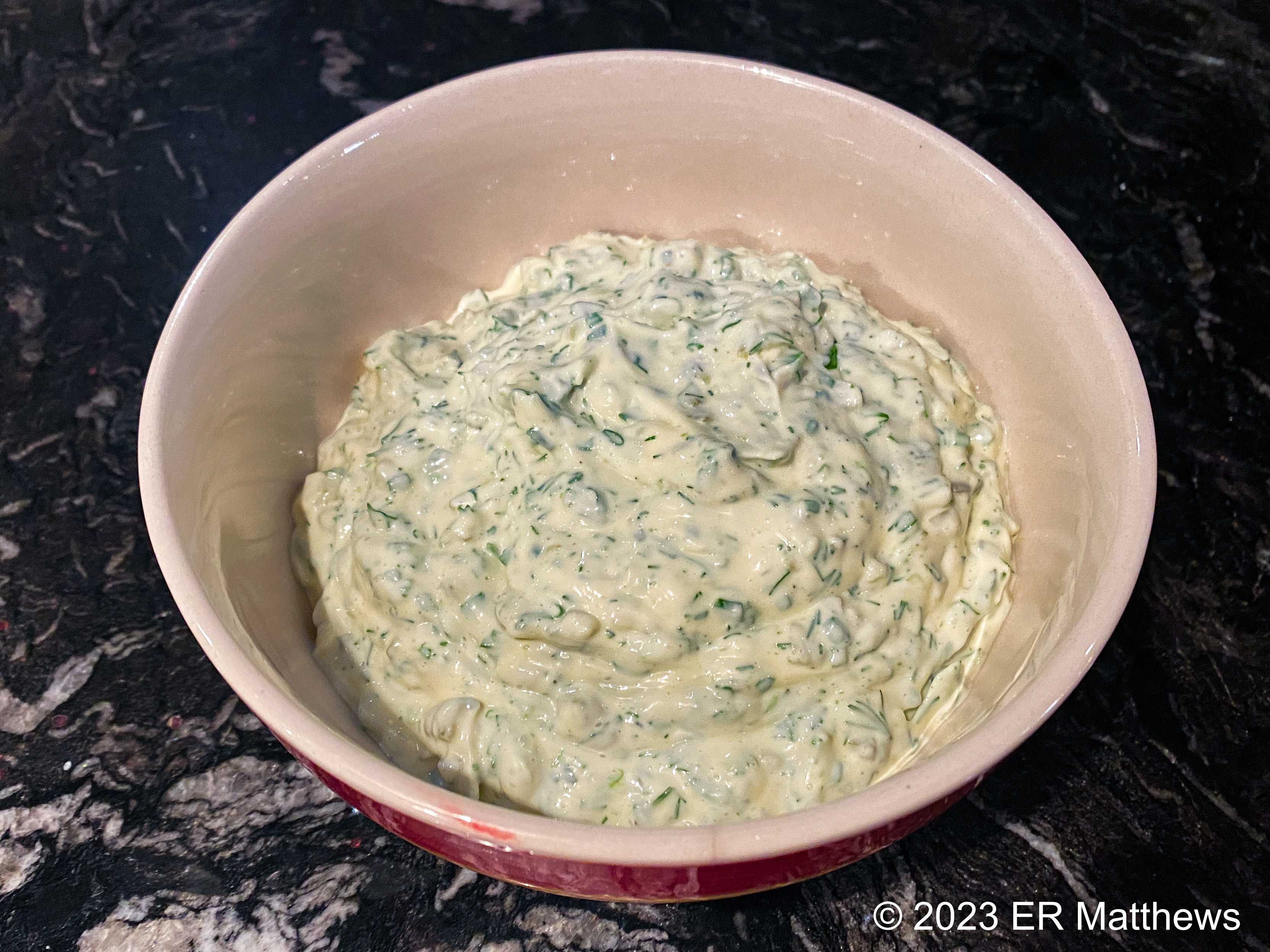
Kitchen Basics: Herb Mayonnaise (Sauce Tartare)

There are few sauces easier to make than the French classic sauce tartare, a sauce based on mayonnaise, for which reason I prefer to call it herb mayonnaise. And truth be told, this lets me add any damned herbs that I want without running afoul of those who claim that tartar sauce can only be made just so. It is a beautiful sauce for fish and seafood, chicken and poultry, and light white meats such as pork and veal.

Herb Mayonnaise (Sauce Tartare)
You'll find all kinds of recipes out there including any manner of ingredients. I prefer a pretty simple version myself using the classic fines herbes that I happen to have on hand. Which is to say, that although I have something of a recipe, each manifestation is different depending on the season and the ingredients that I happen to have.

Herb Mayonnaise Ingredients
Dill, Tarragon, Lemon, Cornichons, Chives, Mayo
The classic fines herbes are four: Italian (flat) parsley, tarragon, chives, and chervil. I seldom have chervil on hand (it's so hard to come by in the US that we used to grow it for our own use at the restaurant). I can hardly resist the temptation to add baby dill to this list if I happen to have it. I really think it adds another dimension to the other herbs, but you will almost never find this ingredient called for in classic recipes.

Although I love and use copious amounts of Italian parsley in my cooking, for the version of herb mayonnaise above, I omitted it, simply because I had so much dill, tarragon, and chives on hand that I wanted to use before they spoiled.

I aways add cornichons, finely minced, to the sauce and I will use the tiny non-pareil ("without equal") capers in brine if I happen to have them, but I do not right now in the food desert that is Central Oregon. I'm not a fan of the coarser salted capers for this sauce, but in a pinch, you can soak them well to remove some of the salt.

At home, I do not typically make the mayonnaise base as it is a lot of work for a small quantity of sauce. Of course at the restaurant when making liters of sauce at a time, making the mayonnaise is de rigueur. So at home, I typically start with commercial mayonnaise, about which I am ultra-picky. I, like most southerners and most chefs of my acquaintance, insist on Duke's. It's Duke's or bust for me.

To the mayonnaise, I add the finely minced herbs, cornichons, and capers. After mixing, I taste for three things: salt, piquancy, and acidity. Salt, you need to be careful with because both capers and cornichons are already salty. If I am using commercial mayo, I will almost always add a fair amount of lemon juice for acidity and a scant sprinkle or two of white pepper for piquancy (you cannot really taste the pepper, but it enhances all the other flavors). If I am using purpose-made mayo, I will have already added both the lemon juice and white pepper when whipping the mayo.

Herb mayo is best made in advance so that the herbs have time to infuse into the mayonnaise. I will typically make it in the morning for use in the evening, letting it mellow all day in the refrigerator. Like soup, sauce tartare is best the next day. But because it contains fresh herbs, you should only make it in the quantity that you will use within a day or perhaps two.

Other cooks, including many renowned French chefs that I admire, will add other ingredients, but those ingredients are not for me. They could include cayenne, mustard, hardboiled egg yolks, onion (yellow or green), or shallot. As I've said many times before on this blog, it's your dish and you are free and even encouraged to do it your way.

Wednesday, November 1, 2023

Paella Party

Ann had wanted me to make a paella for her 60th birthday, but we just could not get large enough group together for such an event at that time. We instead went to Walla Walla wine country to celebrate her birthday and postponed the paella party until the end of October. My large paellera makes enough rice to feed a good 16 people, so it's overkill to make a paella for a small group. Besides, more people is more fun.

Paella Mixta
At its heart, paella is very simple: short-grained rice cooked in broth in a wide, open pan. And thus it depends primarily on two things: the quality of the rice and the quality of the stock used in cooking that rice. I started the day before in making a couple gallons of stock in our big stock pot. For paella, I make stock that complements the garnishes in the paella. So, for example, if I am making a traditional Valencian rabbit paella, I would use rabbit stock. In this case, I wanted to make a paella mixta with chicken, chorizo, and shrimp, so I made a mixed stock.

Starting the Stock; Eight Hours Yet to Cook
In my restaurant days, we would have lots of things laying around for making stock (and sometimes purposefully intended for stock). At home, I start by raiding my freezer in which I collect various bits intended for later use. In this case, I found a whole pork upper shank that I had been saving as well as a bag of trim from frenching a pork rack. Whenever I french a rack by totally denuding the rib bones for presentation purposes, the trim either ends up ground for sausage or other charcuterie or it ends up in the stock pot.

To the pork hock and the rib trim, I added a bunch of pork neck bones, sliced pig's feet, chicken wing tips (from prepping the chicken wings for the paella), shrimp shells (from prepping the shrimp for the paella), a bundle of parsley stems, carrots, celery, saffron, and garlic cloves and peels. Then I added a quart each of chicken stock and clam juice and topped the pot off with water and onto the stove it went to gently simmer for about eight hours, until the giant pork hock was fully cook and fall-apart tender.

When the stock was done, I separated the solids from the broth, mainly in an effort to get the stock as cool as possible as quickly as possible. Nobody wants a foodborne illness from warm stock sitting around growing bacteria. I lightly salted the stock before putting it away. When making paella, I find it easier to control the salt by pre-salting the stock lightly (it will reduce and concentrate the salt) than by trying to guess how much salt to add to the paellera.

At the point when I could bear to put my hands on the hot solids, I picked and reserved all the useable meat. Truth be told, I made more stock than I needed to have leftovers for a great pot of soup, which I did in fact make later in the weekend using the leftover pork meat. You can almost never have too much stock on hand and if you do, you can always cook it down to glace or demiglace and freeze it.

Appetizers: Meatballs in Romesco, Marcona Almonds, and Olives
Despite there being enough paella to feed a small army, Ann and I thought that we should provide some appetizers for our guests that they could munch while I was outside on the patio cooking. The morning of the paella, I made a batch of pork meatballs (pork, parsley, garlic, oregano, basil, and red wine) and that afternoon, I braised them in a big batch of romesco (roasted red peppers, garlic, almonds, white bread, sherry vinegar, and olive oil). These we set out with Marcona almonds (the best!) and some green olives. Simple, but tasty.

Paella Mise en Place from lower left: Vegetables (Piquillos, Onion, Poblano),
Rice, Olive Oil, Chicken Wings, Lima Beans, Shrimp, Salt, Diced Hard Chorizo,
Mix of Parsley/Garlic, and Mix of Pimentón/Saffron
Just before our guests arrived, I lit the fire outside and put out my mise en place for the paella with no fear of lack of refrigeration: it was only about 40 degrees outside and the sun was sinking fast. It would be in the low 20s by morning. The ingredients that I use in my paella vary each time and are certainly non-traditional. I started by learning how to make traditional paella valenciana and now I make my own to suit my mood. I feel lucky not to be bound by the strictures of custom and family pressure to make paella just so.

Preheating the Paellera
Everyone who saw my steel paellera (I love this 55cm Pata Negra from Garcima in Spain) heating on the fire pit on our patio mentioned how perfectly the pan fit on the fire pit. Actually, it was the other way around. I have never cooked a paella on gas before, always lighting a wood fire in the back yard. In our new home in Bend, we have no back yard or really any yard (a plus for travelling), just a patio in the courtyard of our house. And lighting a real fire on our patio wouldn't be all that awesome: we get enough smoke in the house during wildfire season. So, we actually measured the tripod on which the paellera stands and bought a round fire pit that would accommodate it. How is that for planning?

I'm going to say now that I did not make my best paella over the gas. I need more practice to get the perfect soccarat, the crust on the bottom, which I scorched a bit this time. Counterintuitively, I feel like I had better control using a wood fire that I could adjust by moving wood in or out as necessary. I will say that the wind guard around the fire pit really helped with a more even flame. Although I did have to rotate the paellera a bit during cooking, I didn't have to be constantly fiddling with it as I have in the past over a wood fire with an uncontrolled breeze.

Step 1: Brown the Chicken Wings
Steps 2 and 3: Sauté the Vegetables, Then Add the
Pimentón, Saffron, Garlic, and Parsley
Step 4: Add the Stock and Bring to a Mild Boil
Step 5: Add the Rice
Step 6: Add the Shrimp and Lima Beans
Here, you see the cooking paella with all its garnishes (notice how low the flame is now compared to the previous photos), the last to go on the dish are the garnishes that take the least amount of time to cook, the shrimp and the butterbeans/lima beans. The beans are a nod to traditional paella valenciana to which many would add a white bean called the garrofó, or another white bean, or even flat green beans that resemble our romano beans. I'm pretty sure that a traditionalist would cast an evil eye upon these alien beans while silently acknowledging that they taste pretty good in a paella.

Artsy Shot: Flames Glowing Beneath the Paellera

It was well and truly dark by the time the paella finished, at which point, we all migrated into the kitchen where I covered the paella with a towel and let it rest for ten minutes before serving. All eight of us (Ann and I, Rob and Dyce, Andreas and Michelle, and Mark and Kelly) gathered around the big island in the kitchen and dug in to the appetizers and the paella, with lots of red wine poured all around. To finish off the evening's meal, Rob made a delicious apple and green chile pie, with green chiles from Socorro NM that they purchased on their last trip to Santa Fe where they used to live prior to moving to Bend a year ago.

Rob Made This Outstanding New Mexican Apple-Green Chile Pie
Served with Vanilla Ice Cream
We had a great time. I only wish that I hadn't been so busy cooking because I would have liked to have been a bit more present with our guests and to have had the presence of mind to have taken people photographs. This post seems way more clinical than I had wanted for lack of photos of the socializing that took place all evening. Now that the paella is out of the way and it's too dark too early to make a paella until next spring, I'll revert to dishes that do not take active cooking so that I can relax and socialize.

We Did a Thing

Back in March, we had the Viaggio crew to dinner , and while it went well, our dining room was feeling a bit cramped. After the dinner, Ann ...